Can You Convert a VW Beetle to Electric — And Should You?
Short answer: Yes, you can convert a classic VW Beetle (Type 1, 1949–2003) to electric power, and several shops and DIY kits make it possible. Expect to spend $15,000–$40,000+ on top of the donor car cost. Realistic range lands between 60 and 150 miles depending on battery size (typically 20–45 kWh usable). Charging on a standard Level 2 home charger (7.2 kW) takes roughly 3–6 hours from empty. The result is a charming, zero-tailpipe-emissions classic — but it won't qualify for the federal §30D new or used EV tax credit, and you'll sacrifice the original driving experience.
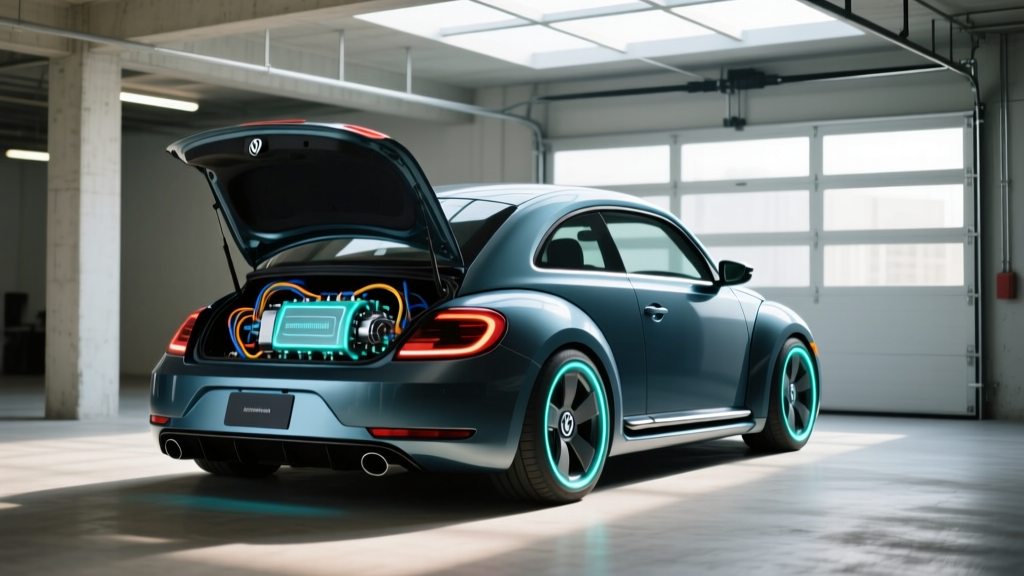
Converting a vintage Beetle to a battery-electric vehicle (BEV) has become one of the most popular EV-swap projects in the classic car world. The Beetle's simple rear-engine layout, lightweight chassis (~1,850 lbs curb weight), and massive aftermarket support make it a natural candidate. But before you pull the air-cooled flat-four, here's what the numbers actually look like in 2026.
How Much Does a VW Beetle EV Conversion Cost?
The total investment breaks into three buckets: the donor vehicle, the conversion itself (parts and labor), and ongoing ownership costs. Here's a realistic breakdown based on current shop quotes and kit pricing:
| Category | Budget DIY | Mid-Range Shop | Premium/Custom |
|---|---|---|---|
| Donor Beetle (running, decent body) | $5,000–$10,000 | $8,000–$15,000 | $12,000–$25,000 |
| EV conversion kit (motor, controller, charger) | $4,000–$7,000 | $6,000–$10,000 | $10,000–$18,000 |
| Battery pack (20–45 kWh, LFP or NMC modules) | $4,000–$8,000 | $6,000–$12,000 | $10,000–$18,000 |
| Labor (professional install) | $0 (DIY) | $8,000–$15,000 | $15,000–$30,000 |
| Wiring, BMS, instrumentation, misc. | $1,500–$3,000 | $2,000–$4,000 | $3,000–$6,000 |
| Total Estimated Cost | $14,500–$28,000 | $30,000–$56,000 | $50,000–$97,000 |
For context, a new 2026 Nissan Leaf starts around $29,990 MSRP with an EPA-estimated 212 miles of range and full factory warranty. A converted Beetle costs a similar amount (or far more) while delivering a fraction of the range, no warranty, and no eligibility for federal or state EV incentives.
Range, Performance, and Charging: The Real Numbers
Most Beetle conversions use a single AC induction or permanent-magnet motor producing 60–120 horsepower — a meaningful upgrade over the original 40–60 HP flat-four. But range is where physics imposes hard limits on a lightweight, aerodynamically challenged chassis.
| Spec | Beetle EV Conversion (Typical) | Original Beetle (Gas, 1970s) | 2026 Nissan Leaf S |
|---|---|---|---|
| Battery / Fuel | 20–45 kWh (LFP or NMC) | 10.6-gallon tank | 60 kWh (NMC) |
| Range | 60–150 mi (real-world) | ~280 mi (~26 MPG) | 212 mi (EPA est.) |
| Horsepower | 60–120 HP | 40–60 HP | 214 HP |
| 0–60 mph | 8–14 sec | 18–22 sec | 6.9 sec |
| Charge / Refuel Time | 3–6 hrs (L2, 7.2 kW) | ~3 min (gas station) | ~10 hrs (L2); 45 min (DCFC 10–80%) |
| "Fuel" Cost per Mile | ~$0.04–$0.06 (home charging) | ~$0.13–$0.16 (gas) | ~$0.04–$0.06 (home charging) |
| Federal Tax Credit | Not eligible | N/A | Up to $7,500 (§30D, income/MSRP rules apply) |
Real-world range reality: A Beetle conversion with a 30 kWh usable battery pack might achieve 90–110 miles in mild city driving (under 40 mph, flat terrain, 70°F). Push it to 65 mph on the highway and expect that to drop to 60–75 miles — the Beetle's upright shape creates substantial aerodynamic drag (Cd ~0.48). In cold weather (below 35°F), add a 15–30% range reduction if the conversion lacks battery thermal management, which most do.
Charging setup: Most conversions include a Level 2 onboard charger rated at 3.3–7.2 kW. That means a full charge from a 240V home outlet takes 3–6 hours depending on pack size. Very few conversions include DC fast charging capability — adding a CCS or NACS inlet with a 50+ kW DC charger adds $2,000–$5,000 to the build and requires significant packaging space that the Beetle simply doesn't have.
Beetle EV Conversion vs. Buying a Modern EV: Which Makes Sense?
This is where the math gets honest. Let's compare the 5-year ownership picture of a mid-range Beetle conversion against a practical new EV:
| Cost Factor | Beetle EV Conversion ($40K build) | 2026 Chevy Bolt EV (~$28K MSRP) |
|---|---|---|
| Purchase price | $40,000 | $28,000 |
| Federal tax credit (§30D) | $0 | Up to $7,500 (if eligible) |
| Effective purchase cost | $40,000 | ~$20,500 |
| Home charger install (Level 2) | $800–$2,000 | $800–$2,000 |
| Electricity (5 yrs, 10K mi/yr) | $2,000–$3,000 | $2,000–$3,000 |
| Maintenance (5 yrs) | $1,500–$3,000 (custom parts, troubleshooting) | $800–$1,200 |
| Insurance (5 yrs) | $6,000–$10,000 (specialty/classic) | $5,000–$7,500 |
| Resale value (est.) | $20,000–$35,000 (niche market) | $12,000–$16,000 |
| Net 5-Year Cost | $30,300–$56,000 | $11,100–$17,700 |
The financial case for a conversion only works if you value the Beetle as a passion project, a collector piece, or a daily-driver-with-character. As pure transportation, a modern EV is dramatically more practical.
Common Misconceptions About Beetle EV Conversions
| Myth | Fact |
|---|---|
| "It'll go 200+ miles on a charge." | Not in a Beetle. The car's weight (~2,100–2,300 lbs post-conversion) and poor aerodynamics limit most builds to 60–150 real-world miles even with large packs. Fitting 60+ kWh into a Beetle is extremely difficult due to space constraints. |
| "I'll qualify for the $7,500 EV tax credit." | Converted vehicles do not qualify for the IRS §30D federal tax credit. The credit applies only to new and qualifying used EVs from OEM manufacturers that meet battery sourcing and MSRP caps. |
| "It's maintenance-free." | While you eliminate oil changes and exhaust repairs, EV conversions introduce their own maintenance: BMS (battery management system) calibration, contactor replacement, coolant system checks (if liquid-cooled), and custom wiring troubleshooting. Parts availability depends on your converter. |
| "Any mechanic can service it." | Most general mechanics won't touch a custom EV conversion. You'll rely on your converter, a specialist EV shop, or your own skills for high-voltage system issues. |
| "It'll be as fast as a Tesla." | Typical Beetle conversions produce 60–120 HP with 0–60 times of 8–14 seconds. That's far quicker than the original gas engine, but nowhere near modern EV performance. The Beetle's drum brakes and suspension weren't designed for 200+ HP. |
What First-Time EV Converters Need to Know
If you're committed to the project, these practical considerations will determine whether your converted Beetle is a joy or a garage queen:
- Home charging is essential. Without a dedicated 240V Level 2 circuit (typically a NEMA 14-50 outlet or hardwired wallbox at 32–48 amps), you'll be limited to Level 1 trickle charging at 1.4 kW — meaning a full charge could take 14–30 hours. Budget $800–$2,000 for a licensed electrician to install a Level 2 circuit, and potentially $2,000–$5,000 more if your home needs a panel upgrade from 100A to 200A service. Always defer to a licensed electrician for final specifications.
- Battery chemistry matters. Most converters offer either LFP (lithium iron phosphate) or NMC (nickel manganese cobalt) modules. LFP is heavier but offers longer cycle life (3,000+ cycles vs. ~1,500 for NMC), better thermal stability, and can be charged to 100% daily without degradation concerns. NMC is lighter and more energy-dense — important in a weight-sensitive Beetle — but degrades faster if routinely charged above 80%. For a daily-driver Beetle, LFP is generally the better choice if you can accept the weight penalty.
- Weight distribution changes. The original Beetle is rear-heavy. A well-designed conversion places battery modules in the front trunk (frunk) and rear engine bay to improve balance, but total weight typically increases by 200–400 lbs. Upgraded brakes, suspension, and tires are strongly recommended.
- Registration and insurance vary by state. Some states require special inspections for converted vehicles. You'll need to re-register the car (often as a "specially constructed vehicle") and find an insurer willing to cover a custom EV at an agreed value. Classic-car insurers like Hagerty or Grundy increasingly cover EV-converted classics, but premiums can run $1,200–$2,500/year.
- Resale is a niche market. A well-executed conversion by a reputable shop (e.g., EV West, Zelectric, or a well-documented DIY build) can hold value among enthusiasts. A poorly documented or unreliable conversion will be very difficult to sell. Keep meticulous records of every component, wiring diagram, and BMS log.
Decision Framework: Should You Convert Your Beetle?
Convert your Beetle to electric IF:
- You own (or can acquire) a Beetle in solid structural condition for under $12,000
- Your daily driving is under 50 miles round-trip at speeds below 55 mph
- You have reliable Level 2 home charging access
- You view this as a passion project or collector build, not pure cost-saving transportation
- You're comfortable with custom-vehicle maintenance or have a relationship with an EV conversion shop
- You live in a mild climate, or accept significant cold-weather range loss
Buy a modern production EV instead IF:
- You need 200+ miles of reliable daily range in all weather conditions
- You want DC fast charging for road trips (10–80% in 20–40 minutes at 150+ kW)
- You want to claim the §30D federal tax credit (up to $7,500 for qualifying new EVs, subject to MSRP caps, buyer income limits, and battery-sourcing rules — consult a tax professional for your specific eligibility)
- You want a factory warranty (typically 8 years/100,000 miles on battery and powertrain)
- You want modern safety features: airbags, ABS, stability control, ADAS — none of which a vintage Beetle chassis provides regardless of powertrain
- Total cost of ownership is your primary decision factor
Frequently Asked Questions
How long does a Beetle EV conversion battery last?
Most quality LFP battery packs are rated for 3,000+ charge cycles before degrading to 80% of original capacity. At one full cycle per day, that's roughly 8–10 years of daily use. NMC packs typically last 1,500–2,000 cycles. Unlike OEM EVs, there's no mandated battery warranty — your coverage depends entirely on your converter's terms (typically 1–3 years on parts).
Can I add DC fast charging to a converted Beetle?
Technically yes, but it's rarely practical. A DC fast-charge system (CCS or NACS inlet, DC-DC converter, high-current contactors, and liquid-cooled cabling) adds $2,000–$5,000 and significant weight and volume. The Beetle's limited battery size (20–45 kWh) means even at 50 kW, a 10–80% charge would take only 15–25 minutes — but sustained high-C-rate charging on passively cooled modules accelerates degradation. Most converters recommend sticking with Level 2.
Does a converted Beetle qualify for any tax credits or incentives?
No. The IRS §30D credit applies exclusively to new and qualifying used clean vehicles purchased from licensed dealers that meet OEM battery-sourcing, critical-mineral, and MSRP requirements. Custom conversions are not eligible. Some states and local utilities offer rebates for Level 2 home charger installation — check afdc.energy.gov for current programs in your area.
Is a VW Beetle EV conversion safe?
This is the most critical question. A 1960s–1970s Beetle has no crumple zones, no airbags, no ABS, and minimal structural protection by modern standards. Converting the powertrain does nothing to improve crash safety. The high-voltage battery system (typically 96–144V DC) also introduces electrical risks if wiring is poorly executed. Have the conversion inspected by a qualified EV technician, ensure all high-voltage connections are properly shielded and fused, and understand that you're accepting significantly higher injury risk than in any modern vehicle.
What's the best battery size for a Beetle conversion?
For a city-focused daily driver, 20–30 kWh usable provides 60–100 miles of real-world range and keeps weight manageable (battery weight: ~300–500 lbs for LFP). For mixed driving with occasional highway use, 35–45 kWh gives 100–150 miles but adds 500–700 lbs of battery, requiring suspension and brake upgrades. Packaging space in the Beetle is the limiting factor — most builds use the front trunk and rear engine bay for modules.