The Short Answer: Can You Convert a Truck to Electric?
Yes, you can convert a gas truck to electric, but expect to spend $25,000–$80,000+ on top of the donor vehicle cost. A professional EV conversion typically yields 80–180 miles of range, 50–120 kW of charge acceptance (if DC fast charging is even included), and 1–3 months of shop time. For most truck buyers, a factory EV truck like the Ford F-150 Lightning (EPA range up to 320 mi, starting ~$55,000) or the Rivian R1T (EPA up to 420 mi, starting ~$71,700) delivers better range, charging speed, warranty coverage, and safety certification for less total money.
Conversions make sense for specialty builds — classic truck restomods, fleet vehicles with predictable routes, or off-grid hobbyists — not as a budget path to EV ownership.
What an Electric Truck Conversion Actually Involves
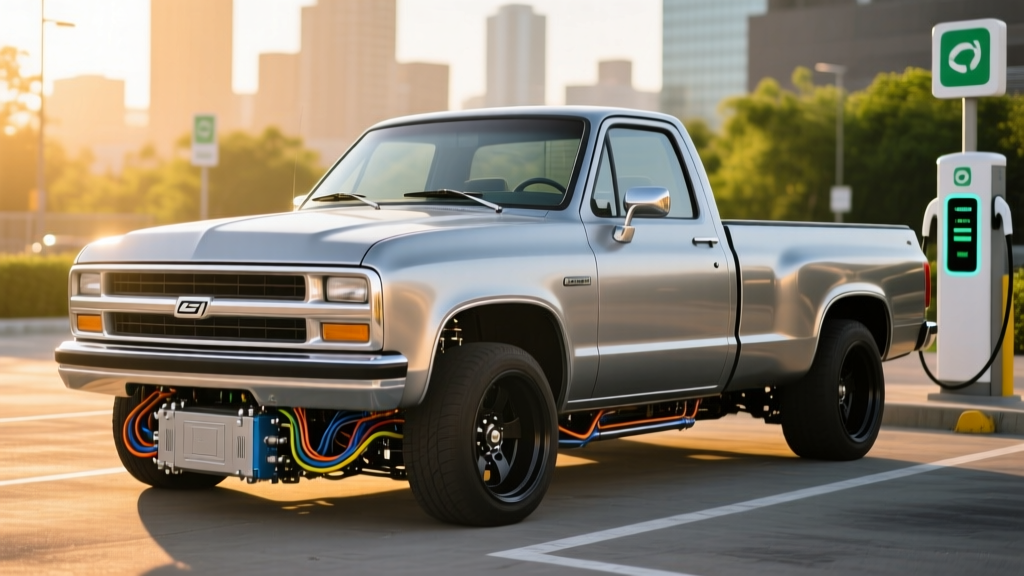
An EV conversion replaces the internal combustion engine, fuel tank, exhaust, and transmission with an electric motor, inverter, battery pack, and charge controller. For a truck platform — whether a 1970s Chevy C10, a 1990s Ford F-150, or a 2005 Toyota Tacoma — the process involves several major subsystems:
- Motor and inverter: Common choices include salvaged Tesla drive units (large or small), NetGain Hyper9 AC motors, or Cascadia Motion systems. Output ranges from 100 HP for basic conversions to 400+ HP for performance builds.
- Battery pack: Most conversions use salvaged Tesla modules, Nissan Leaf modules, or new LiFePO4 (LFP) prismatic cells. Usable capacity typically falls between 30 kWh and 80 kWh, depending on budget and available space in the frame rails and bed.
- Battery Management System (BMS): Mandatory for safe operation — monitors cell voltage, temperature, and balancing. Options include Orion BMS, SimpBMS, or Thunderstruck systems.
- Charging system: Level 2 AC charging (typically 3.3–7.2 kW via an onboard charger like the Elcon PFC or Tesla Gen 2 charger) is standard. DC fast charging adds $3,000–$8,000+ and significant complexity — many conversions skip it entirely.
- Thermal management: Battery cooling and heating systems range from passive air cooling (budget builds, limits charge rate and longevity) to active liquid cooling (required for DC fast charging and sustained high loads).
- Ancillary systems: Power steering pump, brake vacuum pump or booster, cabin heater, 12V DC-DC converter to replace the alternator — all must be addressed.
Shop time for a professional conversion typically runs 300–600 labor hours. At $100–$150/hour for specialized EV conversion shops, that's $30,000–$90,000 in labor alone before parts.
Electric Truck Conversion Cost Breakdown
Here's what a realistic conversion budget looks like in 2026, segmented by build tier:
| Component | Budget DIY Build | Mid-Range Pro Build | High-End Pro Build |
|---|---|---|---|
| Motor + Inverter | $2,500–$5,000 | $6,000–$12,000 | $12,000–$25,000 |
| Battery Pack (usable kWh) | $4,000–$8,000 (25–40 kWh) | $10,000–$20,000 (50–75 kWh) | $20,000–$40,000 (80–120 kWh) |
| BMS + Wiring + Safety | $1,000–$2,500 | $2,500–$5,000 | $5,000–$8,000 |
| Onboard Charger (Level 2) | $800–$1,500 | $1,500–$3,000 | $3,000–$5,000 |
| DC Fast Charge (optional) | — | $4,000–$8,000 | $6,000–$12,000 |
| Thermal Management | $500–$1,500 (passive) | $2,000–$5,000 | $5,000–$10,000 (liquid) |
| Ancillaries (PS, brakes, HVAC, 12V) | $1,500–$3,000 | $3,000–$7,000 | $7,000–$15,000 |
| Labor (professional) | $0 (DIY) | $25,000–$50,000 | $50,000–$90,000 |
| Total Parts + Labor | $10,300–$21,500 | $54,000–$110,000 | $108,000–$205,000 |
Don't forget the donor vehicle. A clean-title 1987 Chevy C10 runs $8,000–$20,000; a 2000s-era Toyota Tacoma in good shape runs $12,000–$25,000. Add that to the conversion cost above.
Range, Charging & Performance: What to Expect
Unlike factory EVs with EPA-tested range figures, conversion range depends entirely on your battery size, vehicle weight, and driving style. Here's realistic data from common builds:
| Metric | Typical Conversion (60 kWh pack) | Ford F-150 Lightning (2026, Ext. Range) | Rivian R1T (2026, Max Pack) | Gas F-150 (2026, 3.5L EcoBoost) |
|---|---|---|---|---|
| Usable Battery / Tank | ~60 kWh | 131 kWh (NMC) | 149 kWh (NMC) | 26 gal fuel tank |
| EPA Range | Not EPA-rated (est. 100–150 mi) | 320 mi | 420 mi | ~500 mi (20 MPG combined) |
| Real-World Highway Range | 70–110 mi | ~250–280 mi | ~330–370 mi | ~450 mi |
| Peak DC Charge Rate | 0–50 kW (if equipped) | 150 kW | 220 kW | N/A |
| Level 2 Charge Time (full) | 8–18 hours (3.3–7.2 kW) | ~13 hours (11.5 kW) | ~14 hours (11.5 kW) | N/A |
| Horsepower | 150–300 HP | 580 HP | 1,025 HP (Tri-Motor) | 400 HP |
| 0–60 mph | 8–14 sec | 3.8 sec | 2.9 sec (Tri) | 5.5 sec |
| Towing Capacity | Not rated / unsafe to tow heavy | 7,700–10,000 lbs | 11,000 lbs | 8,200–13,000 lbs |
| Warranty | None (shop warranty only) | 3 yr/36k mi + 8 yr/100k mi battery | 5 yr/60k mi + 8 yr/175k mi battery | 3 yr/36k mi + 5 yr/60k mi powertrain |
Critical note on conversion range: A 60 kWh pack in a 4,500-lb converted truck with poor aerodynamics will consume roughly 450–550 Wh/mile on the highway. That yields 109–133 miles theoretical, but real-world highway driving at 70+ mph, especially in cold weather or with headwinds, can drop that to 70–100 miles. Factory EV trucks benefit from optimized aerodynamics, heat pumps, and sophisticated thermal management that conversions almost never replicate.
Conversion vs. Factory EV Truck: The Economics
The financial case for a conversion is almost always weaker than buying a factory EV truck. Here's a 5-year ownership comparison:
| Cost Category | Conversion (Mid-Range Build + Donor) | Ford F-150 Lightning XLT (2026) | Gas Ford F-150 XLT (2026) |
|---|---|---|---|
| Purchase / Build Cost | $70,000–$130,000 | ~$55,000–$60,000 | ~$45,000–$50,000 |
| Federal Tax Credit (§30D) | $0 (not eligible) | Up to $7,500 (eligibility varies) | $0 |
| 5-Year Fuel/Energy (15k mi/yr) | ~$4,500–$6,000 | ~$4,500–$6,000 | ~$11,000–$14,000 |
| 5-Year Maintenance | $2,000–$5,000 (custom parts risk) | ~$1,500–$2,500 | ~$3,500–$5,000 |
| Insurance (5-year est.) | $8,000–$15,000 (specialty/collector) | $7,000–$10,000 | $5,500–$8,000 |
| Resale Value (after 5 yrs) | Highly uncertain ($20K–$50K) | $25,000–$35,000 | $22,000–$30,000 |
| Estimated 5-Year Net Cost | $60,000–$130,000+ | $20,000–$40,000 | $30,000–$45,000 |
The conversion's cost disadvantage is stark. You spend more, get less range, have no warranty, and face insurance and resale uncertainty. The IRS §30D federal tax credit — up to $7,500 for qualifying new EVs with income, MSRP, and battery-sourcing requirements — does not apply to conversions since the vehicle was not originally manufactured as an EV. Note: credit eligibility rules change; consult a tax professional and verify current-year requirements on irs.gov.
Real-World Ownership Considerations
Beyond cost, converted trucks come with practical challenges that factory EVs solve out of the box:
Home Charging Access
Most conversions charge at Level 2 speeds of 3.3–7.2 kW. A 60 kWh pack at 7.2 kW takes roughly 8.5 hours for a full charge — manageable overnight on a 240V/40A circuit. However, if you lack home charging (apartment dwellers, street parkers), relying on public Level 2 chargers is impractical for daily use, and many conversions lack DC fast charging entirely. This is the single biggest deal-breaker for conversion viability.
Cold-Weather Range Loss
Lithium-ion batteries lose 15–30% of their usable capacity in freezing temperatures, and cabin heating (typically a 2–5 kW resistive heater in conversions) further drains the pack. A conversion that manages 120 miles at 70°F might deliver only 75–90 miles at 20°F. Factory EV trucks like the Lightning and R1T use heat pumps and battery preconditioning to mitigate this — features rarely present in conversions.
Safety and Registration
Converted vehicles must pass state-specific inspections for registration. Some states (California, Oregon, Washington) have established EV conversion registration pathways; others make it difficult or unclear. There are no crash-test ratings for converted trucks, no airbag system integration guarantees, and no NHTSA oversight of the conversion process. Factory EV trucks carry full NHTSA and IIHS safety ratings.
Reliability and Parts
If your custom BMS fails or a salvaged Tesla drive unit develops a fault, you're not walking into a dealership for warranty service. Troubleshooting falls on you or the conversion shop. Parts availability for custom builds can mean weeks of downtime versus same-day service for mainstream EVs.
Common Conversion Myths vs. Facts
| Myth | Fact |
|---|---|
| "Converting is cheaper than buying an EV truck." | A mid-range professional conversion plus donor vehicle costs $70,000–$130,000. A new F-150 Lightning starts around $55,000 before incentives. |
| "I'll get 200+ miles of range easily." | Most conversions achieve 80–150 real-world miles. A 200-mile conversion requires 100+ kWh of batteries, which is expensive, heavy, and often doesn't fit in a truck frame without extensive fabrication. |
| "I can use Tesla Superchargers." | No. Tesla's Supercharger network requires communication protocols and a NACS connector with authentication that conversions do not support. You're limited to CCS or CHAdeMO public chargers — if your build has DC fast charging at all. |
| "It'll be zero maintenance." | While EVs have fewer moving parts, conversions still have suspension, brakes, cooling systems, and custom electronics that require attention. Salvaged battery modules may degrade unevenly. |
| "Any truck can be converted." | Technically yes, but heavier trucks (3/4-ton, 1-ton) require much larger battery packs and motors to move their weight, driving costs well beyond practical limits. Light-duty half-ton or smaller trucks are the realistic candidates. |
| "I'll qualify for EV tax credits." | Converted vehicles do not qualify for the §30D new EV credit or the §25E used EV credit. Some states offer conversion rebates (check your state energy office), but federal credits apply only to vehicles manufactured as EVs. |
When a Conversion Makes Sense (Decision Framework)
Should You Convert Your Truck to Electric?
Choose a conversion IF:
- You own a classic or sentimental truck (e.g., a 1972 C10, a first-generation Tacoma) and want to preserve it while modernizing the drivetrain — a restomod project where the vehicle's value is personal, not purely financial.
- You're a skilled fabricator or electrician who can do significant work yourself, reducing labor costs by 50–80%.
- The truck will serve a predictable, short-range duty cycle (e.g., a farm truck, campus vehicle, or local delivery route under 60 miles round-trip) where limited range isn't a constraint.
- You have reliable home Level 2 charging and don't need DC fast charging for your use case.
- You understand and accept the safety, registration, insurance, and resale risks as part of a passion project.
Buy a factory EV truck IF:
- You need 250+ miles of real-world range for commuting, road trips, or towing.
- You need DC fast charging for highway travel (150–220 kW on factory trucks, adding 150+ miles in 20–30 minutes).
- You need a tow rating above 5,000 lbs with engineering validation and warranty backing.
- You want a warranty, safety ratings, dealer service, and straightforward insurance.
- Your total budget is under $80,000 — you'll get more truck, more range, and more capability from a factory EV at that price point.
Consider a PHEV or HEV truck IF:
- You lack home charging access but want to reduce fuel consumption.
- You regularly tow heavy loads over long distances where battery weight and range limitations make pure EV impractical.
- You want a lower upfront cost with no range anxiety — trucks like the Ford Maverick Hybrid (42 MPG combined per fueleconomy.gov) start under $30,000.
Frequently Asked Questions
How much does it cost to convert a pickup truck to electric?
A DIY budget conversion using salvaged parts can run $10,000–$22,000 in parts (you supply the labor and expertise). A professional mid-range conversion typically costs $54,000–$110,000 in parts and labor, plus $8,000–$25,000 for the donor vehicle. High-end builds with 200+ mile range and DC fast charging can exceed $150,000 total.
How far can a converted electric truck drive on a charge?
Most conversions with 40–70 kWh battery packs achieve 80–150 miles of real-world range. Highway driving at 70+ mph, cold weather, and towing can reduce this by 20–40%. Achieving 200+ miles requires 100+ kWh of batteries, which adds significant weight and cost.
Can I tow with a converted electric truck?
It's generally not recommended. Converted trucks lack engineered tow ratings, and towing dramatically increases energy consumption (often 600–800+ Wh/mile), cutting an already limited range in half. Factory EV trucks like the F-150 Lightning (up to 10,000 lbs rated) are engineered and tested for towing with proper cooling and braking integration.
How long does a truck EV conversion take?
Professional shops typically quote 3–6 months for a complete conversion, though waitlists at popular shops can extend this to 12+ months. A skilled DIY builder working weekends might complete a basic conversion in 6–12 months.
Are EV conversions street-legal?
Yes, but the registration process varies significantly by state. You'll typically need to pass a safety inspection, provide documentation of the conversion components, and may need to obtain a reconstructed or specially constructed vehicle title. Check your state's DMV requirements before starting a build. Some states also require periodic emissions-related inspections that EV conversions are exempt from, but you must document the conversion properly.
Can I fast-charge a converted truck on a road trip?
Only if your conversion includes DC fast charging hardware — a CCS or CHAdeMO inlet, compatible charge controller, and adequate battery thermal management. This adds $4,000–$12,000+ to the build and is technically complex. Many conversions are Level 2 only, making road trips impractical beyond the truck's single-charge range.
What battery chemistry is best for a conversion?
LFP (lithium iron phosphate) cells are preferred for conversions due to their thermal stability, long cycle life (3,000–5,000+ cycles), and lower fire risk — important in a custom installation without factory-grade crash protection. NMC (nickel manganese cobalt) offers higher energy density (more range per pound) but requires more careful thermal management. Salvaged Tesla NMC modules are popular for their availability but require robust BMS and cooling.