The Short Answer on Converting a Miata to Electric
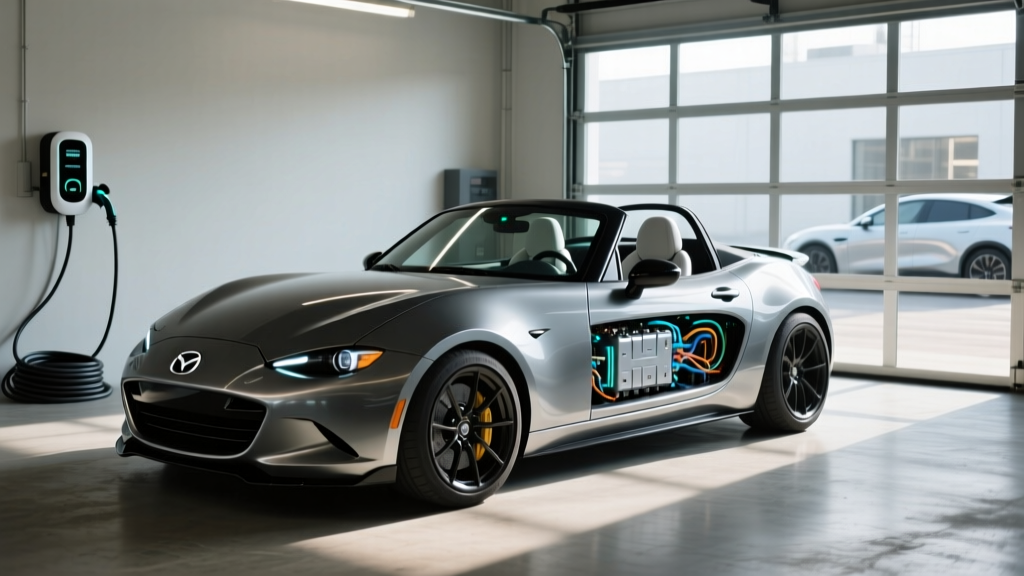
Converting a Mazda Miata (NA, NB, or NC generation) to electric power typically costs between $15,000 and $35,000 in parts and labor on top of the donor car's purchase price. Expect 60 to 120 miles of real-world range depending on battery pack size (usually 20–40 kWh), and charging on a standard Level 2 home setup takes roughly 4–8 hours from empty. The result is a lightweight, tossable roadster with instant torque, zero tailpipe emissions, and minimal drivetrain maintenance — but it will not match the range, fast-charging capability, or warranty protection of a modern production EV like the Chevy Bolt or Nissan Leaf. An EV Miata swap makes sense for hobbyists who value the driving experience and garage-project satisfaction over practicality and total cost of ownership.
Why the Miata Is the Poster Child for EV Conversions
The Mazda MX-5 Miata has been one of the most popular EV-swap platforms for over a decade, and the physics are straightforward. With a curb weight between 2,100 and 2,400 lbs (depending on generation), the Miata is one of the lightest production cars ever sold in the US. Less mass means less energy required to move the car, which directly translates to more miles from a smaller, lighter, and cheaper battery pack.
The engine bay is compact but accessible, the 5-speed and 6-speed manual transmissions mate well to electric motor adapter plates, and the aftermarket support is robust. Companies like EV West and various independent shops have developed repeatable conversion kits, and the DIY community on forums like Miata.net and OpenEVSE has documented dozens of builds.
But "popular" doesn't automatically mean "practical." Let's run the numbers.
What a Miata EV Conversion Actually Costs
The price spread is wide because conversion approaches range from bare-bones DIY to fully engineered turnkey builds. Here's what the budget looks like in 2026:
| Component | Budget DIY | Mid-Range Kit | Turnkey Shop Build |
|---|---|---|---|
| Donor Miata (NA/NB/NC) | $2,500–$5,000 | $4,000–$8,000 | $5,000–$10,000 |
| Electric motor (e.g., NetGain Hyper9, Tesla drive unit) | $1,500–$3,000 | $3,000–$5,000 | $4,000–$7,000 |
| Battery pack (20–40 kWh, used Tesla/Nissan Leaf modules or new LFP) | $4,000–$8,000 | $7,000–$12,000 | $10,000–$18,000 |
| Motor controller & BMS | $1,500–$2,500 | $2,000–$3,500 | $2,500–$4,000 |
| Charger (Level 2 onboard, 3.3–7.2 kW) | $800–$1,500 | $1,200–$2,000 | $1,500–$2,500 |
| Adapter plate, coupler, fabrication | $500–$1,500 | $1,500–$3,000 | $2,500–$5,000 |
| Wiring, cooling, instrumentation, safety | $1,000–$2,500 | $2,000–$4,000 | $3,000–$6,000 |
| Labor (if not DIY) | $0 | $2,000–$5,000 | $8,000–$15,000 |
| Total Estimated Cost | $11,800–$24,000 | $22,700–$42,500 | $36,500–$67,500 |
Most mid-range builds that produce a reliable, daily-drivable car land in the $20,000–$35,000 total range (including the donor car). That's a significant investment — and it does not include the home Level 2 charging installation, which typically runs $800–$2,500 for a 240V/40A circuit and hardwired station like a ChargePoint Home Flex or Emporia Level 2.
Range, Performance, and Charging: The Real Numbers
Because conversions vary so widely, there is no EPA sticker for a converted Miata. But we can estimate based on pack size and vehicle efficiency.
| Spec | 1994 Miata (NA, Gas) | Miata EV Swap (30 kWh) | 2026 Nissan Leaf SV Plus |
|---|---|---|---|
| Energy Source | Gasoline | Grid electricity | Grid electricity |
| Battery / Tank | 12.7 gal | ~30 kWh usable | 62 kWh usable (NMC) |
| Range | ~320 mi (25 MPG combined) | ~80–100 mi real-world | EPA 212 mi |
| Horsepower | 128 hp | 120–200 hp (motor-dependent) | 214 hp |
| 0–60 mph | ~8.5 sec | ~5.5–7.0 sec | ~6.5 sec |
| Charge / Fill Time | ~3 min (gas station) | ~5–8 hr (Level 2, 7.2 kW) | ~10 hr (L2); 10–80% in ~45 min (DC) |
| DC Fast Charge | N/A | Rarely available | 100 kW peak (CHAdeMO) |
| Maintenance (annual est.) | $800–$1,500 | $100–$300 | $200–$500 |
| Fuel / Energy Cost per Mile | ~$0.14/mi (gas at $3.50/gal) | ~$0.04/mi (home charging, $0.14/kWh) | ~$0.04/mi |
| Warranty | Expired | None (aftermarket) | 3 yr/36k basic; 8 yr/100k battery |
Real-World Range Reality
A 30 kWh pack in a Miata conversion will typically deliver 80–100 miles in moderate weather with mixed driving. Highway speeds above 70 mph will drop that to 65–80 miles due to aerodynamic drag (the Miata's soft top and open cockpit create significant drag). In cold weather (below 40°F), expect a 15–30% reduction due to battery chemistry limitations and cabin heating draw. Unlike production EVs, most conversions lack a heat pump and sophisticated thermal management, so winter range loss can be severe.
Charging Speed and the kW vs. kWh Distinction
This is where many first-time conversion owners get tripped up. Your battery holds energy measured in kWh (kilowatt-hours — think of it as the "gallon" equivalent). Your charger delivers power measured in kW (kilowatts — the "flow rate").
Most conversions use a 3.3 kW or 7.2 kW onboard Level 2 charger. With a 30 kWh pack and a 7.2 kW charger, a full charge from empty takes roughly 4.5 hours. DC fast charging is rarely integrated into conversions because of the cost, complexity, and battery-pack compatibility requirements. This means road trips beyond your range are impractical — your converted Miata is effectively a local and commuter car.
EV Conversion vs. Buying a Production EV: The Ownership Math
This is the comparison every prospective converter needs to face. Let's look at 5-year total cost of ownership for three scenarios: a converted Miata, a used 2022 Nissan Leaf, and a new 2026 Chevy Equinox EV.
| Cost Category | Miata EV Conversion ($28K build) | Used 2022 Leaf S ($14K) | 2026 Equinox EV LT ($33K, after credit) |
|---|---|---|---|
| Purchase Price | $28,000 | $14,000 | $33,000 |
| Federal Tax Credit (§30D) | $0 (not eligible — conversions don't qualify) | $0 (used EV credit already applied or expired) | Up to $7,500 (if eligible) |
| Home Charger Install | $1,500 | $1,500 | $1,500 |
| Energy Cost (60K mi × $0.04/mi) | $2,400 | $2,400 | $2,400 |
| Maintenance (5 yr) | $1,000 | $1,500 | $2,000 |
| Insurance (5 yr est.) | $6,000 (specialty/modified vehicle) | $5,500 | $7,000 |
| Estimated Resale Value | $10,000–$15,000 (niche market) | $7,000 | $18,000 |
| Net 5-Year Cost | $28,900–$33,900 | $17,900 | $20,400 |
The math is blunt: from a pure cost perspective, a used production EV will almost always beat a conversion. The Miata EV swap is a passion project, not a financial optimization. That's fine — but go in with eyes open.
Federal Tax Credits: Why Your Conversion Won't Qualify
Under current IRS §30D rules, the federal clean vehicle credit of up to $7,500 applies only to new qualified plug-in electric vehicles purchased from a manufacturer. A custom EV conversion of a used Miata does not qualify — the vehicle is not manufactured by an OEM, does not have a certificate of conformity, and cannot meet the battery sourcing and critical mineral requirements that production EVs are certified against.
If you're cross-shopping a conversion against buying a new production EV, factor in that the production vehicle may qualify for up to $7,500 in federal credits (subject to MSRP caps of $55,000 for sedans / $80,000 for SUVs and trucks, buyer income limits of $150K single / $300K joint, and North American assembly and battery-sourcing requirements). Check the latest rules at fueleconomy.gov before making your decision.
Common Misconceptions About Miata EV Conversions
| Myth | Fact |
|---|---|
| "It'll save me money vs. buying an EV." | A quality conversion costs $20K–$35K+ with no tax credit. A used Leaf or Bolt can be had for $12K–$18K with more range, DC fast charging, and a factory warranty. |
| "I'll get 200 miles of range." | Not realistically. The Miata's limited space and weight tolerance cap most builds at 25–40 kWh, yielding 60–120 real-world miles. 200+ miles would require a pack too heavy for the chassis. |
| "I can fast-charge it on road trips." | DC fast charging integration is rare, expensive ($3K–$6K+ extra), and requires a pack with compatible BMS and thermal management. Most conversions are Level 2 only. |
| "It'll be lighter than a gas Miata." | Almost never. The battery pack alone weighs 400–700 lbs. Most conversions end up 200–500 lbs heavier than the original gas car, affecting handling balance. |
| "Insurance will be cheap." | Modified vehicles often require specialty insurers (Hagerty, Grundy) and agreed-value policies. Budget $1,200–$1,800/year — often more than a stock Miata. |
| "I can register it easily in any state." | Registration requirements for converted EVs vary significantly by state. California, Texas, and Florida have established processes; some states require special inspections or have no clear pathway. |
Home Charging and Real-World Ownership Considerations
Before you start sourcing parts, honestly assess your charging situation:
- Do you have access to home charging? A converted Miata with 80–100 miles of range and no DC fast charging is effectively tethered to your home charger. If you live in an apartment or street-park, this is a serious problem.
- What's your electrical panel capacity? A 40A/240V Level 2 circuit requires a panel with at least 100A service and available breaker slots. Older homes may need a $1,500–$3,000 panel upgrade. Always consult a licensed electrician for the final spec.
- What's your climate? If you live where winters regularly drop below freezing, your range will shrink 15–30%. Most conversion packs lack active thermal management, meaning you'll also face slower charging speeds in cold weather and potential long-term battery degradation.
- What are your driving patterns? A 20-mile round-trip commute with weekend errands fits perfectly. A 60-mile highway commute with detours does not.
Decision Framework: Should You Convert or Buy?
Choose a Miata EV Conversion If:
- You want a weekend project and enjoy fabrication, wiring, and problem-solving
- Your daily driving is under 60 miles round-trip with reliable home charging
- You value the Miata's driving dynamics and want to keep the manual transmission and lightweight chassis
- You're not dependent on this as your only vehicle
- You accept that resale will be to a niche audience and the build cost won't be fully recovered
Choose a Production EV Instead If:
- You need 200+ miles of range and DC fast charging for road trips
- You want a warranty, dealership service, and straightforward insurance
- You qualify for the §30D federal tax credit (up to $7,500 for new, up to $4,000 for used)
- You need a daily driver with no project downtime or debugging
- Total cost of ownership matters more than the joy of the build
Frequently Asked Questions
How long does a Miata EV conversion take?
A professional shop build typically takes 3–6 months. A DIY build by an experienced hobbyist working weekends can take 6–18 months depending on complexity, parts sourcing, and fabrication challenges. First-time converters should budget more time than they expect.
Can I keep the manual transmission in a Miata EV swap?
Yes — this is one of the most popular aspects of Miata conversions. The electric motor connects to the existing transmission via an adapter plate and coupler. Most builders lock the transmission in a single gear (usually 2nd or 3rd) since electric motors produce torque from 0 RPM and don't require shifting. Some builds retain functional shifting for the driving experience, though it's unnecessary for performance.
What battery chemistry is best for a conversion?
Most conversions use either salvaged Tesla modules (NMC/NCA chemistry, high energy density but more sensitive to heat and overcharge) or new LFP (lithium iron phosphate) prismatic cells. LFP offers longer cycle life, better thermal stability, and lower fire risk, but at the cost of lower energy density — meaning a heavier pack for the same kWh. For a lightweight car like the Miata, NMC salvaged modules remain popular despite the trade-offs.
Is a converted Miata safe?
A conversion does not undergo NHTSA crash testing. The original Miata's safety structure (which was modest even when new — no airbags in NA models, for example) remains unchanged. High-voltage wiring must be properly shielded, fused, and routed to avoid shock risk in a collision. Quality builds include an inertia switch that disconnects the pack in an accident. Treat it as a vintage-car safety experience: wear your seatbelt, drive defensively, and understand you don't have modern crumple zones or airbags.
How do I register a converted EV?
Process varies by state. In California, you'll go through the DMV with a Verification of Vehicle (REG 31) form and potentially a brake and light inspection. Some states require a special "constructed vehicle" or "converted EV" title designation. Contact your state DMV or DMV-equivalent before starting the build to understand exactly what documentation you'll need.
What's the best Miata generation for an EV conversion?
The NA (1990–1997) is the most popular due to low donor cost ($2,500–$5,000), simplicity, and lightest weight. The NB (1999–2005) offers slightly more interior room and better rust resistance. The NC (2006–2015) is heavier but has a stronger chassis and more modern interior. Most conversion kits and community documentation target the NA and NB generations.