The Quick Answer: Is an EV Conversion Worth It?
Bottom line: Converting a gasoline car to an electric vehicle in 2026 typically costs $12,000 to $40,000+ depending on the donor vehicle, battery size, and whether you DIY or hire a shop. Most conversions yield 80–150 miles of real-world range with Level 2 home charging but rarely support DC fast charging. An EV conversion makes sense if you have a specific classic or lightweight car you love and can't replace — but for daily commuting, a purpose-built new or used EV almost always delivers more range, faster charging, modern safety, and tax-credit savings for similar or less total spend.
If you've searched "convert car to electric vehicle," you're probably weighing the romance of electrifying a beloved car against the practicality of just buying a Tesla Model 3, Hyundai Ioniq 5, or Chevrolet Equinox EV. This guide walks through the real numbers, the engineering trade-offs, and the ownership math so you can make a grounded decision.
What an EV Conversion Actually Involves
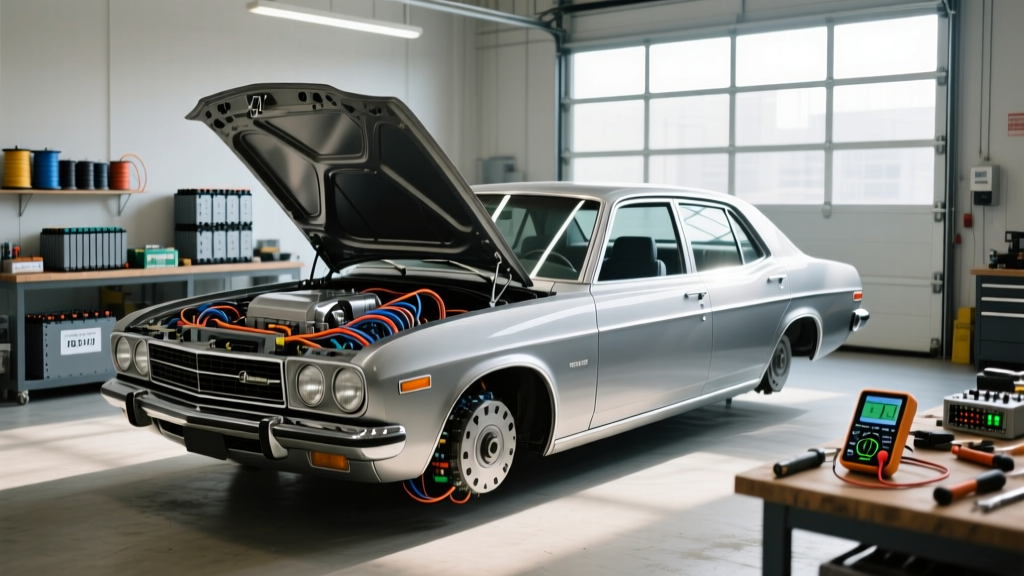
An electric vehicle conversion replaces the internal combustion engine, fuel tank, exhaust system, and often the transmission with an electric motor, motor controller, high-voltage battery pack, and charging system. The 12V auxiliary system is retained or upgraded, and the HVAC system typically needs an electric compressor since there's no engine to drive it.
Here's what a typical conversion includes:
- Electric motor: Usually a repurposed OEM drive unit (e.g., from a wrecked Tesla Model S, Nissan Leaf, or Chevy Bolt) or an aftermarket motor like the NetGain HyPer 9 or Cascadia Motion systems.
- Motor controller: Manages power delivery — units like the AEM EV VCU or OpenInverter are common in the DIY community.
- Battery pack: Salvaged OEM modules (Leaf, Bolt, or Tesla modules) or new LFP (lithium iron phosphate) cells. Capacity typically ranges from 20 kWh to 60 kWh usable in conversions.
- Battery management system (BMS): Essential for cell balancing, thermal monitoring, and preventing overcharge/over-discharge.
- Onboard charger: Most conversions use a 3.3 kW or 6.6 kW Level 2 charger — DC fast charging is rare and expensive to add.
- DC-DC converter: Steps down high-voltage battery to 12V for lights, infotainment, and accessories.
- Throttle integration, instrumentation, and safety interlocks.
Professional conversion shops like EV West, Legacy Motor Works, and various regional specialists handle everything from classic Porsche 911s to VW Beetles and pickup trucks. DIY conversions are possible but require significant electrical and fabrication skills.
EV Conversion Cost Breakdown
The price varies enormously based on your donor vehicle, desired range, and whether you do the work yourself. Here's a realistic 2026 cost breakdown:
| Component / Service | DIY (Budget) | DIY (Mid-Range) | Professional Shop |
|---|---|---|---|
| Electric motor + controller | $1,500 – $3,000 | $3,000 – $6,000 | $5,000 – $10,000 |
| Battery pack (20–60 kWh) | $3,000 – $8,000 | $6,000 – $15,000 | $8,000 – $20,000 |
| BMS + DC-DC converter | $500 – $1,200 | $1,000 – $2,500 | $1,500 – $3,000 |
| Onboard charger (L2, 3.3–6.6 kW) | $400 – $800 | $600 – $1,500 | $1,000 – $2,500 |
| Fabrication, mounts, adapters | $500 – $2,000 | $1,500 – $4,000 | $3,000 – $8,000 |
| Wiring, safety systems, instruments | $500 – $1,000 | $1,000 – $2,000 | $2,000 – $4,000 |
| Labor (if professional) | — | — | $5,000 – $15,000 |
| Total Estimated Cost | $6,400 – $16,000 | $13,100 – $31,000 | $25,500 – $62,500 |
Important note: These figures cover the powertrain conversion only. They do not include the donor vehicle cost, suspension upgrades (EV conversions add 300–800 lbs of battery), brake upgrades, or cosmetic work. A full professional conversion of a classic car can easily exceed $75,000–$100,000 when all-in.
Range, Charging & Performance: What to Expect
Most EV conversions fall well short of modern production EVs in range and charging speed. Here's the reality:
| Metric | Typical DIY Conversion | Pro Shop Conversion | 2026 Chevy Equinox EV (2RS) | 2026 Tesla Model 3 (LR) |
|---|---|---|---|---|
| Battery capacity (usable) | 20 – 35 kWh | 40 – 60 kWh | 85 kWh | 79 kWh |
| EPA-equivalent range | 60 – 100 mi | 120 – 180 mi | 319 mi | 363 mi |
| Real-world range (highway) | 45 – 75 mi | 90 – 140 mi | ~260 – 280 mi | ~300 – 320 mi |
| DC fast charging | Rarely available | Sometimes (CCS add-on) | 150 kW peak | 250 kW peak |
| Level 2 charging rate | 3.3 kW | 6.6 – 7.2 kW | 11.5 kW | 11.5 kW |
| Full L2 charge time (0–100%) | 6 – 11 hours | 6 – 9 hours | ~7.5 hours | ~7 hours |
| 0–60 mph | 8 – 14 sec | 5 – 8 sec | ~7.4 sec | 4.2 sec |
| Horsepower | 80 – 150 HP | 150 – 300 HP | 213 HP | 346 HP |
The biggest functional gap is DC fast charging. Adding CCS or NACS fast-charge capability to a conversion requires a compatible high-voltage architecture, proper communication protocols with the charger, and a battery pack that can accept high C-rates — all of which add thousands of dollars and significant engineering complexity. Without DC fast charging, road trips are impractical; your conversion becomes a local-use vehicle.
Efficiency also tends to be worse in conversions. A purpose-built EV like the Model 3 achieves around 25 kWh/100mi because of optimized aerodynamics, low rolling resistance, heat pump HVAC, and integrated thermal management. A converted 1970s sedan with the aerodynamics of a brick and no heat pump might consume 35–45 kWh/100mi, further reducing effective range.
EV Conversion vs. Buying a New or Used EV
This is the decision most people need to make. Let's compare a $25,000 professional conversion on a donor car you already own against purchasing a new or used production EV:
| Factor | $25K EV Conversion | Used 2022 Chevy Bolt EV (~$18K) | New 2026 Equinox EV 2RS (~$36K) |
|---|---|---|---|
| Upfront cost (incl. vehicle) | $25,000 + donor car | ~$18,000 | ~$36,000 |
| Federal tax credit (§30D) | $0 (not eligible) | Up to $4,000 (used EV credit) | Up to $7,500 (if sourcing rules met) |
| Net cost after credits | $25,000 | ~$14,000 | ~$28,500 (with point-of-sale transfer) |
| Range (real-world) | 90 – 140 mi | ~220 mi | ~260 – 280 mi |
| DC fast charging | Usually no | Yes, 55 kW CCS | Yes, 150 kW CCS |
| Safety ratings (NHTSA/IIHS) | Unrated | Top Safety Pick | Top Safety Pick+ |
| Battery warranty | None (or shop warranty) | Remaining OEM warranty | 8 yr / 100,000 mi |
| Insurance | Specialty/high (agreed value) | Standard rates | Standard rates |
| Resale market | Niche, illiquid | Established | Established |
Source: fueleconomy.gov for EPA range data; IRS §30D credit rules for eligibility.
The financial case is stark: a used Bolt EV delivers more range, DC fast charging, modern safety, and an established service network for less money than most conversions. A new Equinox EV after the federal credit costs only slightly more than a mid-range conversion and delivers double the range with full warranty coverage.
Real-World Ownership Considerations
Beyond the sticker price, daily life with a converted EV involves practical challenges that production EV owners don't face:
Home Charging Access
Most conversions charge at 3.3 kW to 6.6 kW on Level 2. If you have a 240V outlet (NEMA 14-50) or a dedicated Level 2 wallbox, overnight charging works fine for a 30–40 kWh pack. If you rely on public charging, the lack of DC fast charging becomes a serious limitation — a 6.6 kW public Level 2 charger adds only about 20–25 miles per hour of charging.
Cold Weather Impact
Conversions rarely have active battery thermal management or heat pumps. In freezing temperatures, expect 25–40% range loss — a conversion with 100 miles of summer range might deliver only 60–75 miles in a 25°F January commute. Production EVs with heat pumps and battery preconditioning handle cold far better.
Registration, Insurance & Inspection
EV conversions must be registered as modified vehicles. Requirements vary by state — some require special inspections, others need a certified electrician's sign-off on the high-voltage system. Insurance typically requires a specialty agreed-value policy, which can cost 30–60% more than standard auto insurance for a comparable vehicle.
Maintenance & Repairs
The upside: no oil changes, no spark plugs, no transmission fluid, and minimal brake wear thanks to regenerative braking. The downside: if something goes wrong with the motor controller, BMS, or custom fabrication, there's no dealer service department. You're dependent on the conversion shop or your own diagnostic skills. Finding a technician who can troubleshoot a custom high-voltage system is difficult in most regions.
Common Misconceptions About EV Conversions
| Myth | Fact |
|---|---|
| "Converting is cheaper than buying an EV" | A budget DIY conversion starts around $12,000–$16,000 (parts only, no donor car). A used 2022 Nissan Leaf or Chevy Bolt costs $14,000–$18,000 with 150–259 miles of range, DC fast charging, full safety systems, and remaining battery warranty. |
| "I'll get 200+ miles of range" | Only if you spend $20,000+ on a 60+ kWh battery pack and your donor vehicle is lightweight and aerodynamic. Most conversions achieve 60–140 real-world miles. |
| "I can fast-charge on road trips" | DC fast charging requires a CCS/NACS charge port, compatible communication protocol, and a battery that supports high C-rates. Adding this to a conversion adds $3,000–$8,000 and significant engineering complexity. Most conversions are Level 2 only. |
| "It's a green upgrade" | The conversion is only as clean as your electricity source. Also, manufacturing new battery cells carries an upstream carbon cost. A conversion on a car you already own avoids the embedded emissions of building a new vehicle, which is a legitimate environmental argument. |
| "Any car can be converted easily" | Lightweight, simple vehicles (VW Beetles, classic Porsches, old pickups) convert most easily. Modern cars with complex CAN-bus electronics, stability control, and integrated powertrain management are extremely difficult to convert without triggering fault codes and disabling safety systems. |
Decision Framework: Should You Convert?
Convert your car to electric IF:
- You have a classic, vintage, or sentimental vehicle that you want to preserve and drive more often (e.g., a 1965 Mustang, 1973 VW Bus, or 1985 Land Cruiser).
- You have a dedicated garage with 240V Level 2 charging and your daily driving is under 60 miles round-trip.
- You enjoy fabrication, electrical work, and the maker community — and view the project as a hobby, not just transportation.
- You understand the converted car will have no crash-test rating, no ADAS features, and limited resale liquidity.
- Budget is secondary to the satisfaction of the project itself.
Buy a production EV (new or used) IF:
- You need reliable daily transportation with 200+ miles of range.
- You take road trips of 150+ miles and need DC fast charging.
- You want modern safety features (automatic emergency braking, blind-spot monitoring, lane-keeping assist).
- You want federal tax credits (up to $7,500 for qualifying new EVs; up to $4,000 for qualifying used EVs under IRS §30D / §25E rules).
- You want a battery warranty (8 years / 100,000 miles minimum on all new EVs sold in the US).
- You live in a region with cold winters and need battery thermal management and a heat pump.
Frequently Asked Questions
How much does it cost to convert a gasoline car to electric?
A basic DIY conversion using salvaged components costs $6,000–$16,000 in parts. A mid-range build with a larger battery and quality components runs $13,000–$31,000. A professional shop conversion typically costs $25,000–$62,000 or more, not including the donor vehicle. High-end classic car conversions by shops like Lunaz or Everrati can exceed $150,000.
What is the best car to convert to electric?
Lightweight, mechanically simple vehicles with ample space for batteries are ideal. Popular choices include the VW Beetle, VW Bus, classic Porsche 911, old Toyota pickups, Fiat 500, and classic British roadsters. Avoid modern vehicles with complex electronics — the CAN-bus integration alone can make the project impractical.
How long does an EV conversion battery last?
It depends on the chemistry. Salvaged Nissan Leaf modules (NMC) may already have degradation and could last 5–8 years before significant capacity loss. New LFP (lithium iron phosphate) cells can last 2,000–3,000+ charge cycles — potentially 10–15 years with proper BMS management and avoiding extreme states of charge. Neither option comes with the 8-year/100,000-mile warranty that federal law requires on new production EVs.
Can I get a federal tax credit for converting a gas car to electric?
No. The federal §30D clean vehicle credit and §25E used vehicle credit apply only to qualifying production vehicles that meet specific battery sourcing, MSRP, and buyer income requirements. A conversion does not qualify. However, some states or local utilities offer rebates for EV charging equipment installation, which would apply to your home Level 2 setup.
Is it legal to drive a converted EV on public roads?
Yes, but registration requirements vary by state. Most states require a special inspection to verify the vehicle's safety systems, lighting, and braking are intact. Some states require a certified electrician to sign off on the high-voltage installation. Check with your state DMV before starting a project — a few states have restrictive modified-vehicle laws that complicate registration.
How does the driving experience compare to a production EV?
A well-executed conversion delivers smooth, quiet, torque-rich acceleration that feels similar to a production EV at low to moderate speeds. The differences emerge at highway speeds (more wind and road noise from an older chassis), in cold weather (no battery preconditioning), and on longer trips (no fast charging). Regenerative braking quality varies — some conversions achieve near one-pedal driving, others have a less seamless blend between regen and friction brakes.