The Short Answer on Converting a Gas Car to Electric
An EV conversion (swapping an internal-combustion powertrain for an electric motor and battery pack) typically costs $10,000 to $50,000+ in parts and labor, yields 60–150 miles of real-world range depending on battery size, and takes 100–400+ hours of skilled work. While conversions are a passionate niche for classic-car enthusiasts, for most daily drivers, buying a used or new production EV delivers more range, warranty coverage, safety systems, and federal tax-credit eligibility at lower total cost.
What an EV Conversion Actually Involves
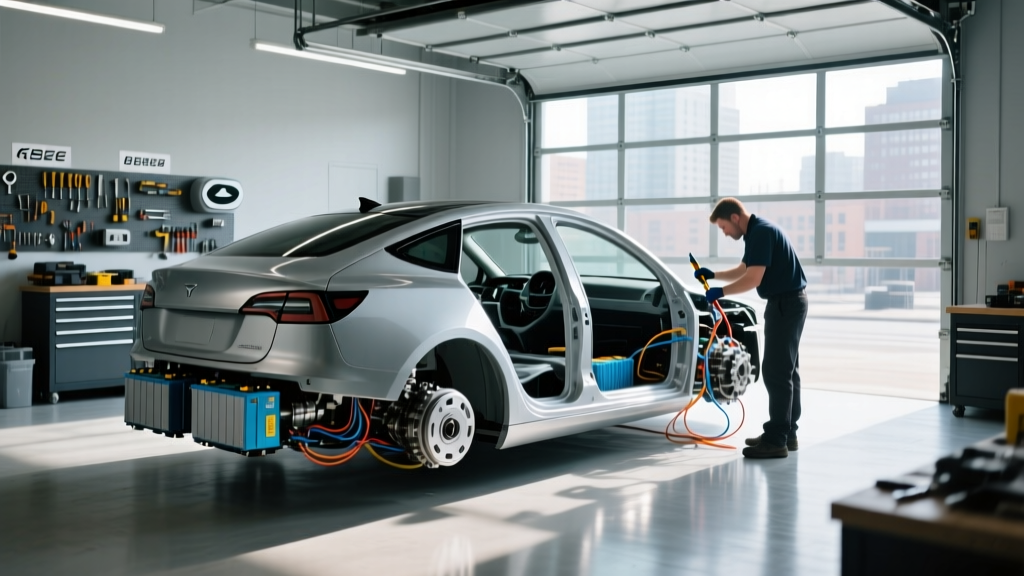
A "convert car to electric" project means removing the engine, fuel tank, exhaust, and related systems, then installing:
- Electric motor (commonly 50–150 kW, AC induction or permanent magnet)
- Battery pack (typically salvaged Tesla modules, Nissan Leaf packs, or LiFePO4 cells — 15 to 60 kWh usable)
- Motor controller / inverter
- Charger (Level 2 onboard, 3.3–7.2 kW typical; DC fast charging is rare and expensive)
- DC-DC converter to run the 12V accessories
- Throttle adapter, custom mounts, high-voltage wiring, BMS (battery management system)
- Instrumentation / display
Popular conversion kit suppliers include EV West, Stealth EV, Electric GT, and various open-source community builds. A basic DIY kit (motor, controller, minimal batteries) starts around $6,000–$8,000 in parts alone, while turnkey professional conversions on classic Porsches, Broncos, or Mustangs routinely exceed $40,000–$100,000.
EV Conversion Cost Breakdown: Parts, Labor, and Hidden Expenses
The sticker shock of an EV swap comes from the battery. Lithium-ion cells are the single largest line item, and costs scale directly with the range you want.
| Component | Budget DIY | Mid-Range Build | Professional / Restomod |
|---|---|---|---|
| Motor + Controller | $2,500–$4,000 | $4,000–$8,000 | $8,000–$15,000 |
| Battery Pack (cells + BMS + enclosure) | $3,000–$6,000 (15–25 kWh) | $6,000–$15,000 (30–50 kWh) | $15,000–$35,000 (50–80+ kWh) |
| Charger + DC-DC + Wiring | $1,000–$2,000 | $2,000–$4,000 | $3,000–$6,000 |
| Fabrication / Mounts / Cooling | $500–$2,000 | $2,000–$5,000 | $5,000–$15,000 |
| Labor (if outsourced) | $0 (DIY) | $5,000–$15,000 | $15,000–$40,000+ |
| Registration / Inspection / Insurance | $200–$800 | $500–$1,500 | $1,000–$3,000 |
| Estimated Total | $7,000–$15,000 | $20,000–$48,000 | $47,000–$115,000+ |
Hidden costs to budget for: upgraded brakes (EVs are heavier), suspension reinforcement, custom driveshaft adapters, thermal management (heating and A/C are non-trivial), and state-specific inspection fees for modified vehicles.
Conversion vs. Buying a Used or New EV: The Real Comparison
The most common question is whether converting makes financial sense versus simply purchasing a production EV. Let's compare a mid-budget conversion against a used Tesla Model 3 and a new Chevrolet Equinox EV (a popular affordable crossover).
| Factor | DIY/Mid EV Conversion | Used 2022 Tesla Model 3 RWD | New 2026 Chevy Equinox EV LT |
|---|---|---|---|
| Upfront Cost | $20,000–$48,000 | $18,000–$24,000 | ~$33,600 MSRP (before credits) |
| EPA Range | None (not EPA-certified); est. 80–140 mi | 272 mi (EPA) | 319 mi (EPA) |
| Battery Capacity | 30–50 kWh (typical) | 57.5 kWh (LFP) | 85 kWh (usable, NMC) |
| DC Fast Charging | Rare; most are Level 2 only | 170 kW peak, 10–80% ~25 min | 150 kW peak, 10–80% ~30 min |
| Level 2 Home Charging | 3.3–7.2 kW (240V) | 11.5 kW (44 mi/hr) | 11.5 kW (~36 mi/hr) |
| 0–60 mph | 8–14 sec (varies widely) | 5.8 sec | ~7.0 sec |
| Warranty | None (self-insured risk) | Remaining factory or aftermarket | 3 yr/36K bumper-to-bumper; 8 yr/100K battery |
| Safety Systems (ADAS) | None (original vehicle era) | Autopilot (SAE Level 2) | Super Cruise / Chevy Safety Assist (Level 2) |
| Federal Tax Credit (§30D) | Not eligible | Used EV credit up to $4,000 (§25E) | Up to $7,500 if sourcing/income rules met |
| Insurance | Specialty/agreed-value; often higher | Standard EV rates | Standard new-EV rates |
The data is clear: for a daily-driver commuter, a production EV wins on range, charging infrastructure access, safety, warranty, and total cost. Conversions shine when the goal is preserving a beloved classic — a 1965 Mustang, an air-cooled 911, a vintage VW Bus — where no production EV equivalent exists.
Range, Charging, and Real-World Ownership Realities
Let's address the practical ownership experience of a converted EV honestly.
Range: Expect Less Than You Calculate
A conversion with a 40 kWh usable battery in a 3,200-lb vehicle might theoretically achieve 3.5–4.0 miles per kWh, suggesting 140–160 miles. In practice, expect 80–120 real-world miles due to:
- Highway driving: Aerodynamic drag at 70+ mph cuts efficiency by 20–30%.
- Cold weather: Lithium-ion packs lose 15–30% capacity below 40°F without active thermal management (most conversions lack this).
- Heating and A/C: Electric cabin heat draws 2–5 kW continuously, directly reducing range.
- Battery aging: Salvaged modules may already have 10–20% degradation.
Charging: Level 2 Is Your Reality
Most conversions use a 3.3 kW or 6.6 kW onboard charger, meaning a full charge from a 240V Level 2 home station takes 6–12 hours for a 40 kWh pack. DC fast charging (CCS or NACS) requires additional hardware costing $3,000–$7,000 and complex integration — most builders skip it. This means road trips beyond your battery range are impractical.
Should You Convert or Buy? A Decision Framework
- Convert IF: You own a classic/vintage car with sentimental or collector value, you want a unique project, you have fabrication skills or a trusted shop, you drive under 60 miles/day, and you have home Level 2 charging.
- Buy a used production EV IF: You need 200+ miles of range, DC fast charging for road trips, modern safety features, warranty protection, tax-credit eligibility, and lower total cost of ownership.
- Buy a new production EV IF: You want the latest battery chemistry (LFP or NMC), full §30D tax credit eligibility, 8-year/100,000-mile battery warranty, and access to Supercharger or NACS networks.
Legality, Registration, and Insurance for Converted EVs
EV conversions are street-legal in most U.S. states, but the registration process varies significantly. States like California, Oregon, and Washington have established procedures for registering "specially constructed" or modified vehicles. Others require a state police or DMV inspection, brake and light certifications, and a new VIN assignment.
Key legal considerations:
- Emissions: Removing a catalytic converter is federally legal once the vehicle no longer has an internal combustion engine, but documentation is required.
- Safety inspections: High-voltage systems must be properly shielded and labeled. Some states require an electrical safety inspection.
- Insurance: Most standard insurers won't cover a conversion at its build cost. You'll likely need a specialty agreed-value policy (Hagerty, Grundy, etc.), which can cost 20–50% more than standard EV insurance.
- Federal tax credits: Converted vehicles do not qualify for the §30D new-EV credit or the §25E used-EV credit. These apply only to factory-built EVs from qualified manufacturers per IRS guidelines.
Common EV Conversion Myths vs. Facts
| Myth | Fact |
|---|---|
| "I can convert any car for $5,000." | A safe, functional conversion with adequate range starts at $10,000+ in parts alone. Labor adds significantly more. |
| "Converted EVs get 200+ miles of range." | Only conversions with 60+ kWh packs in lightweight, aerodynamic vehicles approach 200 miles. Most achieve 80–140 miles real-world. |
| "It's cheaper than buying a used Tesla." | A used 2021–2023 Model 3 RWD sells for $18,000–$24,000 with 272 EPA miles of range, Supercharger access, and Autopilot. Very few conversions match this value. |
| "Conversions qualify for EV tax credits." | They do not. Only factory-built EVs meeting IRS §30D or §25E requirements qualify. |
| "I can DC fast charge a conversion easily." | DC fast charging requires CCS/NACS protocol negotiation, high-voltage contactors, and thermal management — adding $3,000–$7,000 and significant engineering complexity. |
| "It's completely maintenance-free." | You still maintain brakes, suspension, tires, cooling systems, and the 12V battery. Motor and inverter cooling loops need periodic service. |
When an EV Conversion Makes Sense
Despite the cost and complexity, conversions have a legitimate place in the EV ecosystem:
- Classic and collector cars: A 1970s Porsche 911, VW Beetle, or Ford Bronco converted to electric preserves the vehicle's character while eliminating maintenance-prone carburetors and emissions equipment. Companies like Electric Classic Cars and Zero Labs specialize in these builds.
- Fleet and commercial vehicles: Short-range delivery vans or campus shuttles with predictable routes can be cost-effectively converted.
- Engineering education: University programs and hobbyists use conversions to learn power electronics, battery management, and vehicle dynamics.
- Unique vehicles with no EV equivalent: Vintage campers, specific trucks, or rare models where no production EV alternative exists.
What First-Time EV Buyers Should Know Instead
If your goal is simply to drive electric and save on fuel, skip the conversion and explore these options:
- Used EVs under $25,000: The EPA's fueleconomy.gov database lets you compare real efficiency data. Models like the used Chevrolet Bolt EV (259 mi EPA), Nissan Leaf (149–226 mi), or Tesla Model 3 offer strong value.
- New affordable EVs: The 2026 Chevy Equinox EV, Hyundai Ioniq 5, and Tesla Model 3 all offer 300+ miles of range and potential §30D credit eligibility.
- Plug-in hybrids (PHEVs): If you lack home charging or drive long distances, a PHEV like the Toyota RAV4 Prime (42 mi electric-only, 38 mpg combined after depletion) offers a practical bridge.
Before purchasing any EV, verify:
- Home charging feasibility (120V Level 1 is slow; 240V Level 2 installation costs $500–$2,500 depending on panel capacity)
- Tax-credit eligibility: income caps ($150K single / $300K joint for §30D), MSRP caps ($55K cars / $80K SUVs/trucks), and battery-sourcing requirements
- Real-world range: subtract 15–25% from EPA figures for highway and cold-weather driving
- Charging network access in your area (Tesla NACS, Electrify America, EVgo reliability varies by region)
How long does an EV conversion take?
A DIY conversion typically requires 100–400 hours spread over 3–12 months, depending on vehicle complexity, fabrication needs, and your skill level. Professional shops complete builds in 2–6 months.
Can I use Tesla battery modules in a conversion?
Yes, salvaged Tesla Model S/X modules are popular for conversions due to their energy density. However, integrating the BMS, cooling system, and high-voltage architecture requires significant expertise. Expect to pay $3,000–$8,000 for a set of used modules.
Will a converted EV pass state inspection?
In most states, yes — but the process varies. California requires a BAR (Bureau of Automotive Repair) inspection for modified vehicles. Other states require a state police or DMV safety inspection. Research your state's "specially constructed vehicle" registration process before starting.
What's the cheapest car to convert to electric?
Lightweight, simple vehicles are cheapest: VW Beetles, Porsche 914s, classic Mazda Miatas, and old pickup trucks are popular because they require less battery capacity and have simpler drivetrains. Heavy luxury sedans and modern cars with complex electronics are poor conversion candidates.
Is converting a car to electric worth it in 2026?
For daily transportation, no — a used or new production EV offers more range, safety, warranty, and charging infrastructure at lower cost. For preserving a classic car you love, absolutely — a well-executed conversion can add value and decades of drivability to a vintage vehicle.