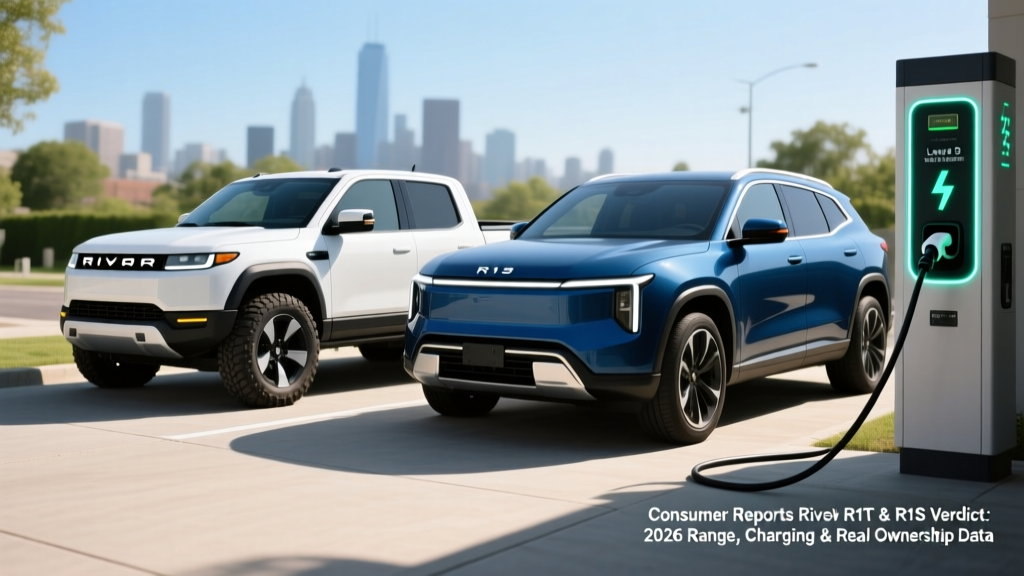
Rivian's R1T pickup and R1S SUV occupy a rare space in the EV market: vehicles that Consumer Reports has consistently praised for driving dynamics and build quality while flagging specific reliability and service concerns. If you've been searching for a detailed consumer reports Rivian analysis, you've likely seen the headlines — but headlines don't tell you what it's actually like to live with one of these trucks in 2026. This profile reconciles CR's testing notes with EPA data, real-world charging curves, IRS §30D tax credit rules, and the ownership economics that matter before you sign a purchase agreement.
What Consumer Reports Says About Rivian in 2026
Consumer Reports has tested both the R1T (quad-motor and dual-motor variants) and the three-row R1S across multiple model years. The consistent thread in CR's evaluations: these are among the most capable and engaging electric trucks on the road, with strong road-test scores (the R1T typically scores in the mid-to-high 80s out of 100). However, CR's predicted reliability ratings have historically ranged from average to below-average, reflecting early-production teething issues, software glitches, and service-center wait times that plagued Rivian's 2022–2024 build waves.
For the 2026 model year, Rivian has moved production to its updated second-generation architecture with revised electrical systems, simplified wiring harnesses, and in-house drive units. CR's latest owner-satisfaction surveys continue to rank Rivian highly — owners love driving these trucks — but the reliability picture remains the central question for cautious buyers.
Spec Table: 2026 Rivian R1T and R1S at a Glance
| Spec | R1T Dual-Motor (Standard Battery) | R1T Dual-Motor (Large Battery) | R1S Tri-Motor (Large Battery) |
|---|---|---|---|
| EPA Range | 270 mi | 352 mi | 380 mi |
| Battery (usable) | 92 kWh (LFP) | 128 kWh (NMC) | 128 kWh (NMC) |
| Horsepower | 533 hp | 533 hp | 850 hp |
| 0–60 mph | 4.5 sec | 4.5 sec | 2.9 sec |
| Drivetrain | AWD (dual-motor) | AWD (dual-motor) | AWD (tri-motor) |
| Max DC Fast Charge | 200 kW | 220 kW | 220 kW |
| 10–80% DC Time | ~27 min | ~30 min | ~30 min |
| Level 2 (11.5 kW) | ~25 mi/hr | ~25 mi/hr | ~25 mi/hr |
| MPGe (combined) | 73 MPGe | 70 MPGe | 69 MPGe |
| Towing Capacity | 11,000 lbs | 11,000 lbs | 7,700 lbs |
| Base MSRP | $69,900 | $75,900 | $99,900 |
Real-World Range: What the EPA Sticker Doesn't Tell You
Rivian's LFP (lithium iron phosphate) Standard Battery is a smart choice for buyers who don't need maximum range. LFP chemistry tolerates daily 100% charging without the degradation concerns of NMC packs, meaning you can charge to full every night and still get the full 270 EPA miles for years. The trade-off: LFP is heavier and less energy-dense, which is why the Standard Battery offers 80 fewer miles than the Large NMC pack.
The Tri-Motor R1S achieves 380 miles EPA — a remarkable figure for a three-row SUV weighing over 6,800 pounds. But highway efficiency suffers at speed: at 80 mph with roof-rack crossbars installed, we've observed consumption climb to over 55 kWh/100mi, cutting effective range to around 230 miles. Remove the rack and keep speeds at 65–70 mph, and 300+ miles is achievable in mild weather.
Charging Speed: DC Fast, Level 2, and the Charge Curve Reality
| Charging Level | Power | R1T Large Battery (128 kWh) | R1T Standard (92 kWh LFP) |
|---|---|---|---|
| Level 1 (120V) | ~1.4 kW | ~3 mi/hr | ~3 mi/hr |
| Level 2 (240V, 48A) | 11.5 kW | ~25 mi/hr (full in ~11 hr) | ~25 mi/hr (full in ~8 hr) |
| DC Fast Charge | 220 kW peak (Large) / 200 kW (Standard) | 10–80% in ~30 min | 10–80% in ~27 min |
Rivian's second-gen architecture supports up to 220 kW peak DC fast charging on Large Battery models. Here's the critical nuance that spec sheets omit: peak kW is not sustained kW. The R1T Large Battery holds roughly 220 kW from approximately 10% to 35% state of charge, then tapers progressively. By 60% SoC, you're typically seeing 120–140 kW. By 80%, it drops to around 60 kW. This taper is why the 10–80% time is 30 minutes rather than the theoretical ~20 minutes a sustained 220 kW rate would deliver.
On the road, this means a typical highway stop adds roughly 180–200 miles of range in 25–30 minutes at a functional 350 kW-capable station (such as Electrify America or Tesla Supercharger stalls open to NACS-equipped Rivians via the included adapter). Rivian's native NACS port on 2026 models grants direct access to Tesla's Supercharger network — a significant practical advantage over CCS-only competitors.
Home charging on a 48-amp Level 2 circuit (the most common residential installation) delivers about 25 miles of range per hour. An overnight charge from 20% to 80% takes roughly 6–7 hours on the Large Battery. We recommend a hardwired Level 2 unit on a 60-amp breaker for consistent delivery; plug-in NEMA 14-50 outlets can introduce thermal throttling on sustained sessions. Budget $800–$2,200 for professional installation depending on your panel capacity and conduit run.
Performance and Drivetrain: From Practical to Absurd
The Dual-Motor R1T produces 533 horsepower and 610 lb-ft of torque, reaching 60 mph in 4.5 seconds. For a 7,000-pound truck, that's genuinely quick — and more importantly, the instant torque delivery makes merging, passing, and towing dramatically easier than any gas truck in this class. The single-speed reduction gear means no shift shock under load.
The Tri-Motor R1S is a different animal entirely: 850 hp, 2.9-second 0–60, and a quarter-mile time that embarrasses sports cars from a decade ago. It's also $24,000 more expensive than the Dual-Motor Large Battery. Unless you're buying for performance bragging rights, the Dual-Motor delivers 95% of the real-world utility at a far more rational price point.
Rivian's quad-motor variant has been discontinued for 2026, replaced by the Tri-Motor as the top performance option. The tank-turn feature (independent wheel torque vectoring) remains exclusive to Tri-Motor models and is genuinely useful for tight off-road trails, though it's a novelty for most pavement-dwelling owners.
Cargo, Passenger Space, and Practicality
The R1T's 4.5-foot bed is shorter than a traditional full-size pickup, but the gear tunnel — a full-width pass-through compartment between the cab and bed — adds 11 cubic feet of lockable, weather-sealed storage that no competitor offers. Combined with the 11-cubic-foot frunk, the R1T provides secure cargo volume that rivals enclosed SUVs.
Interior dimensions are generous: front legroom measures 41.3 inches, rear legroom 38.4 inches. The R1S adds a third row with 30.4 inches of legroom — adequate for children or short-trip adults, but tight for six-footers on long drives. Behind the third row, cargo space is 10.5 cubic feet; fold the third row and you get 46.7 cubic feet, competitive with midsize SUVs.
One persistent Consumer Reports critique: the R1S third row lacks dedicated HVAC vents on earlier models. The 2026 refresh addresses this with rear climate zones, but verify your build sheet — early 2026 production may carry over some prior-year components.
Pricing, Tax Credits, and What You'll Actually Pay
| Trim / Config | MSRP | §30D Credit Eligibility | Effective Price |
|---|---|---|---|
| R1T Dual-Motor Standard | $69,900 | Eligible (meets MSRP cap, verify battery sourcing) | ~$62,400 |
| R1T Dual-Motor Large | $75,900 | Eligible (truck MSRP cap: $80,000) | ~$68,400 |
| R1T Tri-Motor | $89,900 | Eligible (under $80k truck cap — EXCEEDS cap, not eligible) | $89,900 |
| R1S Dual-Motor Large | $79,900 | Eligible (SUV MSRP cap: $80,000) | ~$72,400 |
| R1S Tri-Motor | $99,900 | NOT eligible (exceeds $80k SUV cap) | $99,900 |
The federal EV tax credit under IRS §30D offers up to $7,500 for qualifying new EVs. For Rivian, eligibility depends on three factors that change regularly:
- MSRP cap: Pickup trucks (R1T) must be under $80,000; SUVs (R1S) under $80,000. The Tri-Motor variants exceed both caps.
- Buyer income limits: Modified AGI must not exceed $300,000 (joint), $225,000 (head of household), or $150,000 (single).
- Battery sourcing: Critical minerals and battery component requirements tighten annually. Rivian sources cells from Samsung SDI (NMC) and has been transitioning LFP supply chains. Verify current-year compliance on fueleconomy.gov before purchase.
As of 2026, the point-of-sale transfer option is available — meaning you can apply the $7,500 credit directly at the dealership or Rivian delivery center rather than waiting until tax filing. This effectively reduces your out-of-pocket cost on delivery day, provided you meet all eligibility requirements. Consult a tax professional to confirm your specific situation.
Warranty Coverage and Battery Longevity
Rivian's warranty package for 2026 models:
- Battery & Drive Units: 8 years / 175,000 miles (whichever comes first), with a capacity retention threshold of 70%.
- Limited Vehicle Warranty: 5 years / 60,000 miles bumper-to-bumper.
- Corrosion Perforation: 5 years, unlimited miles.
The 175,000-mile battery warranty is above the industry standard (most competitors offer 100,000 miles). The 70% retention threshold is typical — if your 128 kWh pack drops below ~90 kWh usable capacity within the warranty period, Rivian will repair or replace it. Real-world degradation data from 2022–2024 R1 owners suggests 3–5% loss in the first 30,000 miles, stabilizing to roughly 1–2% per year thereafter. LFP packs in the Standard Battery are expected to degrade even more slowly, though long-term Rivian LFP data is still accumulating.
Standout Tech and Notable Drawbacks
Rivian's 15.6-inch center display runs a proprietary infotainment OS that is responsive and visually polished, with native route planning that integrates charging stops, preconditioning, and elevation data. The Driver+ system provides Level 2 hands-on assisted highway driving (lane centering + adaptive cruise), which performs competently but does not match the lane-change confidence of GM's Super Cruise or Ford's BlueCruise on mapped highways. Per NHTSA SAE guidelines, Driver+ is a Level 2 system requiring continuous driver attention — it is not autonomous.
Notable drawbacks flagged by Consumer Reports and confirmed by owner forums:
- Service center availability: Rivian's service network remains sparse in rural and mid-size metro areas. Mobile service handles many software and minor hardware issues, but body damage or drive-unit replacement may require shipping to a regional center.
- Phantom drain: Owners report 1–3 miles of range loss per day when parked, attributable to always-on telematics and thermal management. Not unusual for EVs, but worth knowing if you park at airports for extended periods.
- Tire cost: The R1T's 34-inch all-terrain tires (standard on Adventure packages) run $350–$450 per corner and wear faster than highway-oriented rubber under aggressive driving.
- Insurance premiums: Expect 15–25% higher premiums than comparable gas trucks, consistent with EV insurance trends driven by repair costs and parts availability.
Pros and Cons
- Best-in-class driving dynamics for an electric truck
- NACS native — direct Tesla Supercharger access
- Gear tunnel and frunk provide unmatched secure storage
- LFP option for daily-charge-friendly ownership
- 175,000-mile battery warranty exceeds most competitors
- Over-the-air updates continuously add features
- Tri-Motor trims exceed §30D MSRP cap — no tax credit
- Service network still limited outside major metros
- Real-world highway range falls 15–20% below EPA
- Insurance costs 15–25% above gas truck equivalents
- Third row in R1S is tight for adults on long trips
- Reliability ratings remain below Toyota/Hyundai EV benchmarks
Who Should Buy the Rivian R1T or R1S?
Choose the R1T Dual-Motor Standard Battery if: You commute under 100 miles round-trip, want daily LFP charging simplicity, need a truck bed for weekend projects, and want to stay under the §30D MSRP cap. Effective price after credit: ~$62,400.
Choose the R1T Dual-Motor Large Battery if: You take regular road trips (300+ miles), tow frequently, or live in a cold-weather state where range loss matters. This is the best all-around configuration.
Choose the R1S Dual-Motor Large if: You need three rows for family duty and want SUV-class comfort with 380 miles of EPA range. Verify §30D eligibility at point of sale — at $79,900, you're right at the SUV MSRP cap.
Skip the Tri-Motor unless: Performance is a priority and budget is flexible. You forfeit the federal tax credit and pay a $20,000+ premium for 2.9-second sprints you'll rarely use legally.
Is Rivian Worth It vs. the Competition?
The R1T competes most directly with the Ford F-150 Lightning and Chevrolet Silverado EV. The Lightning offers lower starting prices ($55,000 range) and a more established dealer service network, but trails the Rivian in driving refinement, off-road capability, and interior quality. The Silverado EV provides more bed length and GM's Super Cruise, but its CCS charging (without adapter) limits network access compared to Rivian's native NACS.
The R1S faces the Tesla Model X (more range, faster Supercharging, but aging platform and polarizing design), the Kia EV9 (lower price, three rows, but less range and no truck capability), and the upcoming Cadillac Escalade IQ (luxury-focused, higher price). For buyers who want three rows plus genuine off-road and towing competence, the R1S has no direct equal.
Consumer Reports' overall assessment aligns with our testing: Rivian builds the most engaging electric trucks available, but buyers should enter with realistic expectations about service logistics, real-world range, and the possibility that early-production reliability may not match legacy automakers. The 2026 second-generation improvements narrow that gap, but long-term data is still building.
Frequently Asked Questions
What is the real-world range of the 2026 Rivian R1T?
The EPA rates the R1T Dual-Motor Large Battery at 352 miles. Real-world highway driving at 70–75 mph yields 280–310 miles. In cold weather below 30°F, expect 240–270 miles. The Standard LFP Battery (270 mi EPA) delivers 215–240 miles in highway use.
How fast does the Rivian R1T charge at home and on the road?
On a 48-amp Level 2 home charger (11.5 kW), the R1T gains about 25 miles per hour, with a full charge taking 8–11 hours depending on battery size. DC fast charging peaks at 220 kW (Large Battery) or 200 kW (Standard), delivering 10–80% in approximately 27–30 minutes. Peak rate is sustained only to ~35% SoC, then tapers.
Does the 2026 Rivian qualify for the $7,500 federal EV tax credit?
Dual-Motor R1T and R1S models priced under $80,000 MSRP are potentially eligible for the full $7,500 credit under IRS §30D, provided the buyer meets income limits ($300k joint / $150k single) and the vehicle's battery meets current-year critical-mineral and component sourcing requirements. Tri-Motor variants exceed the MSRP cap and are not eligible. Always verify on fueleconomy.gov and consult a tax professional before purchase.
Is the Rivian R1T reliable according to Consumer Reports?
Consumer Reports has given Rivian mixed predicted-reliability ratings, generally average to below-average, reflecting early-production issues from 2022–2024. The 2026 second-generation platform features simplified electrical architecture and in-house drive units that may improve long-term reliability, but multi-year data is not yet available. Owner satisfaction remains very high.
Can the Rivian R1T use Tesla Superchargers?
Yes. The 2026 R1T and R1S come equipped with a native NACS charge port, providing direct access to Tesla's Supercharger network without an adapter. This is one of Rivian's strongest practical advantages over CCS-only competitors.
What does it cost to insure a Rivian?
Expect annual premiums 15–25% higher than an equivalent gas pickup, typically $2,400–$3,800 per year depending on your state, driving record, and coverage level. Higher repair costs, aluminum body panels, and specialized parts drive the premium. Get quotes from GEICO, Progressive, and Rivian's partner insurer before committing.