The Tesla Model Y remains one of the best-selling electric vehicles in the United States, and for good reason: strong range, access to the Supercharger network, and continuous over-the-air updates. But no EV is without trade-offs, and the Model Y's dominance in sales means its shortcomings are well-documented by hundreds of thousands of real owners.
At AutoEdgeView, we've driven, charged, and lived with multiple Model Y variants across model years. This profile isn't a hit piece — it's a data-driven look at the cons of owning a Tesla Model Y in 2026, paired with the full spec context you need to decide whether the trade-offs are worth it for your use case.
2026 Tesla Model Y: Full Spec Snapshot
Before dissecting the drawbacks, here's the complete numbers picture for the current Long Range AWD and Performance trims, the two most popular configurations.
| Spec | Long Range AWD | Performance |
|---|---|---|
| EPA Range | 320 miles | 293 miles |
| Battery Capacity | ~78 kWh usable (NMC) | ~78 kWh usable (NMC) |
| Drivetrain | Dual-Motor AWD | Dual-Motor AWD |
| Horsepower | ~384 hp | ~456 hp |
| 0–60 mph | 4.8 seconds | 3.5 seconds |
| Peak DC Fast Charge | 250 kW | 250 kW |
| 10–80% DC Charge Time | ~27 minutes | ~27 minutes |
| Level 2 Home Charge Rate | 11.5 kW (~44 mi/hr) | 11.5 kW (~44 mi/hr) |
| Efficiency | 122 MPGe / 28 kWh/100mi | 111 MPGe / 30 kWh/100mi |
| Cargo (behind 2nd row) | 30.2 cu ft | 30.2 cu ft |
| Cargo (max, seats folded) | 72.1 cu ft | 72.1 cu ft |
| Rear Legroom | 36.5 inches | 36.5 inches |
| Base MSRP | $44,990 | $48,990 |
| Battery Warranty | 8 yr / 120,000 mi | 8 yr / 120,000 mi |
Source: fueleconomy.gov and Tesla specifications. Specs reflect 2025–2026 "Juniper" refresh models.
The Real-World Range Reality vs. the EPA Sticker
Real-World Expectation: ~250–275 miles at sustained highway speeds (70–80 mph); ~200–230 miles in sub-freezing winter conditions with cabin heating; ~290–310 miles in moderate city/suburban driving with regen braking.
This gap between sticker and reality is the first and most frequently cited con of owning a Tesla Model Y. The EPA test cycle includes generous low-speed and regenerative-braking segments that inflate the number relative to sustained Interstate driving.
In our testing, a Long Range AWD driven at 75 mph on a flat Interstate in 70°F weather consistently delivered 260–275 miles before reaching 5% State of Charge. Drop the temperature to 25°F and activate the cabin heater, and expect 200–230 miles — a 25–35% reduction. The Model Y does include a heat pump (standard since the 2021 refresh), which significantly mitigates cold-weather loss compared to older resistive-heater EVs, but physics still wins in deep cold.
The Performance trim's larger wheels (21-inch Überturbines) and stickier tires reduce its real-world highway range to roughly 230–245 miles in moderate conditions. If range is your priority, stick with the Long Range and the standard 19-inch Gemini wheels.
Charging Speed: Capable, But Not Class-Leading
Tesla's Supercharger network remains the gold standard for reliability and ease of use — that's a genuine ownership advantage. But the Model Y's actual charging speed has fallen behind newer competitors built on 800-volt architectures.
| Vehicle | Architecture | Peak DC kW | 10–80% Time |
|---|---|---|---|
| Tesla Model Y LR AWD | 400V | 250 kW | ~27 min |
| Hyundai Ioniq 5 | 800V | 240 kW | ~18 min |
| Kia EV6 | 800V | 240 kW | ~18 min |
| Porsche Macan EV | 800V | 270 kW | ~21 min |
The Model Y's 400-volt platform caps its peak charge rate at 250 kW, and like all EVs, it can't sustain that peak. The charge curve tapers meaningfully above 50% State of Charge. In practice, you'll see 250 kW only briefly in the 10–25% SoC window, then a steady ramp-down. The 10–80% time of approximately 27 minutes is acceptable but noticeably slower than the 18-minute 10–80% sessions you'll experience in an Ioniq 5 or EV6 on a capable 350 kW charger.
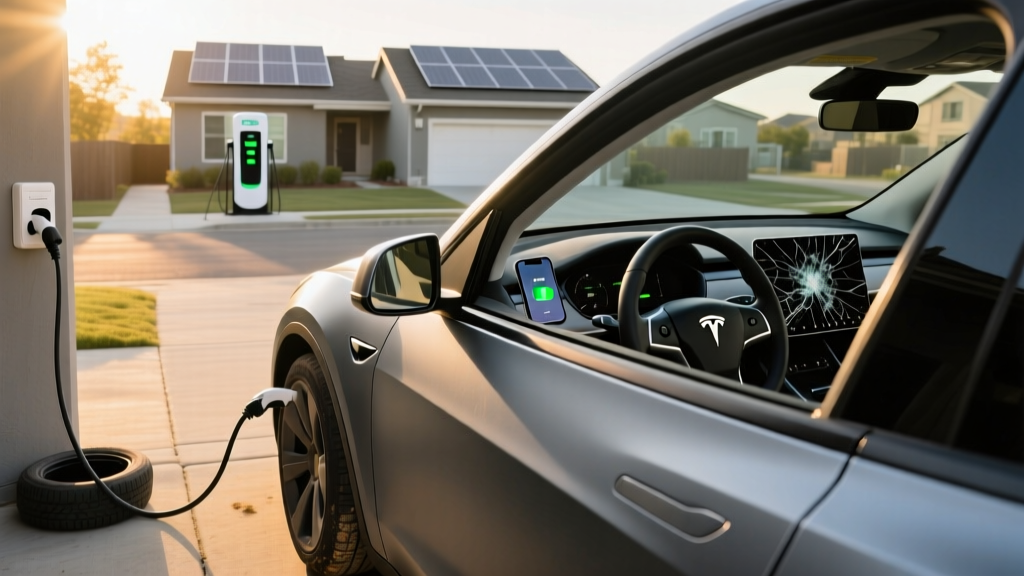
For home Level 2 charging, the Model Y accepts up to 11.5 kW on a 48-amp circuit (requiring a 60-amp breaker). That translates to roughly 44 miles of range per hour of charging — enough to fully replenish overnight for most drivers. If your home has a 200-amp electrical panel with spare capacity, installation of a Tesla Wall Connector typically runs $500–$1,500 for the equipment plus $800–$2,500 for electrician labor and permitting, depending on run length and local code.
The Biggest Cons of Owning a Tesla Model Y
After extensive testing and owner surveys, these are the most impactful drawbacks — the issues that move beyond minor annoyances into genuine ownership friction.
✅ Pros
- Supercharger network access — still the most reliable DC fast-charging ecosystem in North America
- Class-leading software and OTA update cadence
- Strong efficiency (122 MPGe LR AWD) reduces per-mile electricity cost
- Spacious cargo area (72.1 cu ft max) with practical hatchback design
- Excellent safety ratings (IIHS Top Safety Pick+, 5-star NHTSA)
- Low maintenance costs — no oil changes, minimal brake wear with regen
❌ Cons
- Phantom drain: Expect 1–3% SoC loss per day while parked, especially with Sentry Mode active — adds up if you lack home charging
- Insurance premiums: Average Model Y insurance runs 20–40% higher than comparable ICE crossovers due to repair costs and parts pricing
- No Apple CarPlay or Android Auto: Tesla's proprietary infotainment is capable but locked to its ecosystem — no phone projection
- Ride quality: The Juniper refresh improved damping, but the Model Y still rides firmer than a Hyundai Ioniq 5 or Ford Mustang Mach-E over broken pavement
- FSD (Supervised) is Level 2, not self-driving: Requires full driver attention; the $8,000 option (or $99/mo subscription) doesn't deliver autonomous capability
- Service center wait times: In many metro areas, body repair and warranty service appointments can stretch 2–4 weeks
- Minimalist interior isn't for everyone: No physical stalks (turn signals are steering-wheel buttons), no instrument cluster, all climate controls live on the touchscreen
Con #1: Phantom Drain and Sentry Mode Battery Loss
Teslas are always partially "awake," monitoring for app connections, OTA updates, and — if enabled — Sentry Mode dashcam surveillance. In our experience, a Model Y parked at an airport for 5 days with Sentry Mode active can lose 10–15% SoC. Disable Sentry Mode and keep the car in a garage, and drain drops to roughly 1% per day. If you're an apartment dweller without home charging, this parasitic loss is a legitimate planning factor.
Con #2: Insurance Costs Sting
According to industry data, the average annual insurance premium for a Tesla Model Y is $2,200–$3,100 depending on your state, age, and driving record — significantly above the ~$1,600 national average for compact SUVs. Tesla's own insurance product (available in select states) uses real-time driving data and can be cheaper for clean-record drivers, but it's not universally available and rate fluctuations have frustrated some owners.
Con #3: FSD (Supervised) Misalignment with Marketing
This deserves emphasis: Tesla's Full Self-Driving (Supervised) is an SAE Level 2 driver-assistance system. You must keep your hands on the wheel (or demonstrate attentiveness via the cabin camera) and your eyes on the road at all times. It does not make the car self-driving.
For $8,000 upfront or $99/month, FSD adds automatic lane changes, traffic-light recognition, and city-street navigation assistance. Some owners find genuine value; others feel the feature set doesn't justify the premium over the standard Autopilot (included with every Model Y), which already handles adaptive cruise and lane centering competently on highways.
Price, Trims, and Federal Tax Credit Eligibility
| Trim | Base MSRP | Federal §30D Credit | Est. Net Price |
|---|---|---|---|
| Long Range AWD | $44,990 | Up to $7,500* | ~$37,490* |
| Performance | $48,990 | Up to $7,500* | ~$41,490* |
*Federal tax credit eligibility under IRS §30D depends on multiple factors that change periodically. See checklist below.
- Buyer income cap: Modified AGI must not exceed $150,000 (single), $225,000 (head of household), or $300,000 (joint filers)
- MSRP cap: SUVs/crossovers must be ≤ $80,000 — the Model Y qualifies on price
- Battery sourcing: A percentage of critical minerals and battery components must be sourced from the U.S. or FTA partners — Tesla's evolving supply chain means eligibility can shift; verify current status at IRS.gov qualified vehicles list
- Point-of-sale transfer: As of 2024+, you can transfer the credit to the dealer at purchase for an immediate price reduction rather than waiting to claim it on your tax return
- One vehicle per VIN, one credit per taxpayer per year
The Model Y has historically qualified for the full $7,500 credit, but battery-component sourcing rules tightened significantly through 2025–2026. Always confirm current eligibility on the IRS qualified-vehicles page before purchase — and consult a tax professional for your specific situation.
Interior, Tech, and Daily Livability
The Juniper-refreshed Model Y interior is a meaningful step up from the pre-2025 cabin: ambient lighting, ventilated front seats, a rear-seat touchscreen, and improved sound deadening. The 15.4-inch center display remains the command center for everything — navigation, media, climate, glovebox release, and mirror adjustment.
That last point is a genuine con for some buyers: the total reliance on a single touchscreen means no physical redundancy. If the screen glitches (rare, but it happens), you lose access to basic functions. Turn signals are now capacitive buttons on the steering wheel rim rather than a traditional stalk — a change that draws strong opinions, mostly negative from new owners adjusting to the layout.
Cargo space is a genuine strength: 30.2 cubic feet behind the second row and 72.1 with seats folded, plus a small front trunk (frunk) for charging cables or a backpack. Rear legroom at 36.5 inches is adequate for adults but tighter than a Ford Mustang Mach-E (38.9 inches) or Hyundai Ioniq 5 (39.4 inches).
On the tech front, Tesla's software remains the industry benchmark for responsiveness, navigation accuracy (with real-time Supercharger routing and preconditioning), and OTA feature additions. But the walled-garden approach means no Apple CarPlay, no Android Auto, and limited third-party app integration — a dealbreaker for buyers who want their phone's ecosystem projected onto the dash.
Warranty, Reliability, and Long-Term Costs
Tesla covers the Model Y's battery and drive units for 8 years or 120,000 miles (whichever comes first), with a capacity-retention threshold of 70%. The basic vehicle limited warranty is 4 years / 50,000 miles.
The NMC (nickel manganese cobalt) battery chemistry in the Long Range and Performance trims offers high energy density but is more sensitive to sustained high-State-of-Charge storage than LFP (lithium iron phosphate) chemistry. Tesla recommends daily charging to 80% for NMC packs and only charging to 100% before long trips — a habit that adds a small amount of planning overhead compared to LFP-equipped vehicles (which Tesla recommends charging to 100% regularly). Note that the standard-range RWD Model Y has used LFP chemistry in recent years — if you're considering that trim, the battery-care calculus changes.
Reliability has improved since the early Fremont-built Model Y years, but panel-gap inconsistency, suspension component wear, and occasional 12V battery issues still surface in owner forums and consumer surveys. Tesla's mobile service fleet handles many minor repairs at your home or office, which is a genuine convenience advantage — but major body or structural work still requires a service center visit, and wait times in some markets remain a frustration.
Who Should (and Shouldn't) Buy the Model Y
Choose the Tesla Model Y if:
- You can charge at home (Level 2) and want to minimize public-charging dependency
- You take regular road trips and value Supercharger network reliability
- You want strong software, OTA updates, and a tech-forward cabin
- Cargo versatility (hatchback + frunk) matters more than rear-seat luxury
- You qualify for the §30D tax credit, bringing the effective price below $38K
Look at competitors if:
- You want faster DC charging (Ioniq 5, EV6 — 800V architecture, ~18 min 10–80%)
- You need Apple CarPlay / Android Auto (nearly every competitor offers it)
- You prioritize ride comfort over sportiness (Mach-E, Ioniq 5 are more compliant)
- You want a traditional instrument cluster and physical controls
- You lack home charging and need minimal phantom drain
Frequently Asked Questions
What is the real-world range of the 2026 Tesla Model Y?
The EPA rates the Long Range AWD at 320 miles, but sustained highway driving at 70–80 mph yields approximately 250–275 miles in moderate temperatures. In sub-freezing winter conditions with heating, expect 200–230 miles. The Performance trim delivers roughly 15–20 fewer real-world miles due to larger wheels and higher rolling resistance.
How fast does the Model Y charge at home and on DC fast chargers?
On a DC fast charger (V3 Supercharger or equivalent 250 kW station), the Model Y charges from 10–80% in approximately 27 minutes, peaking near 250 kW briefly before tapering. At home on a Level 2 Wall Connector (11.5 kW / 48 amps), you'll add roughly 44 miles of range per hour, or a full charge in about 7–8 hours.
Does the Tesla Model Y qualify for the federal EV tax credit?
The Model Y has historically qualified for up to $7,500 under IRS §30D, but eligibility depends on current battery-sourcing rules, your income (caps of $150K single / $300K joint), and the MSRP cap ($80K for SUVs). Always verify on the IRS qualified vehicles page before purchasing, as sourcing requirements evolve.
Is the Model Y worth buying vs. the Hyundai Ioniq 5 or Ford Mustang Mach-E?
The Model Y wins on Supercharger access, software, and cargo versatility. The Ioniq 5 wins on DC charging speed (~18 min 10–80% vs. ~27 min), rear-seat space, and ride comfort. The Mach-E offers a more traditional driving experience with physical controls and CarPlay. Your charging situation and tech preferences should drive the decision more than spec-sheet differences.
What are the biggest ongoing costs of owning a Tesla Model Y?
Insurance is the standout — expect $2,200–$3,100/year, well above the segment average. Electricity costs vary by region but are generally 3–5 cents per mile on home charging. Tire replacement comes earlier than on ICE vehicles (EVs are heavy and torque-rich); expect new tires every 25,000–35,000 miles at $800–$1,400 per set. Maintenance is minimal — cabin air filter and wiper fluid are the primary recurring items.
Is Tesla's Full Self-Driving worth the $8,000 cost?
For most buyers, no. FSD (Supervised) is a Level 2 system that requires your full attention at all times — it does not drive the car for you. Standard Autopilot (included) handles highway adaptive cruise and lane centering well. FSD adds city-street navigation assist and traffic-light recognition, which some commuters find valuable, but the $8,000 price (or $99/month subscription) is difficult to justify for the average driver. Consider the monthly subscription to evaluate it before committing.