Quick Answer: What Are the Main Cons of Electric Vehicles?
The primary drawbacks of EVs in 2026 are: (1) higher upfront purchase price — the average new EV transaction price sits around $53,000 vs. ~$47,000 for gas cars; (2) charging access limitations — roughly 30% of US households lack reliable home-charging capability; (3) cold-weather range loss of 20–35% below freezing; (4) higher insurance premiums averaging 15–25% more than equivalent gas models; and (5) steeper depreciation on non-Tesla models, averaging 45–55% over three years vs. ~35% for gas counterparts. However, lower fueling and maintenance costs offset many of these over 5+ years of ownership.
The Upfront Cost Reality: Sticker Price vs. Tax Credit Savings
Let's start with the number that stops most first-time EV buyers cold: the purchase price. Despite price cuts across the industry, battery-electric vehicles still command a premium over internal combustion equivalents. Consider a practical comparison:
| Model | Powertrain | Base MSRP | Fed. Credit Eligibility | Net Effective Price |
|---|---|---|---|---|
| Hyundai Ioniq 5 SEL | BEV (77.4 kWh NMC) | $43,600 | $7,500 (§30D)* | ~$36,100 |
| Toyota RAV4 XLE | Gas (2.5L I4) | $32,600 | $0 | $32,600 |
| Toyota RAV4 Prime SE | PHEV (18.1 kWh) | $44,500 | $7,500 (§30D)* | ~$37,000 |
*Per IRS §30D rules, the $7,500 credit requires: vehicle MSRP under $55,000 (cars) or $80,000 (SUVs/trucks), buyer AGI under $150K single / $300K joint, and compliance with critical-mineral and battery-component sourcing thresholds that tighten annually. Not every EV qualifies — always verify on the IRS approved-vehicles list before purchasing. The credit can be transferred at point-of-sale as a discount.
Even with the full $7,500 credit applied, the Ioniq 5 SEL still costs roughly $3,500 more than a well-equipped RAV4 XLE. That gap narrows over time through fuel and maintenance savings, but if your budget is strict and you need a vehicle today, the higher entry price is a genuine barrier. Buyers who don't qualify for the credit due to income caps or vehicle sourcing requirements face the full sticker premium.
Charging Access: The Biggest Practical Hurdle
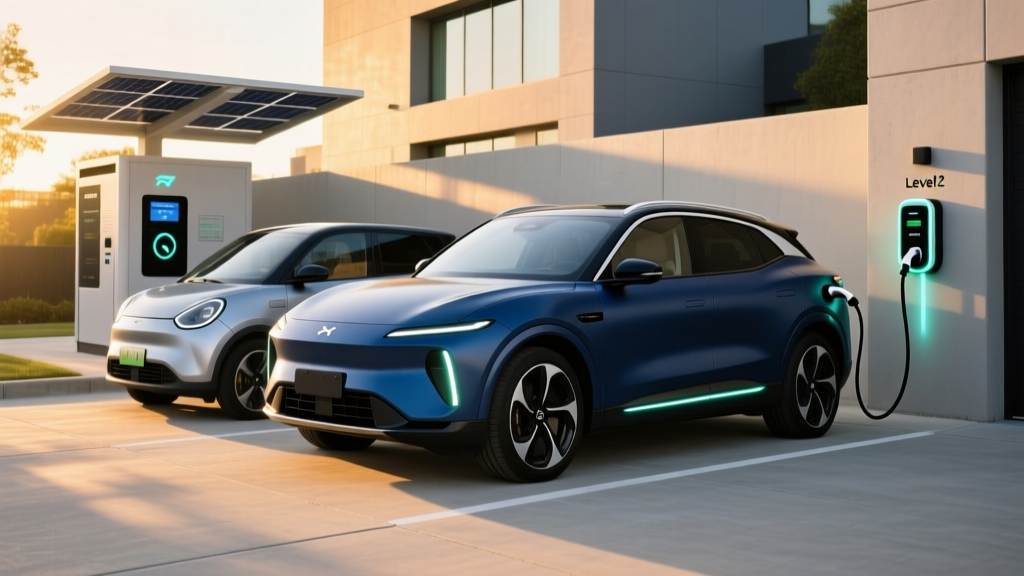
Home charging is the backbone of convenient EV ownership — plug in overnight, wake up to a full battery, and rarely visit a public station. But not everyone can do this. According to DOE estimates, roughly 30% of US households rent, live in multi-unit dwellings, or lack a dedicated parking space with electrical access. If you fall into that category, EV ownership shifts from effortless to logistically complex.
Real-world charging costs and times vary dramatically by method:
| Charging Method | Power (kW) | Miles Added/Hour | Cost per kWh | Cost per 300 mi (avg) |
|---|---|---|---|---|
| Level 1 (120V outlet) | 1.4 kW | ~4 mi/hr | $0.14 (home avg) | ~$12.60 |
| Level 2 (240V home) | 7.7–11.5 kW | ~25–37 mi/hr | $0.14 (home avg) | ~$12.60 |
| DC Fast (public) | 50–350 kW | ~180–800 mi/hr | $0.35–$0.55 | ~$31.50–$49.50 |
| Gas car (30 MPG, $3.40/gal) | N/A | N/A | $0.11/mi | ~$34.00 |
Home Level 2 charging is the cheapest option — often 3–4 cents per mile. But if you rely exclusively on public DC fast charging, your per-mile cost can actually exceed that of a gas car. A 300-mile fill on Electrify America or EVgo at $0.48/kWh averages around $42 for an EV getting 3.5 mi/kWh, compared to $34 for a 30-MPG gas car. This is the reality for apartment dwellers and frequent road-trippers alike.
Installation of a home Level 2 charger adds another variable. A straightforward 240V/50-amp circuit with a ChargePoint Home Flex or Wallbox Pulsar Plus typically runs $800–$2,000 installed, but older homes may need an electrical panel upgrade ($1,500–$3,500 additional) if the existing panel is 100-amp or near capacity. Factor this into your first-year budget.
Range and Cold-Weather Loss: What the EPA Sticker Doesn't Tell You
EPA range estimates are measured under controlled conditions that don't fully capture highway driving at 75+ mph, extreme temperatures, or heavy cargo loads. Every EV owner should mentally discount the sticker range by 15–25% for realistic expectations — and more in cold climates.
Real-World Range Expectations (2026 Models)
| Vehicle | EPA Range | Highway (70 mph, 68°F) | Cold Weather (20°F, mixed) |
|---|---|---|---|
| Tesla Model Y LR (AWD) | 320 mi | ~275 mi | ~225 mi |
| Hyundai Ioniq 5 LR (RWD) | 303 mi | ~260 mi | ~210 mi |
| Ford Mustang Mach-E ER (AWD) | 290 mi | ~250 mi | ~200 mi |
| Chevrolet Equinox EV RS | 319 mi | ~270 mi | ~220 mi |
Cold-weather figures assume heat-pump-equipped vehicles. Models without heat pumps (some older base trims) can see 35–40% range reduction in sub-freezing conditions due to resistive heating draw.
Battery chemistry also plays a role. Lithium iron phosphate (LFP) batteries — found in base Tesla Model 3/Y and some Ford models — offer excellent longevity and can be charged to 100% daily without accelerated degradation, but they suffer slightly more cold-weather range loss than NMC (nickel manganese cobalt) packs. NMC batteries offer higher energy density (more range per pound) but are typically recommended to charge only to 80% for daily use to maximize lifespan.
Charging speed itself is affected by temperature. A cold battery at a DC fast charger may accept only 40–60 kW initially, ramping up as the thermal management system warms the cells. Preconditioning — available on most 2026 models when you navigate to a charger — mitigates this, but forgetting to precondition in winter means sitting at a stall for 45 minutes instead of 20. Per fueleconomy.gov, battery efficiency drops measurably in cold temperatures due to increased internal resistance and cabin-heating demands.
Insurance, Depreciation, and Long-Term Ownership Costs
EV insurance premiums remain stubbornly higher than gas-car equivalents. Industry data from 2025–2026 shows average EV premiums running 15–25% above comparable ICE models. The reasons are straightforward: higher repair costs after collisions (specialized labor, expensive battery packs, sensor recalibration), and higher total-loss payouts due to elevated MSRP. A Tesla Model Y might cost $2,400–$3,000/year to insure, while a gas RAV4 averages $1,800–$2,200/year depending on your state and driving record.
Depreciation is where many non-Tesla EVs take the hardest hit. Early-adopter demand has cooled, the used-EV market is saturated with off-lease models, and rapid price cuts on new EVs have cascaded into used values. Three-year depreciation for mainstream EVs (Hyundai, Ford, VW, Kia) averages 45–55%, compared to ~35% for mainstream gas vehicles. Tesla holds value better (~35–40% depreciation over 3 years) due to Supercharger network exclusivity and strong brand loyalty, but even Tesla resale values have softened since 2023.
| Cost Category | EV (e.g., Ioniq 5 SEL) | Gas (e.g., RAV4 XLE) | Difference |
|---|---|---|---|
| Purchase (after credit) | $36,100 | $32,600 | +$3,500 EV |
| Fuel/Charging (5 yrs, 60K mi) | $4,200 (home L2) | $6,800 | −$2,600 EV |
| Maintenance (5 yrs) | $1,800 | $3,500 | −$1,700 EV |
| Insurance (5 yrs) | $13,000 | $10,000 | +$3,000 EV |
| Depreciation (5 yrs) | $18,000 | $12,500 | +$5,500 EV |
| Total 5-Year Cost | $73,100 | $65,400 | +$7,700 EV |
This comparison is illustrative, not universal. If you have free or subsidized workplace charging, drive fewer than 10,000 miles/year (reducing the fuel savings gap), or live in a state with high gas prices (California, Hawaii), the math shifts in the EV's favor. The key insight: EVs save on fuel and maintenance but lose on insurance, depreciation, and upfront cost. The break-even point typically arrives around year 7–8 for most owners, not year 3.
Public Charging Reliability and Road-Trip Friction
The US public charging network has expanded significantly — there are now over 200,000 public charging ports nationwide — but reliability remains inconsistent. Studies from J.D. Power and consumer surveys consistently show that 15–20% of non-Tesla DC fast charging sessions encounter issues: broken connectors, payment-system failures, stalls delivering far below rated power, or chargers occupied by non-EVs (ICE-ing).
Tesla Superchargers remain the gold standard for reliability, with uptime rates above 99% and consistent charge delivery. The opening of Superchargers to non-Tesla vehicles via the NACS connector and Magic Dock adapter has improved the landscape, but many non-Tesla EVs still require adapters or rely on networks like Electrify America, EVgo, and ChargePoint where experiences vary by location. NACS is becoming the universal standard — most major automakers have adopted it for 2025+ models — but the transition period means some 2024–2025 CCS-equipped vehicles need a CCS-to-NACS adapter ($200–$250) for full network access.
Road-trip planning also demands more forethought than a gas car. You'll need to map charging stops using apps like A Better Routeplanner or PlugShare, account for 20–35 minute charge sessions every 200–250 miles, and have a backup plan if a station is offline. For frequent long-distance travelers, this friction is real — even if it's manageable for the 90% of driving that's local.
Common EV Misconceptions vs. Facts
| Myth | Fact |
|---|---|
| "EV batteries need replacing every 5 years" | Federal law mandates 8-year/100,000-mile battery warranties. Real-world data shows most packs retain 85–90% capacity at 150,000 miles. Replacement costs $8,000–$20,000 but is rarely needed in the vehicle's lifetime. |
| "EVs are worse for the environment" | Even on coal-heavy grids, lifecycle emissions are 50–70% lower than gas cars per EPA analysis. On cleaner grids, the advantage is 70–85%. |
| "The grid can't handle mass EV adoption" | Most charging happens overnight during off-peak hours. Utilities are upgrading infrastructure proactively, and smart-charging/V2G tech spreads load. Grid strain is a regional planning issue, not an immediate crisis. |
| "EVs are slow and boring to drive" | Even mainstream EVs deliver instant torque — a base Model 3 RWD hits 0–60 in 5.8 seconds; an Ioniq 5 in 5.0 seconds. Performance EVs rival supercars. |
| "I can't tow or haul with an EV" | The F-150 Lightning tows 10,000 lbs; Rivian R1T tows 11,000 lbs. However, towing cuts range by 30–50% due to aerodynamic drag and weight. |
Decision Framework: Should You Buy an EV, Hybrid, or Gas Car?
Choose a Battery EV If:
- You have reliable home Level 2 charging (garage, driveway, or workplace charger)
- Your daily commute is under 80 miles round-trip
- You qualify for the §30D tax credit (check income caps and vehicle eligibility on irs.gov)
- You plan to keep the vehicle 7+ years (amortizing the higher upfront cost)
- You live in a mild or moderate climate, or your EV has a heat pump
Choose a Plug-In Hybrid (PHEV) If:
- You want electric-only commuting (25–45 miles) but need gas flexibility for road trips
- You lack reliable home charging but can plug in occasionally
- You live in a cold climate where EV range loss is a major concern
- You want lower upfront cost with some fuel savings (e.g., RAV4 Prime at 42 mi electric, 38 MPG gas)
Choose a Gas/HEV Car If:
- You have zero home or workplace charging access
- You frequently tow heavy loads or drive 300+ miles between stops in rural areas
- Your annual mileage is very low (under 6,000 miles), negating fuel savings
- You plan to keep the vehicle under 4 years (depreciation penalty won't be recovered)
What First-Time EV Buyers Must Know Before Signing
If you've decided an EV makes sense for your situation, here are the non-obvious ownership realities that catch new buyers off guard:
- kW vs. kWh — learn the difference. kWh measures battery capacity (how much energy the "tank" holds — e.g., 77.4 kWh). kW measures charging power (how fast energy flows — e.g., 250 kW peak). A bigger kWh battery takes longer to fill at the same kW rate.
- Charge curves matter more than peak kW. A vehicle advertising "250 kW peak charging" may sustain that rate for only 5 minutes before tapering to 100 kW, then 50 kW above 80% SoC. What matters is 10–80% charge time: a good 2026 EV adds 200+ miles in 20 minutes at a compatible DC fast charger.
- Tire costs are higher. EVs are heavy (4,000–5,500 lbs) and deliver instant torque, wearing tires 20–30% faster than gas cars. Budget $800–$1,400 for a set of EV-rated tires every 30,000–40,000 miles.
- Regenerative braking changes your driving. Most EVs offer adjustable regen, and many drivers adopt one-pedal driving — lifting off the accelerator slows the car significantly, recapturing energy. It takes 1–2 weeks to adapt but reduces brake wear dramatically (brake pads often last 100,000+ miles).
- Precondition before fast charging. Always navigate to your DC fast charger using the car's built-in nav, even if you know the route. This triggers battery preconditioning, warming the pack for optimal charge acceptance and shaving 10–15 minutes off your session in cold weather.
Do EVs really cost more to own than gas cars?
Over 5 years, most EVs cost $5,000–$10,000 more in total ownership due to higher purchase price, insurance, and depreciation — even with the $7,500 tax credit. The break-even point typically arrives at year 7–8, driven by cumulative fuel and maintenance savings. If you keep your cars 10+ years, an EV usually wins on total cost. If you trade every 3–4 years, gas or hybrid often costs less overall.
What happens if an EV battery fails out of warranty?
Complete battery failure is rare. More common is gradual degradation — most packs retain 85–92% of original capacity at 150,000 miles. If a pack does fail post-warranty, replacement costs $8,000–$20,000 depending on the vehicle and pack size. Third-party repair shops increasingly offer module-level repairs for $2,000–$5,000 instead of full-pack replacement. Federal law requires a minimum 8-year/100,000-mile battery warranty covering defects and excessive capacity loss (typically below 60–70% of original capacity).
Is a used EV a good way to avoid the high upfront cost?
A used EV can be a smart buy, but with caveats. The federal used-EV credit (§25E) offers up to $4,000 (30% of sale price) on vehicles priced under $25,000 from a dealer, with buyer income caps of $75K single / $150K joint. Check battery State of Health (SoH) via the car's diagnostics or a third-party scan before purchasing — anything above 85% SoH is generally healthy. Avoid used EVs with no battery health data or those from defunct brands (e.g., early Fisker models).
How do I know if my home electrical panel can handle a Level 2 charger?
A Level 2 charger on a 50-amp circuit draws 40 amps continuous (48 amps for a 60-amp circuit). Most modern 200-amp panels have sufficient capacity, but older 100-amp panels may need upgrading — especially if you also run electric heat, a dryer, and an oven simultaneously. A licensed electrician can perform a load calculation to determine if your panel supports a charger or needs a $1,500–$3,500 upgrade. Never skip the permit — unpermitted electrical work can void homeowners insurance.