Quick Verdict: Which Tesla Fits Your Life?
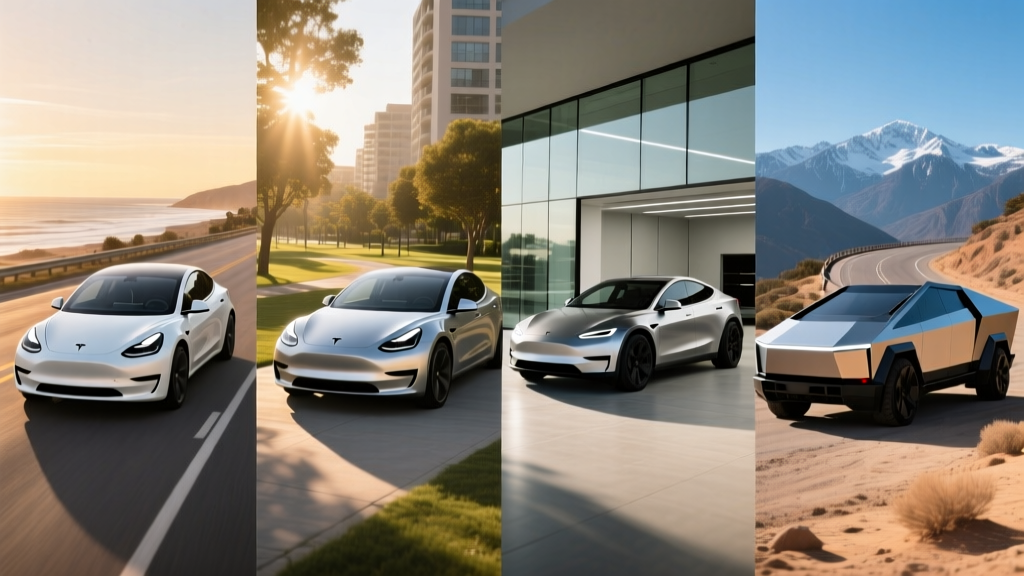
If you're comparing Tesla models in 2026, the decision tree is shorter than it looks. The Model 3 is the efficiency and value pick for commuters. The Model Y dominates family duty with cargo space and Juniper refinements. The Model S remains the performance-and-range flagship. The Model X serves niche three-row buyers who want falcon-wing drama. And the Cybertruck exists for those who need a pickup bed and don't mind polarizing sheet metal. Below, we break down every current Tesla with exact EPA numbers, real-world caveats, charging curves, and current §30D tax credit realities so you can buy on data, not hype.
| Model / Trim | EPA Range | Battery (kWh / Chem) | 0–60 mph | HP | Drivetrain | Base MSRP |
|---|---|---|---|---|---|---|
| Model 3 RWD | 272 mi | ~60 / LFP | 5.8 s | 271 | RWD | $38,990 |
| Model 3 Long Range AWD | 341 mi | ~79 / NMC | 4.2 s | 346 | Dual-Motor AWD | $42,490 |
| Model 3 Performance | 315 mi | ~79 / NMC | 2.9 s | 510 | Dual-Motor AWD | $52,990 |
| Model Y Long Range AWD | 320 mi | ~79 / NMC | 4.8 s | 384 | Dual-Motor AWD | $44,990 |
| Model Y Performance | 285 mi | ~79 / NMC | 3.5 s | 456 | Dual-Motor AWD | $51,490 |
| Model S Long Range | 402 mi | ~100 / NMC | 3.1 s | 670 | Dual-Motor AWD | $79,990 |
| Model S Plaid | 359 mi | ~100 / NMC | 1.99 s | 1,020 | Tri-Motor AWD | $89,990 |
| Model X Long Range | 335 mi | ~100 / NMC | 3.8 s | 670 | Dual-Motor AWD | $84,990 |
| Cybertruck AWD | 340 mi | ~123 / NMC (est.) | 4.1 s | 600 | Dual-Motor AWD | $79,990 |
Sources: EPA / fueleconomy.gov, Tesla.com. MSRP excludes destination. Specs reflect 2025–2026 model-year data available at publication.
Real-World Range vs. the EPA Sticker
The EPA number is a laboratory composite. Real-world range depends on speed, temperature, elevation, and HVAC load. Here's how each model translates when you leave the test cycle behind.
Model 3 Long Range AWD
EPA: 341 miles | Real-world highway (70 mph, 68°F): ~290–310 miles | Cold weather (30°F, highway): ~240–265 miles
The Model 3 LR's heat pump and low drag coefficient (Cd 0.219) help it hold range better than most EVs in cold conditions, but any EV loses 15–30% at sustained highway speeds in freezing temps. City driving with regen braking can actually exceed the EPA combined figure in mild weather.
Model Y Long Range AWD
EPA: 320 miles | Real-world highway: ~270–290 miles | Cold weather highway: ~225–250 miles
The Juniper-refreshed Model Y has improved thermal management and a slightly more aero profile than pre-2025 models, but its taller crossover body means more drag at 75+ mph. Expect a 10–15% deficit vs. the Model 3 LR on the same route.
Model S Long Range
EPA: 402 miles | Real-world highway: ~340–365 miles | Cold weather highway: ~290–320 miles
The Model S's ~100 kWh pack is the largest in Tesla's current lineup and gives it the longest legs. On a flat, temperate interstate at 70 mph, 350+ miles is achievable. Mountain passes and headwinds will cut that.
Cybertruck AWD
EPA: 340 miles | Real-world highway: ~280–300 miles | Towing (5,000 lb trailer): ~170–190 miles
Despite stainless-steel panels, the Cybertruck's angular shape creates significant aero drag at highway speeds. Towing range drops roughly 40–50%, consistent with every EV truck on the market. Plan charging stops accordingly.
Charging Speed: DC Fast, Level 2, and the Curve Reality
Peak kW is a headline number. Sustained kW over the 10–80% window is what actually matters on a road trip. Tesla's V4 Superchargers (now rolling out widely) and the legacy V3 network both deliver strong charge curves, but taper is real above 80% State of Charge.
| Model | Max DC kW | 10–80% Time | Level 2 Rate (kW) | Mi/Hr at L2 (240V) |
|---|---|---|---|---|
| Model 3 (all trims) | 250 kW | ~25 min | 11.5 kW | ~44 mi/hr |
| Model Y (all trims) | 250 kW | ~27 min | 11.5 kW | ~40 mi/hr |
| Model S / X | 250 kW | ~30 min | 11.5 kW | ~35 mi/hr |
| Cybertruck | 250 kW (V3) / 350 kW (V4 capable) | ~25 min (est.) | 11.5 kW | ~32 mi/hr |
Times assume battery preconditioning is active (navigation routed to a Supercharger). Without preconditioning, add 5–10 min in cold weather.
Preconditioning matters. When you navigate to a Supercharger in the Tesla app or in-car nav, the car warms the battery to optimal temperature before you arrive. Skip this step in winter and your peak charge rate may be cut in half for the first several minutes. All current Teslas use the NACS (North American Charging Standard) connector natively — the same port now adopted by Ford, GM, Rivian, and most major automakers. This gives Tesla owners access to the Supercharger network plus, increasingly, cross-brand compatibility.
Home charging: A Tesla Wall Connector on a 60-amp circuit delivers up to 11.5 kW (48 amps continuous). Most owners charge overnight from 20–80%, which takes roughly 4–5 hours for a Model 3 LR — more than enough for daily replenishment. A standard 120V outlet (Level 1) adds only ~3–4 miles per hour and is best reserved for emergency trickle or low-mileage commuters.
Performance, Drivetrains, and the Tri-Motor Question
Tesla's dual-motor AWD setup is standard on Long Range and Performance trims across the lineup. The Model S Plaid and Cybertruck Cyberbeast use a tri-motor configuration (one front, two rear) for torque vectoring and absurd acceleration.
The Model 3 Performance (2.9 s 0–60) is arguably the best performance-per-dollar sedan in existence. The Model S Plaid (1.99 s) remains one of the quickest production cars ever built, though its $89,990 price and 359-mile EPA range (lower than the LR due to performance tires and tuning) make it a specialty purchase.
For most buyers, the dual-motor AWD Long Range trims offer the right balance: sub-5-second 0–60 times, confident all-weather traction, and the longest range in each model line. RWD is only available on the base Model 3, and it's a perfectly adequate commuter setup if you live in a mild climate and don't need the extra range or traction.
Pricing, Trims, and Federal Tax Credit Eligibility
Tesla's pricing shifts frequently — sometimes monthly — so treat these MSRPs as a snapshot. The critical question for most buyers is whether a given model qualifies for the §30D federal EV tax credit (up to $7,500), which as of 2026 can be applied as a point-of-sale rebate through a registered dealer.
| Model / Trim | Base MSRP | §30D Eligible? | Effective Price (est.) |
|---|---|---|---|
| Model 3 RWD | $38,990 | Yes (partial or full, sourcing-dependent) | ~$31,490–$38,990 |
| Model 3 Long Range | $42,490 | Yes (partial or full) | ~$34,990–$42,490 |
| Model 3 Performance | $52,990 | Yes (under $55k sedan cap) | ~$45,490–$52,990 |
| Model Y Long Range | $44,990 | Yes (partial or full) | ~$37,490–$44,990 |
| Model Y Performance | $51,490 | Yes (under $80k SUV cap) | ~$43,990–$51,490 |
| Model S Long Range | $79,990 | No (exceeds $55k sedan cap) | $79,990 |
| Model S Plaid | $89,990 | No | $89,990 |
| Model X Long Range | $84,990 | No (exceeds $80k SUV cap for some configs) | $84,990 |
| Cybertruck AWD | $79,990 | Likely (under $80k truck cap) | ~$72,490–$79,990 |
§30D Eligibility Checklist (2026 Rules)
- MSRP cap: Sedans ≤ $55,000; SUVs, vans, and trucks ≤ $80,000
- Buyer income cap: AGI ≤ $150,000 (single), $225,000 (head of household), $300,000 (joint)
- Battery sourcing: Critical minerals and battery components must meet phased-in domestic/free-trade thresholds — the full $7,500 requires both halves satisfied; partial credit ($3,750) if only one is met
- Point-of-sale transfer: Available through registered dealers — reduces purchase price at signing rather than waiting for tax filing
- Verification: Always check IRS qualified vehicle list before purchasing — sourcing rules change quarterly
Consult a tax professional for your specific situation. State and local incentives vary by jurisdiction and are not included above.
Interior, Cargo, and Tech: Where Each Model Wins (and Falls Short)
Model 3 (Highland Refresh)
The refreshed Model 3 interior is significantly quieter and more refined than pre-2024 versions, with ventilated front seats, ambient lighting, and a rear touchscreen for passengers. Cargo: 23 cu ft trunk + rear-seat fold. No frunk in RWD; small frunk in AWD trims. The minimalist interior is polarizing — no turn-signal stalk (buttons on the wheel), no instrument cluster. Everything routes through the 15.4" center display.
Model Y (Juniper Refresh)
The 2025–2026 Juniper refresh brought a redesigned interior with improved materials, a rear touchscreen, ventilated seats, and a power-folding second row. Cargo: 30 cu ft behind the second row, 72 cu ft with seats folded — the most practical EV crossover for families. A small frunk adds ~4 cu ft. The 15.4" center screen handles everything. Ride quality is noticeably improved over the prior generation.
Model S
The Model S still offers the most premium Tesla interior: a 17" landscape center screen, a 12.3" instrument cluster, a rear passenger touchscreen, and available yoke steering. Cargo: 28 cu ft rear + a usable frunk. The 22-speaker audio system is one of the best in any car at any price. Downsides: the platform dates to 2012 (refreshed 2021), and some interior panel gaps and switchgear feel dated vs. newer competitors like the Lucid Air or BMW i5.
Model X
Falcon-wing rear doors are the headline, and they genuinely help with car-seat loading in tight spaces. Available in 5-, 6-, or 7-seat configurations. Cargo: up to 88 cu ft with seats folded. The panoramic windshield is stunning. Downsides: the falcon-wing doors can be slow in rain, the second-row seats don't fold completely flat, and the ~$85K starting price is steep for what's fundamentally a Model S platform with more room.
Cybertruck
The stainless-steel exoskeleton and 6.5-foot bed are unique in the EV space. The interior is spartan but functional, with an 18.5" front screen and a 9.4" rear screen. The bed offers 67 cu ft of lockable storage plus a front trunk (frunk) and sail-pillar storage. Towing: 11,000 lbs max. Downsides: visibility is compromised by the thick A-pillars and small rear window, the bed is shorter than a full-size truck, and the angular design limits garage compatibility (it's 79.8" wide with mirrors).
Driver Assistance: Autopilot and FSD (Supervised)
SAE Automation Level: Level 2
All Tesla driver-assistance features — including Basic Autopilot, Enhanced Autopilot, and Full Self-Driving (Supervised) — are SAE Level 2 systems. The driver must remain fully engaged, hands on the wheel (or providing steering-torque input), and eyes on the road at all times. These are not autonomous systems. Only Level 4 services like Waymo operate without a human driver, and those are limited to specific geofenced areas.
Tesla's FSD (Supervised) has improved substantially through 2025–2026 via its end-to-end neural network approach, handling complex urban intersections, lane changes, and highway merges with increasing competence. However, it still requires active supervision and can make unexpected decisions in construction zones, unusual intersections, or adverse weather. It costs $8,000 as a one-time purchase or $99/month — a significant add-on that should be evaluated during a test drive, not assumed.
Basic Autopilot (included on all Teslas) provides competent highway lane-centering and adaptive cruise control. For most buyers, this is sufficient. Enhanced Autopilot ($6,000) adds auto lane-change, navigate-on-autopilot, and smart summon — useful but not essential.
⚠️ What FSD (Supervised) Does NOT Do
- Drive the car without a licensed, attentive driver in the seat
- Handle all weather conditions (heavy rain, snow, fog degrade performance)
- Obey every temporary traffic control device (hand-held signs, flaggers)
- Replace your auto insurance requirement or liability as the driver
Efficiency, Warranty, and Total Ownership Picture
Tesla vehicles remain among the most energy-efficient EVs on the market, thanks to strong thermal management, low rolling resistance, and optimized drivetrains.
| Model | MPGe | kWh/100 mi |
|---|---|---|
| Model 3 RWD | 132 MPGe | 25 |
| Model 3 Long Range | 125 MPGe | 27 |
| Model Y Long Range | 117 MPGe | 29 |
| Model S Long Range | 120 MPGe | 28 |
| Model X Long Range | 109 MPGe | 31 |
| Cybertruck AWD | ~100 MPGe (est.) | ~34 |
Battery and Powertrain Warranty
All current Tesla models carry the following warranty structure:
- Basic vehicle: 4 years / 50,000 miles
- Battery & drive unit (Model 3/Y RWD with LFP): 8 years / 100,000 miles
- Battery & drive unit (Model 3/Y AWD, Model S/X): 8 years / 120,000 miles
- Capacity retention guarantee: Minimum 70% of original capacity during the warranty period
Real-world degradation data from fleet sources suggests Tesla NMC packs typically retain 85–90% capacity at 100,000 miles. LFP packs (Model 3 RWD) show slightly higher initial degradation that stabilizes, with strong long-term cycle life — Tesla recommends periodic charging to 100% for LFP, unlike NMC where 80–90% daily is preferred.
Pros and Cons by Model
✅ Pros
- Model 3: Best efficiency in lineup, lowest entry price, §30D eligible, Supercharger access, strong resale
- Model Y: Best cargo-to-price ratio, Juniper refinement, family-friendly, §30D eligible
- Model S: 402-mile EPA range, Plaid performance, premium interior, Supercharger access
- Model X: Falcon-wing utility, 3-row seating, strong towing (5,000 lbs)
- Cybertruck: Unique truck bed, 11,000-lb towing, stainless durability, V4 charging capable
❌ Cons
- Model 3: No instrument cluster, stalkless turn signals, tight rear seat, limited cargo vs. Y
- Model Y: Still rides firmer than some competitors, less range than Model 3 LR, higher price
- Model S: Aging platform, no §30D credit, high price, competition from Lucid/BMW
- Model X: Falcon-wing door quirks, expensive, heavy, aging platform, no §30D credit
- Cybertruck: Polarizing design, compromised visibility, towing range loss, limited garage fit
Who Should Buy Which Tesla?
Decision Framework
- Choose Model 3 RWD if: You commute <40 miles/day, live in a mild climate, want the lowest cost of entry, and don't need AWD. (~$31K after potential credit.)
- Choose Model 3 Long Range if: You road-trip regularly, live in a cold climate, want AWD, and value 341 EPA miles. The best all-around Tesla for most drivers.
- Choose Model Y Long Range if: You have kids, need cargo space, want a crossover ride height, and road-trip as a family. The best-selling Tesla for good reason.
- Choose Model S Long Range if: You want 400+ mile range, premium comfort, and don't need the §30D credit. Best for high-mileage executives and long-distance drivers.
- Choose Model X if: You need three rows and want falcon-wing convenience for car seats. A niche pick — cross-shop the Kia EV9 and Rivian R1S first.
- Choose Cybertruck if: You need a pickup bed, tow regularly, and want an EV truck that fits in a standard garage (barely). Cross-shop the Ford F-150 Lightning and Rivian R1T.
Frequently Asked Questions
What is the real-world range of the most popular Tesla?
The Model Y Long Range AWD (the best-selling Tesla) has a 320-mile EPA rating. Expect ~270–290 miles on a real highway trip at 70 mph in temperate weather, and ~225–250 miles in freezing conditions. The Model 3 Long Range delivers ~290–310 real-world highway miles from its 341-mile EPA rating, thanks to its lower drag coefficient.
How fast does a Tesla charge at home and on the road?
At home on a Level 2 Tesla Wall Connector (11.5 kW / 48A), a Model 3 Long Range gains ~44 miles of range per hour — a full overnight charge from 20–80% takes about 4 hours. On a V3 Supercharger (250 kW peak), expect a 10–80% charge in ~25–27 minutes with battery preconditioning active. Charging slows significantly above 80% to protect the battery — plan road-trip stops to 80%, not 100%.
Does Tesla still qualify for the $7,500 federal tax credit?
It depends on the model, your income, and current battery-sourcing rules. The Model 3 and Model Y (under the $55K sedan / $80K SUV cap) are generally eligible, though the full $7,500 requires both critical-mineral and battery-component sourcing thresholds to be met — otherwise, you may receive $3,750. The Model S and Model X exceed MSRP caps and do not qualify. Always verify on the IRS qualified vehicles page before purchase, as sourcing compliance can change quarterly.
Is Tesla's FSD worth buying in 2026?
FSD (Supervised) has improved markedly with Tesla's end-to-end neural network approach, but it remains a Level 2 driver-assist system requiring constant supervision. At $8,000 or $99/month, it's a premium add-on. We recommend trying it during a demo drive before committing. For most drivers, the included Basic Autopilot (lane-centering + adaptive cruise) is sufficient for highway commuting.
How does Tesla's Supercharger network compare to competitors?
Tesla's Supercharger network remains the largest and most reliable DC fast-charging network in North America, with over 6,000 V3/V4 stalls in the US alone. With NACS now adopted industry-wide, non-Tesla EVs are gaining Supercharger access, but Tesla owners still benefit from seamless plug-and-charge integration, real-time stall availability in the nav system, and generally higher uptime vs. third-party networks like Electrify America. This network advantage is one of the strongest reasons buyers choose Tesla.
Which Tesla has the lowest cost of ownership?
The Model 3 RWD, at ~$38,990 MSRP and potentially ~$31,490 after the §30D credit, offers the lowest 5-year total cost. Combined with 25 kWh/100 mi efficiency (roughly $0.04–0.06/mile to charge at home depending on your electricity rate), minimal maintenance (no oil changes, reduced brake wear from regen), and strong resale values, the Model 3 RWD's 5-year TCO can undercut comparable gas sedans by $8,000–$12,000 depending on local fuel and electricity prices.
Should I wait for a next-generation Tesla model?
Tesla has hinted at a more affordable next-gen vehicle (often referred to as the "Model 2" or "Redwood" platform), but as of 2026 it remains unreleased and unpriced. If you need a vehicle now, the current Model 3 and Model Y represent mature, well-refined products with strong charging infrastructure support. Waiting for an unannounced model means indefinite delay — buy on current specs and your actual timeline.
Always verify the latest pricing, specs, and tax credit eligibility on Tesla.com and fueleconomy.gov before making a purchase decision. State and local incentives vary — check your jurisdiction's energy or DMV website for additional savings.