If you're an electric vehicle owner—or prospective buyer—in the ComEd service territory of northern Illinois, you may have encountered references to a ComEd EV rebate reaching as high as $30,000. That figure is attention-grabbing, but understanding what it actually covers, who qualifies, and how to navigate the application is critical before you sign a purchase agreement. This guide breaks down the ComEd EV rebate program, layers in the federal §30D tax credit, and runs the full 5-year total cost of ownership math so you can evaluate an EV purchase with real numbers, not marketing claims.
What Is the ComEd EV Rebate and Who Qualifies?
ComEd (Commonwealth Edison), the primary electric utility serving Chicago and much of northern Illinois, has offered various EV incentive programs over the years through its Electric Vehicle Program and participation in Illinois state incentive initiatives. The headline "$30,000" figure typically refers to fleet or commercial EV incentives—such as rebates for electric medium- and heavy-duty trucks, school buses, or delivery vans—rather than a direct consumer rebate on a passenger car.
For individual consumers in 2026, the relevant ComEd programs include:
- Residential EV charging rebate: ComEd has historically offered rebates covering a portion of Level 2 home charger equipment and installation costs, often in the range of $250–$1,000 depending on the active program cycle.
- Time-of-use (TOU) rate programs: Reduced electricity rates for overnight EV charging, which effectively lowers your per-mile fuel cost.
- Make-ready infrastructure support: In some programs, ComEd covers or subsidizes the electrical panel upgrade or wiring needed to support a home Level 2 charger.
How to Apply for ComEd EV Incentives
While the specific application steps depend on the active program, the general process for ComEd residential EV incentives follows this pattern:
- Confirm eligibility: You must be a ComEd residential customer with an active account. Some programs require you to apply before purchasing equipment.
- Choose qualifying equipment: ComEd typically requires ENERGY STAR®-certified Level 2 chargers (240V, typically 32A–48A, delivering 7.7–11.5 kW). Approved brands often include ChargePoint, Emporia, Grizzl-E, and Wallbox.
- Hire a licensed electrician: Installation must be performed by a licensed contractor. Keep all itemized receipts for equipment, labor, and permits.
- Submit the application: Most ComEd rebates are submitted online via their rebate portal within 60–90 days of installation. You'll need your ComEd account number, equipment model/serial number, electrician invoice, and permit documentation.
- Receive your rebate: Approved rebates are typically issued as a check or account credit within 6–10 weeks.
For commercial or fleet applicants pursuing the larger incentive tiers (which can reach $30,000+ for heavy-duty electric vehicles), the process involves a pre-application consultation with ComEd's EV fleet team, a site assessment for charging infrastructure, and a formal incentive reservation before vehicle procurement.
Federal Tax Credit: The §30D Rules You Actually Need to Know
Beyond utility rebates, the federal Clean Vehicle Credit under IRS §30D remains the most significant EV purchase incentive. For 2026, the credit offers up to $7,500 for qualifying new EVs and up to $4,000 for qualifying used EVs (under §25E). However, eligibility is far from automatic—it depends on your income, the vehicle's MSRP, and where the battery and critical minerals are sourced.
- Income caps (modified AGI): $150,000 single / $225,000 head of household / $300,000 married filing jointly
- MSRP caps: $55,000 for sedans; $80,000 for SUVs, vans, and pickup trucks
- Battery sourcing: Battery components must be manufactured or assembled in North America (percentage thresholds increase annually); critical minerals must be sourced from the U.S. or a free-trade-agreement partner
- Point-of-sale transfer: As of 2024, you can transfer the credit to the dealer at purchase, receiving it as an immediate price reduction rather than waiting to claim it on your tax return
- Vehicle assembly: Final assembly must occur in North America
- One credit per vehicle, once per buyer: You can claim one new EV credit per year; the same VIN cannot receive the credit twice
Source: IRS.gov — Clean Vehicle Credits. Rules are subject to change; consult a tax professional before relying on credit eligibility.
5-Year Total Cost of Ownership: EV vs. Gas Vehicle
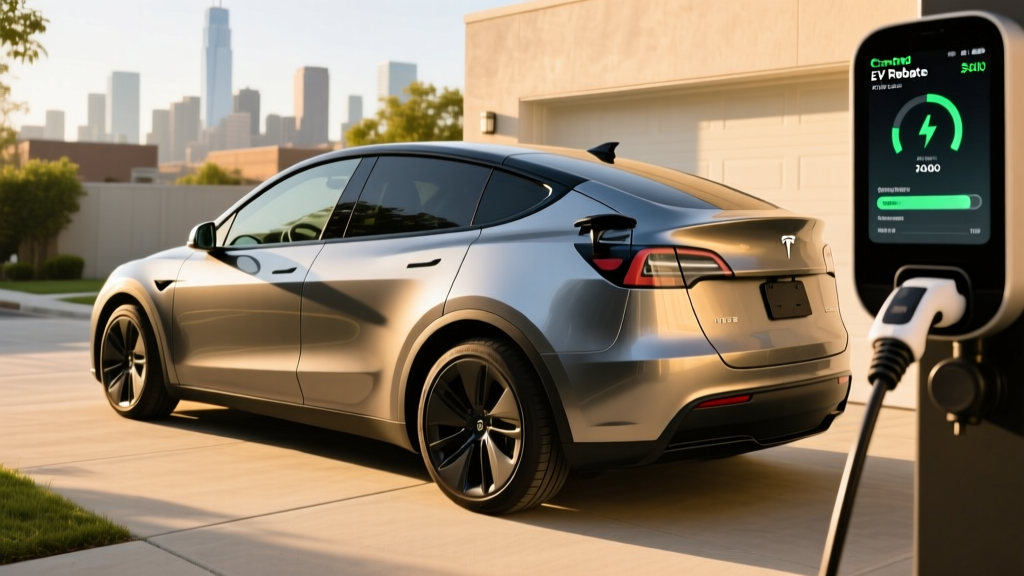
To understand whether an EV makes financial sense, we need to model a realistic 5-year ownership period. Below, we compare a representative 2026 EV (a Tesla Model Y Long Range AWD at approximately $46,000 MSRP before incentives) against a comparable gas-powered compact SUV (2026 Toyota RAV4 AWD at approximately $33,000 MSRP).
| Category | Tesla Model Y LR AWD | Toyota RAV4 AWD (Gas) |
|---|---|---|
| Purchase Price (MSRP) | $46,000 | $33,000 |
| Federal Tax Credit (§30D) | −$7,500 (if eligible) | $0 |
| ComEd Charging Rebate | −$500 (est.) | $0 |
| Net Purchase Cost | $38,000 | $33,000 |
| Fuel/Energy (75k mi) | $3,375 (see below) | $8,125 |
| Maintenance (5 years) | $1,200 | $3,500 |
| Insurance (5 years) | $11,500 | $8,750 |
| Depreciation (est.) | $19,000 (50%) | $13,200 (40%) |
| 5-Year Total | $73,075 | $66,575 |
Assumptions: Electricity at $0.15/kWh (ComEd residential average blended with TOU discount), EV efficiency 3.0 mi/kWh (100 MPGe combined per fueleconomy.gov), gasoline at $3.25/gal, RAV4 at 30 MPG combined. Insurance figures from industry averages; individual quotes vary significantly. Depreciation estimates based on 2024–2025 resale trends. Your actual numbers will differ—run your own scenario.
Charging vs. Gas: The Per-Mile Cost Math
This is where EVs consistently win, and the math is straightforward:
EV (Tesla Model Y, home charging on ComEd TOU rate):
Efficiency: ~3.0 miles per kWh (EPA-rated 28 kWh/100mi)
Electricity cost: ~$0.12/kWh (off-peak TOU) to $0.15/kWh (blended average)
Cost per mile: $0.040–$0.045
75,000-mile fuel cost: ~$3,000–$3,375
Gas (Toyota RAV4 AWD):
Efficiency: 30 MPG combined (EPA)
Gasoline cost: ~$3.25/gallon
Cost per mile: $0.108
75,000-mile fuel cost: ~$8,125
5-year fuel savings with EV: approximately $4,750–$5,125
Public DC fast charging caveat: If you rely heavily on public DC fast chargers (Electrify America, EVgo, Tesla Superchargers), expect to pay $0.30–$0.50/kWh, which pushes your per-mile cost to $0.10–$0.17—potentially exceeding gasoline. The fuel savings above assume 80%+ home charging. Plan your charging access before buying.
Maintenance Savings: Where EVs Genuinely Cost Less
EVs eliminate several recurring maintenance items that gas vehicles require. Here's a realistic comparison over 5 years and 75,000 miles:
| Service Item | EV Cost (5 yr) | Gas Vehicle Cost (5 yr) |
|---|---|---|
| Oil changes | $0 | $450 (10 changes) |
| Brake pads (regen reduces wear) | $200 (often none) | $600 |
| Transmission fluid | $0 | $200 |
| Cabin air filter | $150 | $150 |
| Tire rotation & replacement | $850 (heavier, more torque) | $700 |
| Coolant / misc. | $0 | $400 |
| Spark plugs, belts, emissions | $0 | $500 |
| Washer fluid, wipers, misc. | $100 | $100 |
| Total Maintenance | ~$1,300 | ~$3,100 |
Net maintenance savings over 5 years: approximately $1,800–$2,300. Note that EVs tend to wear tires faster due to higher vehicle weight and instant torque—budget for tire replacement accordingly. Battery replacement is extremely rare within the first 5 years; federal law mandates battery warranties of at least 8 years/100,000 miles.
Insurance Reality: The Cost EV Owners Often Underestimate
EV insurance premiums are typically 15–30% higher than comparable gas vehicles. The reasons are data-driven, not speculative:
- Higher repair costs: EV battery packs, power electronics, and specialized body structures (aluminum, high-strength steel) cost more to repair or replace after a collision.
- Higher purchase price: Insurers base comprehensive and collision coverage partly on vehicle replacement value.
- Specialized labor: High-voltage system repairs require certified technicians, and fewer shops have that certification.
- Total-loss frequency: Battery damage from even minor collisions can push repair costs above the vehicle's value threshold.
For our Model Y vs. RAV4 comparison, expect to pay approximately $2,300/year for the Tesla versus $1,750/year for the RAV4—a 5-year insurance gap of roughly $2,750. Always get insurance quotes before purchasing. Some insurers (Progressive, State Farm, Geico) now offer EV-specific discounts that narrow the gap.
EV Depreciation: The Biggest Variable
Depreciation remains the largest single ownership cost for any vehicle, and EVs have experienced steeper-than-average depreciation in 2024–2025, driven by aggressive price cuts from Tesla, rapid technology advancement, and consumer uncertainty about battery longevity.
Key depreciation dynamics for 2026:
- Tesla Model Y: 5-year depreciation estimated at 45–55%. A $46,000 purchase may retain $20,700–$25,300 in resale value.
- Toyota RAV4 (gas): 5-year depreciation estimated at 35–45%. A $33,000 purchase may retain $18,150–$21,450.
- EVs from legacy automakers (Hyundai Ioniq 5, Ford Mustang Mach-E, Chevrolet Equinox EV) show varied depreciation, with some models holding value better than Teslas due to lower initial MSRPs and improving demand.
The depreciation gap is narrowing as the used-EV market matures and the federal used-EV credit (§25E, up to $4,000) boosts demand for pre-owned electric vehicles. If you plan to own your EV for 8–10 years (past the steepest depreciation curve), this factor matters less.
Illinois State Incentives: What Else Is Available?
Illinois does not currently offer a statewide EV purchase rebate comparable to programs in California, Colorado, or New York. However, Illinois EV buyers should monitor:
- Illinois EPA EV rebate programs: Periodically funded through state environmental grants; availability varies by fiscal year.
- Chicago-area municipal incentives: Some municipalities offer discounted parking, HOV lane access, or local charging credits.
- ComEd TOU rates: Not a direct rebate, but charging overnight at ComEd's off-peak rate (~$0.08–$0.10/kWh vs. peak $0.18–$0.22/kWh) saves $300–$600/year for an average driver.
Check the Illinois EPA website and your local municipality for active programs.
Frequently Asked Questions
Is the ComEd EV rebate really $30,000?
The $30,000 figure generally applies to commercial and fleet EV incentives (electric trucks, buses, delivery vans), not individual consumer passenger vehicles. Residential ComEd EV programs typically offer $250–$1,000 for home charger installation. Verify current amounts directly with ComEd, as program terms change annually.
Can I combine the ComEd rebate with the federal tax credit?
Yes. Utility rebates (ComEd) and the federal §30D tax credit are separate programs with separate eligibility requirements. You can stack both. The ComEd rebate reduces your out-of-pocket cost for charging equipment; the federal credit reduces your vehicle purchase cost by up to $7,500 (new) or $4,000 (used), subject to income, MSRP, and sourcing rules.
How much does it really cost to own an EV over 5 years?
Based on our Model Y vs. RAV4 comparison above: approximately $73,000 for the EV and $66,500 for the gas vehicle over 5 years/75,000 miles, assuming full §30D credit eligibility and primarily home charging. The EV saves $4,750+ on fuel and $1,800+ on maintenance but costs more in insurance (+$2,750) and depreciation (+$5,800). At 8+ years of ownership, the EV typically reaches cost parity or advantage.
Do I qualify for the $7,500 federal tax credit?
You qualify if your modified AGI is under $150K (single) / $300K (married filing jointly), the vehicle's MSRP is under $55K (sedan) or $80K (SUV/truck), the vehicle's battery meets North American sourcing requirements, and final assembly occurred in North America. Check the official eligibility list at fueleconomy.gov for specific qualifying models and credit amounts.
Are EVs more expensive to insure?
Yes, typically 15–30% more than comparable gas vehicles due to higher repair costs, specialized parts, and elevated total-loss rates from battery damage. Get quotes from multiple insurers before purchasing—some now offer EV-specific discounts that partially close the gap.
How well do EVs hold their value?
EV depreciation has been steeper than gas vehicles in 2024–2025, with 5-year depreciation of 45–55% for popular models versus 35–45% for gas equivalents. However, the gap is narrowing as the used-EV market grows and the federal used-EV credit (§25E) boosts demand. Long-term owners (8+ years) are less affected by depreciation.