The Real Math Behind EV Ownership in ComEd Territory
If you live in northern Illinois and plug into Commonwealth Edison's grid, the ComEd electric vehicle rebate is one of several incentives that can meaningfully lower the barrier to going electric. But a rebate on a charger or a time-of-use rate plan is only one piece of a much larger financial picture. To make a smart purchase decision, you need to understand the full 5-year cost of ownership — including the incentives that stack, the costs that surprise, and the savings that actually materialize.
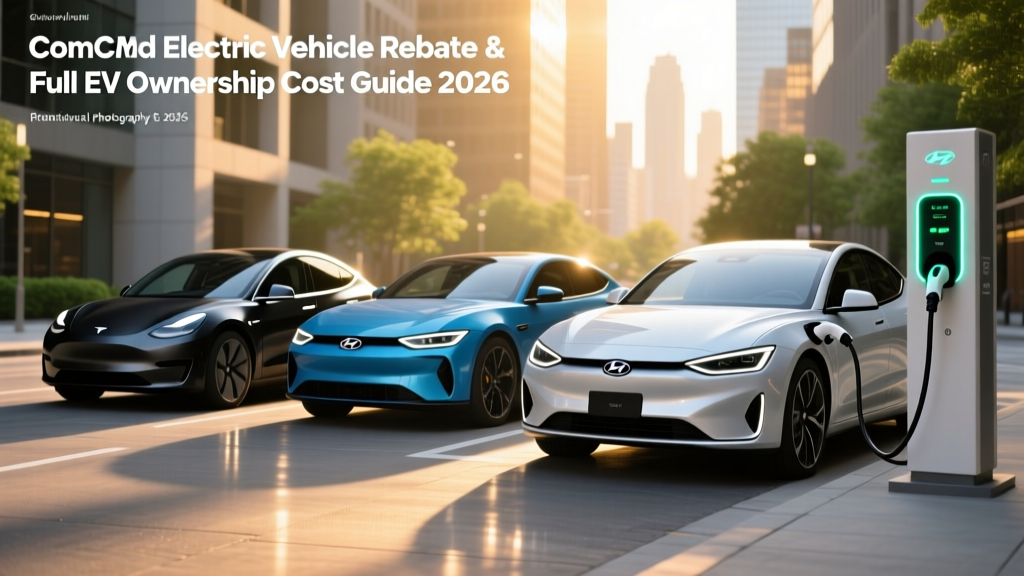
This guide breaks down every major ownership cost category with 2026 figures: purchase price after federal and local incentives, home charging vs. gasoline on a per-mile basis, maintenance realities, insurance premiums, and depreciation trends. We'll use the 2026 Tesla Model Y Long Range (AWD, 81 kWh usable NMC battery, EPA 320 miles, 384 hp, 0-60 in 4.8 seconds, starting at $44,990) and the 2026 Hyundai Ioniq 5 SEL AWD (84 kWh NMC, EPA 290 miles, 320 hp, 0-60 in 5.1 seconds, starting at $48,600) as reference vehicles, compared against a popular gas crossover baseline: the 2026 Toyota RAV4 AWD (28 MPG combined, starting at $31,500).
ComEd-Specific Incentives (Northern Illinois)
ComEd has historically offered EV-related programs including:
- Residential EV charging rate plan (REVV): Off-peak charging rates that can drop electricity costs to roughly $0.05–$0.08/kWh overnight, compared to the standard residential rate of approximately $0.13–$0.16/kWh.
- Make-Ready infrastructure support: ComEd has run programs to help cover the utility-side cost of upgrading electrical infrastructure for multifamily and commercial EV charging installations. Residential rebate availability and amounts change annually.
- Illinois state incentives: As of 2026, Illinois does not offer a broad state EV purchase rebate comparable to Colorado or California. However, the Illinois EPA has periodically administered limited EV rebate lotteries — check current availability.
Always verify current ComEd programs at ComEd's official EV page, as rebate amounts, eligibility, and enrollment windows change year to year.
Federal Tax Credit: §30D Eligibility in 2026
The federal Clean Vehicle Credit (IRS §30D) remains the single largest purchase incentive for qualifying new EVs — up to $7,500 — but eligibility in 2026 is narrower than many buyers assume. The credit is now available as a point-of-sale transfer, meaning the dealer applies it as a direct discount at purchase rather than waiting for a tax refund. However, several strict requirements apply:
§30D Requirements Checklist (2026 Tax Year)
- Income caps: Modified adjusted gross income (MAGI) must not exceed $300,000 (married filing jointly), $225,000 (head of household), or $150,000 (single filers).
- MSRP caps: Vans, SUVs, and pickups must have an MSRP at or below $80,000. Sedans and other vehicles: $55,000 cap.
- Battery sourcing: The credit splits into two $3,750 halves — one tied to critical minerals sourcing, one to battery component manufacturing. Both must be satisfied for the full $7,500. As of 2026, the foreign entity of concern (FEOC) restrictions on battery components and critical minerals are fully phased in, disqualifying vehicles with Chinese-sourced materials.
- Vehicle assembly: Final assembly must occur in North America.
- Point-of-sale transfer: Buyers can transfer the credit to the dealer for an immediate price reduction, but you must still meet income requirements — if your income exceeds the cap at tax filing time, you owe the credit back to the IRS.
Source: IRS Clean Vehicle Credit manufacturer/model list. Eligibility changes as manufacturers update battery supply chains. Always confirm your specific vehicle's status before purchasing.
For our reference vehicles: the 2026 Tesla Model Y Long Range (MSRP $44,990, assembled in Texas) has historically qualified for the full $7,500, bringing the effective starting price to approximately $37,490. The Hyundai Ioniq 5 SEL AWD (MSRP $48,600, assembled in Georgia) also qualifies at full credit, effective price $41,100. The gas RAV4 receives no such credit.
5-Year Total Cost of Ownership Breakdown
Below is a side-by-side 5-year / 60,000-mile ownership cost model. Assumptions: 12,000 miles/year, Illinois electricity rates (standard ~$0.14/kWh, off-peak ComEd REVV ~$0.07/kWh), gasoline at $3.40/gallon (Illinois average), and standard financing. Figures are estimates — your actual costs depend on driving patterns, local rates, and insurance profile.
| Cost Category | Tesla Model Y LR (after §30D) | Hyundai Ioniq 5 SEL AWD (after §30D) | Toyota RAV4 AWD (gas) |
|---|---|---|---|
| Purchase Price (effective) | $37,490 | $41,100 | $31,500 |
| Fuel / Energy (5 yr) | $2,520 (off-peak) / $5,040 (standard) | $2,800 (off-peak) / $5,600 (standard) | $7,286 |
| Maintenance (5 yr) | $1,800 | $1,900 | $4,200 |
| Insurance (5 yr) | $11,400 | $9,600 | $7,800 |
| Estimated Depreciation | $18,750 | $20,550 | $12,600 |
| Total (off-peak charging) | $71,960 | $75,950 | $63,386 |
| Cost per mile | $1.20/mi | $1.27/mi | $1.06/mi |
Key takeaway: Even after the $7,500 federal credit, EVs in this segment still carry a higher 5-year total cost than a mainstream gas crossover — primarily due to steeper depreciation and higher insurance premiums. However, the gap narrows significantly when you factor in off-peak utility rates, and it can flip entirely for buyers who would have otherwise purchased a more expensive gas vehicle or who drive above-average annual miles.
Charging vs. Gasoline: The Per-Mile Cost Reality
This is where EVs consistently win, and where ComEd's off-peak rate plan makes the biggest difference. Let's run the math:
| Vehicle | Efficiency | Energy Rate | Cost Per Mile |
|---|---|---|---|
| Tesla Model Y LR | 3.6 mi/kWh (128 MPGe) | $0.14/kWh (standard) | $0.039/mi |
| Tesla Model Y LR | 3.6 mi/kWh | $0.07/kWh (ComEd off-peak) | $0.019/mi |
| Hyundai Ioniq 5 AWD | 3.2 mi/kWh (114 MPGe) | $0.14/kWh (standard) | $0.044/mi |
| Hyundai Ioniq 5 AWD | 3.2 mi/kWh | $0.07/kWh (ComEd off-peak) | $0.022/mi |
| Toyota RAV4 AWD | 28 MPG combined | $3.40/gallon | $0.121/mi |
At ComEd's off-peak rate, the Model Y costs roughly 2 cents per mile to fuel — about one-sixth the cost of the RAV4 on gasoline. Over 60,000 miles, that's a fuel savings of $4,766 to $4,486 depending on the EV. Even at the standard residential rate, you save $2,200–$2,300 over five years.
Important real-world caveats: DC fast charging on road trips costs significantly more — Electrify America and Tesla Superchargers in Illinois typically run $0.35–$0.48/kWh, pushing highway-trip fuel costs to $0.10–$0.13/mile, nearly matching gasoline. If more than 30% of your charging happens on public DC fast chargers, your savings shrink substantially. Home Level 2 charging at off-peak rates is where the economics work best.
Maintenance Savings: Where EVs Quietly Win
EVs eliminate many routine maintenance items that gas car owners pay for every 5,000–10,000 miles. Here's the comparison:
| Maintenance Item | EV Cost | Gas Vehicle Cost |
|---|---|---|
| Oil changes (6–12 over 5 yr) | $0 | $480–$960 |
| Transmission fluid | $0 (single-speed reducer) | $150–$300 |
| Brake pads/rotors | $200–$400 (regen extends life 2–3x) | $800–$1,500 |
| Engine air filter | $0 (no intake) | $150–$250 |
| Spark plugs | $0 | $200–$400 |
| Cabin air filter | $100–$200 | $100–$200 |
| Tire rotation/replacement | $800–$1,200 (heavier vehicle, instant torque wears tires faster) | $600–$900 |
| Coolant / misc. fluids | $100–$200 | $200–$400 |
| Total Estimated | $1,800–$2,200 | $3,800–$4,500 |
Net maintenance savings for an EV: roughly $2,000–$2,400 over five years. The biggest caveat is tires — EVs are heavier (the Model Y weighs ~4,400 lbs vs. the RAV4 at ~3,600 lbs) and deliver instant torque, which accelerates tire wear. Budget for tire replacement sooner than you would on a gas car.
Insurance: The Cost That Catches Buyers Off Guard
EV insurance premiums are typically 15–30% higher than comparable gas vehicles. According to industry data, the average annual EV insurance premium in Illinois runs $1,800–$2,400 depending on the model, driver profile, and coverage level — compared to $1,400–$1,700 for a gas crossover.
Why the premium?
- Higher repair costs: EV battery packs, power electronics, and specialized structural components cost more to replace after a collision. A minor rear-end impact that might total a battery enclosure can result in a total-loss declaration.
- Higher vehicle values: Insurers price premiums partly on replacement cost. A $45,000 EV costs more to insure than a $31,500 gas crossover.
- Specialized labor: High-voltage system repairs require certified technicians, and fewer shops have that capability, driving up labor rates.
- Model-specific variation: Teslas historically carry higher premiums due to repair complexity and parts pricing. The Ioniq 5 and other mainstream-brand EVs tend to be closer to gas-car insurance costs.
Practical tip: Get insurance quotes before purchasing. The difference between the Model Y ($2,280/yr average) and the Ioniq 5 ($1,920/yr average) in our model is $1,800 over five years — meaningful money that affects the total-cost equation.
Depreciation and Resale Value Trends
Depreciation is the single largest ownership cost for any vehicle, and it's where EVs have historically struggled. In 2024–2025, aggressive price cuts by Tesla and intensifying competition compressed used EV values significantly. By 2026, the market is stabilizing, but EVs still depreciate faster on average than mainstream gas crossovers.
Estimated 5-year depreciation for our reference vehicles:
- Tesla Model Y LR: ~50% retention after 5 years / 60,000 miles → ~$18,750 depreciation (from $37,490 effective purchase)
- Hyundai Ioniq 5 SEL AWD: ~48% retention → ~$20,550 depreciation (from $41,100)
- Toyota RAV4 AWD: ~60% retention → ~$12,600 depreciation (from $31,500)
The RAV4's stronger resale value erases a significant portion of the EV's fuel and maintenance savings in a total-cost comparison. However, two factors could improve EV retention going forward:
- Battery health data transparency: As standardized State of Health (SoH) reporting becomes more common, buyers gain confidence in used EV batteries, supporting resale values.
- Market maturation: As EVs become the norm rather than the exception, the "used EV discount" driven by early-adopter turnover and tech obsolescence fears should moderate.
See fueleconomy.gov for EPA-rated efficiency and range data on all current models.
Stacking Incentives: ComEd + Federal + Other Savings
The financial case for an EV in ComEd territory is strongest when you layer every available incentive and behavioral optimization:
- Federal §30D credit: Up to $7,500 off the purchase price at point of sale (verify your vehicle's eligibility on the IRS qualifying vehicle list).
- ComEd REVV off-peak rate: Cuts home charging cost roughly in half compared to the standard residential rate. Requires scheduling charging for overnight hours (typically 10 PM – 6 AM).
- ComEd infrastructure support: Check current availability for any make-ready or residential charger rebates.
- Employer or municipal incentives: Some Chicago-area employers and municipalities offer additional EV purchase or charging incentives.
- Used EV credit (§25E): If buying a qualifying used EV, a separate credit of up to $4,000 (30% of sale price, capped) may apply, with its own income limits.
A buyer who qualifies for the full $7,500 federal credit, enrolls in ComEd's off-peak rate, drives 15,000+ miles per year, and owns a vehicle with moderate insurance premiums can approach or achieve cost parity with a gas crossover within the 5-year window. Lower-mileage drivers and those who rely heavily on public DC fast charging will see a longer payback period.
Decision Framework: Is an EV Right for Your Budget?
Choose an EV if:
- You qualify for the full or partial §30D federal tax credit
- You can install a Level 2 home charger and use off-peak utility rates
- You drive 12,000+ miles per year (higher mileage = faster fuel payback)
- You value lower per-mile fuel cost and reduced maintenance hassle
- You plan to keep the vehicle 5+ years, giving savings time to compound
Stick with gas or consider a hybrid if:
- You exceed §30D income caps or your target vehicle exceeds MSRP limits
- You cannot charge at home and must rely on public DC fast charging
- You drive under 8,000 miles per year (fuel savings won't offset higher purchase/insurance costs)
- You plan to sell or trade within 3 years (depreciation will dominate your costs)
- Your insurance quotes come in 40%+ above your current gas vehicle
Frequently Asked Questions
How much does it really cost to own an EV over 5 years?
For a mainstream EV like the Tesla Model Y or Hyundai Ioniq 5, expect a 5-year total cost of ownership between $70,000 and $78,000 at 60,000 miles — including purchase (after federal credit), energy, maintenance, insurance, and depreciation. A comparable gas crossover like the RAV4 runs $60,000–$66,000. The gap is primarily depreciation and insurance, partially offset by fuel and maintenance savings of $4,000–$7,000 depending on your charging setup.
Do I qualify for the federal EV tax credit?
You qualify for up to $7,500 under §30D if: your MAGI is under $150K (single) / $300K (joint), the vehicle MSRP is under $55K (cars) or $80K (SUVs/trucks), final assembly is in North America, and the battery meets critical-mineral and component-sourcing requirements. The credit can be transferred to the dealer at point of sale for an immediate price reduction. Always verify your specific vehicle on the IRS qualifying list before purchasing.
How much do I save on fuel and maintenance?
Fuel savings: $2,200–$4,800 over 5 years / 60,000 miles, depending on whether you charge at standard residential rates or off-peak utility rates. Maintenance savings: approximately $2,000–$2,400 over the same period, driven by eliminated oil changes, reduced brake wear from regenerative braking, and fewer fluid services. Combined, expect $4,200–$7,200 in operating savings.
Are EVs more expensive to insure?
Yes, typically 15–30% more than a comparable gas vehicle. The Model Y averages ~$2,280/year in Illinois; the Ioniq 5 ~$1,920/year; the RAV4 ~$1,560/year. Over five years, that's an additional $1,800–$3,600 in insurance costs. Get quotes for your specific profile before committing to a purchase.
How well do EVs hold their value?
EVs currently retain approximately 45–52% of their value after 5 years / 60,000 miles, compared to 55–65% for popular gas crossovers. The gap has narrowed since the 2023–2024 used-EV price correction but persists due to battery degradation concerns and rapid technology turnover. Battery warranty coverage (typically 8 years / 100,000 miles at 70% capacity retention) provides some resale support.
Does the ComEd electric vehicle rebate cover the cost of a home charger?
ComEd's programs have historically focused on charging rate plans (like the REVV off-peak rate) and infrastructure make-ready support rather than direct rebates on Level 2 charger hardware. Some Illinois municipalities and employers offer separate charger purchase rebates. Check ComEd's current EV programs page and your local utility for the most up-to-date offerings, as these change annually.