Quick Answer: Is ComEd the Only Electric Company in Chicago?
No, ComEd is not the only electric company in Chicago — but it is the sole regulated utility delivering electricity to nearly all residential customers within the city limits. ComEd (Commonwealth Edison) holds the distribution monopoly for the greater Chicagoland area. However, Illinois operates a deregulated energy market for supply, meaning you can choose an alternative retail electric supplier (ARES) to buy your electricity from, even though ComEd still delivers it and maintains the grid. For EV owners, this distinction directly affects your per-kWh charging cost and how much you pay to fuel your car at home.
Understanding Chicago's Electricity Market as an EV Owner
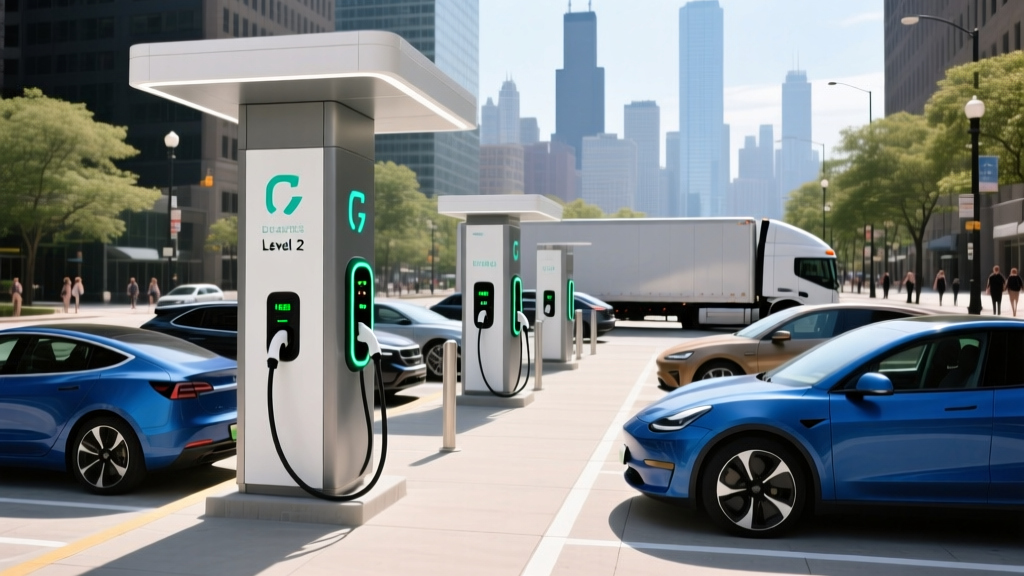
Illinois deregulated its electricity supply market in the late 1990s, and the choice program — managed through the Plug In Illinois portal — lets residential customers pick their electricity supplier. ComEd remains the default utility: it owns the poles, wires, transformers, and meters. When you plug your EV into a Level 2 home charger at 7.2 kW or 11.5 kW, ComEd's infrastructure delivers that power regardless of who supplies it.
Here's the practical breakdown for Chicago EV owners:
- ComEd as default supplier: ComEd's Price to Compare (PTC) fluctuates monthly. As of early 2026, it hovers around $0.09–$0.11 per kWh for the supply portion, with delivery charges adding roughly $0.04–$0.06/kWh. All-in, expect $0.14–$0.17/kWh on the standard ComEd rate.
- Alternative Retail Electric Suppliers (ARES): Companies like Dynegy Energy Services, Nordic Energy Services, and MC Squared Energy Services compete to supply electricity. Some offer fixed-rate contracts at $0.07–$0.09/kWh for supply — potentially saving EV owners who charge heavily at home.
- Municipal aggregation: Some Chicago suburbs participate in municipal aggregation programs where the city or village negotiates a bulk supply rate on behalf of residents. The City of Chicago itself has explored community aggregation, which can sometimes undercut ComEd's PTC.
- ComEd EV-specific rate (Residential EV Rate): ComEd offers a time-of-use rate specifically designed for EV owners. Charging overnight (off-peak, typically 10 PM – 6 AM) can drop your effective rate to roughly $0.07–$0.09/kWh all-in — a significant discount versus the standard rate.
What It Actually Costs to Charge an EV in Chicago
Let's ground this in real numbers. We'll compare three popular 2026 EVs at ComEd's standard residential rate versus the EV time-of-use rate, assuming 1,000 miles driven per month (a typical Chicago commute-plus-errands mix).
| Vehicle | Efficiency (kWh/100mi) | Monthly kWh Needed | Cost @ $0.16/kWh (Standard) | Cost @ $0.08/kWh (EV TOU Rate) |
|---|---|---|---|---|
| 2026 Tesla Model 3 Long Range | 25 kWh/100mi | 250 kWh | $40.00 | $20.00 |
| 2026 Hyundai Ioniq 5 (84 kWh, RWD) | 28 kWh/100mi | 280 kWh | $44.80 | $22.40 |
| 2026 Ford F-150 Lightning (Std Range) | 42 kWh/100mi | 420 kWh | $67.20 | $33.60 |
At the off-peak EV rate, a Tesla Model 3 owner in Chicago spends roughly $240/year on home electricity for driving — compared to approximately $1,500–$1,800/year on gasoline for a comparable 30 MPG gas sedan driven the same distance (assuming $3.40/gallon). That's a fuel savings of $1,200–$1,500 annually.
EV vs. Gas vs. Hybrid: Total Cost Breakdown for Chicago Drivers
Chicago driving has unique cost factors: harsh winters reduce EV range by 20–30%, stop-and-go traffic on I-90/94 actually favors EVs (regenerative braking recovers energy), and Illinois gas taxes push fuel costs above the national average. Let's compare a 5-year ownership scenario.
| Cost Category | 2026 Tesla Model 3 LR ($42,490 MSRP) | 2026 Toyota Camry LE ($28,700 MSRP, Gas) | 2026 Toyota RAV4 PHEV ($38,400 MSRP) |
|---|---|---|---|
| Purchase Price (after incentives) | $34,990 (est. $7,500 §30D credit) | $28,700 | $38,400 (credit eligibility varies) |
| Fuel/Energy (5 years) | $1,200 (home TOU) – $2,400 (standard rate) | $6,800 (30 MPG avg, $3.40/gal) | $2,800 (mixed electric + gas) |
| Maintenance (5 years) | $1,500 (tires, cabin filter, wiper fluid) | $3,500 (oil, filters, brakes, belts) | $3,000 (gas engine + electric maintenance) |
| Insurance (5-yr avg) | $9,500 ($1,900/yr) | $6,500 ($1,300/yr) | $7,500 ($1,500/yr) |
| Estimated 5-Year Total | $47,190 – $48,390 | $45,500 | $51,700 |
The EV wins on fuel and maintenance but carries higher insurance premiums and a higher entry price. The IRS §30D federal tax credit of up to $7,500 (available as a point-of-sale transfer at the dealer) narrows the gap substantially — but eligibility depends on your income (≤$150K single / ≤$300K joint), the vehicle's MSRP (≤$55K for sedans), and battery component/critical-mineral sourcing requirements that tighten each year through 2032.
Chicago-Specific EV Ownership Realities
Cold-Weather Range Loss
Chicago winters are the single biggest variable in your EV ownership calculus. Lithium-ion batteries lose efficiency in cold temperatures, and cabin heating draws significant power. Based on aggregated real-world data:
- A 2026 Tesla Model 3 Long Range (EPA 341 miles) typically delivers ~240–260 miles in sustained sub-30°F highway driving.
- A 2026 Hyundai Ioniq 5 (EPA 303 miles, 84 kWh NMC battery) sees roughly ~210–230 miles in January conditions.
- Vehicles equipped with a heat pump (standard on Tesla, available on Ioniq 5 trims) recover 10–15% of cold-weather range versus resistive heating.
For most Chicago commutes (round-trip 30–50 miles), even reduced winter range leaves ample buffer. But if you regularly drive to Milwaukee, Indianapolis, or the UP, plan for mid-trip DC fast charging stops.
Home Charging Access in Chicago
This is where Chicago diverges from suburban EV ownership. Approximately 35–40% of Chicago residents live in multi-unit buildings (condos, apartments, townhomes) where installing a personal Level 2 charger is complicated or impossible.
- Single-family homeowners: A 240V/48A Level 2 home charger installation typically costs $800–$2,500 (equipment + electrician + permit), depending on whether your panel needs upgrading from 100A to 200A service.
- Condo/townhome owners: You'll need HOA approval. ComEd offers a Make-Ready program that can cover some shared-infrastructure costs for multi-dwelling EV charger installations.
- Renters and street parkers: You'll rely on public Level 2 and DC fast chargers. Chicago's public network includes Tesla Superchargers, Electrify America stations, and ChargePoint locations — but reliability and pricing vary. Expect to pay $0.30–$0.48/kWh at public DC fast chargers, erasing much of the home-charging cost advantage.
ComEd's EV Rate Program: Is It Worth It?
ComEd's Residential EV Rate uses a time-of-use structure:
- Off-Peak (10 PM – 6 AM weekdays, all day weekends): ~$0.07–$0.09/kWh all-in
- On-Peak (6 AM – 10 PM weekdays): ~$0.18–$0.22/kWh all-in
If you can schedule your EV charging (and ideally shift other loads like dishwashers and laundry) to off-peak hours, the savings are substantial. Most modern EVs and Level 2 chargers have built-in scheduling — set your car to start charging at 10:30 PM and you'll wake up with a full battery at the cheapest rate. But if your lifestyle means you frequently need to charge at 4 PM on a weekday, the standard flat rate may actually be cheaper.
Common EV Misconceptions for Chicago Buyers
| Myth | Fact |
|---|---|
| "EVs can't handle Chicago winters." | Range drops 20–30% in deep cold, but modern EVs with heat pumps still deliver 200+ usable miles. Preconditioning while plugged in restores much of the loss. |
| "You must use ComEd — there's no choice." | ComEd delivers power, but Illinois lets you choose an alternative supplier (ARES) for the generation portion, potentially lowering your per-kWh rate. |
| "Charging at home costs the same as gas." | At ComEd's EV off-peak rate (~$0.08/kWh), fueling a Model 3 costs ~$0.02/mile vs. ~$0.11/mile for a 30 MPG gas car at $3.40/gallon. |
| "EV batteries need replacing every few years." | 2026 EV batteries carry 8-year/100,000-mile warranties (10 years in CARB states like Illinois) with guaranteed ≥70% capacity retention. Real-world data shows ~10–15% degradation at 150K miles for NMC chemistries. |
| "The grid can't handle everyone driving EVs." | ComEd has invested in grid upgrades and specifically encourages off-peak EV charging. A single EV adding ~250 kWh/month is equivalent to one additional household appliance load. |
Decision Framework: Should You Go EV, Hybrid, or Stick with Gas in Chicago?
If/Then EV Decision Guide for Chicago Buyers
- Choose a BEV (full EV) if: You have access to home Level 2 charging (garage, driveway, or approved condo setup), your daily driving is under 80 miles round-trip, you can enroll in ComEd's EV time-of-use rate, and you qualify for the §30D tax credit (income under caps, vehicle MSRP under $55K sedan / $80K SUV/truck).
- Choose a PHEV (plug-in hybrid) if: You lack reliable home charging or frequently drive 200+ miles in a day, you want 30–42 miles of electric-only commuting (covering most Chicago trips) with a gas engine for longer hauls, and you live in a condo or apartment where overnight charging isn't guaranteed.
- Stick with a conventional hybrid (HEV) if: You have zero charging access (street parking only, no workplace charging), you want maximum flexibility without plug-in logistics, and your priority is fuel economy (45–52 MPG combined in a RAV4 Hybrid) without range compromise in winter.
- Wait on a full EV if: You currently rely entirely on street parking in dense Chicago neighborhoods (Lincoln Park, Wicker Park, Logan Square) with no foreseeable home or workplace charging access. Public DC fast charging at $0.35–$0.48/kWh erases most of the cost advantage.
Frequently Asked Questions
Can I switch from ComEd to another electric supplier for my EV charging?
You can switch your supply to an alternative retail electric supplier (ARES) through Plug In Illinois, but ComEd will still deliver the electricity, read your meter, and handle outages. The switch only changes who generates or procures the power and what rate you pay for the supply portion (roughly 55–65% of your bill). Compare fixed-rate ARES contracts against ComEd's Price to Compare carefully — some ARES contracts include early termination fees or rate escalators.
Does ComEd offer any rebates for EV charger installation?
Yes. ComEd periodically offers rebates for Level 2 home charger installations, typically $250–$500 toward the cost of a qualifying smart charger. They also offer a Make-Ready program for multi-dwelling unit (MDU) installations that covers some shared electrical infrastructure costs. Check ComEd's EV programs page for current offerings, as rebate amounts and availability change annually.
How much does public DC fast charging cost in Chicago compared to home?
Public DC fast charging in Chicago typically costs $0.30–$0.48/kWh depending on the network (Tesla Superchargers, Electrify America, EVgo). At $0.40/kWh, fully charging a Hyundai Ioniq 5 (84 kWh battery) from 10–80% costs about $23.50 and adds roughly 210 miles — comparable to filling a gas tank. Home charging at the ComEd off-peak rate (~$0.08/kWh) costs only $4.70 for the same charge. Public charging is best reserved for road trips, not daily fueling.
Will my EV battery degrade faster in Chicago's extreme temperatures?
Chicago's temperature swings (-10°F to 100°F) do stress lithium-ion batteries more than mild climates, but modern thermal management systems (liquid cooling and heating) mitigate most damage. Expect ~12–18% capacity loss over 10 years / 150,000 miles for NMC batteries in a Chicago climate versus ~8–12% in temperate regions. LFP (lithium iron phosphate) batteries, used in some Tesla Model 3 Standard Range vehicles, show even slower degradation (~5–8% over the same period) and tolerate 100% daily charging better — making them a smart choice for cold-climate owners who want to maximize daily range.
Do I qualify for the federal EV tax credit in Illinois?
The IRS §30D Clean Vehicle Credit provides up to $7,500 for qualifying new EVs. Key requirements for 2026: your modified adjusted gross income must be ≤$150,000 (single) or ≤$300,000 (married filing jointly); the vehicle MSRP must be ≤$55,000 (sedans/wagons) or ≤$80,000 (SUVs/trucks); and the battery must meet escalating critical-mineral and battery-component sourcing thresholds. As of 2026, the credit can be transferred to the dealer as a point-of-sale discount — meaning you don't need to wait until tax filing to benefit. Always confirm eligibility with your tax professional and check the latest IRS guidance, as sourcing requirements tighten annually.