If you live in Colorado and are shopping for an electric vehicle, the incentive stack available to you in 2026 is among the most generous in the country. Between the federal §30D credit, Colorado's state EV tax credit, utility rebates from providers like Xcel Energy, and potential local incentives, the effective purchase price of a new EV can drop by $7,500 to $12,500 or more — before you even factor in years of fuel and maintenance savings.
But incentives only tell half the story. EV ownership involves trade-offs: higher insurance premiums, steeper upfront MSRPs on some models, and depreciation curves that still lag behind Toyota-badged hybrids. This guide breaks down every dollar — credits, fuel costs, maintenance, insurance, and resale — so you can calculate what an EV actually costs over five years in Colorado.
Colorado's State EV Tax Credit: What You Get in 2026
Colorado offers one of the strongest state-level EV incentives in the U.S. For the 2026 tax year, the Colorado Innovative Motor Vehicle Tax Credit provides up to $5,000 for the purchase or lease of a new battery-electric vehicle (BEV) with an MSRP of $80,000 or less. The credit applies equally to plug-in hybrid electric vehicles (PHEVs) at the same $5,000 tier, though the qualifying vehicle list differs.
Key details of the Colorado credit:
- Credit amount: Up to $5,000 for new BEVs and qualifying PHEVs (MSRP ≤ $80,000)
- Used EV credit: Up to $2,500 for used EVs priced under $80,000
- No income cap: Unlike the federal credit, Colorado's credit does not phase out based on adjusted gross income
- Point-of-sale option: Colorado allows the credit to be assigned to the dealer at purchase, reducing your out-of-pocket cost immediately rather than waiting until you file taxes
- Stackable: This credit is in addition to the federal §30D credit — they are separate programs and do not offset each other
Colorado utility companies offer additional EV rebates that stack on top of state and federal credits. Xcel Energy (serving the Denver metro and Front Range) has historically offered up to $500–$1,000 in EV purchase rebates and discounted off-peak charging rates. Colorado Springs Utilities, Holy Cross Energy, and other providers may offer separate programs. Municipalities like Boulder and Denver have periodically offered additional incentives. Check your utility's current EV program page and the Colorado Energy Office for the latest offerings — these programs change frequently and may have funding caps.
Federal §30D Tax Credit: Eligibility Rules That Matter
The federal Clean Vehicle Credit under IRS §30D remains a cornerstone of EV affordability, but qualifying for the full $7,500 requires threading several needles. The rules, as updated through the Inflation Reduction Act amendments, impose income caps, MSRP caps, and battery-sourcing requirements that disqualify a significant number of vehicles and buyers.
- Maximum credit: $7,500 ($3,750 for meeting critical-mineral requirements + $3,750 for battery-component requirements)
- Income caps (modified AGI): $150,000 single / $225,000 head of household / $300,000 married filing jointly
- MSRP caps: $80,000 for vans, SUVs, and pickups; $55,000 for sedans and other body styles
- Battery sourcing: Critical minerals and battery components must meet escalating domestic/free-trade-partner sourcing thresholds — this eliminates many vehicles with China-sourced supply chains
- Final assembly: Vehicle must undergo final assembly in North America (verify via VIN at NHTSA)
- Point-of-sale transfer: You can transfer the credit to the dealer at purchase, reducing your down payment or monthly payment — the dealer then claims the credit from the IRS
- Used EV credit: Separate 30% credit up to $4,000 for used EVs priced under $25,000, with lower income caps ($75k/$112.5k/$150k)
Source: IRS §30D Clean Vehicle Credits. Rules are subject to change — verify current-year eligibility with a tax professional before relying on credit amounts in your purchase decision.
As of early 2026, vehicles that commonly qualify for the full $7,500 include the Tesla Model Y (Long Range and Performance), Ford F-150 Lightning, Chevrolet Equinox EV, and certain trims of the Rivian R1S and R1T. Vehicles like the Hyundai Ioniq 5 and Kia EV6, despite being excellent EVs, have faced partial or full disqualification due to battery-sourcing rules tied to their South Korean manufacturing — though Hyundai's new Georgia plant has shifted some production to North America. Always verify the current qualifying list at fueleconomy.gov before signing paperwork.
5-Year Total Cost of Ownership: EV vs. Gas in Colorado
To understand whether an EV saves you money, we need to compare apples to apples over a realistic ownership window. The table below models a 5-year / 75,000-mile ownership period for a representative EV (2026 Tesla Model Y Long Range AWD, $44,990 MSRP) versus a comparable gas crossover (2026 Toyota RAV4 AWD, $32,500 MSRP), both driven in Colorado.
| Cost Category | Tesla Model Y LR AWD (BEV) | Toyota RAV4 AWD (Gas) |
|---|---|---|
| Base MSRP | $44,990 | $32,500 |
| Federal Tax Credit (§30D) | −$7,500 | $0 |
| Colorado State Credit | −$5,000 | $0 |
| Effective Purchase Price | $32,490 | $32,500 |
| Fuel/Energy (75,000 mi) | $3,375 (home charging @ $0.12/kWh) | $9,375 (gas @ $3.50/gal, 28 MPG) |
| Maintenance (5 years) | $1,200 | $3,500 |
| Insurance (5 years, avg) | $12,500 | $9,500 |
| Estimated Depreciation | $16,245 (50%) | $13,000 (40%) |
| Total 5-Year Cost | $65,810 | $67,875 |
Assumptions: 15,000 miles/year; Model Y efficiency 28 kWh/100mi; home charging at Colorado average residential rate ~$0.12/kWh; gas at $3.50/gal; insurance averages based on national EV vs. gas data from industry reports. Depreciation estimates are approximate and vary by market conditions. Actual costs depend on driving habits, charging mix, insurance profile, and resale market at trade-in.
The takeaway: after incentives, the Model Y's effective purchase price nearly matches the RAV4, and the fuel and maintenance savings over five years push the EV ahead by roughly $2,000 in this scenario. But the higher insurance and depreciation costs eat into that advantage significantly. Your mileage — literally and financially — will vary.
Charging vs. Gas: The Per-Mile Math in Colorado
The single largest ongoing savings of EV ownership comes from energy costs. But how much you save depends entirely on how you charge.
| Scenario | Cost per kWh or Gallon | Cost per Mile | Annual Cost (15k mi) |
|---|---|---|---|
| Home Level 2 (CO avg residential) | $0.12/kWh | $0.034 | $506 |
| Xcel off-peak EV rate | $0.07/kWh | $0.020 | $294 |
| Public DC fast charging (avg) | $0.40/kWh | $0.112 | $1,680 |
| Gas vehicle (28 MPG, $3.50/gal) | $3.50/gal | $0.125 | $1,875 |
If you charge primarily at home on a standard residential rate, you'll pay roughly 3.4 cents per mile — about a quarter of the cost of gas. On Xcel Energy's off-peak EV charging rate (available to Colorado Front Range customers), that drops to just 2 cents per mile. Even exclusive DC fast charging at $0.40/kWh undercuts gas, though only marginally.
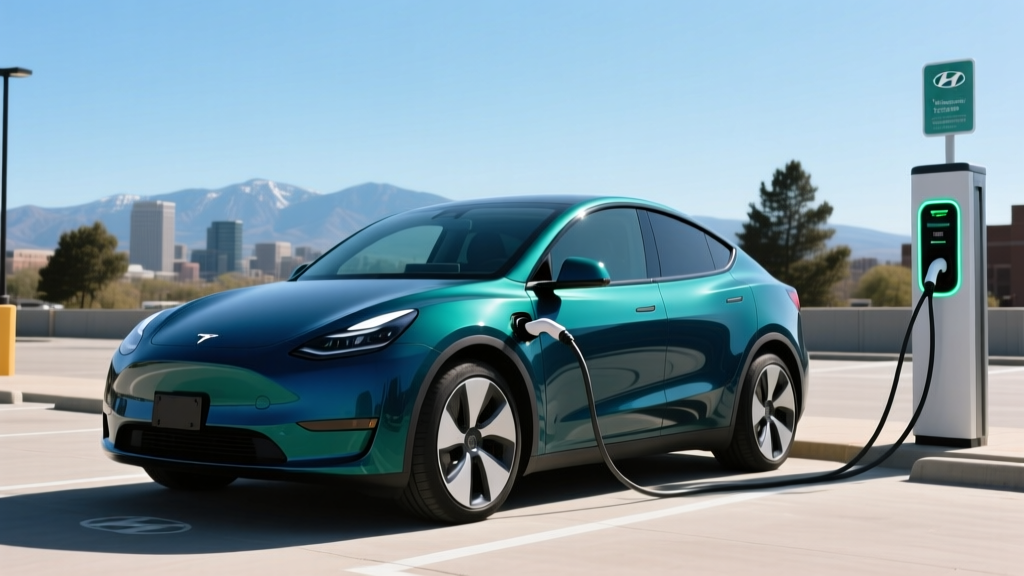
The critical variable: home charging access. If you can install a Level 2 charger at home (a 240V circuit, typically 32–48 amps), your fuel costs collapse. If you rely entirely on public charging — common for apartment dwellers in Denver or Boulder — your per-mile cost rises substantially, though still typically below gas. Colorado has invested heavily in public charging infrastructure along I-70 and I-25, with Electrify America, ChargePoint, and Tesla Supercharger stations widely available on the Front Range, but rural Western Slope coverage remains thinner.
Maintenance Savings: Where EVs Quietly Win
EVs have dramatically fewer moving parts than internal-combustion vehicles. There's no engine oil to change, no transmission fluid to flush, no spark plugs, no timing belt, no exhaust system, and no emissions equipment to fail. Regenerative braking handles most deceleration, which means brake pads and rotors last far longer — often 100,000+ miles before needing replacement.
| Maintenance Item | Gas Vehicle (5 yr / 75k mi) | EV (5 yr / 75k mi) |
|---|---|---|
| Oil changes (6–8 over 5 years) | $400–$600 | $0 |
| Transmission fluid / service | $200–$400 | $0 |
| Brake pads & rotors | $500–$900 | $0–$200 (regen extends life) |
| Air filters, cabin filters | $150–$250 | $75–$125 (cabin filter only) |
| Coolant / belts / exhaust | $300–$600 | $0–$100 (thermal system service) |
| Tire rotation / replacement | $800–$1,200 | $900–$1,400 (EVs wear tires faster due to weight + torque) |
| Total Estimated | $2,350–$3,950 | $975–$1,825 |
The one area where EVs cost more: tires. EVs are heavier (the Model Y weighs ~4,400 lbs vs. the RAV4's ~3,600 lbs) and deliver instant torque, both of which accelerate tire wear. Budget for tire replacement sooner than you would on a gas vehicle — typically every 30,000–40,000 miles rather than 50,000+.
Battery replacement is the elephant in the room for many buyers. The reality: modern EV batteries rarely need full replacement within the warranty period. Federal law mandates that EV batteries carry a warranty of at least 8 years / 100,000 miles, and most manufacturers warrant against degradation below 70% of original capacity. Real-world data from Tesla, Hyundai, and others shows average degradation of 10–15% over 150,000 miles. A full battery replacement outside warranty on a mainstream EV currently runs $10,000–$20,000, but this scenario is uncommon within a typical first-ownership window.
Insurance: The Cost Most EV Shoppers Underestimate
EV insurance premiums are typically 15–30% higher than equivalent gas vehicles. In Colorado, expect to pay $2,200–$2,800 annually for full coverage on a Model Y, compared to $1,700–$2,100 for a RAV4, depending on your driving record, age, location, and coverage level.
Why the premium?
- Higher repair costs: EV repairs often require specialized training, proprietary parts, and high-voltage safety protocols. Even minor collision damage near the battery pack can trigger expensive diagnostics or replacement.
- Higher vehicle values: Insurers base premiums partly on replacement cost. A $45,000 EV costs more to replace than a $32,500 gas crossover.
- Limited repair network: Fewer body shops have EV-certified technicians, which drives up labor rates for claims.
- Total-loss thresholds: Battery damage in a collision can push a repair estimate past the total-loss threshold more easily, increasing insurer risk.
Mitigation strategies: shop quotes from EV-friendly insurers (Tesla Insurance, Geico, Progressive, and USAA all price EVs differently), and consider that as EV market share grows and repair networks expand, premiums are gradually normalizing. Some Colorado insurers also offer green-vehicle discounts.
Depreciation and Resale Value: The Honest Picture
EV depreciation has been volatile. In 2023–2024, a wave of Tesla price cuts cascaded through the used EV market, causing steeper-than-expected depreciation for nearly all electric models. By 2025–2026, the market has largely stabilized, but EVs still generally depreciate faster than top-selling gas and hybrid vehicles.
Typical 5-year depreciation ranges:
- Mainstream EVs (Model Y, Ioniq 5, EV6): 45–55% depreciation over 5 years
- Luxury EVs (iX, EQS, Taycan): 55–65% depreciation over 5 years
- Gas crossovers (RAV4, CR-V): 35–45% depreciation over 5 years
- Hybrids (RAV4 Hybrid, Prius): 30–40% depreciation over 5 years
Factors working against EV resale: rapid technology improvements (newer models offer more range and faster charging, making older ones feel dated), battery health uncertainty for second owners, and the fact that federal and state credits effectively lower the "real" new-vehicle price, compressing used values. Factors working in favor: growing consumer acceptance, expanding charging infrastructure, and the fact that well-maintained EVs with healthy batteries are increasingly desirable in the used market.
Colorado-specific note: the Front Range (Denver, Boulder, Colorado Springs) has one of the highest EV adoption rates in the country, which supports stronger used-EV demand locally compared to more rural markets. If you plan to sell or trade in within Colorado, you're in a relatively favorable market.
Stacking Credits: A Real Purchase Example
Here's how the incentive stack works on an actual 2026 purchase in the Denver metro area:
Vehicle: 2026 Tesla Model Y Long Range AWD
MSRP: $44,990
Federal §30D credit: $7,500 (qualifies — North American assembly, meets sourcing requirements, buyer under income cap)
Colorado state credit: $5,000 (MSRP under $80,000, assigned at point of sale)
Xcel Energy rebate: $500 (current EV purchase incentive program)
Effective price after incentives: $31,990
At that effective price, the Model Y competes directly with well-equipped gas crossovers — and then saves you an additional $5,000–$7,000 in fuel and maintenance over five years of Colorado driving. The math works, provided you qualify for the credits and have home charging access.
Frequently Asked Questions
How much does it really cost to own an EV over 5 years in Colorado?
For a mainstream EV like the Tesla Model Y, expect a total 5-year cost of $60,000–$70,000 including purchase (net of incentives), energy, insurance, maintenance, and depreciation. That's competitive with — and often slightly lower than — a comparable gas crossover, primarily due to fuel and maintenance savings offsetting higher insurance and depreciation. Your actual cost depends heavily on home charging access, insurance profile, and how long you hold the vehicle.
Do I qualify for the federal $7,500 EV tax credit?
You likely qualify if your modified adjusted gross income is under $150,000 (single) or $300,000 (married filing jointly), the vehicle MSRP is under the applicable cap ($55,000 sedans / $80,000 SUVs and trucks), the vehicle was assembled in North America, and its battery meets critical-mineral and component sourcing thresholds. Verify specific vehicle eligibility at fueleconomy.gov and consult a tax professional. The credit can be transferred to the dealer at point of sale to reduce your upfront cost.
Can I stack the Colorado state credit with the federal credit?
Yes. Colorado's Innovative Motor Vehicle Tax Credit is a separate state program and does not reduce or interact with the federal §30D credit. A qualifying buyer purchasing a qualifying vehicle can receive up to $7,500 federal + up to $5,000 state = $12,500 in combined tax credits. Both can potentially be applied at point of sale.
How much do I save on fuel and maintenance with an EV?
Colorado EV owners charging primarily at home save approximately $1,200–$1,500 per year on fuel compared to a 28 MPG gas vehicle, based on 15,000 annual miles and $0.12/kWh residential electricity. Maintenance savings add another $400–$600 per year from eliminated oil changes, reduced brake wear, and fewer scheduled services. Combined annual savings: $1,600–$2,100.
Are EVs more expensive to insure in Colorado?
Yes, typically 15–30% more expensive than equivalent gas vehicles. For a Model Y in the Denver area, expect $2,200–$2,800 annually for full coverage, compared to $1,700–$2,100 for a RAV4. The higher cost reflects greater repair complexity, higher vehicle values, and a still-developing EV repair network. Shopping multiple insurers and asking about green-vehicle discounts can reduce the gap.
How well do EVs hold their value compared to gas cars?
EVs currently depreciate faster than top-selling gas and hybrid vehicles. Expect 45–55% depreciation over five years for a mainstream EV, compared to 35–45% for a gas crossover like the RAV4 and 30–40% for a hybrid like the Prius. However, Colorado's high EV adoption rate supports relatively strong local used-EV demand, and the gap is narrowing as the market matures.
Does Colorado offer any incentives for home charger installation?
Colorado does not currently offer a dedicated state tax credit specifically for home Level 2 charger installation, but some utility programs (Xcel Energy, Holy Cross Energy, and others) periodically offer rebates of $200–$500 for smart charger installation. Additionally, the federal Alternative Fuel Infrastructure Tax Credit (30C) may cover 30% of home charger equipment and installation costs up to $1,000, subject to census-tract eligibility requirements. Check IRS 30C guidelines and your local utility for current availability.