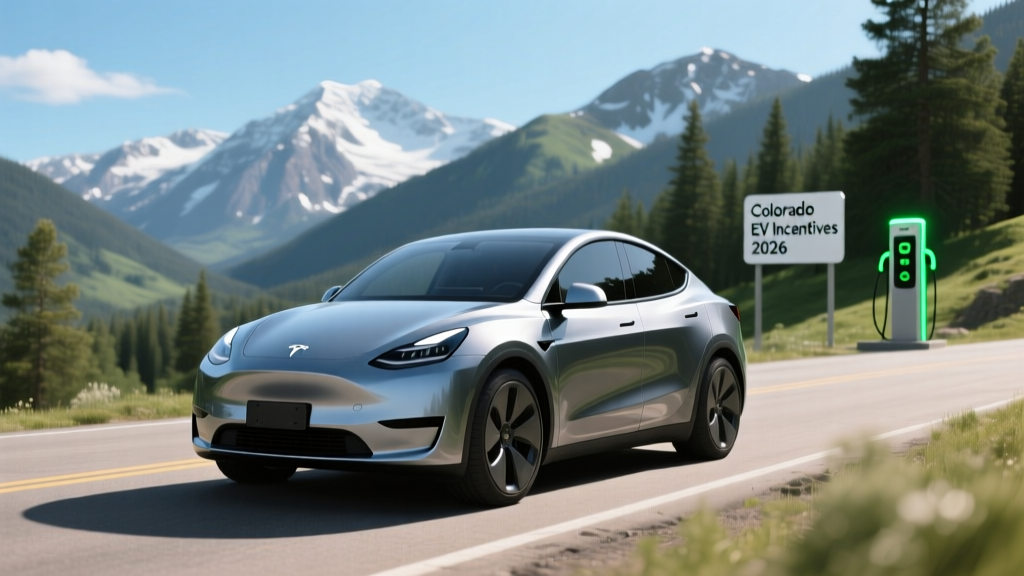
Colorado has quietly become one of the best states in the US to buy an electric vehicle — not because of a single headline-grabbing incentive, but because of how its state tax credit, utility rebates, and federal §30D credit can stack together. Done right, a Colorado buyer in 2026 can shave $10,000–$15,000+ off the effective purchase price of a new EV before factoring in years of fuel and maintenance savings.
But stacking incentives requires navigating income caps, MSRP limits, battery-sourcing rules, and utility-specific rebate paperwork. This guide breaks down exactly what's available, who qualifies, and what your real five-year ownership cost looks like compared to a gas car — with the math to back it up.
How the Colorado EV Credit Works in 2026
Colorado's Innovative Motor Vehicle Credit is one of the most straightforward state EV incentives in the country. For the 2026 tax year, the credit structure for new electric vehicles is:
- $5,000 for new EVs with an MSRP up to $80,000 (purchased or leased)
- $2,500 for new EVs with an MSRP between $80,001 and $100,000
- An additional $2,500 bonus is available for income-qualified buyers (those earning below certain thresholds set by the Colorado Department of Revenue)
This is a state income tax credit, meaning it reduces your Colorado state tax liability dollar-for-dollar. It's not a deduction — it's direct money off your state tax bill. If the credit exceeds your state tax liability in the purchase year, Colorado allows you to carry the remainder forward for up to five years.
For 2026, Colorado also expanded eligibility to include used EVs purchased from a dealer for the first time in Colorado, with credits up to $3,500 depending on the vehicle's age and battery capacity. The used-EV credit phases down for more expensive models.
Federal §30D Tax Credit: What Colorado Buyers Actually Qualify For
The federal EV tax credit under IRS §30D offers up to $7,500 for qualifying new EVs, but the actual amount depends on two components: battery critical minerals sourcing ($3,750) and battery component manufacturing ($3,750). Many popular models in 2026 qualify for the full $7,500, but not all — and buyer eligibility has its own rules.
§30D Federal Credit Eligibility Checklist (2026)
- MSRP cap: Vans, SUVs, and trucks must have an MSRP ≤ $80,000; sedans and other body styles ≤ $55,000
- Buyer income cap: Modified AGI must not exceed $300,000 (married filing jointly), $225,000 (head of household), or $150,000 (single/other)
- Battery sourcing: A percentage of critical minerals must be extracted or processed in the US or an FTA partner country ($3,750 component)
- Battery components: A percentage of battery components must be manufactured or assembled in North America ($3,750 component)
- Foreign entity of concern (FEOC): Vehicles with battery components from a FEOC (primarily Chinese-owned entities) are disqualified entirely
- Point-of-sale transfer: As of 2024, you can transfer the credit to the dealer at purchase, applying it as a down payment reduction — even if you have no federal tax liability
- One credit per taxpayer per year: You can claim one new EV credit and one used EV credit per calendar year
According to the IRS Clean Vehicle Credit page, the battery-sourcing requirements tighten annually. For 2026, the critical mineral threshold is higher than in 2024, meaning some models that previously qualified for the full $7,500 may now only receive $3,750 or nothing at all. Always verify a specific vehicle's eligibility on fueleconomy.gov before signing a purchase agreement.
Utility Rebates: Xcel Energy, Colorado Springs, and More
Beyond state and federal tax credits, Colorado's electric utilities offer some of the most generous EV rebates in the country. These are typically point-of-sale or post-purchase rebates and stack with tax credits.
| Utility | Rebate Type | Amount |
|---|---|---|
| Xcel Energy | EV purchase rebate (income-qualified tiers) | Up to $5,500 for new EV; up to $3,000 for used |
| Xcel Energy | Level 2 home charger install rebate | Up to $1,200 |
| Colorado Springs Utilities | New EV rebate | $1,000 |
| La Plata Electric (LPEA) | EV purchase incentive | Up to $1,500 |
| Fort Collins Utilities | EV + charger bundle rebate | Up to $1,500 combined |
| Holy Cross Energy | EV purchase rebate | Up to $4,000 (income-tiered) |
5-Year Total Cost of Ownership: EV vs. Gas in Colorado
Incentives reduce the purchase price, but the ongoing cost of ownership determines whether an EV actually saves money long-term. Here's a realistic five-year breakdown comparing a typical mid-price EV (like a 2026 Tesla Model Y Long Range, ~$46,000 MSRP) against a comparable gas SUV (like a 2026 Toyota RAV4 AWD, ~$33,000 MSRP).
| Category | EV (Tesla Model Y LR) | Gas (Toyota RAV4 AWD) |
|---|---|---|
| Purchase price (MSRP) | $46,000 | $33,000 |
| Federal §30D credit | -$7,500 | $0 |
| Colorado state credit | -$5,000 | $0 |
| Utility rebate (Xcel avg.) | -$2,500 | $0 |
| Effective purchase price | $31,000 | $33,000 |
| Fuel/charging (5 yr, 60k mi) | $3,240 | $7,500 |
| Maintenance (5 yr) | $1,800 | $3,600 |
| Insurance (5 yr) | $10,200 | $7,800 |
| Depreciation (5 yr est.) | $15,500 | $11,200 |
| Total 5-year cost | $61,740 | $63,100 |
In this scenario, the EV comes out roughly $1,360 ahead over five years — and that's before accounting for Colorado's relatively low electricity rates or any time-of-use savings from overnight charging. The gap widens if you qualify for the income-based bonus credits or a larger utility rebate.
Charging vs. Gas: The Per-Mile Cost Math
Colorado's average residential electricity rate in 2026 hovers around $0.135/kWh (Xcel Energy standard rate; less on time-of-use plans). A Tesla Model Y Long Range achieves roughly 3.5 miles per kWh (or about 286 Wh/mi) in mixed driving, per EPA data.
| Metric | EV (Model Y LR) | Gas (RAV4 AWD) |
|---|---|---|
| Energy cost | $0.135/kWh (home) | $3.50/gal (CO avg.) |
| Efficiency | 3.5 mi/kWh (113 MPGe) | 28 MPG combined |
| Cost per mile | $0.039 | $0.125 |
| Annual cost (12,000 mi) | $468 | $1,500 |
| 5-year cost (60,000 mi) | $2,340 | $7,500 |
That's a $5,160 fuel savings over five years with primarily home charging. Public DC fast charging costs more — typically $0.30–$0.48/kWh on networks like Electrify America or EVgo — which raises the per-mile cost to roughly $0.09–$0.14, comparable to gas. The savings depend heavily on your home charging access.
Cold-weather reality check: Colorado winters reduce EV range by 15–30% depending on temperature and whether you precondition. At -10°F without preconditioning, expect your Model Y's EPA 310-mile range to drop to roughly 220–250 miles. This doesn't change the per-mile cost significantly (you're still using the same kWh), but it affects trip planning on I-70 mountain passes.
Maintenance Savings: Where EVs Quietly Win
EVs have dramatically fewer moving parts than internal combustion vehicles — no engine oil, no transmission fluid, no spark plugs, no timing belts, no exhaust system. The maintenance advantage compounds over years.
| Service Item | EV Cost | Gas Car Cost |
|---|---|---|
| Oil changes | $0 | $450 (6 changes @ $75) |
| Brake pads | $0–$200 (regen extends life 2–3x) | $600 (2 replacements) |
| Transmission fluid | $0 | $200 |
| Coolant flush | $150 | $200 |
| Air filter (cabin) | $150 | $150 |
| Tire rotation + replacement | $1,400 (EV tires wear faster due to weight/torque) | $1,100 |
| Wiper blades, misc. | $100 | $100 |
| Total | ~$1,800 | ~$3,600 |
The biggest offset is tires: EVs are heavier and deliver instant torque, which accelerates tire wear. Budget for tire replacement 20–30% sooner than you would on an equivalent gas vehicle. Regenerative braking, however, extends brake pad life enormously — many EV owners report original brake pads at 80,000+ miles.
The Insurance Reality: Why EVs Cost More to Insure
This is where honest math matters. EV insurance premiums in Colorado are typically 15–25% higher than comparable gas vehicles. The reasons are structural, not arbitrary:
- Higher repair costs: EV battery packs are expensive to replace after collision damage. Even minor undercarriage impacts can total a battery.
- Specialized labor: Fewer body shops have EV-certified technicians, driving up labor rates.
- Higher vehicle values: EVs generally carry higher MSRPs, increasing comprehensive and collision premiums.
- Parts availability: EV-specific parts (battery modules, power electronics) have longer lead times than common ICE parts.
For the Tesla Model Y in Colorado, expect annual premiums of roughly $1,900–$2,200 depending on your driving record, age, and coverage level — versus $1,400–$1,700 for a RAV4. That's an extra $2,000–$2,500 over five years that partially offsets fuel and maintenance savings.
Some insurers (like Tesla Insurance in eligible states) offer usage-based policies that can narrow this gap. Always get quotes from at least three carriers before purchasing.
Depreciation: The Wildcard in EV Ownership
EV depreciation has been volatile. Between 2023 and 2025, aggressive price cuts from Tesla and an influx of new models compressed used EV values significantly. As of early 2026, the market has stabilized somewhat, but EVs still depreciate faster than many gas counterparts on a percentage basis.
Key factors affecting EV resale value:
- Battery health perception: Buyers discount used EVs based on battery degradation fears, even though most modern LFP and NMC packs retain 85–92% capacity at 100,000 miles.
- Technology obsolescence: Faster iteration in charging speed, range, and software makes 3-year-old EVs feel dated compared to 3-year-old gas cars.
- New model competition: Each new affordable long-range EV entering the market pressures used prices of older models.
- Tax credit effect: When new EVs qualify for $7,500 federal + $5,000 Colorado credits, the effective new price drops, compressing the used market further.
Current five-year depreciation estimates for mainstream EVs run 40–55% versus 30–40% for comparable gas vehicles. However, this gap is narrowing as the used EV market matures and battery longevity data accumulates. Models with strong brand loyalty and proven battery durability (like the Hyundai Ioniq 5 and Ford Mustang Mach-E) have held value better than early-market entrants.
Putting It All Together: Who Saves the Most?
Colorado EV Incentive Decision Framework
You'll maximize savings if:
- Your household income qualifies for the full §30D credit (under $300K joint / $150K single)
- Your chosen EV falls under the MSRP cap ($80K for SUVs/trucks, $55K for sedans)
- You have access to Level 2 home charging (garage or driveway with a 240V circuit)
- Your utility offers a substantial purchase or charger rebate (Xcel, Holy Cross, LPEA customers benefit most)
- You drive 10,000+ miles annually (more miles = more fuel savings to offset insurance)
The math is tougher if:
- You exceed income caps and lose the $7,500 federal credit
- You rely entirely on public DC fast charging (per-mile cost approaches gas)
- You drive fewer than 6,000 miles/year (fuel savings don't offset the insurance premium)
- You plan to sell within 2–3 years (higher depreciation eats your savings)
Frequently Asked Questions
Can I combine the Colorado EV credit with the federal §30D credit?
Yes. Colorado's Innovative Motor Vehicle Credit is a state-level tax credit that stacks independently with the federal §30D Clean Vehicle Credit. They are separate programs with separate eligibility rules. A qualifying buyer can receive up to $7,500 federal + $5,000 Colorado (or more with income-based bonuses) on a single vehicle purchase.
Does the Colorado EV credit apply to leased vehicles?
Yes, Colorado's credit is available for both purchased and leased new EVs, provided the vehicle meets the MSRP and eligibility requirements. For leases, the credit typically passes through to the lessee, but confirm the lease agreement specifies this — the lessor technically claims the credit and must pass the savings on.
What if my income exceeds the federal §30D cap but I'm under Colorado's threshold?
You can still claim the Colorado state credit even if you don't qualify for the federal credit due to income limits. The Colorado credit has its own income-qualification tiers for the bonus amount, but the base $5,000 credit (for vehicles under $80K MSRP) is available to all Colorado taxpayers regardless of income.
How do I claim the Colorado EV credit on my taxes?
File Colorado form DR 0104CR (Individual Credit Schedule) with your state income tax return. You'll need the vehicle purchase agreement, VIN, and proof that the vehicle was titled and registered in Colorado. Consult a Colorado-licensed tax professional to ensure proper filing, especially if you're carrying forward unused credit amounts.
Do I need to install a Level 2 charger at home to benefit from Colorado incentives?
No, home charging is not required to claim the vehicle purchase credits. However, utility charger rebates (like Xcel's $1,200 Level 2 rebate) do require installation of qualifying equipment. Home Level 2 charging also dramatically reduces your per-mile cost compared to public DC fast charging, making the overall ownership math significantly more favorable.
Are used EVs eligible for any Colorado incentives?
Yes. Colorado offers a used EV credit of up to $3,500 for qualifying pre-owned electric vehicles purchased from a dealer and titled in Colorado for the first time. Federally, the §25E used clean vehicle credit offers up to $4,000 (or 30% of the sale price, whichever is less) for used EVs under $25,000 purchased from a dealer, with buyer income caps of $150K joint / $75K single.
The bottom line for Colorado buyers: the incentive landscape in 2026 is among the strongest in the nation, but the savings aren't automatic. Verify your specific vehicle's federal eligibility on the IRS and fueleconomy.gov databases, confirm your utility's current rebate availability, and run the five-year math with your actual mileage and electricity rate before signing. The numbers work for most Colorado drivers — just make sure they work for yours.