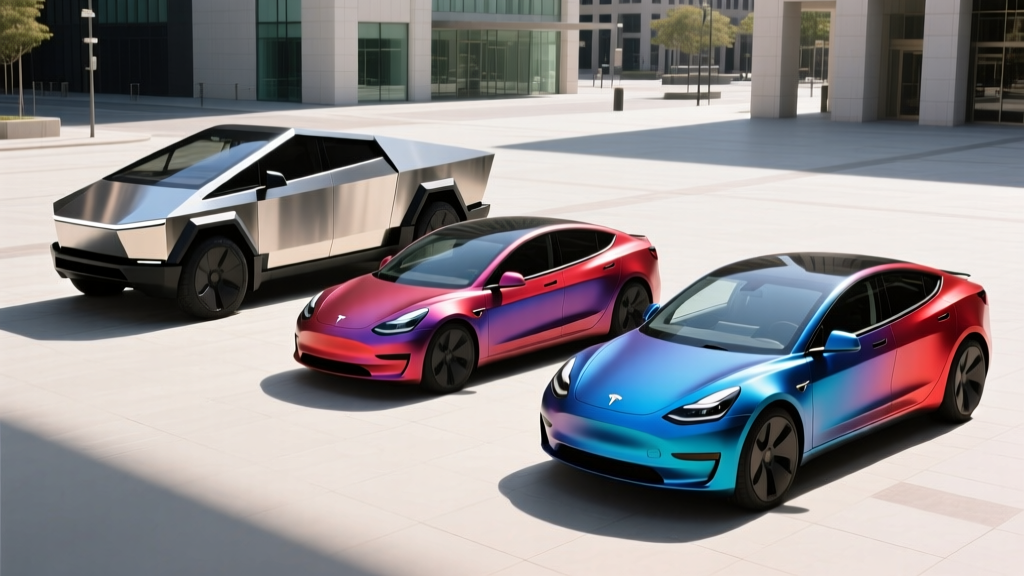
When buyers search for a color changing Tesla, they're usually chasing one of two things: the viral Cybertruck vinyl-wrap transformations that dominate social media, or the genuine paint-technology options Tesla offers across its 2026 lineup. Unlike BMW's iX Flow with E Ink panels — a concept that hasn't reached production at scale — Tesla's approach to exterior color is grounded in traditional automotive paint, a limited factory palette, and a booming aftermarket wrap industry.
This guide breaks down every factory color available on the 2026 Tesla Model 3, Model Y, Model S, Model X, and Cybertruck, examines the real costs and durability of color-change wraps, and profiles the Cybertruck as the model most associated with the color-changing trend. We'll also cover the specs that actually matter to buyers: EPA range, charging speeds, battery chemistry, and federal tax credit eligibility under current IRS §30D rules.
Tesla's 2026 Factory Color Palette by Model
Tesla's factory paint options remain deliberately narrow compared to legacy automakers. This simplifies production and keeps base prices lower, but it frustrates buyers who want个性化 expression straight from Fremont or Giga Texas. Here's the current lineup:
| Model | Standard (Free) | Paid Options ($1,000–$2,500) | Specialty |
|---|---|---|---|
| Model 3 (2026) | Stealth Grey | Pearl White, Deep Blue, Solid Black, Ultra Red | Quicksilver ($2,500) |
| Model Y (2026 Refresh) | Stealth Grey | Pearl White, Deep Blue, Solid Black, Ultra Red | Quicksilver ($2,500) |
| Model S / X | Stealth Grey | Pearl White, Deep Blue, Solid Black, Ultra Red | Quicksilver ($2,500) |
| Cybertruck | Unpainted Stainless Steel | N/A — wrap or film only | Painted Armor ($6,500 Satin White/Black at Giga Texas) |
The key takeaway: if you want a Tesla in a color Tesla doesn't sell — or you want to change that color later — a vinyl wrap is your primary path. This is especially true for the Cybertruck, whose cold-rolled stainless steel exoskeleton literally cannot be painted through conventional factory processes.
The Cybertruck: Tesla's Most 'Color-Changing' Vehicle
The Cybertruck has become synonymous with the color-changing Tesla phenomenon precisely because its bare stainless steel body invites customization. Owners and wrap shops have turned this into a cottage industry, with full-body color-change wraps ranging from matte chrome-delete blacks to pearlescent purples and even thermochromic films that shift hue with temperature.
| Spec | Cybertruck AWD (2026) | Cybertruck Cyberbeast (2026) |
|---|---|---|
| EPA Range | 340 miles | 320 miles |
| Battery (usable) | ~123 kWh (estimated, NMC) | ~123 kWh (estimated, NMC) |
| Max DC Fast Charge | 250 kW (peak) | 250 kW (peak) |
| 10–80% DC Charge Time | ~30 minutes | ~30 minutes |
| Level 2 Home Charging | 11.5 kW (~34 mi/hr) | 11.5 kW (~34 mi/hr) |
| 0–60 mph | 3.9 seconds | 2.6 seconds |
| Horsepower | 600 hp | 845 hp |
| Drivetrain | Dual-Motor AWD | Tri-Motor AWD |
| Efficiency | ~50 MPGe / ~67 kWh/100mi | ~47 MPGe / ~71 kWh/100mi |
| Towing Capacity | 11,000 lbs | 11,000 lbs |
| Cargo (bed + frunk) | ~67 cu ft bed + ~7 cu ft frunk | ~67 cu ft bed + ~7 cu ft frunk |
| Base MSRP | $79,990 | $99,990 |
| Battery Warranty | 8 years / 120,000 miles | 8 years / 120,000 miles |
Color-Change Wraps: Costs, Durability, and What to Know
A professional full-body vinyl wrap on a Tesla typically costs between $2,500 and $5,500 depending on material quality, shop reputation, and vehicle size. The Cybertruck's flat stainless panels are actually easier to wrap than curved surfaces, but its sharp creases and panel gaps demand an experienced installer.
| Wrap Type | Cost Range | Durability | Notes |
|---|---|---|---|
| Standard Gloss/Matte Vinyl (3M, Avery) | $2,500–$3,500 | 5–7 years | Most popular; wide color selection |
| Satin / Metallic Finish | $3,000–$4,500 | 5–7 years | Premium feel; shows fingerprints |
| Chrome Delete (black trim only) | $800–$1,500 | 5+ years | Partial wrap; very common on Model 3/Y |
| Colorshift / Chameleon Film | $4,500–$6,500 | 3–5 years | Angular color change; less UV-stable |
| PPF + Color Tint (XPEL, SunTek) | $5,000–$8,000 | 7–10 years | Paint protection + color in one layer |
Critical ownership note: Wrapping a Cybertruck's stainless steel is reversible and won't damage the body — but wrapping a painted Model 3 or Model Y requires caution. Low-quality vinyl or improper removal can pull clear coat, especially on Tesla's notoriously thin factory paint (typically 90–110 microns, thinner than most legacy brands). Always use a reputable installer and specify cast vinyl (not calendared) for painted surfaces.
Model 3 and Model Y: The Wrap-Friendly Fleet
While the Cybertruck dominates the color-change conversation, the Model 3 and Model Y are far more common wrap candidates by volume. With over 2 million Model 3s and 3 million Model Ys on U.S. roads, the aftermarket has perfected Tesla-specific wrap templates that minimize seams and installation time.
| Spec | Model 3 Long Range AWD (2026) | Model Y Long Range AWD (2026) |
|---|---|---|
| EPA Range | 363 miles | 320 miles |
| Battery (usable) | ~79 kWh (NMC) | ~79 kWh (NMC) |
| Max DC Fast Charge | 250 kW (peak) | 250 kW (peak) |
| 10–80% DC Charge | ~25 minutes | ~27 minutes |
| Level 2 Home Charging | 11.5 kW (~44 mi/hr) | 11.5 kW (~37 mi/hr) |
| 0–60 mph | 4.2 seconds | 4.8 seconds |
| Horsepower | 346 hp | 384 hp |
| Base MSRP | $47,740 | $48,990 |
| Efficiency | 132 MPGe / 25 kWh/100mi | 117 MPGe / 28 kWh/100mi |
| Cargo Volume | 23 cu ft (rear trunk + frunk) | 76 cu ft (rear seats folded) |
| Rear Legroom | 35.2 inches | 40.5 inches |
| Battery Warranty | 8 years / 120,000 miles | 8 years / 120,000 miles |
Both vehicles use Tesla's NMC (nickel-manganese-cobalt) battery chemistry in Long Range trims, prioritizing energy density over cycle life. The Standard Range RWD trims use LFP (lithium iron phosphate) chemistry — heavier but more durable over thousands of cycles, and recommended for daily 100% charging. If you're wrapping an LFP-equipped Standard Range model, note the slightly lower EPA range (~272 miles for Model 3 RWD) and plan accordingly.
Federal Tax Credit: Does a Color-Changing Tesla Qualify?
Under IRS §30D rules for 2026, the federal clean vehicle credit offers up to $7,500 — but eligibility depends on a web of requirements that trip up many Tesla buyers:
- MSRP Cap: Sedans (Model 3, Model S) must have an MSRP ≤ $55,000; SUVs, trucks, and vans (Model Y, Model X, Cybertruck) ≤ $80,000.
- Buyer Income Cap: Modified AGI ≤ $150,000 (single), $225,000 (head of household), $300,000 (married filing jointly).
- Battery Sourcing: A percentage of critical minerals and battery components must be sourced from the U.S. or free-trade-agreement countries — this requirement tightens annually and has disqualified some Tesla trims in past years.
- Point-of-Sale Transfer: Since 2024, buyers can transfer the credit to the dealer at purchase, reducing the out-of-pocket price immediately rather than waiting for tax filing.
- Assembly: Vehicle must undergo final assembly in North America (all U.S.-market Teslas qualify).
| 2026 Tesla Model | Base MSRP | Under MSRP Cap? | Estimated Credit |
|---|---|---|---|
| Model 3 RWD | $38,990 | Yes ($55K sedan cap) | Up to $7,500 (sourcing-dependent) |
| Model 3 Long Range | $47,740 | Yes | Up to $7,500 (sourcing-dependent) |
| Model Y Long Range | $48,990 | Yes ($80K SUV cap) | Up to $7,500 (sourcing-dependent) |
| Model S | $79,990 | No (exceeds $55K sedan cap) | $0 |
| Model X | $79,990 | Yes ($80K SUV cap — borderline) | Up to $7,500 if below cap after options |
| Cybertruck AWD | $79,990 | Yes ($80K truck cap) | Up to $7,500 (sourcing-dependent) |
| Cybertruck Cyberbeast | $99,990 | No (exceeds $80K cap) | $0 |
Important: Battery sourcing requirements have been the moving target. Always verify current-year eligibility on the fueleconomy.gov tax credit database before purchasing, as Tesla's supply chain shifts can move trims in and out of qualification mid-year. Consult a tax professional for your specific situation.
Autopilot, FSD, and the Tech That Actually Matters
Every 2026 Tesla ships with Basic Autopilot (adaptive cruise + lane centering) and the option to purchase Full Self-Driving (Supervised) for $8,000 or $99/month. To be clear about SAE automation levels:
The 2026 infotainment stack runs on Tesla's HW4 computer with a 15.4-inch center display (Model 3/Y) or 18.5-inch (Model S/X). The Cybertruck uses a unique yoke-style steering wheel (no round wheel option) and an 18.5-inch horizontal display. Standout features include:
- Over-the-air updates that add features post-purchase
- Sentry Mode dashcam recording (requires USB drive)
- Dog Mode and Camp Mode climate management
- NACS (North American Charging Standard) native connector — the industry standard as of 2026
- Vehicle-to-load (V2L) capability on Cybertruck (powers tools/appliances from the bed outlet)
Notable drawbacks: Tesla's panel-gap consistency remains below German and Korean competitors. The Cybertruck's yoke steering is polarizing and offers no round-wheel alternative. The Model 3 Highland refresh eliminated ultrasonic parking sensors, relying solely on Tesla Vision (camera-based) for proximity alerts — a downgrade some owners find less reliable in rain or low light. Insurance premiums for Teslas remain 20–40% above segment averages due to repair costs.
Pros
- Best-in-class Supercharger network access (20,000+ U.S. stalls)
- OTA updates continuously improve the vehicle
- Strongest real-world efficiency (kWh/mi) in most segments
- Wrap-friendly surfaces; massive aftermarket color-change ecosystem
- Industry-leading DC fast-charge reliability
Cons
- Limited factory color palette forces wrap dependency for customization
- Thin factory paint vulnerable to chips and wrap-removal damage
- Insurance costs 20–40% above comparable EVs
- Cybertruck range disappointing vs. EPA at highway speeds
- No Apple CarPlay / Android Auto support
Who Should Buy a Color-Changing Tesla?
The answer depends on which Tesla and which motivation:
- The customization enthusiast: If you want a vehicle that's a canvas for personal expression, the Model 3 or Model Y in Stealth Grey (free) plus a $3,000–$4,000 quality wrap gives you a one-of-one EV with 320+ miles of range and the lowest operating costs in the segment.
- The Cybertruck buyer: You're already buying a vehicle that demands aftermarket color work if you want anything beyond bare steel. Budget $4,000–$6,000 for a premium wrap or PPF+tint combo on top of the $79,990 MSRP.
- The pragmatic commuter: Skip the wrap budget. Order a Model 3 RWD in Stealth Grey, apply the $7,500 credit (if eligible), and enjoy ~$0.04/mile electricity costs. You can always wrap later.
- The family road-tripper: Model Y Long Range with a protective PPF wrap (preserves resale while adding subtle color tint) offers the best combination of 320-mile range, 76 cu ft cargo space, and Supercharger access for cross-country drives.
Frequently Asked Questions
Does Tesla offer a factory color-changing paint option?
No. Tesla does not offer E Ink or electrochromic paint on any production vehicle as of 2026. BMW demonstrated this technology on the iX Flow concept, but it hasn't reached mass production. Tesla's color options are traditional automotive paint in 5–6 colors per model, plus the Cybertruck's unpainted stainless steel.
How much does it cost to wrap a Tesla?
A full-body color-change wrap costs $2,500–$5,500 for a Model 3 or Model Y, and $3,500–$6,500 for a Cybertruck (larger surface area). Chrome deletes (black window trim and badges) run $800–$1,500. Premium materials like XPEL color PPF cost $5,000–$8,000 but combine paint protection with color.
Will wrapping my Tesla void the warranty?
A vinyl wrap does not void Tesla's battery or powertrain warranty (8 years/100,000–120,000 miles). However, if wrap removal damages the factory paint, Tesla will not cover the repaint under warranty. For Cybertruck owners, wrapping stainless steel is completely reversible with zero paint risk.
How fast does a Tesla charge at home and on the road?
At home on a Level 2 charger (11.5 kW / 48-amp circuit), a Model 3 Long Range adds ~44 miles of range per hour — a full overnight charge from 20% to 100% takes about 7 hours. On DC fast charging, Teslas peak at 250 kW at V3/V4 Superchargers, reaching 10–80% in 25–30 minutes depending on battery temperature and state of charge. Note: charge speed tapers significantly above 80% to protect battery health.
Is a Tesla worth buying vs. competitors in 2026?
For buyers prioritizing charging infrastructure, efficiency, and software, Tesla still leads. The Supercharger network remains the most reliable DC fast-charging ecosystem in the U.S. However, the Hyundai Ioniq 5, Kia EV6, and Chevrolet Equinox EV now match or exceed Tesla on interior quality, warranty coverage (Hyundai's 10-year/100,000-mile battery warranty vs. Tesla's 8-year), and available color options from the factory. If factory color choice matters to you without a wrap, competitors offer 8–12 colors vs. Tesla's 5–6.
What is the real-world range of a Tesla?
Real-world range typically falls 10–20% below EPA estimates at sustained highway speeds (70–80 mph), and 20–35% below in freezing temperatures. A Model 3 Long Range rated at 363 miles EPA delivers ~290–320 miles on a mixed-drive summer day, ~260–280 miles at highway speeds, and ~230–250 miles in sub-30°F weather. The Cybertruck suffers the largest real-world gap due to aerodynamic drag.
Sources: EPA range and efficiency data via fueleconomy.gov; IRS §30D credit rules via irs.gov; Tesla specifications via tesla.com.