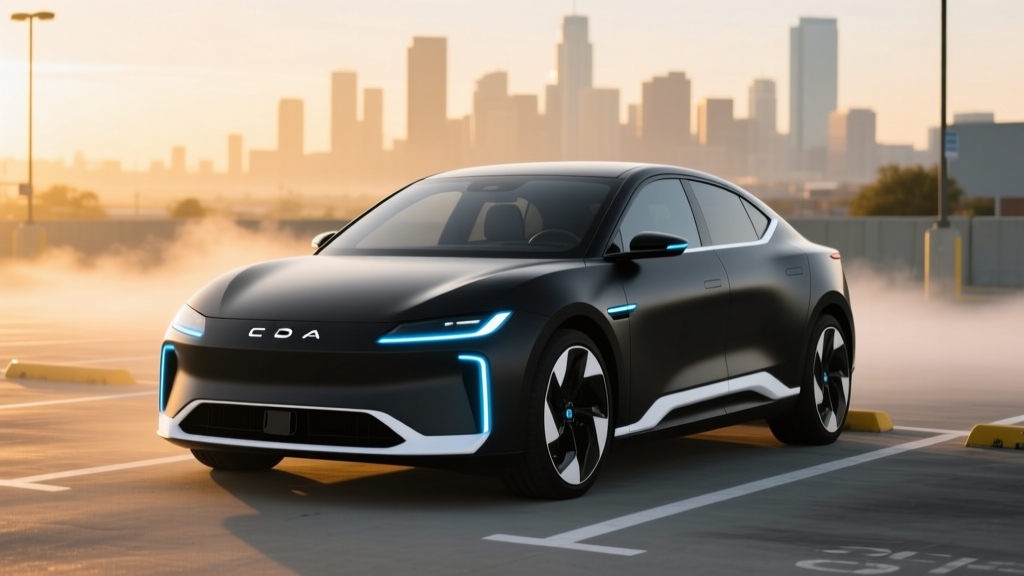
The short answer: The Coda electric car (officially the Coda sedan) was produced only for the 2012–2013 model years by the now-defunct Coda Automotive. It is not available new and has not been manufactured for over a decade. If you're researching the Coda electric car in 2026, you're almost certainly looking at a used vehicle — and we'd recommend extreme caution. The original 31 kWh battery delivered just 88 miles of EPA range, the company went bankrupt, and parts and service support are essentially nonexistent. For most buyers, modern used EVs like a 2019 Nissan Leaf, 2018 Chevrolet Bolt, or 2020 Tesla Model 3 offer dramatically better range, reliability, and support at comparable or lower prices.
What Was the Coda Electric Car?
Coda Automotive, a California-based startup founded in 2009, launched a single product: a battery-electric sedan based on the Chinese-market Hafei Saibao III chassis. The company imported the rolling chassis and fitted it with an electric powertrain and a 31 kWh lithium iron phosphate (LFP) battery pack. Sales began in California in March 2012 at an MSRP of $37,250 (before any federal or state incentives). The Coda sedan was sold only in select California dealerships, with limited availability in Oregon and Hawaii.
Coda Automotive filed for Chapter 11 bankruptcy in March 2013 after selling fewer than 100 vehicles. The company's assets were later acquired, and remaining inventory was liquidated at steep discounts — some Codas reportedly sold for under $15,000. Today, Coda sedans occasionally surface on used-car marketplaces, typically priced between $4,000 and $8,000 depending on condition and mileage.
Coda Sedan Specifications: The Numbers
| Specification | Coda Sedan (2012–2013) |
|---|---|
| EPA Range | 88 miles |
| Battery Capacity | 31 kWh (LFP chemistry) |
| Motor Output | 134 hp (100 kW) |
| 0–60 mph | ~9.5 seconds |
| Top Speed | 85 mph (electronically limited) |
| AC Charging (Level 2) | 6.6 kW onboard charger |
| DC Fast Charging | Not available |
| Charge Time (Level 2, 0–100%) | ~6 hours |
| Connector | J1772 (Level 2 only) |
| EPA Efficiency | 105 MPGe combined |
| Original MSRP | $37,250 |
| Used Price Range (2026) | $4,000–$8,000 |
| Battery Warranty | 10 years / 100,000 miles (defunct — no recourse) |
Real-World Range: 88 Miles EPA, Often Less
The Coda's 88-mile EPA rating was modest even by 2012 standards — the Nissan Leaf offered 73 miles that same year but at a lower price point and with a major manufacturer behind it. In real-world driving, expect the Coda to deliver 70–80 miles in mixed driving and potentially 55–65 miles in cold weather or sustained highway speeds above 65 mph.
The LFP battery chemistry is a notable bright spot. LFP cells degrade more slowly than the nickel-manganese-cobalt (NMC) chemistry used in most competing EVs of that era, meaning a 2012 Coda's battery may retain more of its original capacity than a similarly aged Leaf. However, after 13+ years, some degradation is inevitable — expect 80–90% state of health (SoH) on a well-maintained pack, reducing real-world range to perhaps 65–75 miles.
The complete absence of DC fast charging is a major practical limitation. With only a 6.6 kW Level 2 onboard charger and no CCS or CHAdeMO capability, the Coda cannot use any public fast-charging network. Every charge requires a Level 2 station or standard 120V outlet (which would take over 20 hours for a full charge). This makes the Coda strictly a local commuter vehicle.
Cost Breakdown: What Ownership Actually Costs
Let's model what owning a used Coda sedan looks like in 2026 versus a comparably priced used gas car and a modern used EV alternative.
| Cost Factor | Coda Sedan (Used) | 2016 Honda Civic (Used, Gas) | 2019 Nissan Leaf S (Used, 40 kWh) |
|---|---|---|---|
| Purchase Price | $6,000 | $9,500 | $10,500 |
| Annual Electricity/Fuel (12,000 mi) | ~$430 | ~$1,440 | ~$480 |
| Annual Maintenance | ~$200 (minimal) | ~$800 | ~$300 |
| Annual Insurance | ~$1,100 | ~$1,200 | ~$1,300 |
| Battery Replacement Risk | High — no OEM support | N/A | Low — Nissan parts network |
| 5-Year Total Cost | ~$14,000 + battery risk | ~$21,700 | ~$19,000 |
| Federal Tax Credit (§30D) | Not eligible (discontinued) | Not eligible | May qualify for $4,000 used-EV credit |
The Coda's low purchase price is tempting, but the total cost equation is undermined by the battery-replacement risk. A new 31 kWh pack is not available from any OEM supplier, and third-party EV battery rebuilds typically cost $5,000–$10,000 — potentially more than the car is worth. The IRS §30D used-EV credit of up to $4,000 is also unavailable because the Coda is no longer a qualifying vehicle from a recognized manufacturer with active reporting.
Coda vs. Gas vs. Modern Used EV: A Direct Comparison
| Attribute | Coda Sedan | Gas Sedan (2016 Civic) | 2019 Nissan Leaf (40 kWh) |
|---|---|---|---|
| Range | 88 mi (EPA) | ~380 mi (tank) | 150 mi (EPA) |
| Refuel/Recharge Time | 6 hrs (Level 2) | 5 min (gas station) | 40 min (CHAdeMO DC) |
| DC Fast Charging | No | N/A | Yes (50 kW CHAdeMO) |
| Parts Availability | Essentially none | Excellent | Good (Nissan network) |
| Service Network | None | Universal | Nissan dealers nationwide |
| Safety Ratings (NHTSA) | Not rated | 5-star overall | 4-star overall |
| Cargo Space | ~12 cu ft | 15.1 cu ft | 23.6 cu ft |
| Battery Warranty Remaining | Expired / no recourse | N/A | May retain partial coverage |
The comparison makes the Coda's limitations stark. A 2019 Leaf at roughly $10,500 offers 70% more range, DC fast charging, a functioning parts and service network, NHTSA safety ratings, and potential eligibility for the used clean vehicle credit (up to $4,000, subject to income caps and dealer reporting requirements). Even accounting for the Leaf's higher purchase price, the total ownership picture strongly favors the modern alternative.
Common Misconceptions About the Coda
| Myth | Fact |
|---|---|
| "LFP batteries last forever, so the Coda's pack is fine." | LFP chemistry degrades more slowly than NMC, but 13-year-old cells still lose capacity through calendar aging. Expect 80–90% SoH at best. |
| "It's cheap, so it's a good deal." | The purchase price ignores the lack of service support, absent safety ratings, no DC fast charging, and the battery-replacement gamble that could exceed the car's value. |
| "I can charge it at any public station." | Without DC fast charging, the Coda can only use Level 2 public chargers (J1772). At 6.6 kW, a 20-minute stop adds roughly 20 miles — impractical for road trips. |
| "It qualifies for EV tax credits." | The Coda is not eligible for the §30D new-vehicle credit (discontinued) or the used-EV credit (manufacturer not actively reporting to IRS). Check IRS qualifying vehicle lists. |
| "Someone still services these." | Coda Automotive ceased operations in 2013. No authorized service network exists. Independent EV shops may help, but proprietary parts are unavailable. |
Who (If Anyone) Should Buy a Used Coda?
Consider the Coda ONLY if ALL of the following apply:
- You need a dirt-cheap local commuter and drive fewer than 40 miles round-trip daily.
- You have reliable Level 2 home charging (a 240V outlet or installed EVSE).
- You live in a mild climate — cold weather will further reduce the already limited range.
- You are mechanically inclined or have access to an EV-savvy independent mechanic.
- You accept that the car may become unfixable if the battery or power electronics fail.
- You view this as a $4,000–$6,000 disposable purchase — you're prepared to walk away if a major component fails.
Choose a modern used EV (Leaf, Bolt, Model 3) if ANY of the following apply:
- You drive more than 50 miles per day or take occasional road trips.
- You need DC fast charging for apartment living or long-distance travel.
- You want NHTSA/IIHS safety ratings and modern crash protection.
- You want access to the used-EV tax credit (up to $4,000 via point-of-sale transfer).
- You want a vehicle that can be serviced at a dealer or established chain.
- You plan to keep the car for more than 2–3 years.
Real-World Ownership Considerations
Home charging is mandatory. Without DC fast charging, the Coda is entirely dependent on Level 2 charging. If you live in an apartment without EV charging infrastructure or rely solely on public chargers, the Coda is impractical. A basic Level 2 home EVSE installation runs $500–$2,000 depending on electrical panel capacity and run length — an added cost on top of the purchase price.
Insurance may be difficult. Some insurers decline to cover vehicles from defunct manufacturers due to the inability to source replacement parts. Before purchasing, get quotes from multiple carriers. Expect premiums in the $900–$1,300/year range if coverage is available.
Registration and inspections vary by state. Some states require EV-specific inspections or have registration fees for electric vehicles (ranging from $50 to $200+ annually) that offset lost gas-tax revenue. Check your state's DMV requirements before committing.
Resale value is essentially zero. The Coda already trades at rock-bottom prices, and further depreciation is likely. Do not expect to recoup your investment when it's time to sell.
Better Alternatives at Similar Price Points
If your budget is under $15,000 and you want an electric vehicle, here are far more practical options available in the 2026 used market:
- 2018–2019 Chevrolet Bolt EV: 238-mile EPA range, 60 kW DC fast charging (CCS), widely available parts via GM dealers, typically $9,000–$13,000 used.
- 2019–2020 Nissan Leaf (40 kWh): 150-mile EPA range, CHAdeMO DC fast charging, strong Nissan service network, $8,500–$11,000 used, potentially eligible for the $4,000 used-EV credit.
- 2017–2018 Tesla Model 3 (Standard Range): 220–240-mile range, Supercharger access (NACS), over-the-air updates, $12,000–$16,000 used.
- 2017–2019 Volkswagen e-Golf: 125-mile EPA range (2017+ with 35.8 kWh pack), CCS DC fast charging, VW dealer support, $8,000–$11,000 used.
Each of these alternatives provides more range, fast-charging capability, active manufacturer support, and better safety ratings — making them objectively superior choices for nearly every buyer.
Frequently Asked Questions
Is the Coda electric car still being made?
No. Coda Automotive filed for bankruptcy in March 2013 and ceased all operations. The Coda sedan was only produced for the 2012 and 2013 model years, with fewer than 100 units sold. The company no longer exists, and no successor entity produces vehicles.
What battery does the Coda use, and can it be replaced?
The Coda uses a 31 kWh lithium iron phosphate (LFP) battery pack. While LFP chemistry is known for longevity, the pack is now 13+ years old. Replacement is extremely difficult — no OEM supplier offers a new pack, and third-party EV battery rebuilders may not support the Coda's proprietary configuration. Expect a custom rebuild to cost $5,000–$10,000 if one is even possible.
Can I get the $7,500 federal tax credit for a Coda?
No. The Coda is not eligible for the §30D new clean vehicle credit (the vehicle is discontinued) or the up-to-$4,000 used clean vehicle credit (Coda Automotive no longer exists to report qualifying sales to the IRS). No federal EV incentives apply to this vehicle.
How does the Coda compare to a modern EV like the Chevy Bolt?
The 2018–2019 Chevrolet Bolt EV offers 238 miles of EPA range (vs. 88 for the Coda), 60 kW DC fast charging (the Coda has none), a full GM dealer service network, NHTSA 5-star safety ratings, and modern infotainment. Used Bolt prices overlap with the Coda's, making the comparison decisively one-sided.
Is the Coda safe to drive?
The Coda was never crash-tested by NHTSA or IIHS. It was built on a Chinese-market chassis (Hafei Saibao III) that predates modern crash-safety engineering standards. It lacks standard features like automatic emergency braking, lane-keeping assist, or adaptive cruise control that are common even in budget vehicles today. We cannot recommend it on safety grounds.
Where can I get a Coda serviced?
There is no authorized Coda service network. Some independent mechanics or EV-specialty shops may be willing to work on one, but proprietary parts (body panels, electronics, powertrain components) are essentially unavailable. Any major repair could render the vehicle a total loss.