Quick Answer: Is a Classic EV Conversion Worth It?
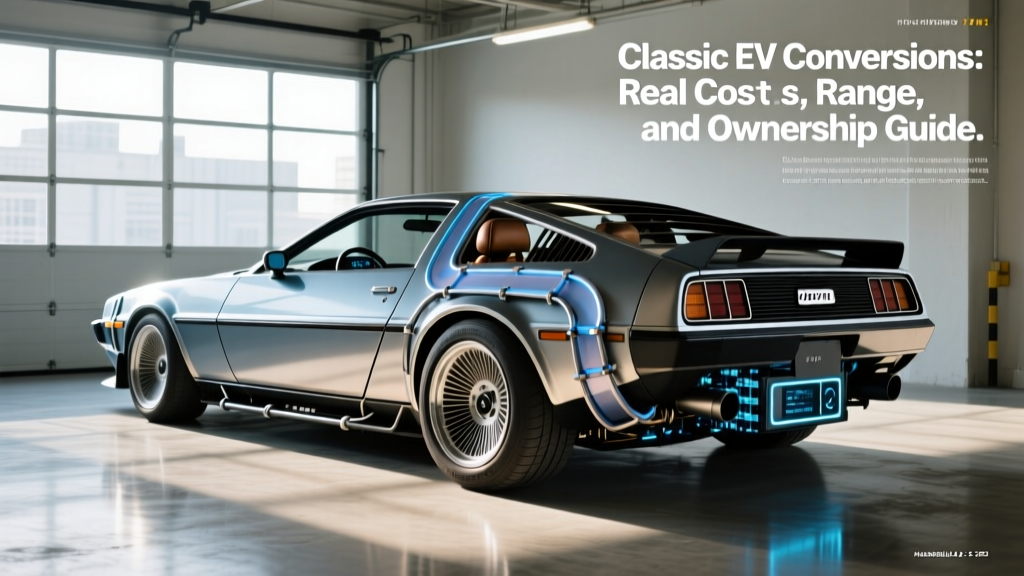
A classic EV conversion replaces a vintage car's internal-combustion powertrain with an electric motor and battery pack. Expect to pay $30,000–$100,000+ for the conversion alone, on top of the donor vehicle cost. Most builds deliver 80–200 miles of real-world range, charge at 3–7 kW on Level 2 (adding 12–28 miles per hour), and lack DC fast charging unless you spec a modern inverter and CCS/NACS port. Conversions make sense if you want a zero-emission daily-driver classic with low running costs and already have home Level 2 charging. They do not make sense as a budget alternative to a new EV — a new Chevrolet Equinox EV starts around $33,000 before incentives and delivers 315+ miles EPA range with full fast-charging capability.
What a Classic EV Conversion Actually Involves
An EV swap removes the engine, fuel tank, exhaust, and often the transmission, then installs an electric motor (typically an AC induction or permanent-magnet unit), a motor controller/inverter, a high-voltage battery pack, a DC-DC converter to run 12V accessories, and an onboard charger for Level 1/Level 2 AC charging. The original transmission is sometimes retained to simplify the drivetrain interface, though single-speed reduction gearboxes are increasingly common in higher-budget builds.
Popular donor vehicles include the 1960s–70s Volkswagen Beetle, Porsche 911, Ford Bronco, Chevrolet C10, and various air-cooled Porsches — chosen for light weight, simple mechanicals, and strong aftermarket support. Companies like EV West, Electric Classic Cars, and Zelectric have established reference builds that set the benchmark for the hobby.
The battery pack is the single largest cost driver. Most conversions use salvaged Tesla modules, new LFP (lithium iron phosphate) prismatic cells, or NMC (nickel manganese cobalt) pouch cells. Pack sizes typically range from 20 kWh to 60 kWh usable, with the physical space available in the donor chassis being the primary constraint.
Cost Breakdown: Conversion vs. New EV
The economics of an EV conversion look very different from buying a factory electric vehicle. Here is a realistic breakdown based on current market pricing for parts and labor:
| Category | Classic EV Conversion | New EV (e.g., Equinox EV LT) |
|---|---|---|
| Vehicle / donor car | $5,000–$40,000 | $33,600 MSRP |
| Motor + controller | $3,000–$8,000 | Included |
| Battery pack (cells + BMS + enclosure) | $8,000–$25,000 | Included |
| Onboard charger + DC-DC + wiring | $2,500–$5,000 | Included |
| Labor (if not DIY) | $10,000–$30,000 | N/A |
| Charging port (J1772/NACS) | $500–$1,500 | Included |
| Heating / HVAC integration | $1,500–$4,000 | Included |
| Registration, inspection, insurance uplift | $1,000–$3,000 | Standard registration |
| Total estimated cost | $31,500–$116,500 | ~$33,600 (before credits) |
| Federal §30D tax credit eligibility | Not eligible (not a new qualified vehicle) | Up to $7,500 if income/MSRP/sourcing rules met |
Key takeaway: a professionally done conversion on a desirable donor car routinely exceeds $70,000 total. This is an emotional and lifestyle purchase, not a cost-saving strategy versus a new EV. The IRS §30D federal tax credit applies only to new qualified plug-in electric vehicles meeting MSRP caps, buyer income limits, and battery critical-mineral sourcing requirements — a home-built or shop-converted classic does not qualify.
Range, Charging, and Efficiency: What the Numbers Actually Look Like
Factory EVs publish EPA-certified range figures. Conversions have no such certification, so real-world range depends entirely on pack size, vehicle weight, aerodynamics, and driving style. Here are typical figures from well-documented builds:
| Metric | VW Beetle Conversion (36 kWh pack) | Original VW Beetle (gas) | 2026 Chevy Equinox EV (factory) |
|---|---|---|---|
| Energy capacity | 36 kWh usable, LFP | 10.6 gal fuel tank | 85 kWh usable, NMC |
| Real-world range | 100–130 mi | ~280 mi (at 26 MPG) | 315 mi EPA |
| Efficiency | ~280–320 Wh/mi | 26 MPG combined | ~270 Wh/mi (124 MPGe) |
| Level 2 charge rate | 3.3–6.6 kW | N/A | 11.5 kW (up to 19.2 kW) |
| Level 2 miles per hour | 12–22 mi/hr | N/A | ~37–60 mi/hr |
| DC fast charging | Rare; most builds lack it | N/A | Up to 150 kW; 10–80% in ~30 min |
| 0–60 mph | 8–12 sec (varies widely) | ~20 sec (original) | ~7.5 sec |
Understanding kW vs. kWh: kW (kilowatts) measures power — how fast energy flows into the car. kWh (kilowatt-hours) measures energy — the total capacity of the battery. A 36 kWh battery charged at 6.6 kW takes roughly 5.5 hours from empty to full on Level 2. This is the single most common point of confusion for newcomers to conversions.
Real-World Range Reality Check
A conversion with a 36 kWh LFP pack rated at "130 miles" will realistically deliver 90–110 miles at sustained highway speeds (65–75 mph), and potentially 70–85 miles in cold weather (below 35°F) if the build lacks a heat pump or battery preconditioning system. Aerodynamic drag on boxy classics like Broncos and C10 trucks hits efficiency especially hard above 55 mph. Plan your daily driving radius accordingly.
Battery Chemistry: LFP vs. NMC for Conversions
Your battery chemistry choice affects range, longevity, safety, and cost. Here is how the two dominant options compare in a conversion context:
| Factor | LFP (Lithium Iron Phosphate) | NMC (Nickel Manganese Cobalt) |
|---|---|---|
| Energy density | Lower (~150–170 Wh/kg cell-level) | Higher (~220–260 Wh/kg cell-level) |
| Space needed for 40 kWh | Larger/heavier pack | More compact pack |
| Cycle life | 3,000–5,000+ cycles to 80% SoH | 1,000–2,000 cycles to 80% SoH |
| Thermal stability | Excellent — very resistant to thermal runaway | Good — requires robust BMS and thermal management |
| Cost per kWh (2026) | ~$100–$130/kWh (cell-level) | ~$120–$160/kWh (cell-level) |
| Cold-weather performance | Reduced charge acceptance below 32°F; needs heating | Better low-temp charge/discharge |
| Best for | Daily-driver conversions with space; longevity priority | Performance builds with tight packaging constraints |
For most classic conversions, LFP is the pragmatic choice in 2026. The superior cycle life means the pack will likely outlast the rest of the car, and the thermal safety margin is valuable when you are installing cells into a chassis not originally designed for high-voltage systems. The energy-density penalty matters less in a Beetle or bus where you have trunk and rear-seat space to fill.
Common Misconceptions About Classic EV Swaps
| Myth | Fact |
|---|---|
| "Conversions save money versus buying a new EV." | Most professional conversions cost $50K–$100K+ total. A new Tesla Model 3 starts around $38,000 with 363 miles of EPA range and full warranty coverage. |
| "You can charge at any public DC fast charger." | The vast majority of conversions are AC-only (Level 1 and Level 2). Adding CCS or NACS DC fast charging requires a compatible high-voltage inverter, proper communication protocol hardware, and significant additional cost ($3,000–$6,000+). Many builds simply cannot fast-charge. |
| "EV swaps are maintenance-free." | While you eliminate oil changes, spark plugs, and exhaust repairs, conversions introduce new maintenance: BMS monitoring, coolant loop service (if liquid-cooled), contactor replacement, and 12V auxiliary battery upkeep. The donor car's suspension, brakes, and steering still need standard classic-car maintenance. |
| "Any classic car can be converted easily." | Heavier, more complex donor cars (luxury sedans, cars with extensive electronics) are far more difficult. Lightweight, mechanically simple classics with ample trunk/engine-bay space are ideal. Rust, structural issues, and power-steering/brake integration add significant complexity. |
| "Converted EVs qualify for the $7,500 federal tax credit." | They do not. The IRS §30D credit applies only to new qualified clean vehicles purchased from a manufacturer, meeting MSRP caps ($55,000 for cars, $80,000 for SUVs/trucks/vans), buyer AGI limits, and battery component/critical-mineral sourcing requirements. A conversion is neither new nor manufacturer-certified. |
Real-World Ownership: What Daily Life Looks Like
Owning a converted classic EV is a fundamentally different experience from owning a factory EV. Here are the practical realities that no spec sheet will tell you:
Home charging is essentially mandatory. With 100–150 miles of typical range and no DC fast charging on most builds, public charging infrastructure is largely irrelevant for daily use. You need a dedicated Level 2 home charger (240V, 32–48 amp circuit) installed by a licensed electrician. Budget $800–$2,500 for a quality Level 2 EVSE (Emporia, ChargePoint, or Wallbox) plus $500–$2,500 for professional installation — more if your electrical panel needs an upgrade to 200A service.
Insurance requires a specialty carrier. Standard auto insurers often struggle to value a converted classic. Companies like Hagerty, Grundy, or American Modern offer agreed-value classic car policies, but you will need to document the conversion thoroughly (receipts, component list, battery specs) to establish an insured value. Expect premiums of $800–$2,500/year depending on agreed value and your driving profile.
Registration varies wildly by state. Some states have straightforward processes for registering a converted vehicle (inspecting the new drivetrain, issuing a new title notation). Others make it bureaucratically painful. Check your state DMV's requirements before starting the build — some states require specific safety inspections for modified vehicles, and a few have emissions-testing exemptions for EVs that can actually work in your favor.
Cold climate considerations. LFP batteries lose significant charge acceptance below freezing. If you live where winters regularly drop below 32°F, your conversion needs an active battery heating system (typically silicone heating pads or a liquid thermal loop) or you risk being unable to charge at all in winter. Range loss of 20–40% in cold weather is realistic, just as with factory EVs, but conversions rarely have the sophisticated thermal management of a Tesla or Hyundai platform.
Decision Framework: Should You Convert or Buy?
Choose a Classic EV Conversion If:
- You already own or deeply want a specific classic car and want to drive it daily without gas
- You have reliable home Level 2 charging and a daily driving radius under 80 miles
- You enjoy the build process, or have a trusted conversion shop and a $50K+ budget beyond the donor car
- You value uniqueness and are willing to forgo factory warranty, DC fast charging, and modern ADAS features
- You understand that this is a passion project, not a cost-optimization strategy
Choose a New Factory EV If:
- Your priority is reliable daily transportation with minimal hassle
- You need 250+ miles of range, DC fast charging for road trips, and full warranty coverage
- You want to take advantage of the federal §30D tax credit (up to $7,500 point-of-sale for eligible buyers and vehicles)
- You need modern safety features: automatic emergency braking, lane-keeping, blind-spot monitoring, and crash-test certification
- Your total vehicle budget is under $45,000
Choose a PHEV or Hybrid Classic If:
- You want some electric daily driving but need gas-engine range flexibility
- You lack reliable home charging and need fueling flexibility
- You want lower upfront cost — a Toyota RAV4 Prime PHEV offers 42 miles of electric-only range and 38 MPG combined for around $44,000 MSRP
Frequently Asked Questions
How long does a classic EV conversion battery last?
With LFP cells, expect 3,000–5,000+ charge cycles before the pack degrades to 80% State of Health (SoH). At one cycle per day, that is 8–14 years of daily use. NMC packs typically deliver 1,000–2,000 cycles. Unlike factory EVs, there is no mandated battery warranty — longevity depends on cell quality, BMS calibration, and thermal management. Budget $8,000–$15,000 for a future cell replacement if needed.
Can I add DC fast charging to a conversion later?
It depends on your inverter and battery architecture. If your build uses a CCS-compatible inverter (like certain Cascadia Motion or NetGain setups) and your battery pack can accept 50+ kW charge rates without overheating, a retrofit is technically possible but costs $3,000–$6,000+ in parts and labor. Many simpler builds using AC-only chargers cannot be upgraded without replacing major components.
What does charging cost versus gas for a conversion?
At the US average residential electricity rate of ~$0.17/kWh (per EIA data), charging a 36 kWh pack from empty to full costs about $6.12 and yields roughly 110 real-world miles — that is approximately $0.056 per mile. A comparable gas car at 25 MPG with fuel at $3.40/gallon costs $0.136 per mile. Over 12,000 miles per year, the conversion saves roughly $960 in fuel costs annually. Maintenance savings (no oil changes, fewer brake replacements due to regen) add another $300–$600/year.
Do converted EVs hold their value?
Depreciation is highly unpredictable. A well-documented, professionally converted classic from a reputable shop (e.g., Zelectric, Icon) on a desirable donor can hold value well or even appreciate in the collector market. A DIY conversion with poor documentation on a common donor car typically loses money at resale. The conversion quality, documentation, and donor desirability matter far more than the components alone.
What should a first-time EV conversion buyer know before starting?
Five essentials: (1) Confirm your state registration process for converted vehicles before spending a dollar. (2) Budget at least 30% more than the shop quote for unexpected fabrication, wiring, and integration work. (3) Prioritize battery thermal management — it is the single biggest factor in long-term pack health. (4) Install a dedicated 240V/48A circuit at home before the car is finished. (5) Keep every receipt and photograph every step of the build — this documentation is critical for insurance, resale, and your own troubleshooting.
Are classic EV conversions safe?
Safety depends entirely on build quality. A professional conversion with proper high-voltage isolation monitoring, fused circuits, crash-rated battery enclosures, and correctly rated contactors can be very safe. However, conversions do not undergo NHTSA crash testing, lack modern crumple-zone engineering, and do not include airbags or ADAS features like automatic emergency braking. You are driving a classic car chassis — drive accordingly. The NHTSA does not certify aftermarket EV conversions.