Are Class 8 Electric Trucks Ready for Heavy-Duty Work in 2026?
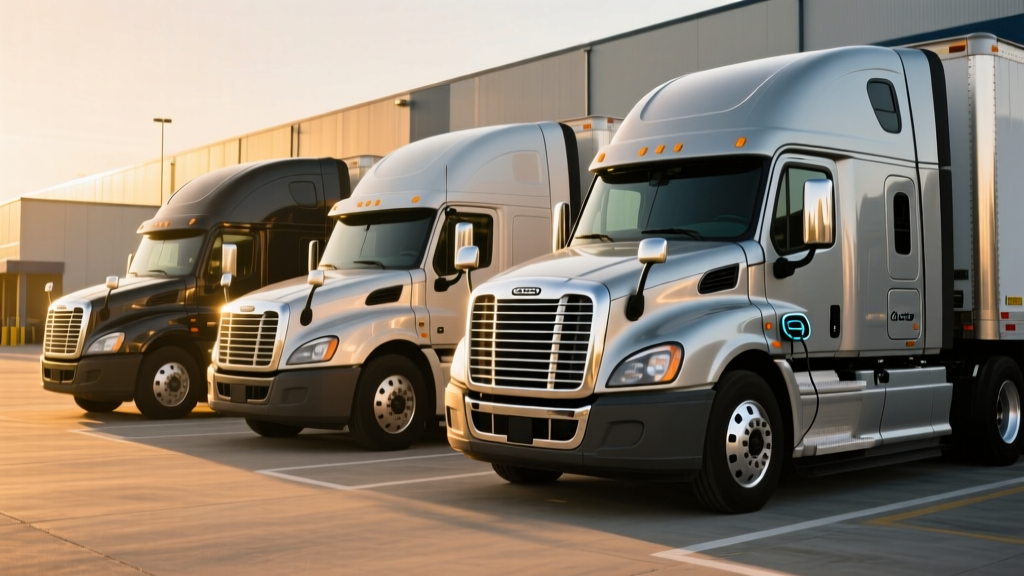
Class 8 electric trucks — semi-tractors with a gross vehicle weight rating (GVWR) above 33,000 lbs — are now in serial production and actively hauling freight for major carriers. Models like the Tesla Semi, Freightliner eCascadia, Volvo VNR Electric, and Peterbilt 579EV deliver between 150 and 500 miles of range, with battery packs from 150 kWh to over 900 kWh and DC fast-charging capability up to 1.2 MW (megawatts). Base pricing ranges from roughly $180,000 to $430,000 before incentives.
For fleets running regional and drayage routes under 250 miles, these trucks are operationally viable today — offering 50-70% lower per-mile energy costs versus diesel and dramatically reduced maintenance. For long-haul OTR (over-the-road) routes exceeding 400 miles, diesel still holds a practical advantage due to sparse megawatt-charging infrastructure and battery weight trade-offs.
Class 8 Electric Trucks Compared: Specs You Need
The heavy-duty EV market has matured from early pilot programs into orderable, warrantied production vehicles. Below are the key players available or in advanced delivery as of the 2026 model year, with manufacturer-published and independently verified specifications.
| Model | Battery (kWh) | Est. Range (mi) | Peak DC Charge | 10-80% Charge | Motor HP | Base MSRP |
|---|---|---|---|---|---|---|
| Tesla Semi (Long Range) | ~900 kWh (NMC) | 500 (EPA est.) | ~1.2 MW (MCS connector) | ~30 min | ~1,000+ (tri-motor) | ~$290,000 |
| Freightliner eCascadia | 291-438 kWh (NMC) | 155-230 | 400 kW (CCS2/MCS) | ~45-90 min | ~470 (dual e-axle) | ~$300,000-$370,000 |
| Volvo VNR Electric (6-battery) | 565 kWh (NMC) | 275 | 250 kW (CCS2) | ~60-70 min | ~455 | ~$350,000 |
| Peterbilt 579EV | 396 kWh (NMC) | ~150-200 | 350 kW (CCS2) | ~50-70 min | ~670 | ~$280,000-$330,000 |
| Kenworth T680E | 396 kWh (NMC) | ~150-200 | 350 kW (CCS2) | ~50-70 min | ~670 | ~$280,000-$340,000 |
Sources: Manufacturer spec sheets, Freightliner eCascadia, Volvo VNR Electric. Range figures vary by payload, terrain, and ambient temperature. Tesla Semi specs reflect manufacturer-claimed estimates; independent third-party EPA certification data remains limited.
Electric vs. Diesel Class 8: Operating Cost Breakdown
The purchase price of a Class 8 electric semi is 2-3x that of a comparable diesel tractor, but the per-mile operating cost tells a different story — especially for high-utilization fleet applications.
| Cost Category | Diesel Class 8 | Electric Class 8 | Notes |
|---|---|---|---|
| Purchase Price (tractor only) | $130,000-$170,000 | $280,000-$430,000 | EV includes battery; diesel excludes fuel tanks/DEF system costs |
| Energy/Fuel Cost per Mile | $0.65-$0.95 | $0.18-$0.40 | Diesel at $4.20/gal, 6.5 MPG; Electricity at $0.12-$0.25/kWh, 1.8-2.2 kWh/mi |
| Maintenance per Mile | $0.15-$0.22 | $0.05-$0.10 | No oil, DEF, DPF, turbo, or transmission service on EV; brake wear reduced via regen |
| Estimated 5-Year TCO (600,000 mi) | $650,000-$870,000 | $480,000-$750,000 | Includes purchase, energy, maintenance; excludes insurance, driver wages, tolls |
| Battery Replacement (year 8-10) | N/A | $40,000-$90,000 | Depends on pack size; most OEMs warranty 80% capacity at 5-7 years / 500K-750K mi |
The energy savings are the primary economic driver. At 2.0 kWh per mile (a reasonable real-world average for a loaded 80,000-lb combination) and a blended depot electricity rate of $0.18/kWh, an electric semi costs roughly $0.36/mile in energy. A diesel at 6.5 MPG and $4.20/gallon burns $0.65/mile. Over 120,000 miles per year, that's a $34,800 annual fuel savings — and that gap widens in states with higher diesel prices like California ($5.50+/gal).
Maintenance savings compound further. Electric drivetrains eliminate oil changes (every 40,000-50,000 miles on diesel), DEF fluid ($0.03/mi), diesel particulate filter (DPF) replacements ($3,000-$7,000), and turbocharger service. Regenerative braking extends friction brake life by 2-3x.
Federal and State Incentives: Offsetting the Upfront Gap
The IRA Commercial Clean Vehicle Credit (§45W) provides up to $40,000 for qualified commercial EVs with GVWR above 14,000 lbs — which includes all Class 8 trucks. Unlike the consumer §30D credit, §45W has no MSRP cap or personal income restriction, but the vehicle must be placed in service by a business and meet domestic-content and battery-sourcing requirements that tighten annually through 2032.
Additional incentives available to fleet buyers in 2026 include:
- California HVIP (Hybrid and Zero-Emission Truck and Bus Voucher Incentive Project): Vouchers of $60,000-$120,000+ per Class 8 zero-emission truck, with bonus amounts for fleets operating in disadvantaged communities.
- EPA Clean School Bus / Clean Heavy-Duty Vehicle Program: Grants covering up to $400,000 per vehicle plus charging infrastructure for eligible entities.
- Charging Infrastructure Tax Credit (§30C): Up to $100,000 per item of qualified charging property (including megawatt chargers) installed in eligible census tracts, covering 30% of hardware and installation costs.
- Utility Make-Ready Programs: Many investor-owned utilities (PG&E, SCE, ConEdison) cover 50-100% of the electrical infrastructure cost from the transformer to the charger pedestal for commercial fleet depots.
Stacking these incentives can reduce the effective purchase price of a $350,000 electric semi to under $150,000 — achieving near-parity with diesel on day one. However, incentive availability is jurisdiction-specific, application-based, and subject to funding exhaustion. Always confirm current program status with the administering agency.
Charging Infrastructure: The Depot Is the Fueling Station
Unlike consumer EVs that rely on public charging networks, Class 8 electric trucks primarily charge at fleet depots overnight. This is both their greatest advantage (predictable, low-cost fueling) and their greatest barrier (significant capital outlay for electrical infrastructure).
| Charging Level | Power (kW) | Miles Added/Hour | Full Charge Time | Use Case |
|---|---|---|---|---|
| Level 2 AC (depot overnight) | 40-80 kW | 20-40 mi/hr | 8-12 hours | Return-to-base daily routes under 200 mi |
| DC Fast (CCS2, depot) | 150-350 kW | 75-175 mi/hr | 2-4 hours | Multi-shift fleets, opportunity charging |
| Megawatt Charging (MCS) | 600-1,200 kW | 300-600 mi/hr | 30-60 min | Highway corridor charging, long-haul en route |
Depot installation cost for a 10-truck fleet with 350 kW CCS2 chargers typically ranges from $800,000 to $2.5 million, including switchgear, transformers, trenching, chargers, and software management systems. Per-stall costs of $80,000-$250,000 are common. This is where utility make-ready programs and the §30C credit become critical to the business case.
Public megawatt charging infrastructure is in early deployment. The WattEV corridor project along I-5 in California and NACFE-run Run on Less Electric depot demonstration have proven feasibility, but a national MCS network comparable to diesel truck stops does not yet exist. Fleets planning long-haul routes must treat public MCS as supplemental, not primary.
Battery Longevity, Warranty, and Replacement Costs
Class 8 truck batteries are engineered for higher cycle counts than passenger EVs, given the daily deep-cycling demands of commercial operation. Most OEMs use nickel-manganese-cobalt (NMC) chemistry optimized for energy density and thermal stability at large pack sizes.
| Factor | NMC (Most Class 8 Trucks) | LFP (Emerging for HDV) |
|---|---|---|
| Energy Density | Higher — more range per pound | Lower — heavier pack for same range |
| Cycle Life | 1,500-3,000 cycles | 3,000-6,000+ cycles |
| Cold-Weather Performance | Better low-temp discharge | Needs active heating; more range loss in cold |
| Cost per kWh | $130-$170 (2026 pack-level) | $90-$120 (2026 pack-level) |
| Warranty Typical | 5-7 yr / 500K-750K mi, 80% SoH | Similar; LFP degradation curve is flatter |
Battery replacement for a 400-565 kWh pack runs $40,000-$90,000 in 2026, down from estimates of $100,000+ just two years ago as pack-level pricing continues to decline. Some OEMs and third parties (including battery refurbishment firms) offer repurposed or remanufactured packs at 30-50% discount for second-life fleet applications.
Smart fleet operators monitor State of Health (SoH) via telematics and plan battery swaps or truck redeployment to shorter routes as capacity degrades below 85%. Most degradation occurs in the first 100,000 miles (5-8% loss), then plateaus — meaning a truck at 80% SoH at 500,000 miles still has substantial usable life for drayage or yard-hostler duty.
Decision Framework: Should Your Fleet Go Electric?
Choose a Class 8 Electric Truck If:
- Your routes are under 250 miles round-trip and return to a fixed depot daily (drayage, regional distribution, port operations, dedicated lanes).
- You have depot ownership or a long-term lease that permits electrical infrastructure upgrades.
- Your fleet operates in a state with strong incentive programs (CA, NY, NJ, WA, OR, CO) that can bridge the upfront cost gap.
- Your average diesel cost exceeds $4.00/gal or you face idling restrictions at ports and warehouses where zero-emission operation is mandated.
- You're preparing for regulatory compliance (e.g., CARB Advanced Clean Fleets rule, which requires drayage and certain fleet segments to transition to ZEV on a defined schedule).
- You run high annual mileage (100,000+ mi/yr) where per-mile energy and maintenance savings compound fastest.
Stick With Diesel (or Consider Fuel-Cell/Hydrogen) If:
- Your routes regularly exceed 400 miles without return-to-base, and public MCS charging is not available on your corridor.
- You operate in extreme cold climates (sustained sub-10°F) where 25-35% range loss could strand a loaded truck.
- You lack depot charging access and your utility cannot support the electrical load within your timeline.
- Your fleet's utilization is below 60,000 miles/year, where the TCO payback period stretches beyond the vehicle's economic life.
- You need maximum payload — battery weight (5,000-10,000+ lbs) reduces legal cargo capacity on weight-sensitive loads, though some states offer a 2,000-lb GVW exemption for ZEVs.
Common Misconceptions About Class 8 Electric Trucks
| Myth | Fact |
|---|---|
| "Electric semis can't pull full loads." | The Tesla Semi and eCascadia are rated for 82,000 lbs GCW. Torque delivery is instant — electric trucks often outperform diesel on grade-climbing. The trade-off is range reduction under full load, not inability to pull. |
| "Battery replacement will bankrupt the fleet." | Pack pricing has fallen to $130-$170/kWh. A 400 kWh replacement is $52,000-$68,000 — roughly equivalent to a diesel engine rebuild. Most packs outlast the truck's first-owner lifecycle at 80%+ SoH. |
| "Charging takes too long for logistics." | Overnight depot charging (8-10 hours) aligns with driver rest periods and daily return-to-base operations. For multi-shift fleets, opportunity charging at 350 kW adds 100+ miles in 30 minutes. MCS at 1 MW+ can add 300 miles in under an hour. |
| "The grid can't support fleet electrification." | Managed charging software (e.g., ChargePoint Fleet, EV Connect) staggers charging across off-peak hours. A 20-truck depot drawing 3 MW is comparable to a small industrial facility. Utility planning and on-site storage (batteries/solar) mitigate peak demand charges. |
| "Electric trucks are a California-only experiment." | Fleet deployments are active in TX, TN, GA, NJ, WA, and across major logistics corridors. PepsiCo, Sysco, Walmart, and JB Hunt all operate electric Class 8 trucks outside California. |
FAQ: Class 8 Electric Truck Ownership
What is the real-world range of a Class 8 electric truck with a full trailer?
Expect 60-75% of the manufacturer's published range at full 80,000-lb GCW on mixed terrain. A Volvo VNR Electric rated at 275 miles typically delivers 175-210 miles fully loaded on a route with moderate grades. The Tesla Semi's 500-mile claim translates to roughly 350-420 miles under real-world highway conditions with a loaded trailer. Cold weather (below 30°F) can reduce range an additional 15-25% due to battery resistance and cabin/climate load.
How much does it cost to install depot charging for a fleet of electric semis?
For a 10-truck depot with 350 kW CCS2 chargers, budget $800,000 to $2.5 million total — covering utility interconnection, transformers, switchgear, trenching, charger hardware ($40,000-$120,000 per stall), and software. Per-stall all-in costs average $80,000-$250,000. Megawatt charging (1 MW+) pushes per-stall costs to $300,000-$500,000+. Utility make-ready programs can offset 50-100% of the infrastructure on the utility side of the meter.
Do Class 8 electric trucks qualify for the federal tax credit?
Yes — under IRC §45W (Commercial Clean Vehicle Credit), businesses can claim up to $40,000 for qualified vehicles over 14,000 lbs GVWR. The credit is subject to battery-sourcing and critical-minerals requirements that tighten annually. The vehicle must be placed in service by the claiming business and used predominantly in the U.S. Consult a tax professional for eligibility specifics, as rules differ materially from the consumer §30D credit. Details at IRS.gov.
How does cold weather affect an electric semi's range and charging speed?
At sustained temperatures below 20°F, expect 20-35% range reduction depending on pack thermal management quality. Charging speed also tapers — a truck that charges 10-80% in 45 minutes at 70°F may take 65-80 minutes at 10°F without preconditioning. Most Class 8 EVs include active liquid thermal management and battery preconditioning routines that mitigate this when the charger is pre-programmed in the route. Depot charging in an enclosed or semi-enclosed bay reduces cold-weather impact substantially.
What happens when the battery degrades — is the truck retired?
No. A Class 8 electric truck with a battery at 75-80% State of Health is still highly functional for shorter routes, yard operations, or drayage. Many fleets plan a "cascade deployment" strategy: long routes in years 1-5, shorter routes in years 6-10, then repowering or second-life battery swap. Battery replacement costs ($40,000-$90,000) are comparable to a diesel engine overhaul and extend the truck's service life by another 5-7 years.
Can electric semis handle steep grades like the Grapevine or Donner Pass?
Yes — electric motors deliver peak torque from zero RPM, which actually gives them an advantage on sustained climbs versus turbo-diesel engines that can lose power at altitude. The trade-off is energy consumption: climbing a 6% grade at full GCW can consume 3-5x the energy per mile versus flat terrain. Regenerative braking on the descent recovers 30-50% of that energy. Route planning software accounts for elevation profiles to ensure adequate range buffer.
This article reflects model-year 2026 specifications and incentive programs current as of publication. Federal and state incentive rules, including §45W eligibility and battery-sourcing requirements, are subject to legislative and regulatory change. Always verify current pricing, incentive availability, and tax-credit eligibility with the manufacturer, administering agency, and a qualified tax professional before making a purchasing decision.