Quick Answer: Is a Citroen Electric Car Right for You?
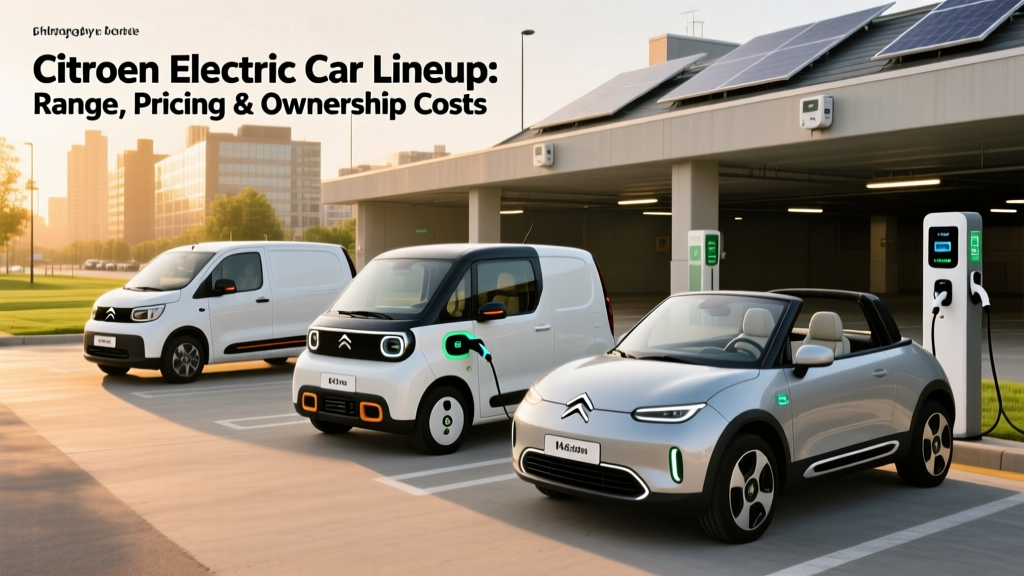
Citroen's electric lineup—anchored by the ë-C3 (starting around €23,000 / ~$25,000), the ë-C4 (~€35,000 / ~$38,000), and the utility-focused ë-Berlingo—targets budget-conscious European buyers prioritizing comfort over performance. Expect 180–350 km (112–217 miles) of WLTP range, DC fast charging at 100 kW peak, and a ride quality emphasis that sets Citroen apart from sportier rivals. These vehicles are not sold in the United States, so US buyers should treat this guide as reference material for European-market options or potential future Stellantis platform sharing. No Citroen qualifies for the US federal §30D tax credit.
Citroen's Electric Lineup at a Glance
Stellantis has pushed its e-CMP and Smart Car platforms across multiple brands, and Citroen benefits from shared battery packs and motors with Peugeot, Opel/Vauxhall, and Fiat. Here's what's available or announced for the 2026 model year:
| Model | Battery (kWh usable) | WLTP Range | Peak DC Charge | 10–80% Time | Power (HP) | 0–100 km/h | Starting Price (EUR) |
|---|---|---|---|---|---|---|---|
| ë-C3 (2025+) | 44 kWh (LFP) | ~320 km / 199 mi | 100 kW | ~26 min | 113 HP | ~11.0 sec | €23,300 |
| ë-C4 (2026 facelift) | 54 kWh (NMC) | ~360 km / 224 mi | 100 kW | ~27 min | 156 HP | ~9.5 sec | €35,500 |
| ë-Berlingo | 50 kWh (NMC) | ~280 km / 174 mi | 100 kW | ~30 min | 136 HP | ~11.5 sec | €31,000 |
Note: WLTP range figures run 10–20% higher than US EPA equivalents. An ë-C4 rated at 360 km WLTP would likely sticker around 190–210 miles EPA if sold in the US. Real-world highway driving at 120 km/h (75 mph) in cool weather may drop effective range to 150–170 miles.
Range, Charging, and Real-World Expectations
Citroen uses the shared Stellantis 100 kW DC charging architecture. This is adequate for European motorway networks but trails Hyundai/Kia's 800V systems (which peak at 240+ kW) and Tesla's 250 kW Supercharger capability.
Real-World Range Reality Check
ë-C3 (WLTP 320 km / 199 mi): Expect 240–260 km (150–162 mi) in mixed driving, dropping to ~190 km (118 mi) on sustained highway runs in winter at 5°C (41°F). LFP chemistry means less range anxiety about daily 100% charging, but also slightly reduced cold-weather performance versus NMC.
ë-C4 (WLTP 360 km / 224 mi): Real-world mixed: 280–300 km (174–186 mi). Highway summer: ~260 km. Highway winter: ~210 km (130 mi).
The 100 kW peak charge rate is rarely sustained. Expect the charge curve to taper significantly above 50% state of charge, with the 50–80% portion taking nearly as long as 10–50%. On a 50 kW public charger—still common in European city centers—a full 10–80% session takes 50–60 minutes.
Level 2 AC charging tops out at 7.4 kW (single-phase) or 11 kW (three-phase, where available). A full 0–100% charge on a 7.4 kW wallbox takes approximately 7 hours for the ë-C3 and 8.5 hours for the ë-C4—fine for overnight home charging.
Cost Breakdown: Purchase, Charging, and Maintenance
European buyers benefit from various national incentives (France's bonus écologique, Germany's former Umweltbonus now discontinued, and varying VAT reductions). Let's compare running costs for an ë-C4 owner driving 15,000 km/year in France, where electricity averages €0.22/kWh and gasoline runs €1.85/liter.
| Cost Category | Citroen ë-C4 (EV) | Citroen C4 1.2 PureTech (Gas) | Annual Savings (EV) |
|---|---|---|---|
| Purchase Price (base) | €35,500 | €25,900 | — |
| French Bonus Écologique | -€4,000 (income-dependent) | €0 | €4,000 |
| Effective Purchase | €31,500 | €25,900 | — |
| Energy Cost / Year (15,000 km) | €530 (home charging) | €1,850 (6.5 L/100km) | €1,320 |
| Maintenance / Year | ~€250 | ~€600 | €350 |
| Insurance / Year | ~€850 | ~€700 | -€150 |
| 5-Year Total Cost | ~€39,300 | ~€41,650 | ~€2,350 |
The EV breaks even around year 4–5 depending on incentive eligibility and electricity sourcing. Public fast charging at €0.50–0.65/kWh narrows the gap substantially—frequent DC charging can push annual energy costs to €900+, eroding half the savings.
Maintenance advantages are real: no oil changes, no timing belt replacements (a known PureTech concern), reduced brake wear from regenerative braking. However, EV insurance premiums run 15–25% higher across Europe due to repair cost structures and battery replacement risk.
Citroen EV vs. Gas and Hybrid: The Data
| Metric | ë-C4 (BEV) | C4 1.2 Gas | C4 Hybrid 136 (MHEV) |
|---|---|---|---|
| Energy Use (per 100 km) | 15.5 kWh | 6.5 L gasoline | 5.2 L gasoline |
| Cost per 100 km (home charge / fuel) | €3.41 | €12.03 | €9.62 |
| CO₂ Tailpipe | 0 g/km | 148 g/km | 118 g/km |
| 0–100 km/h | 9.5 sec | 10.4 sec | 9.8 sec |
| Refuel/Recharge Time | 27 min (10–80% DC) | 5 min | 5 min |
| Range | ~280 km real | ~750 km | ~900 km |
The mild-hybrid C4 Hybrid 136 offers a compelling middle ground for buyers without home charging access: 15–20% fuel savings versus the pure gas model, no range anxiety, and a ~€2,500 price premium that pays back in 3–4 years of typical driving. If you cannot charge at home or at work, the MHEV is the pragmatic choice.
First-Time EV Buyer Considerations
Before committing to any Citroen electric car, verify these practical factors:
Decision Framework
- If you have dedicated home parking with a wallbox (7+ kW): A Citroen BEV works well. Overnight charging covers 95% of daily needs. Choose the ë-C3 for city commuting under 100 km/day, the ë-C4 for mixed use with occasional 200 km trips.
- If you rely on apartment/shared parking without charging: Wait for better public infrastructure or choose the C4 Hybrid. Public DC charging at €0.55/kWh makes EVs cost-competitive with gas only if you drive high annual kilometers.
- If you regularly drive 400+ km trips: The ë-C4's 280 km real-world range means two charging stops, adding 60–90 minutes. A PHEV or efficient diesel remains more practical for frequent long-distance drivers.
- If you live in cold climates (sub-zero winters): Expect 25–35% range loss. The ë-C3's LFP battery is more sensitive to cold than NMC. Preconditioning while plugged in is essential—this warms the battery using grid power rather than battery energy.
- If budget is the primary driver: The ë-C3 at €23,300 (before incentives) undercuts most European BEVs. Dacia Spring is cheaper (~€18,000) but significantly smaller and slower.
Home Charging Setup
A 7.4 kW wallbox installation in France typically costs €1,200–€2,000 including equipment and electrician labor, with potential €300 tax credits via the crédit d'impôt pour la transition énergétique. A full charge on a 7.4 kW box costs approximately €11–12 (ë-C4) versus €65–75 for a tank of gasoline.
Common Misconceptions Addressed
| Myth | Fact |
|---|---|
| "Citroen EVs are unreliable because French cars are unreliable" | The e-CMP platform is shared across Stellantis with millions of units deployed. Electric drivetrains have far fewer failure points than ICE. The 8-year/160,000 km battery warranty covers capacity below 70%. |
| "LFP batteries (ë-C3) are inferior" | LFP offers longer cycle life (3,000+ cycles vs ~1,500 for NMC), safer thermal stability, and tolerates daily 100% charging. Trade-offs: lower energy density (heavier pack for same range) and worse cold-weather performance. |
| "100 kW charging is too slow" | For typical European driving patterns (200–300 km trips), a 25-minute charge stop aligns with a rest break. The limitation appears on 600+ km journeys where cumulative charging time exceeds 90 minutes. |
| "EVs don't save money" | With home charging and national incentives, the ë-C4 breaks even versus gas in 4–5 years at 15,000 km/year. Without incentives or with exclusive public charging, payback extends to 7+ years or may not occur. |
| "The battery will need expensive replacement" | Stellantis e-CMP batteries show ~10–12% degradation over 5 years/100,000 km based on fleet data. At 8 years/160,000 km, most packs retain 75–85% capacity. Full replacement (€8,000–€12,000) is rare before 200,000+ km. |
Warranty and Long-Term Ownership
Citroen provides a 5-year/100,000 km vehicle warranty and an 8-year/160,000 km battery warranty (whichever comes first) guaranteeing minimum 70% capacity retention. This aligns with European industry norms but trails Hyundai/Kia's 8-year/unlimited-km coverage in some markets.
Depreciation data for Citroen EVs remains limited—the ë-C3 launched in 2024, and the ë-C4 is newer still. Early indicators from the discontinued ë-Spacetourer and limited ë-C4 sales suggest 45–55% value retention at 3 years, comparable to Peugeot e-208 but below Tesla Model 3 and Volkswagen ID.3.
FAQ: Citroen Electric Cars
Can I buy a Citroen electric car in the United States?
No. Citroen withdrew from the US market in 1974 and has no announced plans to return. Stellantis sells EVs in the US under Jeep, Chrysler, Dodge, Ram, Alfa Romeo, and Fiat brands. The Fiat 500e is the closest US-market relative, though on a different platform.
What's the real-world range of the ë-C4?
WLTP rates the ë-C4 at ~360 km (224 mi). In mixed real-world driving at moderate temperatures, expect 280–300 km (174–186 mi). Sustained highway driving at 120 km/h reduces this to ~250 km in summer and ~210 km in winter.
Does the ë-C3 support fast charging?
Yes, at 100 kW peak DC. A 10–80% charge takes approximately 26 minutes. The LFP battery chemistry charges slightly slower at low temperatures—preconditioning via the MyCitroen app before arrival at a charger improves speeds.
Is the Citroen ë-C4 eligible for any US tax credits?
No. The §30D federal tax credit applies only to vehicles purchased for use in the United States from manufacturers with US dealer networks. Citroen has no US presence. European buyers should consult their national incentive programs (France's bonus écologique, for example, offers up to €4,000 based on income and vehicle price caps).
How does Citroen's charging speed compare to competitors?
Citroen's 100 kW peak is mid-tier for 2026. Hyundai Ioniq 5 and Kia EV6 peak at 235–260 kW on 800V architecture (10–80% in ~18 min). Tesla Model Y peaks at 250 kW. Renault Megane E-Tech matches Citroen at 130 kW. For urban and suburban use, 100 kW is adequate; for frequent long-distance travel, faster-charging platforms save meaningful time.
What charging connector does Citroen use?
European-market Citroen EVs use CCS2 (Combined Charging System Type 2), the EU standard. This provides AC charging via Type 2 and DC fast charging via the two additional DC pins below. All European public DC chargers support CCS2.
Sources: Citroen France official specifications, Stellantis corporate platform data, European WLTP homologation filings. US buyers should consult fueleconomy.gov for EPA-rated vehicles available in the American market.