Quick Answer: Can You Buy the Citroën Ami in the US?
No — the Citroën Ami electric vehicle is not sold, certified, or street-legal in the United States as of 2026. It is classified as a heavy quadricycle (EU category L7e) and does not meet NHTSA Federal Motor Vehicle Safety Standards (FMVSS) for passenger cars. It lacks airbags, crash-test certification, and US homologation. If you're in Europe, it's available from approximately €7,990 (~$8,700 USD). For US buyers seeking a similar ultra-compact electric runabout, viable alternatives include the used Mitsubishi i-MiEV, the NEV-class GEM e2, or stepping up to a Chevrolet Bolt EV (~$28,000 before incentives). This guide covers what the Ami is, what it costs to own in markets where it's sold, and what US buyers should consider instead.
What Exactly Is the Citroën Ami Electric Vehicle?
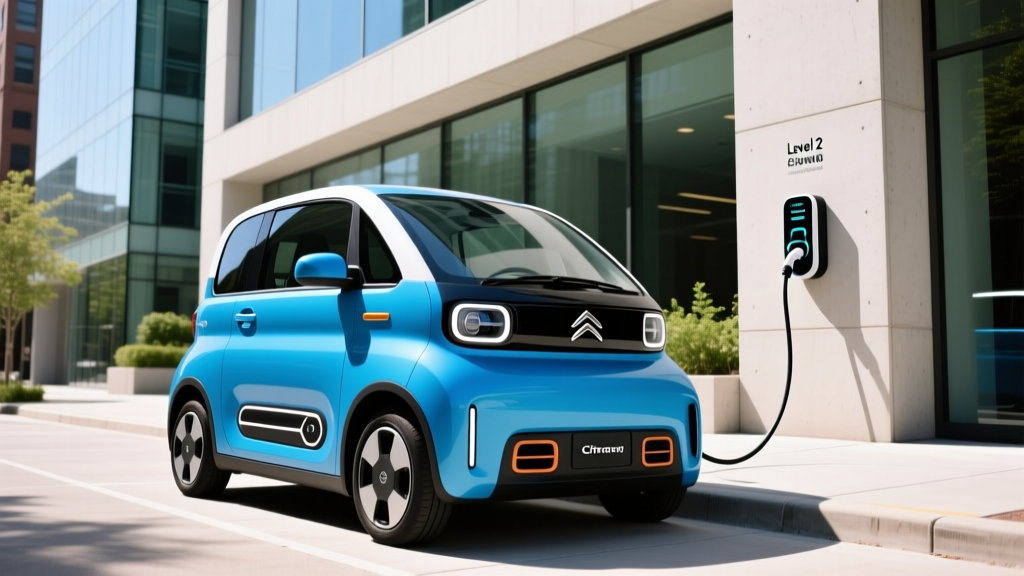
The Citroën Ami is a two-seat electric microcar that launched in 2020 and received a mild update in 2024. It's engineered for dense urban environments — narrow streets, limited parking, and short commutes. Citroën classifies it as a "mobility solution" rather than a conventional automobile, which is a diplomatic way of saying it's closer to an enclosed electric scooter than a highway-capable car.
| Specification | Value |
|---|---|
| Classification | EU L7e Heavy Quadricycle |
| Motor Output | 6 kW (8 hp) |
| Top Speed | 45 km/h (28 mph) |
| Battery Capacity | 5.5 kWh (usable), Lithium-ion |
| WLTP Range | 75 km (~46 miles) |
| Real-World Range (city, mild climate) | ~35–42 miles |
| Charging (230V household outlet) | ~3 hours (0–100%) |
| DC Fast Charging | Not supported |
| Length × Width × Height | 2.41m × 1.39m × 1.52m |
| Curb Weight | 485 kg (~1,069 lbs) |
| Seats | 2 (staggered) |
| EU Price (base) | ~€7,990 (~$8,700 USD) |
A few things jump off this spec sheet. The 5.5 kWh battery is roughly one-tenth the capacity of a modern EV like the Tesla Model Y. The 6 kW motor means the Ami physically cannot exceed 28 mph — it's governed. And the lack of DC fast charging means you're limited to slow AC top-ups, though with a battery this small, a standard European 230V outlet fills it in about three hours.
Why the Citroën Ami Can't Be Sold in the US
The United States requires all vehicles sold for road use to comply with Federal Motor Vehicle Safety Standards administered by NHTSA. These standards cover crashworthiness, occupant protection, lighting, braking, and dozens of other categories. The Ami was never designed to meet these requirements.
Specific gaps include:
- No airbags — the Ami has zero airbag coverage, which FMVSS mandates for passenger vehicles.
- No crash-test certification — the vehicle has not undergone NHTSA or IIHS crash testing and would likely perform poorly given its minimal mass and structure.
- Quadricycle classification — the US has no direct equivalent to the EU's L7e heavy quadricycle category. The closest US designation is a Low-Speed Vehicle (LSV) or Neighborhood Electric Vehicle (NEV), which are limited to roads with speed limits of 35 mph or less and have their own (less stringent) safety requirements.
- No US dealer network or parts supply chain — Stellantis (Citroën's parent company) does not sell the Ami brand in North America.
Some importers and gray-market enthusiasts have explored bringing Amis into the US under the 25-year import rule or Show or Display exemption, but these apply to vehicles of historical significance — not current-production microcars. There is no legal pathway to register a new Ami for street use in any US state as of 2026.
Real Costs: What Ami Ownership Looks Like (EU Data)
For readers in European markets — or those curious about the economics of ultra-compact EVs — here's a realistic cost breakdown based on EU ownership data and energy pricing.
| Cost Category | Citroën Ami (Electric) | Fiat 500 1.0L Mild Hybrid (Gas) |
|---|---|---|
| Purchase Price | ~€7,990 | ~€16,500 |
| Annual Energy/Fuel (5,000 km/yr) | ~€90 (€0.25/kWh avg) | ~€550 (€1.85/L, 5.5 L/100km) |
| Annual Insurance (avg, EU) | ~€250–€400 | ~€500–€800 |
| Maintenance (annual) | ~€50–€100 (tires, wipers, cabin filter) | ~€300–€500 (oil, filters, brakes) |
| 5-Year Total Cost of Ownership | ~€10,500–€11,200 | ~€22,000–€24,500 |
The Ami's total cost of ownership is dramatically lower than a conventional city car — but that comparison comes with a massive asterisk. You're getting dramatically less vehicle: no highway capability, no crash protection, no climate control beyond a basic heater, and essentially no cargo space. The Ami is a complement to a primary vehicle, not a replacement for one.
US Alternatives: What Can You Actually Buy?
If the Ami's concept appeals to you — a tiny, cheap-to-run electric vehicle for short urban trips — here's what's realistically available in the US market in 2026:
| Vehicle | Category | EPA Range | Top Speed | Price (2026) | Street Legal? |
|---|---|---|---|---|---|
| Chevrolet Bolt EV (used, 2022–2023) | Full EV (subcompact) | 259 mi | 93 mph | ~$14,000–$18,000 (used) | Yes — full highway |
| GEM e2 (Neighborhood EV) | LSV/NEV | ~30 mi | 25 mph | ~$12,000–$14,000 (new) | Yes — roads ≤35 mph |
| Mitsubishi i-MiEV (used, 2012–2017) | Full EV (micro) | 62 mi | 80 mph | ~$6,000–$10,000 (used) | Yes — full highway |
| Nissan Leaf S (used, 2018–2022) | Full EV (compact) | 149–226 mi | 89 mph | ~$10,000–$18,000 (used) | Yes — full highway |
| ElectraMeccanica SOLO (discontinued) | Full EV (3-wheel) | 100 mi | 82 mph | ~$12,000–$15,000 (used) | Yes — full highway |
The used Chevrolet Bolt EV stands out as the strongest value proposition for US buyers who want the Ami's spirit — affordable, compact, cheap to run — in a vehicle that can actually handle American roads. A 2022–2023 Bolt EV with the 65 kWh battery delivers 259 miles of EPA range, supports DC fast charging at up to 55 kW, and qualifies for the §25E used EV tax credit of up to $4,000 if you meet income requirements and the sale price is under $25,000.
Charging Economics: What an Ami-Sized Battery Actually Costs
One area where the Ami concept shines — even as a thought exercise for US buyers — is charging cost. With only 5.5 kWh of usable battery capacity, filling the Ami from empty to full requires about as much electricity as running a space heater for two hours.
At the US average residential electricity rate of approximately $0.16/kWh (EIA, 2025 data), a full charge costs roughly $0.88. That gives you around 35–42 real-world miles, or about 2.1–2.5 cents per mile in energy cost.
Compare that to a gas-powered Honda Fit getting 33 MPG combined at $3.20/gallon: that's 9.7 cents per mile. The energy savings are real, but at the Ami's limited range and speed, you're making a significant utility trade-off.
For US alternatives like the Bolt EV (65 kWh battery, 259-mile range), a full home charge costs about $10.40 — still dramatically cheaper than gasoline, and you get a vehicle capable of road trips, highway merging, and winter driving.
Common Misconceptions About the Ami and Micro-EVs
| Myth | Fact |
|---|---|
| "I can import an Ami and register it in my state." | No legal pathway exists for registering a new Ami for US street use. It doesn't meet FMVSS standards and cannot be imported under current exemptions. |
| "It's basically a golf cart — those are legal everywhere." | Golf carts and LSVs/NEVs are governed by specific state and federal rules. The Ami is not manufactured to US LSV standards (FMVSS 500), even though its performance is similar. |
| "The range is fine for city driving." | The WLTP-rated 46 miles drops to roughly 30–35 miles in cold weather (below 40°F) or with heater use. In northern European winters, owners report needing daily charging for commutes over 15 miles each way. |
| "It qualifies for EV tax credits." | The Ami is not sold in the US and therefore does not appear on the IRS qualified vehicles list. US alternatives like the used Bolt EV may qualify for the §25E used credit (up to $4,000). |
| "Micro-EVs are the future of urban transport." | They fill a niche in European cities with dense infrastructure and low speed limits. US cities, built around higher-speed arterials and longer trip distances, have not adopted them at scale. |
Decision Framework: Is a Micro-EV Right for You?
Should You Buy an Ultra-Compact EV?
Choose a micro-EV (NEV/LSV class like the GEM e2) if:
- You live in a planned community, retirement village, or island with speed limits of 35 mph or below
- Your daily trips are under 15 miles round-trip
- You already own or have access to a full-size vehicle for highway travel, bad weather, and longer trips
- You have access to a standard 120V outlet for overnight charging
- You're comfortable with minimal crash protection and no airbags
Choose a compact full-EV (Bolt EV, used Leaf, Mini Cooper SE) if:
- You need highway capability for any portion of your commute
- You live in a region with cold winters (battery range drops 20–30% below freezing)
- You need to carry more than one passenger or any significant cargo
- You want eligibility for federal or state EV tax credits
- This will be your only vehicle
Avoid a micro-EV entirely if:
- Your commute includes roads with speed limits above 45 mph
- You frequently drive in rain, snow, or extreme heat without robust climate control
- You have passengers who expect standard safety features (airbags, stability control, crash structures)
What First-Time EV Buyers Should Know (US Market)
If the Citroën Ami sparked your interest in electric vehicles, that curiosity is well-placed — but the US market demands a different calculus. Here are the essentials:
Home charging is the foundation. Over 80% of EV charging happens at home. A standard 120V outlet (Level 1) adds roughly 3–5 miles of range per hour — sufficient for a Bolt EV driven 30 miles daily. A Level 2 home charger (240V, 32–48 amps) adds 25–40 miles per hour and costs $500–$1,500 installed, depending on your electrical panel. Always get a quote from a licensed electrician before committing.
Real-world range is 15–30% below EPA estimates in adverse conditions. Highway driving at 75 mph, winter temperatures below 30°F, and aggressive acceleration all reduce range. A 259-mile EPA rating might deliver 180–200 miles on a cold highway day. Plan accordingly.
Tax credits have rules. The federal §30D credit for new EVs (up to $7,500) and §25E credit for used EVs (up to $4,000) have income caps, MSRP caps, battery-sourcing requirements, and point-of-sale transfer options. Check the IRS clean vehicle credit page for current-year eligibility before purchasing. State incentives vary widely and may stack on top.
Maintenance savings are real but modest. EVs eliminate oil changes, spark plugs, and transmission fluid. Brake wear drops significantly due to regenerative braking. But tires wear faster (heavier vehicles, instant torque), and insurance premiums run 10–20% higher than comparable gas cars on average.
Frequently Asked Questions
Can I legally drive a Citroën Ami on US roads?
No. The Ami does not meet US Federal Motor Vehicle Safety Standards and is not sold or homologated for the United States. There is no current legal import pathway for a new Ami. Driving one on public roads would be illegal in all 50 states.
How does the Ami's range compare to a real EV?
The Ami's WLTP-rated range of ~46 miles (real-world ~35–42 miles) is roughly one-fifth the range of a Chevrolet Bolt EV (259 miles EPA) or one-eighth that of a Tesla Model 3 Long Range (~341 miles EPA). The Ami is designed for hyper-local trips only.
What's the cheapest electric car I can actually buy in the US?
In 2026, the cheapest new full-speed EV is the Nissan Leaf S at approximately $28,140 MSRP. On the used market, a 2018–2020 Leaf with a 40 kWh battery can be found for $8,000–$12,000 and may qualify for the §25E used EV credit of up to $4,000, bringing effective cost below $8,000.
Are Neighborhood Electric Vehicles (NEVs) a good Ami alternative?
NEVs like the GEM e2 are street-legal on roads with speed limits of 35 mph or below (varies by state). They offer similar urban utility to the Ami but with US compliance. However, they lack airbags, climate control, and highway capability. They work well as second or third vehicles in specific communities but are not practical as primary transportation for most US drivers.
Will Citroën ever sell the Ami in the United States?
There is no announced plan from Stellantis (Citroën's parent company) to bring the Ami to the US market. Given the significant safety-standard gap and the US market's preference for larger vehicles, a US launch appears unlikely before 2028 at the earliest. If it does arrive, it would likely need substantial structural modifications to meet FMVSS requirements.
How much does it cost to charge a small EV at home?
At the US average electricity rate of ~$0.16/kWh, charging a 5.5 kWh battery (Ami-sized) costs about $0.88. Charging a 65 kWh battery (Bolt EV) from empty costs about $10.40. Most daily driving requires only a partial charge — expect $1–$3 per day in electricity for a typical commuter EV.