Quick Answer: The Citroën Ami is a 5.5 kWh, 46-mile-range electric quadricycle sold in Europe for roughly €7,990 (~$8,700 USD). It is not street-legal in the United States as a passenger vehicle because it lacks FMVSS certification, airbags, and crash-test compliance. U.S. buyers seeking a similar micro-EV must look at low-speed vehicles (LSVs) like the Polaris GEM or the Eli Zero, or import an Ami under strict show-and-display exemptions. For urban micro-mobility in Europe, the Ami delivers genuine savings — about €0.80 per 100 km in electricity vs. €8–10 for a gas city car — but its 28 mph top speed and minimal crash protection limit it to low-speed urban zones.
What the Citroën Ami Electric Quadricycle Actually Is
The Citroën Ami is classified in the European Union as a heavy quadricycle (L7e), not a passenger car (M1). That distinction matters enormously. Quadricycles are exempt from the full suite of EU vehicle safety regulations that govern cars — no mandatory airbags, no full crash-test homologation, no advanced driver-assistance systems. In exchange, they can be driven by 14-year-olds in France (with an AM license) and by 16-year-olds in many other EU nations.
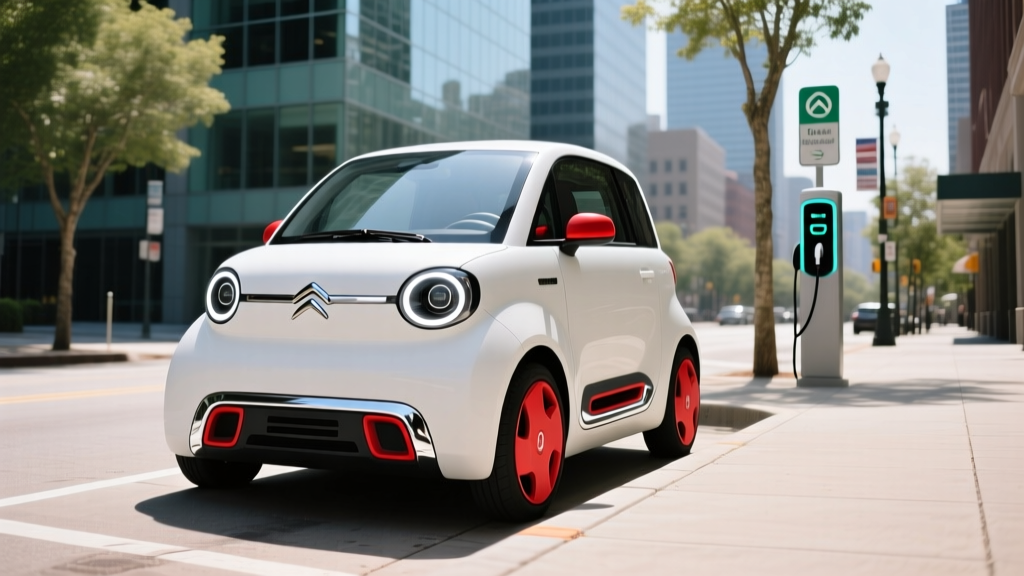
Physically, the Ami is symmetrical — the left and right body panels are identical to cut manufacturing costs. It seats two adults side by side in a compact 2.41-meter footprint. The 2025/2026 model retains the original 5.5 kWh lithium-ion battery pack (usable capacity approximately 5.0 kWh), a 6 kW (8 hp) electric motor, and a governed top speed of 45 km/h (28 mph).
There is no U.S. homologation pathway for the Ami in its current form. The National Highway Traffic Safety Administration (NHTSA) requires all on-road vehicles to meet Federal Motor Vehicle Safety Standards (FMVSS), which the Ami was never engineered to satisfy. Citroën, owned by Stellantis, has announced no plans to bring the Ami to the American market.
Specs, Range, and Charging: The Numbers
| Specification | Value |
|---|---|
| Battery Capacity (Total / Usable) | 5.5 kWh / ~5.0 kWh |
| Battery Chemistry | Lithium-ion (NMC) |
| WLTP Range | 75 km (46 miles) |
| Real-World Range (City, Mild Climate) | 55–65 km (34–40 miles) |
| Real-World Range (Cold Weather / Hills) | 35–45 km (22–28 miles) |
| Top Speed | 45 km/h (28 mph) |
| Motor Output | 6 kW (8 hp) |
| Charging (Standard 230V Outlet) | ~3 hours (0–100%) |
| DC Fast Charging | Not supported |
| Curb Weight | 485 kg (1,069 lbs) |
| Length × Width × Height | 2.41 m × 1.39 m × 1.52 m |
| EU Price (2025/2026) | ~€7,990 (~$8,700 USD) |
| U.S. Availability | Not available (no FMVSS certification) |
Range reality check: The 75 km WLTP figure assumes ideal urban driving — low speeds, flat terrain, moderate temperatures. In practice, expect 55–65 km in a European city at 20°C (68°F). In cold weather (below 5°C / 41°F), the small battery loses 25–35% of its capacity to cabin heating demands and reduced electrochemical efficiency, dropping real range to as low as 35 km. The Ami has no heat pump; cabin warmth comes from a resistive heater that draws directly from the traction battery.
Charging reality: The Ami charges exclusively via a standard European 230V Schuko plug at approximately 1.8 kW. There is no CCS, no CHAdeMO, no NACS connector — and no DC fast-charging capability. A full charge from empty takes roughly 3 hours. This is perfectly adequate for overnight top-ups at home but means the Ami cannot use any public fast-charging infrastructure. U.S. buyers would need a 120V-to-230V step-up transformer or a dedicated 240V circuit, adding $200–$500 in electrical work.
Cost Breakdown: Purchase, Running, and Maintenance
The Ami's value proposition hinges on radically low operating costs. Here's how it stacks up against a typical European gas city car (e.g., a Fiat 500 or Toyota Aygo) and a U.S. low-speed vehicle alternative.
| Cost Factor | Citroën Ami (EU) | Gas City Car (EU Avg.) | U.S. LSV (e.g., Polaris GEM) |
|---|---|---|---|
| Purchase Price | ~€7,990 ($8,700) | ~€16,000–€20,000 | ~$12,000–$18,000 |
| Fuel / Energy per 100 km | ~€0.80 (6 kWh × €0.13/kWh est. after losses) | ~€8.50 (5.5 L/100km × €1.55/L) | ~$1.10 (electric, ~7 kWh) |
| Annual Fuel/Energy (8,000 km/yr) | ~€64 | ~€680 | ~$88 |
| Annual Maintenance | ~€100–€150 (minimal) | ~€500–€800 | ~$200–$400 |
| Insurance (Annual Avg.) | ~€200–€400 | ~€600–€1,200 | ~$400–$800 |
| 5-Year Total Operating Cost | ~€1,820–€3,250 | ~€8,900–€14,000 | ~$3,440–$6,400 |
The Ami's energy cost is roughly one-tenth that of a comparable gas car per kilometer. Maintenance is negligible — no oil changes, no exhaust system, no transmission fluid, no spark plugs. Brake wear is minimal thanks to regenerative braking handling most deceleration at low speeds.
However, the Ami's purchase price is misleading as a standalone figure. It lacks basic features standard on even budget cars: no infotainment screen (just a phone mount), no power steering, no climate control beyond basic resistive heating, no trunk (only a small rear shelf), and no highway capability. You are paying for a covered, weather-protected scooter — not a car.
Ami vs. Gas Car vs. Hybrid: Who Wins on What?
| Category | Citroën Ami | Gas City Car | Hybrid (e.g., Toyota Yaris) |
|---|---|---|---|
| Purchase Price | Winner (€7,990) | €16,000–€20,000 | €22,000–€26,000 |
| Fuel Cost per km | Winner (~€0.008/km) | ~€0.085/km | ~€0.055/km |
| Highway Capability | Impossible (28 mph max) | Winner (120+ km/h) | Winner (120+ km/h) |
| Safety (Crash Protection) | Minimal (no airbags) | Winner (full M1 certification) | Winner (full M1 + ADAS) |
| Cargo Capacity | Negligible | Moderate (200–300 L) | Winner (280–350 L) |
| Passenger Comfort | Basic (noisy, firm) | Adequate | Winner (refined ride) |
| Parking Ease | Winner (2.41 m length) | Moderate | Difficult in tight cities |
| Driver Licensing (EU) | Winner (AM license, age 14+) | Full license required | Full license required |
| Weather Protection | Enclosed but basic | Full HVAC | Winner (full HVAC + heat pump) |
The Ami wins decisively on purchase price, fuel cost, and urban parking. It loses on everything else: speed, range, safety, comfort, cargo, and versatility. A hybrid like the Toyota Yaris costs three times more upfront but delivers genuine multi-purpose capability — highway driving, five seats, advanced safety systems, and 60+ mpg combined.
U.S. Alternatives: What Can You Actually Buy?
Since the Citroën Ami cannot be legally registered for road use in the United States, American buyers interested in a micro-EV have limited options. Here are the closest functional equivalents:
- Polaris GEM e2/e4: A low-speed vehicle (LSV) with a 25 mph top speed, ~50-mile range, and FMVSS 500 compliance. Priced at $12,000–$18,000. Street-legal on roads with speed limits up to 35 mph in most states.
- Eli ZERO: A compact LSV with a 55-mile range and 25 mph top speed, starting around $11,900. Available in the U.S. with proper LSV certification.
- Used NEV imports: Some older neighborhood electric vehicles (NEVs) exist on the used market, but parts availability and battery health are concerns.
- E-bikes / electric scooters: For pure micro-mobility, a high-quality e-bike ($1,500–$3,500) may offer more practical value in U.S. cities, though without weather protection.
None of these alternatives match the Ami's combination of enclosed cabin, modern design, and sub-€8,000 pricing. The GEM and Eli ZERO are significantly more expensive and feel more utilitarian. The Ami's absence from the U.S. market is a genuine gap for urban micro-mobility seekers.
Common Misconceptions About the Ami
| Myth | Fact |
|---|---|
| "The Ami is just a golf cart." | The Ami is a homologated L7e quadricycle with a steel tubular frame, enclosed cabin, and automotive-grade components. It is far more robust than a golf cart, though less protected than a car. |
| "You can import one to the U.S. and drive it." | Importing a non-FMVSS-compliant vehicle for road use is prohibited by NHTSA. Show-and-display exemptions exist but are extremely narrow and do not permit daily driving. |
| "75 km range is enough for anyone." | WLTP testing is optimistic. Real-world cold-weather range drops to 35–45 km. If your daily commute exceeds 25 km round-trip, range anxiety becomes real — especially with no fast-charging option. |
| "It's as safe as a small car." | The Ami has no airbags, no crumple zones engineered to car standards, and no ADAS. In a collision with a full-size vehicle, occupants are significantly more vulnerable than in any M1-certified car. |
| "The battery will last forever." | NMC lithium-ion batteries degrade. Expect 80–85% capacity retention after 5 years / 40,000 km. Citroën offers a 2-year unlimited-mileage warranty on the vehicle and limited battery coverage. Replacement cost is estimated at €2,000–€3,000. |
Decision Framework: Is the Ami (or an Alternative) Right for You?
Choose the Citroën Ami (if you're in Europe) if:
- Your daily driving is under 40 km round-trip in a flat, low-speed urban zone
- You have access to a standard 230V outlet for overnight charging (apartment, garage, or driveway)
- You prioritize lowest-possible purchase price and operating cost over comfort and safety
- You hold (or qualify for) an AM-category license and don't need highway access
- You accept the safety trade-off inherent in quadricycle classification
Choose a U.S. LSV (Polaris GEM / Eli Zero) if:
- You live in a community that permits LSVs on roads up to 35 mph
- Your daily trips are under 30 miles at low speeds
- You need FMVSS 500 compliance and basic crash protection
- You have a garage or covered parking with access to a 120V or 240V outlet
Choose a compact BEV (Chevrolet Bolt, Nissan Leaf) or a hybrid if:
- You need highway capability, full crash protection, and multi-passenger seating
- Your commute includes roads above 35 mph or distances beyond 40 miles
- You want to qualify for the federal §30D clean vehicle credit (up to $7,500, subject to MSRP caps, income limits, and battery-sourcing requirements — consult a tax professional)
- You drive in cold climates where the Ami's range loss and resistive heating become serious limitations
Frequently Asked Questions
Can I legally drive a Citroën Ami in the United States?
No. The Ami does not meet Federal Motor Vehicle Safety Standards (FMVSS) and cannot be registered for road use in any U.S. state. NHTSA does not offer a general exemption for quadricycles. Importing one for personal road use is not legally viable.
How much does it cost to charge the Ami at home?
At an average European electricity rate of €0.13–€0.20 per kWh, a full charge (approximately 6 kWh accounting for charging losses) costs €0.78–€1.20. In the U.S., at $0.14–$0.18 per kWh, a full charge would cost roughly $0.84–$1.08. Annual charging cost for 8,000 km of driving is under $90.
Does the Ami qualify for any EV tax credits?
In the U.S., no — the Ami is not available and would not qualify for the §30D credit regardless, as it does not meet the vehicle classification, MSRP, or battery-sourcing requirements outlined by the IRS. In France, the Ami has been eligible for a modest ecological bonus (bonus écologique), though amounts and eligibility change annually.
How long will the Ami's battery last before needing replacement?
NMC lithium-ion cells in a small, low-stress application like the Ami typically retain 80–85% of original capacity after 5 years. Citroën's battery warranty covers defects but offers limited capacity-retention guarantees compared to full EVs. Budget €2,000–€3,000 for a potential replacement after 8–10 years, though many packs last longer with proper care (avoiding deep discharge and extreme heat storage).
Is the Ami safe in a crash?
The Ami provides a steel tubular frame and enclosed cabin, which is significantly safer than a motorcycle or bicycle. However, it lacks airbags, crumple zones engineered to M1 car standards, and electronic stability control. In a collision with a full-size vehicle traveling at road-legal speeds, Ami occupants face substantially higher injury risk than car occupants. The Ami is designed for low-speed urban environments — it is not a substitute for a car in mixed traffic.
What's the best U.S. alternative to the Citroën Ami?
For enclosed, street-legal micro-mobility, the Polaris GEM e2 (~$13,000) or Eli ZERO (~$11,900) are the closest LSV alternatives. For pure cost efficiency without weather protection, a quality e-bike ($1,500–$3,500) delivers far more range and speed per dollar. For genuine car capability, a used Nissan Leaf or Chevrolet Bolt offers 150+ miles of range, full safety equipment, and potential used-EV tax credit eligibility (up to $4,000 under §25E).