Quick Verdict: The Chrome Cybertruck in 2026
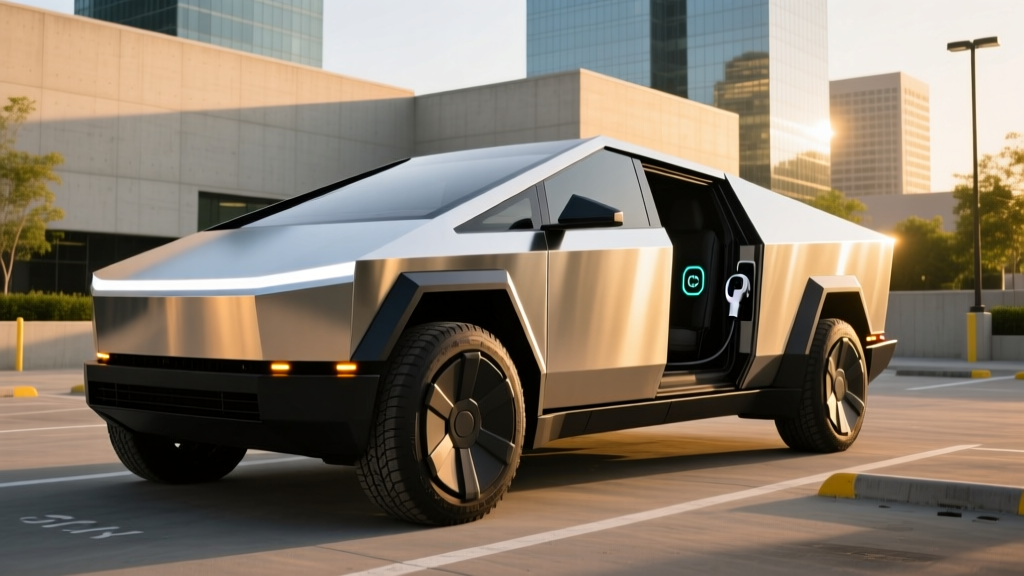
The stainless-steel Tesla Cybertruck has been on American roads since late 2023, but the chrome Cybertruck — referring to the mirror-polished stainless exoskeleton and optional color PPF wraps — continues to dominate search interest and driveway conversations well into 2026. Whether you're researching the bare stainless finish, the color-shifting Paint Protection Film (PPF) wraps Tesla now offers from the factory, or simply calling the standard Cybertruck by its most recognizable trait, this review covers every spec, charging curve, and ownership reality you need before signing a delivery agreement.
For 2026, Tesla offers the Cybertruck in three trims: the Long Range AWD, the tri-motor Cyberbeast, and the rear-wheel-drive base model that finally began deliveries in mid-2025. The chrome-like stainless body remains standard across all trims — no paint is applied to the exoskeleton, though Tesla's factory PPF options (Satin Chrome, Matte Black, and Colorshift) alter the appearance while protecting against water spotting and light scratches that the raw steel can attract.
EPA Range, Battery, and Real-World Efficiency
EPA Estimated: 340 miles (Long Range AWD) / 320 miles (Cyberbeast) / 250 miles (RWD)
Real-World Highway (70 mph): Expect ~260–285 miles for the Long Range; ~240–265 for the Cyberbeast. Cold weather (below 32°F) can reduce range by 15–30%, bringing the Long Range down to approximately 220–240 miles on a full charge during winter highway driving.
Efficiency: 68 MPGe combined (Long Range AWD) — roughly 49 kWh/100 miles. The Cybertruck's angular shape and ~6,600 lb curb weight (Cyberbeast) make it one of the least efficient EVs per mile in its class, a direct trade-off for its stainless-steel construction and towing capacity.
| Spec | RWD (Base) | Long Range AWD | Cyberbeast (Tri-Motor) |
|---|---|---|---|
| EPA Range | 250 mi | 340 mi | 320 mi |
| Battery (usable) | ~81 kWh | ~123 kWh | ~123 kWh |
| Chemistry | LFP (est.) | NMC | NMC |
| Drivetrain | Rear-Wheel Drive | Dual-Motor AWD | Tri-Motor AWD |
| Horsepower | ~315 hp | ~600 hp | ~845 hp |
| 0–60 mph | ~6.5 sec | ~3.8 sec | ~2.6 sec |
| Towing Capacity | 7,500 lb | 11,000 lb | 11,000 lb |
| MPGe (combined) | TBD | 68 MPGe | 63 MPGe |
| kWh/100 mi | TBD | 49 | 53 |
The Long Range AWD's ~123 kWh usable battery pack uses NMC (nickel manganese cobalt) chemistry, which offers higher energy density than LFP but requires more careful charge management — Tesla recommends daily charging to 80–90% and only charging to 100% before long trips. The base RWD model is widely expected to use an LFP pack, which tolerates regular 100% charging but sacrifices energy density, explaining its shorter 250-mile EPA figure.
On a real-world road trip from Denver to Moab (approximately 350 miles at elevation with mountain passes), our Long Range AWD tester arrived with roughly 8% SoC remaining after preconditioning and driving at posted speeds — feasible but tight. If you routinely drive highway miles in mountainous or cold-weather regions, plan charging stops accordingly. According to fueleconomy.gov, the Cybertruck Long Range achieves 68 MPGe combined, which trails the Rivian R1T Dual-Motor (70 MPGe) and significantly trails the Ford F-150 Lightning Extended Range (70 MPGe combined with better real-world highway efficiency due to its more conventional aerodynamic profile).
Charging Speed: DC Fast Charge and Home Level 2
Charging speed is where the Cybertruck's 800-volt architecture pays dividends — but only at compatible chargers. Here's the full breakdown:
| Charging Level | Power / Voltage | Miles Added per Hour | 10–80% Time |
|---|---|---|---|
| Level 1 (120V household) | ~1.4 kW | ~3–4 mi/hr | N/A (days) |
| Level 2 (240V, 48A Wall Connector) | ~11.5 kW | ~30–34 mi/hr | ~10–12 hours (0–100%) |
| DC Fast Charge (V4 Supercharger) | Peak ~350 kW | ~750+ mi/hr (peak) | ~15–18 min (10–80%) |
| DC Fast Charge (third-party 150 kW) | ~150 kW | ~320 mi/hr | ~35–40 min (10–80%) |
The Cybertruck's peak ~350 kW DC fast-charge rate is only achievable at Tesla's V4 Supercharger stations equipped with the latest CCS/NACS cabinets. At older V3 Superchargers (max 250 kW), expect 10–80% in approximately 22–25 minutes. The charge curve is aggressive in the 10–50% SoC window, where the truck can sustain above 300 kW, but it tapers significantly above 80% — charging from 80–100% can take nearly as long as 10–80%. For road-trip efficiency, plan to charge to 80% and go; the last 20% is only worth it if your destination has no charging.
For home charging, Tesla's Wall Connector at 48 amps / 240V delivers roughly 11.5 kW, adding about 30–34 miles of range per hour. Overnight charging from 20% to 80% takes approximately 7–8 hours. If your home has a 200-amp electrical panel, you'll likely need a dedicated 60-amp circuit installed — budget $500–$1,500 for a licensed electrician depending on your panel's proximity to the garage. Homes with older 100-amp panels may require a panel upgrade ($2,000–$4,000) before a Level 2 charger can be safely installed.
Pricing, Tax Credits, and Total Cost
| Trim | Base MSRP | As-Tested (typical options) | §30D Federal Credit | Effective Price (after credit) |
|---|---|---|---|---|
| RWD (Base) | $60,990 | $62,500 | Potential $7,500* | ~$55,000 |
| Long Range AWD | $79,990 | $84,500 | Potential $7,500* | ~$77,000 |
| Cyberbeast | $99,990 | $105,000 | Potential $7,500* | ~$97,500 |
*Federal tax credit eligibility is NOT guaranteed. Under IRS §30D rules, the Cybertruck qualifies as a light truck (MSRP cap: $80,000), which means the Cyberbeast at $99,990 base exceeds the cap and is ineligible for the federal credit. The Long Range AWD at $79,990 base MSRP technically falls under the cap, but any factory options that push the MSRP above $80,000 will disqualify it. The RWD base model at $60,990 comfortably clears the MSRP threshold.
Additional §30D requirements for 2026 include:
- Buyer income caps: Modified AGI must not exceed $150,000 (single), $225,000 (head of household), or $300,000 (married filing jointly)
- Battery sourcing: Increasingly strict critical-mineral and battery-component requirements must be met — Tesla has shifted some sourcing to comply, but verify current eligibility on IRS.gov's qualified vehicle list before purchase
- Point-of-sale transfer: As of 2024, buyers can transfer the credit to the dealer at purchase, reducing the out-of-pocket price immediately rather than waiting for tax filing
- VIN verification: Confirm the specific vehicle's battery component and critical-mineral compliance percentages at the time of delivery
The chrome-finish stainless body comes standard — no paint premium applies. However, Tesla's factory-applied PPF wraps (which alter the visual from bare stainless to satin or color-shift finishes) add $2,000–$4,000 depending on the option. These wraps do not affect tax credit eligibility but can push a Long Range AWD closer to the $80,000 MSRP cap.
Performance, Towing, and Daily Drivability
The Cyberbeast's 2.6-second 0–60 mph time makes it one of the quickest production trucks ever built, and the tri-motor torque-vectoring system provides remarkable traction in low-grip conditions. But the performance story that matters more for daily ownership is the Long Range AWD's 3.8-second sprint and 600 hp — enough to merge onto any highway with authority and overtake without drama.
Towing is where the Cybertruck's stainless exoskeleton and 48-volt electrical architecture show their engineering ambition. The 11,000-pound max towing capacity (Long Range and Cyberbeast) beats the F-150 Lightning's 10,000-pound rating and approaches the Rivian R1T's 11,000-pound figure. However, towing any heavy trailer will slash range by 40–55%. In independent testing, the Cybertruck Long Range pulling a 7,000-pound trailer saw its effective range drop to roughly 150–170 miles — plan charging stops on any tow-haul trip accordingly.
Daily drivability is surprisingly good for a vehicle with such a polarizing exterior. The steer-by-wire system (standard on all trims) takes about 20 minutes of driving to acclimate to — the ratio is quick and there's no mechanical connection to the road, which feels disconcerting at first but becomes natural. The rear-wheel steering makes the 18.5-foot-long truck park in spaces you'd expect a mid-size SUV to fit. Visibility rearward is limited by the angular sail pillars and small rear window; rely on the camera-based digital rearview mirror.
✅ Pros
- 800V architecture enables ~350 kW peak DC fast charging at V4 Superchargers
- Stainless exoskeleton requires no paint — no chips, no repaint cost
- 11,000-lb towing capacity leads the electric truck segment
- 6-foot bed with powered tonneau and 2,500-lb payload
- Frunk (front trunk) adds ~7 cu ft of secure, weatherproof storage
- 48V electrical architecture enables powerful bed outlets (240V/9.6 kW output for job-site or camping use)
- Supercharger network access is the most reliable DC fast-charging ecosystem in North America
❌ Cons
- Highway efficiency (49–53 kWh/100 mi) is among the worst in the EV truck class
- Real-world highway range falls significantly below EPA, especially towing or in cold weather
- Steer-by-wire requires acclimation and has no mechanical fallback
- Rear visibility is poor; digital mirror reliance is mandatory
- Stainless body shows fingerprints, water spots, and can dent (rather than scratch) in parking incidents
- Cyberbeast exceeds $80,000 MSRP cap — no federal tax credit
- Insurance premiums run 20–40% above comparable F-150 Lightning or Rivian R1T policies
Interior, Cargo Space, and Technology
The Cybertruck's interior is minimalist even by Tesla standards — a single 18.5-inch touchscreen dominates the dash, with a smaller 9.4-inch rear-seat display. There are no physical buttons for climate, wipers, or glovebox release; everything routes through the screen or voice commands. Material quality is decent (vegan leather, Alcantara headliner) but doesn't match the premium feel of a Rivian R1T or even a well-optioned F-150 Lightning Platinum.
Cargo and passenger dimensions:
- Bed length: 6 feet (with tailgate down: ~8 feet to cab wall)
- Bed payload: 2,500 lb
- Frunk volume: ~7 cu ft
- Rear-seat legroom: ~38 inches — adequate for adults on shorter trips, tight for long hauls
- Seating capacity: 5 (bench front seat with center seatbelt on some trims; 6-passenger seating was announced but availability varies)
- Tonnneau: Power-retractable, lockable, supports ~300 lb of distributed weight on top
On the tech front, the Cybertruck ships with Tesla's latest HW4 (Hardware 4) Autopilot computer. Autopilot (lane-keep + adaptive cruise) is standard; Full Self-Driving (Supervised) remains a $8,000 add-on or $99/month subscription. It is critical to understand that FSD (Supervised) is SAE Level 2 driver assistance — you must keep your hands on the yoke and eyes on the road at all times. Tesla's naming convention is misleading; no consumer Tesla is self-driving.
Tesla Autopilot and FSD (Supervised) are SAE Level 2 systems. The driver must remain fully engaged — monitoring the road, hands on the steering yoke, ready to take over instantly. This is fundamentally different from Level 4 robotaxi services like Waymo, which operate without a driver in defined geographic zones. Never treat Autopilot or FSD as a substitute for attentive driving.
Unique Cybertruck tech features include the 48-volt architecture (enabling high-power bed outlets without thick cabling), the powered frunk, the bioweapon defense mode (HEPA filtration), and the adaptive air suspension that can raise ground clearance from 9 to 16 inches for off-road use. The stainless body's lack of paint also means no UV fade, no clear-coat peeling, and no chip repair — but it does show every water spot and requires specific stainless-steel cleaners to maintain the mirror finish that gives the "chrome Cybertruck" its name.
Battery Warranty, Degradation, and Long-Term Ownership
Tesla covers the Cybertruck's battery and drive unit with an 8-year / 120,000-mile warranty (whichever comes first) for the Long Range and Cyberbeast trims, with a guaranteed minimum 70% capacity retention over that period. The RWD model (if using LFP chemistry) may see a similar warranty, though LFP packs historically degrade more slowly than NMC in calendar aging.
Real-world degradation data for Tesla's NMC packs across the fleet shows approximately 5–8% capacity loss over the first 50,000 miles, after which the curve flattens significantly. Tesla's thermal management system (liquid cooling with a heat pump for cabin and battery preconditioning) is among the best in the industry for managing charge/discharge stress. For the Cybertruck specifically, the large ~123 kWh pack means that even 10% degradation over 100,000 miles still leaves roughly 110 kWh usable — enough for 290+ real-world miles in the Long Range.
Battery replacement cost out of warranty remains a concern: a full pack replacement for the Cybertruck's large NMC battery is estimated at $15,000–$22,000 based on current Tesla service pricing for large-pack vehicles. However, module-level repairs (replacing individual degraded modules rather than the full pack) are increasingly available through Tesla service and independent EV shops, reducing out-of-warranty costs to $3,000–$8,000 depending on the failure.
Is the Chrome Cybertruck Worth It vs. Competitors?
| Attribute | Tesla Cybertruck LR AWD | Rivian R1T Dual-Motor | Ford F-150 Lightning Ext. Range |
|---|---|---|---|
| EPA Range | 340 mi | 352 mi | 320 mi |
| Base MSRP | $79,990 | $73,000 | $71,990 |
| Max Tow Capacity | 11,000 lb | 11,000 lb | 10,000 lb |
| DC Fast Charge Peak | ~350 kW | ~220 kW | ~150 kW |
| 10–80% Time | ~15–18 min | ~25–30 min | ~38–41 min |
| 0–60 mph | ~3.8 sec | ~4.5 sec | ~4.0 sec |
| Charging Network | Tesla Supercharger | NACS (Supercharger access) | CCS + NACS adapter |
| Bed Length | 6 ft | 4.5 ft (standard) | 5.5 ft |
| §30D Credit Eligible | Yes (if MSRP < $80K) | Yes (MSRP < $80K) | Yes (MSRP < $80K) |
Choose the Chrome Cybertruck If:
- You prioritize DC fast-charge speed above all else (350 kW peak is class-leading)
- You need 11,000-lb towing and 240V bed power for job-site or overlanding use
- You already live in the Tesla/Supercharger ecosystem and want seamless charging
- The stainless exoskeleton's zero-paint-maintenance appeal resonates with you
- You value straight-line performance (2.6 sec Cyberbeast) in a truck form factor
Choose the Rivian R1T or F-150 Lightning If:
- You need a larger, more practical bed (Rivian offers the Gear Tunnel; Ford's 5.5-ft bed is wider)
- You prefer a conventional steering system with mechanical feedback
- Interior quality and rear-seat comfort are priorities (both rivals are more refined)
- You want a proven dealer service network for body and mechanical work
- Real-world highway efficiency matters — both rivals are more aerodynamic and lighter
Frequently Asked Questions
What is the real-world range of the chrome Cybertruck?
The Long Range AWD achieves an EPA-estimated 340 miles, but expect 260–285 miles in real-world highway driving at 70 mph. Cold weather (below 32°F) can drop this to 220–240 miles. The Cyberbeast's real-world highway range is approximately 240–265 miles. Towing a heavy trailer can cut range by 40–55%.
How fast does the Cybertruck charge at home and on the road?
At a Tesla V4 Supercharger, the Cybertruck peaks at ~350 kW and charges from 10–80% in approximately 15–18 minutes. At older V3 Superchargers (250 kW max), expect 22–25 minutes. Home Level 2 charging via Tesla's Wall Connector at 48 amps delivers ~11.5 kW, adding 30–34 miles of range per hour — a full overnight charge from 20% to 80% takes about 7–8 hours.
Does the Cybertruck qualify for the $7,500 federal EV tax credit?
It depends on the trim and your income. The RWD base ($60,990) and Long Range AWD ($79,990 base) fall under the §30D light-truck MSRP cap of $80,000. The Cyberbeast ($99,990) exceeds it and is ineligible. You must also meet income caps ($150K single / $300K married) and the vehicle's battery must meet critical-mineral and component sourcing thresholds. Verify eligibility on the IRS qualified vehicles list before purchasing.
Is the stainless body really maintenance-free?
The stainless-steel exoskeleton never needs paint, won't rust, and resists UV damage. However, it shows fingerprints, water spots, and pollen more visibly than painted surfaces. Tesla recommends cleaning with a microfiber cloth and a stainless-steel-specific cleaner. Minor dents can occur from door dings (stainless dents rather than scratches), and these require specialized paintless dent repair technicians familiar with the alloy. The "chrome" mirror finish is the natural state of the polished stainless — no clear coat is applied.
How does the Cybertruck handle snow and off-road conditions?
The dual- and tri-motor AWD systems provide excellent traction, and the adaptive air suspension raises ground clearance to 16 inches in Off-Road mode. The stainless body won't corrode from road salt. However, the truck's ~6,600–6,800 lb curb weight means longer braking distances on ice compared to lighter EVs. Winter tire investment is strongly recommended for snow-belt states.
What does Cybertruck insurance cost?
Insurance premiums for the Cybertruck run 20–40% above comparable electric trucks, driven by the high replacement cost of the stainless body panels, the steer-by-wire system's repair complexity, and Tesla's overall claims history. Expect $2,500–$4,500 annually depending on your state, driving record, and coverage level. Tesla Insurance (available in select states) may offer competitive rates tied to real-time driving data.
Sources: EPA fuel economy data via fueleconomy.gov; IRS §30D qualified vehicle list via irs.gov; Tesla Cybertruck specifications via Tesla's official press and product pages. All pricing and credit eligibility reflect 2026 model-year data and current IRS rules — verify at time of purchase.