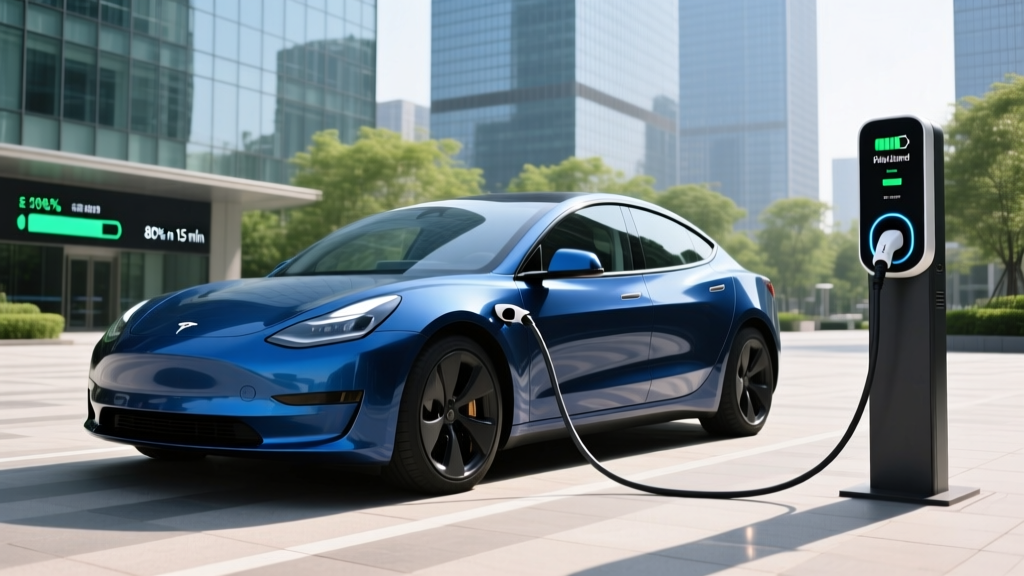
Search "chinese tesla" and you'll find a tangle of headlines about BYD, NIO, and Xiaomi — plus a persistent misconception that Tesla's Shanghai Gigafactory cars are flooding US dealerships. The reality is more nuanced. The Tesla Model 3 "Highland" refresh, engineered and built primarily at Giga Shanghai, represents the most significant update to the sedan since its 2017 launch. But for US buyers in 2026, the story is less about importing a Chinese-built EV and more about how Shanghai's engineering and LFP battery supply chain shaped the Model 3 you can actually buy stateside.
This review breaks down the 2026 Tesla Model 3 Long Range RWD — the variant most directly influenced by Giga Shanghai's production philosophy — with exact numbers on range, charging curves, battery chemistry, and total cost. We'll also untangle which "Chinese Tesla" models you can and cannot buy in the US.
2026 Tesla Model 3 Long Range RWD: Core Specifications
| Spec | Value |
|---|---|
| EPA Est. Range | 363 miles (Long Range RWD) |
| Battery (usable) | ~75 kWh (Long Range, NMC); ~57.5 kWh (Standard RWD, LFP) |
| Battery Chemistry | NMC (Long Range); LFP (Standard Range RWD) |
| Peak DC Fast Charge | 250 kW (Long Range); 170 kW (Standard RWD) |
| 10–80% DCFC Time | ~25 min (Long Range); ~30 min (Standard RWD) |
| Level 2 Home Charging | 11.5 kW / 44 mi/hr (Long Range); 7.6 kW / 30 mi/hr (Std) |
| 0–60 mph | 4.9 sec (LR RWD); 5.8 sec (Std RWD) |
| Horsepower | 346 hp (LR RWD); 271 hp (Std RWD) |
| Drivetrain | Rear-Wheel Drive (single motor) |
| MPGe (combined) | 132 MPGe (LR RWD) |
| Efficiency | 25 kWh/100 mi (LR RWD) |
| Cargo Volume | 23.1 cu ft (trunk + frunk combined) |
| Rear Legroom | 35.3 in |
| Base MSRP | $42,490 (Std RWD); $47,740 (LR RWD) — before incentives |
| Battery Warranty | 8 yr / 120,000 mi (Long Range); 8 yr / 100,000 mi (Std) |
| Basic Vehicle Warranty | 4 yr / 50,000 mi |
Real-World Range vs. the EPA Sticker
The Highland refresh improved efficiency through a more aerodynamic body (drag coefficient dropped to 0.219 Cd from 0.23), revised thermal management with a standard heat pump, and lower-rolling-resistance tires. The result is roughly 10–15% more range than the pre-2024 Model 3 Long Range on a similar battery size.
The Standard Range RWD variant, equipped with a CATL-supplied LFP (lithium iron phosphate) battery, carries an EPA rating of 272 miles. Real-world highway driving yields roughly 230–250 miles, and cold-weather drops can be steeper on LFP cells — expect 190–215 miles in sub-freezing conditions. LFP chemistry trades energy density for longevity and cost, a tradeoff we detail below.
Charging Speed: DC Fast Charge and Home Level 2
| Charging Method | Long Range (NMC) | Standard Range (LFP) |
|---|---|---|
| Level 1 (120V / 12A) | ~3 mi/hr | ~3 mi/hr |
| Level 2 (240V / 48A) | 11.5 kW / ~44 mi/hr | 7.6 kW / ~30 mi/hr |
| DC Fast Charge (peak) | 250 kW | 170 kW |
| DCFC 10–80% Time | ~25 minutes | ~30 minutes |
| DCFC 10–80% Avg Power | ~150 kW sustained | ~100 kW sustained |
| Connector | NACS (native) | NACS (native) |
A critical distinction many spec sheets omit: peak kW is not sustained kW. The Long Range Model 3 peaks near 250 kW only between roughly 10–30% State of Charge (SoC). Above 50%, the charge curve tapers significantly — you'll see 80–100 kW in the 50–70% range, and under 50 kW above 80%. This is why the 10–80% time is the meaningful metric, not the peak number.
On Tesla's V4 Superchargers (now widely deployed across the US as of 2025), the Model 3 Long Range consistently delivers 200+ kW in the early portion of the charge curve. On third-party networks using NACS adapters (Electrify America, EVgo), speeds can be 10–20% lower due to handshake protocols and cable thermal limits.
Preconditioning matters. If you navigate to a Supercharger using the car's built-in navigation, the Model 3 automatically warms the battery to optimal charging temperature en route. Without preconditioning — especially in cold weather — your initial charge rate can be cut by 50% or more for the first 5–10 minutes. Always use nav-based routing to chargers.
For home charging, a Tesla Wall Connector on a 60A circuit delivers the full 11.5 kW (48A continuous) to the Long Range model, adding roughly 44 miles of range per hour — enough to fully replenish overnight. Installation typically costs $500–$2,000 depending on panel proximity and whether a 200A service upgrade is needed.
Battery Chemistry: LFP vs. NMC in the Model 3 Lineup
The 2026 Model 3 lineup splits along a chemistry line that directly traces back to Giga Shanghai's supply chain:
- Standard Range RWD: CATL-supplied LFP (lithium iron phosphate) — ~57.5 kWh usable. Lower energy density, but rated for 3,000+ full charge cycles with minimal degradation. Tesla recommends charging LFP to 100% regularly to maintain battery calibration.
- Long Range RWD / AWD: NMC (nickel manganese cobalt) — ~75 kWh usable. Higher energy density for more range, but Tesla recommends daily charging to 80% to preserve longevity. Expect 1,500–2,000 effective cycles before notable degradation.
In practical ownership terms, LFP means you can charge to 100% every night without guilt — ideal for commuters who need maximum daily range from a smaller pack. NMC gives you the 363-mile ceiling but requires the 80% daily habit. Over 5 years and 75,000 miles, NMC packs typically retain 90–93% of original capacity; LFP packs retain 94–97%, based on fleet data from Tesla's annual impact reports and third-party analyses.
The LFP cells in the Standard Range Model 3 are sourced from CATL's Chinese manufacturing, which directly impacts federal tax credit eligibility — a point we address in the pricing section.
Pricing, Trims, and Federal Tax Credit Eligibility
| Trim | Base MSRP | §30D Credit Eligibility | Effective Price (with credit) |
|---|---|---|---|
| Standard Range RWD | $42,490 | Partial / $3,750 (critical minerals only) | ~$38,740 |
| Long Range RWD | $47,740 | Partial / $3,750 (critical minerals only) | ~$43,990 |
| Long Range AWD | $50,490 | Partial / $3,750 | ~$46,740 |
| Performance AWD | $54,990 | Partial / $3,750 | ~$51,240 |
Tax credit reality check: Under IRS §30D rules effective for 2026, the full $7,500 credit requires meeting both a critical-minerals threshold and a battery-component sourcing threshold. The Model 3's battery supply chain — heavily reliant on CATL (China) for LFP cells and Panasonic (Japan/US) for NMC — means most trims qualify for only $3,750 (the critical-minerals half). The battery-component requirement, which phases out sourcing from "foreign entities of concern" (FEOC), disqualifies the China-sourced component portion.
Additional eligibility requirements for the buyer:
- Adjusted gross income must not exceed $150,000 (single), $225,000 (head of household), or $300,000 (joint filers)
- The vehicle MSRP must not exceed $55,000 for sedans (all Model 3 trims comply)
- The credit can be transferred at point of sale as an immediate price reduction (new for 2024+, continues in 2026)
- Must be new, purchased for personal use in the US
Always verify current eligibility on fueleconomy.gov before purchasing, as battery sourcing determinations are updated periodically by the Treasury Department.
Performance, Ride, and the Highland Refinement
The Highland refresh transformed the Model 3 from a competent but rough-edged sedan into something closer to a luxury sport sedan. Key changes:
- Suspension: Revised frequency-selective dampers and softer bushings eliminate the crashy ride over sharp bumps that plagued 2018–2023 models. The car now absorbs expansion joints and potholes with composure.
- NVH (noise, vibration, harshness): Acoustic glass on all four doors, additional sound deadening in the floor and firewall, and redesigned motor mounts drop cabin noise by an estimated 3–5 dB at highway speed. It's noticeably quieter than a pre-refresh Model 3 and competitive with the BMW i4.
- Steering: Still electrically assisted and relatively light, but the ratio is more progressive. It won't satisfy enthusiasts who want feedback, but it's precise and confidence-inspiring for daily driving.
The Long Range RWD hits 60 mph in 4.9 seconds — quick enough for any merging situation and genuinely fun off the line. The Performance AWD variant drops that to 2.9 seconds with 510 hp, but at a $7,250 premium over the LR AWD. For most buyers, the LR RWD offers the best value-to-thrill ratio in the lineup.
Interior, Tech, and Driver Assistance
The Highland interior is a study in minimalism taken further. The 15.4-inch center touchscreen remains the command hub, but Tesla added:
- 8-inch rear touchscreen for climate, media, and entertainment (rear passengers no longer need to ask the driver to adjust temperature)
- Ambient LED lighting integrated into the dashboard and door panels — a first for Model 3
- Ventilated front seats (standard on all trims — a significant comfort upgrade)
- Power-folding side mirrors with auto-dimming
- Removed: turn-signal stalk and gear selector — signals are now on the steering wheel rim, and gear selection is via the touchscreen or a roof console. This is the Highland's most polarizing change.
Autopilot and FSD (Supervised): All 2026 Model 3 vehicles ship with Tesla's HW4.0 computer and the latest FSD (Supervised) software. It's critical to understand: this is SAE Level 2 driver assistance, not self-driving. You must keep your hands on the wheel and eyes on the road at all times. FSD (Supervised) handles highway lane changes, on-ramp to off-ramp navigation, and some city street driving, but it requires constant supervision and can make errors at construction zones, unusual intersections, and in heavy rain.
The base Autopilot (included free) provides adaptive cruise control and lane-centering on highways — adequate for most commuters. The $8,000 FSD purchase or $99/month subscription is a personal calculus: impressive as a technology demo, but not a reliable replacement for attentive driving.
Is the "Chinese Tesla" Available in the US?
Here's where the search term "chinese tesla" meets reality. Tesla's Giga Shanghai produces Model 3 and Model Y vehicles for multiple markets — China, Europe, Australia, and parts of Asia. However, US-market Model 3 vehicles are produced at the Fremont, California factory. Giga Shanghai cars are not imported to the US due to the 27.5% tariff on Chinese-manufactured automobiles (100% on Chinese EVs under 2025 tariff escalations) and differing regulatory homologation.
That said, the Shanghai influence is real:
- The Highland design and engineering were led by Giga Shanghai's team and subsequently adopted globally
- CATL LFP battery cells, pioneered in Shanghai-produced Standard Range models, are now used in Fremont-built Standard Range vehicles
- Manufacturing techniques (mega-casting, simplified wiring harnesses) developed in Shanghai were transferred to Fremont and Giga Berlin
So when people refer to the "Chinese Tesla," they're usually talking about either (a) the Shanghai-built cars sold in Europe/Asia that American enthusiasts import via gray market, or (b) the Chinese-sourced components (especially CATL batteries) inside US-market Teslas. Neither scenario means you're buying a fully Chinese-manufactured vehicle in a US Tesla showroom.
Chinese EV brands like BYD, NIO, XPeng, and Xiaomi's SU7 remain unavailable in the US as of 2026 due to tariffs and the absence of a US dealer/service network. The Xiaomi SU7, often called the "Chinese Tesla killer" in tech media, starts at roughly $30,000 in China and has drawn comparisons to the Model 3 for its design and performance — but it has no announced US launch timeline.
Pros, Cons, and the Verdict
Pros
- Class-leading efficiency: 25 kWh/100 mi (Long Range)
- 363-mile EPA range (LR RWD) — among the longest for a sedan under $50K
- NACS native — full Supercharger network access without adapters
- Dramatically improved ride comfort and cabin quietness (Highland)
- LFP option for buyers who want maximum battery cycle life
- Over-the-air updates continuously add features
- Strong resale value relative to EV segment average
Cons
- Stalkless steering wheel (turn signals, gear selector) requires adaptation
- Only $3,750 federal credit — not the full $7,500 (battery sourcing)
- Rear seat is tighter than Hyundai Ioniq 6 or BMW i4 (35.3" legroom)
- No Apple CarPlay or Android Auto — Tesla-only ecosystem
- FSD (Supervised) is expensive and still requires full driver attention
- LFP Standard Range loses more range in cold weather vs. NMC
- Insurance premiums run 15–30% above comparable gas sedans
Who Should Buy the 2026 Tesla Model 3?
Choose the Model 3 Standard Range RWD if: You commute under 50 miles round-trip, have reliable home Level 2 charging, want the lowest entry price (~$38,740 after credit), and value LFP's long cycle life and 100% daily charging.
Choose the Model 3 Long Range RWD if: You take regular road trips of 200+ miles, want maximum range (363 mi EPA), and can stretch to ~$43,990 after credit. This is the sweet-spot trim for most buyers.
Look at the Hyundai Ioniq 6 instead if: You need more rear-seat room, prefer physical controls, want the full $7,500 tax credit (Ioniq 6 qualifies), or need Apple CarPlay. The Ioniq 6 SE Long Range offers 361 miles EPA at a lower effective price after the full credit.
Look at the BMW i4 eDrive40 instead if: You value a traditional luxury interior, want a more engaging driving experience, and don't mind a lower EPA range (307 mi) and higher starting price ($57,900).
Frequently Asked Questions
Can I buy a Giga Shanghai-built Tesla Model 3 in the United States?
No. All US-market Model 3 vehicles are manufactured at Tesla's Fremont, California factory. Chinese-built Model 3s are sold in China, Europe, and Asia-Pacific markets. US tariffs (100% on Chinese EVs as of 2025) make direct import economically impossible, and the vehicles lack US-spec safety certifications.
What is the real-world range of the Tesla Model 3 Long Range?
The EPA rates it at 363 miles. Real-world mixed driving at highway speeds yields 310–330 miles in moderate temperatures. In winter (below 30°F), expect 250–280 miles. City driving with regen braking can approach the EPA figure.
Does the 2026 Model 3 qualify for the full $7,500 federal tax credit?
No. Due to battery component sourcing rules under IRS §30D, the Model 3 currently qualifies for $3,750 (the critical-minerals portion). The battery-component half is disqualified because of FEOC (foreign entity of concern) restrictions on Chinese-sourced components. Buyer income and MSRP caps also apply.
How fast does the Model 3 charge at home?
With a Tesla Wall Connector on a 60A circuit, the Long Range charges at 11.5 kW, adding about 44 miles of range per hour. A full charge from 10% takes roughly 7 hours. The Standard Range charges at 7.6 kW (~30 mi/hr) due to its smaller onboard charger.
Is the LFP battery in the Standard Range Model 3 better than NMC?
It depends on your use case. LFP offers superior cycle life (3,000+ cycles), can be charged to 100% daily without degradation concern, and costs less. But it has lower energy density (less range in the same physical space) and worse cold-weather performance. For a commuter who charges at home nightly, LFP is arguably the better choice. For road-trip-heavy drivers, NMC's range advantage wins.
How does the Model 3 compare to Chinese competitors like BYD Seal or Xiaomi SU7?
The BYD Seal and Xiaomi SU7 are compelling EVs in the Chinese domestic market, offering competitive range and aggressive pricing. However, neither is available in the US as of 2026, and neither has an announced US launch. For American buyers, the Model 3 remains the direct comparison point, with the Hyundai Ioniq 6 and BMW i4 as the closest cross-shop alternatives in showrooms today.