The Short Answer on Chinese EVs in Canada
As of 2026, buying a Chinese-made electric vehicle in Canada is effectively impossible for mainstream consumers. Canada imposed a 100% surtax on all Chinese-manufactured EVs in October 2024, mirroring U.S. and EU trade actions. This tariff applies to battery electric vehicles (BEVs) and certain hybrids assembled in China — regardless of the brand badge on the hood. That means a Tesla Model 3 built in Shanghai faces the same penalty as a BYD Seal. The result: no Chinese-built EVs are currently sold through authorized dealer channels in Canada, and grey-market imports carry the doubled price plus homologation headaches. If you're shopping for an affordable EV in Canada, your realistic options are vehicles assembled in North America, South Korea, or Europe.
What the 100% Tariff Actually Means for Canadian Buyers
Canada's 100% surtax was announced in August 2024 and took effect October 1, 2024, under the Department of Finance. The tariff applies to:
- All battery electric vehicles (BEVs) manufactured in China
- Certain plug-in hybrids assembled in China
- Vehicles from any brand — Chinese-owned (BYD, NIO, Xpeng) or Western-owned (Tesla, Volvo/Polestar) — if the final assembly occurs in China
The practical math is brutal. A BYD Atto 3 (known as the Yuan Plus in China) that might wholesale at roughly $25,000 USD would land in Canada at approximately $50,000+ CAD before freight, dealer fees, or provincial taxes — eliminating the price advantage that made Chinese EVs disruptive in European and Southeast Asian markets.
Brands that had been preparing Canadian market entries — including BYD, which dominates globally with over 3 million NEV sales annually — have shelved those plans. MG, which sells the Chinese-built MG4 EV in Europe at aggressive prices, cannot viably import it to Canada. Polestar shifted production of the Polestar 4 from China to South Korea partly in response to Western tariff environments.
Which EVs Are Affected vs. Exempt?
The tariff targets country of manufacture, not country of brand origin. This creates a nuanced landscape:
| Vehicle | Brand Origin | Assembly Location | Tariff Status |
|---|---|---|---|
| Tesla Model 3 (Shanghai) | USA | China | 100% surtax applies |
| Tesla Model 3 (Fremont/Austin) | USA | USA | No surtax |
| BYD Seal | China | China | 100% surtax applies |
| Volvo EX30 | Sweden (Geely-owned) | China | 100% surtax applies |
| Polestar 4 (2026+) | Sweden (Geely-owned) | South Korea | No surtax |
| Hyundai Ioniq 5 | South Korea | South Korea / USA (GA) | No surtax |
| MG4 EV | UK (SAIC-owned) | China | 100% surtax applies |
The Volvo EX30 situation illustrates the complexity: Volvo is headquartered in Gothenburg, Sweden, but Geely (its Chinese parent company) manufactures the EX30 in Luqiao, China. Canadian buyers lost access to what would have been one of the most affordable premium compact EVs on the market — the EX30 starts around $34,950 USD in the U.S., where it faces the same 100% tariff.
Cost Comparison: What Canadian EV Buyers Pay Instead
Without access to Chinese-manufactured budget EVs, Canadian shoppers are looking at a higher price floor. Here's how the realistic alternatives stack up against what Chinese EVs might have cost:
| Vehicle | Base MSRP (CAD) | EPA Range | Battery | DC Fast Charge (10-80%) | Federal iZEV Eligible? |
|---|---|---|---|---|---|
| BYD Dolphin (if available, hypothetical) | ~$32,000* | ~340 km (WLTP) | 60.4 kWh LFP | ~26 min at 80 kW | No (tariff-blocked) |
| Hyundai Kona Electric (2026) | $44,999 | 420 km (EPA est.) | 65.4 kWh NMC | ~43 min at 100 kW | Yes ($5,000) |
| Chevrolet Equinox EV (2026) | $44,999 | 513 km (EPA est.) | 85 kWh NMC | ~20 min at 190 kW | Yes ($5,000) |
| Tesla Model 3 RWD (USA-built) | $54,990 | 438 km (EPA) | 60 kWh LFP | ~25 min at 170 kW | Yes ($5,000) |
| Volkswagen ID.4 (2026, USA-built) | $52,995 | 443 km (EPA est.) | 82 kWh NMC | ~28 min at 175 kW | Yes ($5,000) |
*Hypothetical pre-tariff price based on European/global pricing; not actually available in Canada.
Canada's federal iZEV program offers up to $5,000 CAD for eligible BEVs with a base MSRP under $55,000 (for cars) or $60,000 (for SUVs/pickups), with a final MSRP cap of $65,000/$70,000 respectively. Most Chinese-built EVs would have been price-competitive even after tariff if the surtax didn't exist — but it does, so the effective floor for a new EV in Canada sits around $40,000 CAD after incentives.
EV vs. Gas: Real Ownership Costs in Canada
Whether you choose a Korean, American, or European-built EV, the ownership economics in Canada still favor electrification for most drivers — but the gap narrows without ultra-cheap Chinese EV options.
| Cost Factor (5-Year / 100,000 km) | Chevy Equinox EV 2LT | Honda CR-V EX (Gas AWD) | Toyota RAV4 Hybrid XLE |
|---|---|---|---|
| Purchase Price (after iZEV) | $44,999 CAD | $39,400 CAD | $41,250 CAD |
| Fuel/Energy Cost | ~$4,200 (electricity) | ~$11,800 (gasoline) | ~$7,900 (gasoline) |
| Maintenance | ~$1,800 | ~$4,500 | ~$4,200 |
| Insurance (avg) | ~$9,500 | ~$7,800 | ~$7,800 |
| Estimated Depreciation | ~$18,000 | ~$14,000 | ~$13,500 |
| Total 5-Year Cost | ~$78,499 | ~$77,500 | ~$74,650 |
Assumptions: $0.13/kWh home charging (varies by province — Quebec ~$0.07, Ontario ~$0.15), $1.55/L gas average, 20,000 km/year. Insurance estimates are national averages; EV premiums vary significantly by province and insurer. Depreciation estimates based on current market trends.
The EV wins on energy and maintenance but loses on purchase price, insurance premiums, and depreciation. Without a $30,000 Chinese EV option, the total-cost-of-ownership advantage for EVs in Canada is thinner — particularly for lower-mileage drivers. If you drive under 15,000 km/year, a hybrid like the RAV4 Hybrid often beats both pure EV and gas on total cost.
Real-World Ownership: Cold Climate, Charging Access, and Range Reality
Canadian EV ownership carries challenges that don't appear in California marketing materials:
Cold-Weather Range Loss
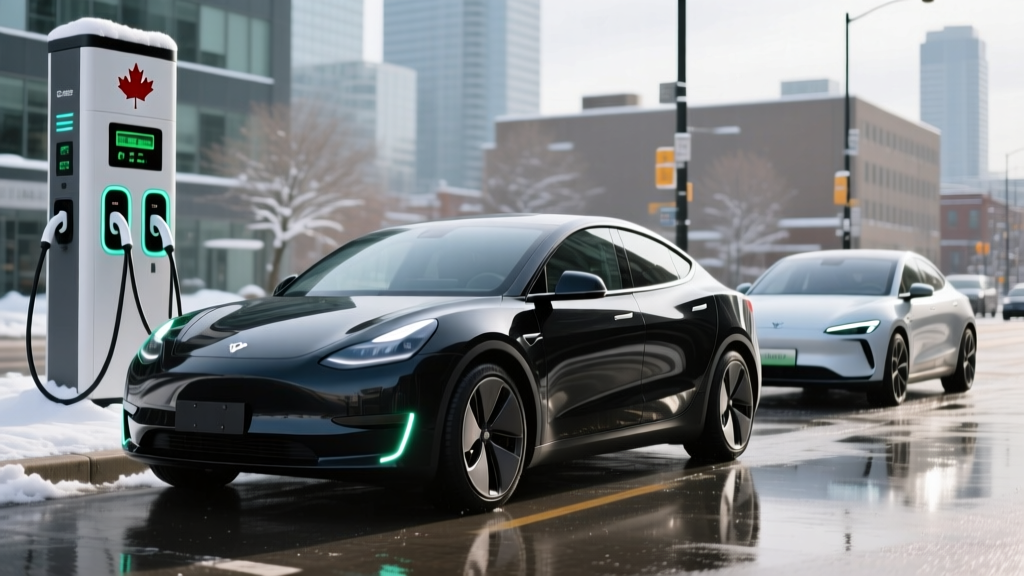
Lithium-ion batteries lose efficiency in freezing temperatures. In Canadian winter testing (−15°C to −25°C), expect 30-45% range reduction compared to EPA estimates. A Chevrolet Equinox EV rated at 513 km EPA may deliver 280-350 km in January in Winnipeg. Vehicles equipped with heat pumps (standard on most 2025+ EVs) recover roughly 10-15% of that loss by heating the cabin more efficiently than resistive heaters.
Home Charging Access
Approximately 35% of Canadian households lack access to dedicated home charging — particularly condo/apartment dwellers in Toronto, Vancouver, and Montreal. Without home Level 2 charging (7.2-11.5 kW, adding ~40-60 km of range per hour), EV ownership becomes significantly less convenient. Public DC fast charging in Canada costs $0.35-$0.55/kWh on networks like Electrify Canada, Petro-Canada, and Flo — roughly 3-4× the cost of home charging, which can erase the fuel-cost advantage over gasoline.
Charging Infrastructure Gaps
While the Trans-Canada Highway corridor is increasingly well-served, rural and northern regions remain charging deserts. Northern Ontario, rural Saskatchewan, and the territories have sparse DC fast-charger coverage. If your driving includes regular trips outside major corridors, a PHEV (plug-in hybrid) may be the more pragmatic choice.
Common Misconceptions About Chinese EVs in Canada
| Myth | Fact |
|---|---|
| "Chinese EVs are cheap and low quality" | BYD, NIO, and Xpeng vehicles score well in Euro NCAP crash tests. The BYD Seal earned 5 stars. Build quality and software rival Korean and European competitors at lower price points. |
| "I can just import one privately" | The 100% surtax applies to all imports regardless of channel. Plus, Transport Canada homologation requirements make grey-market imports expensive and slow. |
| "The tariff will be lifted soon" | As of early 2026, there is no announced timeline for tariff reduction. Canada's policy aligns with U.S. and EU positions on Chinese EV overcapacity. |
| "All Teslas in Canada are Chinese-made" | Tesla delivers USA-built Model 3 and Model Y to Canadian customers. Shanghai-built units are diverted to other markets. |
| "Chinese EV batteries are unsafe" | CATL and BYD Blade batteries (LFP chemistry) have strong thermal stability records. LFP cells are less prone to thermal runaway than NMC. BYD's Blade Battery passed nail-penetration tests without fire. |
Decision Framework: What Should Canadian EV Buyers Do?
Choose a Korean-built EV (Hyundai/Kia) if you want the best value proposition currently available — the Ioniq 5 and EV6 offer 800V architecture, ~300 km of range in 18 minutes at 350 kW chargers, and competitive pricing from ~$50,000 CAD.
Choose a USA-built EV (Tesla, GM, Ford) if you prioritize Supercharger network access (Tesla) or want an SUV/truck form factor (Equinox EV, Blazer EV, F-150 Lightning). Most qualify for the $5,000 federal iZEV.
Choose a plug-in hybrid (Toyota RAV4 Prime, Hyundai Tucson PHEV) if you lack home charging, regularly drive in extreme cold, or take long trips through charging-sparse regions. PHEVs give you 50-60 km of electric-only commuting with a gas engine for range security.
Wait for Chinese EVs only if you're prepared to wait years. BYD has announced plans to build a factory in Mexico or Brazil for North/South American supply, but tariff policies may extend to those facilities as well if trade agreements shift. There is no confirmed timeline for affordable Chinese EVs reaching Canadian showrooms.
Frequently Asked Questions
Are any Chinese-brand EVs sold in Canada right now?
No. As of 2026, no Chinese-headquartered automaker sells vehicles through authorized Canadian dealer networks. The 100% tariff makes importing economically unviable. BYD, NIO, Xpeng, and Li Auto have no Canadian retail presence.
Does the tariff apply to EV parts and batteries too?
The 100% surtax applies to complete vehicles. Separate tariffs on Chinese EV batteries and critical minerals exist at lower rates (25% on lithium-ion batteries under separate 2024 measures). This means a vehicle assembled in Korea using a CATL battery pack does not face the 100% vehicle surtax, though the battery component faces its own duties.
Will the Volvo EX30 ever come to Canada?
Volvo has indicated it will bring the EX30 to Canada once production shifts to its Ghent, Belgium plant or another non-China facility. As of early 2026, Canadian availability remains unconfirmed with no firm date. U.S. deliveries were similarly delayed.
What's the cheapest new EV I can actually buy in Canada in 2026?
The Nissan Leaf S starts around $39,998 CAD and qualifies for the $5,000 federal iZEV, bringing effective cost to ~$34,998. However, the Leaf uses a CHAdeMO connector (increasingly obsolete), has a 40 kWh battery (~240 km EPA range), and lacks DC fast-charge speeds competitive with newer platforms. The Hyundai Kona Electric or Chevrolet Equinox EV represent more future-proof choices at ~$45,000.
How do provincial rebates stack with the federal iZEV?
Quebec offers up to $7,000 CAD in provincial EV rebates (income-tested, reducing for higher earners), stackable with the $5,000 federal credit — potentially $12,000 total. British Columbia's CleanBC Go Electric program offers up to $4,000 (income-tested). Most other provinces offer no additional purchase rebates, though some provide reduced registration fees or HOV lane access.