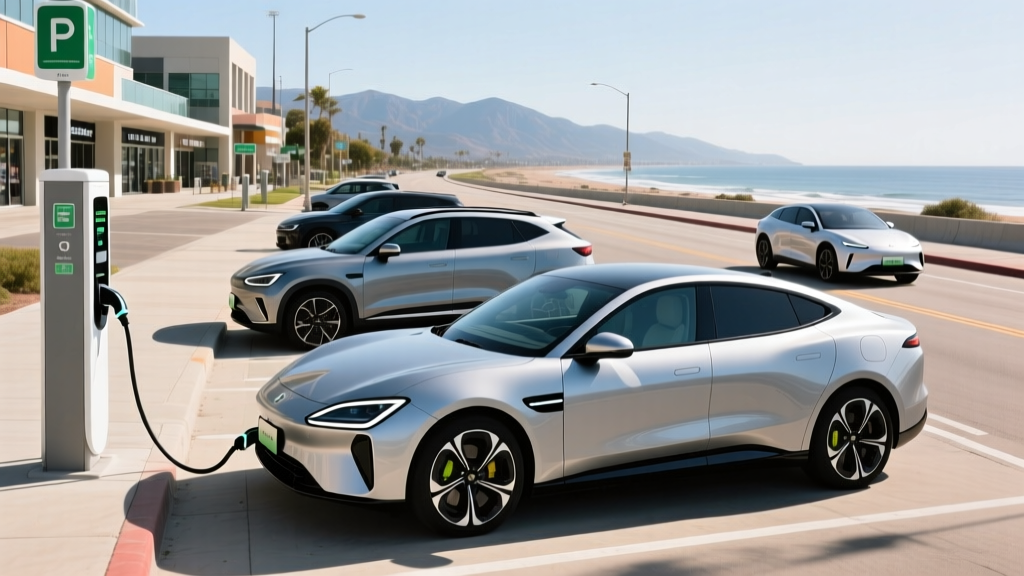
The short answer: As of 2026, you cannot buy a Chinese-made battery electric vehicle (BEV) from brands like BYD, NIO, Xpeng, or Zeekr in the US passenger car market. A combination of 100%+ cumulative tariffs on Chinese-origin EVs, national security reviews, and IRS §30D battery-sourcing rules that disqualify vehicles containing Chinese-manufactured battery components from the $7,500 federal tax credit have effectively blocked Chinese EVs from American showrooms. However, Chinese-owned brands manufacturing outside China (like Volvo/Polestar, built in South Carolina and Europe) are available, and Chinese EV supply chains still influence global pricing.
Why Chinese EVs Aren't Sold in the US (The Tariff Wall)
The US has erected a multi-layered tariff and regulatory structure that makes importing Chinese-built EVs commercially unviable:
- Section 301 tariffs (2024 escalation): 100% tariff on Chinese-origin battery electric vehicles, effective 2024 and continuing through 2026. This doubled the prior 25% rate.
- Baseline import duties: An additional 2.5% standard auto import tariff applies on top of Section 301 penalties.
- IRA battery-sourcing rules (§30D): Any vehicle with battery components manufactured or assembled by a "foreign entity of concern" (FEOC) — which includes Chinese companies like CATL and BYD — is ineligible for the $7,500 federal clean vehicle credit. This rule tightened in 2024 and remains in effect for 2026 model-year vehicles.
- Critical minerals requirement: Separate from FEOC, a growing percentage of battery minerals must be sourced from the US or free-trade-agreement partners, further excluding Chinese supply chains.
The practical result: even if BYD wanted to ship a $30,000 Seagull to the US, the 102.5% tariff stack would push the landed cost above $60,000 — eliminating any price advantage and making the vehicle uncompetitive against domestically assembled alternatives like the Chevrolet Equinox EV or Tesla Model 3.
Chinese-Owned Brands You CAN Buy in the US
Not every vehicle with Chinese corporate ties is blocked. The distinction is where the vehicle is manufactured and where the battery components originate:
| Brand | Parent Company | US Assembly | 2026 Availability | §30D Credit Eligible? |
|---|---|---|---|---|
| Volvo EX90 / EX30 | Geely (China) | EX90: Ridgeville, SC | Available | EX90: Partial (verify trim) |
| Polestar 3 / 4 | Geely/Volvo (China) | Polestar 3: Ridgeville, SC | Available | Polestar 3: Check sourcing |
| Lotus Eletre | Geely (China) | China-built (Wuhan) | Not sold in US | N/A |
| MG (SAIC) | SAIC Motor (China) | N/A | Not sold in US | N/A |
| BYD | BYD Company (China) | N/A | Not sold in US | N/A |
The Volvo EX90, assembled in South Carolina with an 111 kWh NMC battery, 85 kWh usable, and an EPA-estimated range of approximately 300-330 miles (depending on trim), is the clearest example of a Chinese-owned EV that's both purchasable and potentially credit-eligible in the US. The EX30, however, is built in China for other markets — US-bound units shifted to European assembly to navigate tariff exposure.
What Chinese EVs Cost Globally vs. US Alternatives
The appeal of Chinese EVs stems from their aggressive pricing in open markets. Here's how the global prices compare to what US buyers actually pay for domestic and Korean alternatives:
| Vehicle | Origin | Global/US MSRP | EPA Range | Battery (kWh) | Max DC Charge (kW) |
|---|---|---|---|---|---|
| BYD Seagull | China | ~$10,000 (China) | ~250 mi (CLTC) | 44.9 LFP | ~40 kW |
| BYD Atto 3 (Yuan Plus) | China | ~$28,000 (EU/AU) | ~260 mi (WLTP) | 60.5 LFP | 88 kW |
| Chevrolet Equinox EV LT | US (Mexico-assembled) | $33,600 (US) | 319 mi (EPA) | 85 NMC | 150 kW |
| Hyundai Ioniq 5 SE | US (Georgia) | $42,600 (US) | 303 mi (EPA) | 77.4 NMC | ~240 kW (peak) |
| Tesla Model 3 RWD | US (California) | $38,990 (US) | 272 mi (EPA) | 60 LFP | 170 kW |
Real-world range note: CLTC (China) and WLTP (Europe) range figures are significantly more generous than EPA testing. A BYD Atto 3 rated at 260 miles WLTP would likely test around 210-225 miles under EPA methodology — and expect 170-190 miles in cold weather or sustained highway driving at 75+ mph. Always convert to EPA-equivalent when comparing.
The True Cost: Owning a US-Alternative EV vs. Gas
If Chinese EVs are off the table, here's what a comparable US-market EV actually costs to own over five years versus a gas-powered equivalent. This comparison uses the Chevrolet Equinox EV 2LT ($33,600 before incentives) against the Honda CR-V EX ($33,850):
| Cost Category (5 Years / 75,000 mi) | Equinox EV 2LT | Honda CR-V EX (Gas) |
|---|---|---|
| Purchase Price (MSRP) | $33,600 | $33,850 |
| Federal Tax Credit (§30D, if eligible) | −$7,500 (point-of-sale) | $0 |
| Effective Net Price | $26,100 | $33,850 |
| Fuel / Electricity (75k mi) | ~$3,750 (home L2, $0.14/kWh avg) | ~$9,375 (28 MPG, $3.50/gal) |
| Maintenance (5 yr) | ~$1,200 (tires, cabin filter, fluid) | ~$3,800 (oil, brakes, filters, belts) |
| Insurance (est. avg) | ~$9,500 | ~$7,800 |
| Total 5-Year Cost | ~$40,550 | ~$54,825 |
The Equinox EV saves roughly $14,275 over five years when the buyer qualifies for the full §30D credit and charges primarily at home. Key caveats:
- Income caps apply: Modified AGI must not exceed $150,000 (single), $225,000 (head of household), or $300,000 (joint). Verify at IRS.gov.
- MSRP caps: Vans/SUVs/pickups capped at $80,000; sedans at $55,000.
- Battery sourcing: FEOC rules may disqualify specific trims or model years — always check the latest eligibility list before purchasing.
- Insurance premium gap: EVs typically cost 15-25% more to insure due to higher repair costs and battery replacement exposure. Shop quotes before buying.
Chinese EV Influence: How They Still Affect Your Purchase
Even without direct US sales, Chinese EV makers shape the market you're buying into:
1. Price pressure on global competitors. BYD's ability to sell a well-equipped EV for under $30,000 in Europe, Southeast Asia, and Latin America has forced legacy automakers to accelerate cost reduction. The Chevrolet Equinox EV's aggressive $33,600 MSRP exists partly because GM knows it competes with BYD globally and needs to defend its home market with credible pricing.
2. LFP battery dominance. Chinese manufacturers (CATL, BYD) control roughly 75%+ of global LFP battery cell production. LFP — lithium iron phosphate — is now used in the Tesla Model 3 RWD, base Ford Mustang Mach-E, and several other US-market EVs. This chemistry offers longer cycle life and lower fire risk than NMC, but with ~15-20% lower energy density. The cells may be LFP chemistry, but US automakers must source from non-Chinese FEOC suppliers to qualify for tax credits, pushing development of LFP plants in North America (e.g., Ford's BlueOval Battery Park in Michigan using licensed CATL technology).
3. Charging-speed benchmarking. BYD's e-Platform 3.0 vehicles and competitors like Xpeng's 800V architecture have pushed fast-charge expectations globally. The Hyundai Ioniq 5's 800V system (peak ~240 kW, 10-80% in roughly 18 minutes) competes directly with Chinese 800V platforms on charge speed, and this competition benefits US buyers regardless of brand origin.
Common Misconceptions About Chinese EVs in the US
| Myth | Fact |
|---|---|
| "Chinese EVs are banned in the US." | Not banned — tariffed at 102.5%+, making them commercially unviable. Chinese-owned brands assembling in the US or Europe (Volvo, Polestar) are fully legal and available. |
| "Chinese EVs are low quality." | BYD, NIO, and Xpeng score competitively in Euro NCAP and C-NCAP testing. The BYD Seal earned 5 stars in Euro NCAP (2023). Quality is no longer the barrier — trade policy is. |
| "I can import a Chinese EV myself." | Federal importation requires DOT/NHTSA compliance, EPA certification, and the 102.5% tariff applies. Gray-market import is not practical for modern EVs with software-locked features and proprietary charging protocols. |
| "Chinese batteries are in all US EVs." | FEOC rules under the IRA specifically exclude vehicles with Chinese-manufactured battery components from the §30D credit. Automakers have restructured supply chains to comply. Some licensed technology (like Ford-CATL) uses Chinese IP but US/EU manufacturing. |
| "Tariffs will drop and Chinese EVs will flood the market." | As of 2026, bipartisan support for maintaining EV tariffs remains strong. No announced timeline for reduction exists. Plan your purchase on currently available vehicles. |
First-Time EV Buyer Decision Framework
If you were hoping to access ultra-cheap Chinese EV pricing, here's how to find the best value among vehicles actually available in the US market:
IF your budget is under $30,000 (net of credits):
→ Look at the Chevrolet Equinox EV LT ($33,600 MSRP, potentially $26,100 after §30D). EPA range: 319 mi. Battery: 85 kWh NMC. DC fast charge: 150 kW peak (10-80% in ~30 min). This is the closest US-market equivalent to Chinese EV value pricing.
IF your budget is $30,000–$40,000:
→ Tesla Model 3 RWD ($38,990, credit-eligible trims exist). 272 mi EPA, 60 kWh LFP, 170 kW peak DC charge. Best Supercharger network access.
→ Hyundai Ioniq 5 SE Standard Range ($42,600). 303 mi EPA, 77.4 kWh NMC, ~240 kW peak. Fastest charging in class.
IF you want Chinese-owned but US-available:
→ Volvo EX90 Twin Motor (~$79,995). 111 kWh NMC, ~300-330 mi EPA, 250 kW peak DC charge. Assembled in South Carolina. Premium segment — verify §30D eligibility by trim and model year, as MSRP cap for SUVs is $80,000.
IF you can't charge at home:
→ Consider a PHEV (Toyota RAV4 Prime, Hyundai Tucson PHEV) instead. You get 30-42 miles of electric-only range for daily commuting plus a gas engine for road trips, avoiding public-charging dependency entirely.
IF you live in a cold climate (sub-20°F winters):
→ Budget 25-35% range loss vs. EPA in winter. A 319-mi Equinox EV may deliver 210-240 mi in January. Prioritize vehicles with heat pumps (Ioniq 5, Tesla Model 3, Volvo EX90) over resistive heating for better cold-weather efficiency.
What to Watch: Could Chinese EVs Enter the US Market?
Three scenarios could change the landscape, though none are imminent:
1. Chinese automakers build US factories. BYD has explored North American manufacturing sites, but no announced US EV plant exists. Even if built, FEOC battery-sourcing rules would require non-Chinese cell suppliers — a significant supply-chain challenge. This is a 2028+ scenario at the earliest.
2. Tariff reduction via trade negotiation. No active US-China trade framework includes EV tariff relief. Both political parties have signaled intent to maintain or increase tariffs on Chinese technology goods.
3. Chinese brands enter via Mexico. BYD and Chery have explored Mexican assembly, but US rules of origin under USMCA require 75% North American content for tariff-free import, and the 2024 tariff escalation specifically targets Chinese-branded vehicles regardless of assembly location through anti-circumvention provisions.
Frequently Asked Questions
Can I buy a BYD vehicle in the United States?
No. BYD does not sell passenger vehicles in the US. Their commercial vehicles (electric buses) are also restricted under separate federal procurement rules. The 102.5% tariff stack on Chinese-origin EVs makes direct import commercially impractical.
Are Polestar and Volvo considered Chinese EVs?
They are owned by Geely, a Chinese conglomerate, but the vehicles sold in the US are assembled in South Carolina (Volvo EX90, Polestar 3) or Sweden/Belgium (select trims). They are not subject to the Chinese-origin EV tariff. However, battery-sourcing rules for the §30D tax credit require careful verification by specific model year and trim — check the IRS eligibility tool before purchasing.
Will Chinese EV tariffs affect EV prices in the US?
Indirectly, yes. Without low-cost Chinese competition, US-market EVs face less downward price pressure than they would in an open market. However, competition between Tesla, GM, Hyundai/Kia, and Ford has still driven prices down significantly — the Equinox EV at $33,600 is an example of competitive pricing even without Chinese entrants.
Is it safe to buy a Chinese-owned EV brand like Volvo?
Yes. Volvo maintains its Swedish engineering and safety standards under Geely ownership. The EX90 earned top marks from IIHS testing. Corporate ownership does not override the brand's engineering, manufacturing, and safety compliance obligations in the US market.
What's the cheapest EV I can buy in the US in 2026?
The Nissan LEAF S starts at approximately $28,140 (2026 model year) with 149 mi EPA range and a 40 kWh battery. After a potential §30D credit of $3,750-$7,500 (verify eligibility — the LEAF's battery sourcing has been a moving target), effective pricing can drop below $21,000. For more range, the Chevy Equinox EV at $33,600 offers 319 mi EPA. Neither is Chinese-made.
Do Chinese EV batteries pose a security risk?
The US government's FEOC designation is based on national security concerns around supply-chain dependency and potential data access through connected vehicle software. Whether these concerns are proportionate is debated among analysts, but the regulatory effect is clear: Chinese battery components disqualify a vehicle from federal tax credits, and the 100% tariff blocks finished vehicle imports.