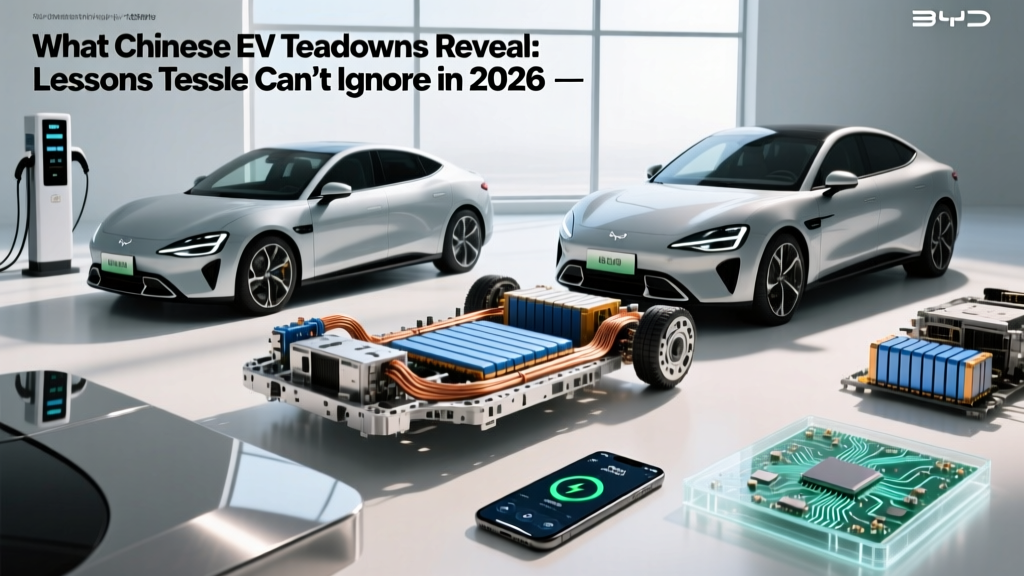
The automotive engineering world has a new obsession: Chinese EV teardowns. When firms like Munro & Associates and UBS disassembled vehicles from BYD, NIO, and Xpeng over the past two years, what they found sent shockwaves through Detroit, Wolfsburg, and Palo Alto. The Chinese EV teardowns Tesla lessons aren't about cheap labor anymore — they're about vertically integrated battery manufacturing, cell-to-body structural packs, and software-defined architectures that rival or undercut the Model 3 on cost while matching it on capability.
For US buyers, these teardowns matter because they reveal what's technically possible at a given price point — and because some of these vehicles, particularly from BYD, are beginning to appear in adjacent markets like Mexico and Canada. Below, we use the BYD Seal (the vehicle most frequently torn down and compared to the Tesla Model 3) as our spec anchor, while extracting the broader engineering lessons that every EV shopper should understand.
The BYD Seal at a Glance: Specs That Made the Teardowns Famous
The BYD Seal is a mid-size electric sedan positioned squarely against the Tesla Model 3 and Hyundai Ioniq 6. It's currently sold in China, Europe, Australia, and parts of Latin America — but not yet in the United States as of early 2026. Still, its engineering blueprint is the single most referenced data point in Chinese EV teardown reports.
| Spec | Value |
|---|---|
| EPA-equivalent range (WLTP) | 346 mi (WLTP); est. ~295 mi EPA if US-certified |
| Battery capacity | 82.5 kWh (usable) |
| Battery chemistry | LFP (Lithium Iron Phosphate) — BYD Blade Cell |
| Max DC fast charge | 150 kW peak |
| 10–80% DC charge time | ~26 minutes |
| Level 2 home charge rate | 11 kW (~37 mi/hr) |
| 0–60 mph | 5.9 seconds (RWD); 3.8 sec (AWD Performance) |
| Horsepower | 308 hp (RWD); 523 hp (AWD) |
| Drivetrain | RWD single motor / AWD dual motor |
| Efficiency (est.) | ~130 MPGe / 26 kWh/100 mi |
| Cargo volume | 14.1 cu ft trunk + 1.8 cu ft frunk |
| Base MSRP (Europe, converted) | ~$42,000 (est. US equivalent ~$36,000 if sold stateside) |
| Battery warranty | 8 years / 100,000 mi (global markets) |
Teardown Lesson #1: Cell-to-Body Architecture Cuts Cost and Weight
When UBS disassembled the BYD Seal in 2023 and published its findings, the headline was structural: BYD's Cell-to-Body (CTB) technology integrates the battery pack directly into the vehicle's floor structure, eliminating the separate battery enclosure that traditional EVs require.
Here's why that matters:
- Weight reduction: BYD claims a 10–15 kg savings versus a conventional pack-in-enclosure design. The Seal's curb weight is approximately 4,409 lbs (RWD) — competitive with the Tesla Model 3 Long Range at 4,034 lbs despite the Seal's larger battery.
- Torsional rigidity: The CTB design contributes to a claimed 40,500 Nm/deg torsional stiffness — higher than many luxury sedans and comparable to the Model 3's structural pack.
- Cost savings: Fewer parts, fewer fasteners, less adhesive. Munro & Associates estimated the CTB approach saves $200–$400 per vehicle in battery-pack assembly alone.
Tesla pioneered the structural battery pack with the 4680 cells in the Model Y, but BYD achieved a similar outcome with LFP blade cells at a lower cost per kWh. The lesson for the industry: structural integration is table stakes for cost-competitive EVs by 2026.
Teardown Lesson #2: LFP Blade Cells — Safety and Longevity Over Energy Density
BYD's Blade Cell is a long, thin LFP prismatic cell that is individually housed in a steel sleeve before being packed into the array. Teardowns reveal several engineering choices that differ from Tesla's approach:
| Attribute | LFP (BYD Blade) | NMC (NCA/NMC 811) |
|---|---|---|
| Energy density | ~150 Wh/kg (lower) | ~250 Wh/kg (higher) |
| Cycle life | 3,000–5,000 cycles | 1,500–2,500 cycles |
| Thermal runaway risk | Very low — passes nail penetration test | Higher — requires active thermal management |
| Cold-weather performance | Weaker — 20–30% range loss below freezing | Better — 15–20% range loss |
| Cost per kWh | ~$80–95/kWh | ~$110–130/kWh |
| Recommended SoC for daily use | 100% (no degradation concern) | 80% (to prolong life) |
| Cobalt/nickel content | None | Significant — supply-chain risk |
The practical ownership implication: LFP batteries like the BYD Blade can be charged to 100% daily without the degradation penalty that NMC batteries suffer. This means a Seal owner with an 82.5 kWh pack effectively has 82.5 kWh of daily usable capacity, while a Model 3 Long Range owner (NMC, ~75 kWh usable) is advised to charge to 80% for daily driving — yielding roughly 60 kWh of daily usable energy.
The teardown lesson? Usable daily capacity matters more than total pack size. BYD's LFP approach effectively neutralizes the energy-density disadvantage in day-to-day commuting.
Charging Deep Dive: Where Tesla Still Holds the Edge
This is where Chinese EV teardowns reveal a genuine Tesla advantage. The BYD Seal peaks at 150 kW on DC fast charging — respectable, but well below the Tesla Model 3's 250 kW (V3 Supercharger) or the Hyundai Ioniq 6's 240 kW on 800V architecture.
| Vehicle | Peak DC kW | 10–80% Time | Level 2 Rate | Connector (US) |
|---|---|---|---|---|
| BYD Seal (Global) | 150 kW | ~26 min | 11 kW | CCS2 (global) / GB/T (China) |
| Tesla Model 3 LR (2026) | 250 kW | ~18 min | 11.5 kW (48A) | NACS |
| Hyundai Ioniq 6 LR (2026) | 240 kW | ~18 min | 10.9 kW | NACS (2026+ models) |
| BMW i4 eDrive40 | 205 kW | ~22 min | 11 kW | CCS1 (adapter for NACS) |
The 150 kW ceiling on the Seal means that on a 350 kW Electrify America or Ionity station, the Seal is using less than half the available power. On a road trip, that's 8 extra minutes per stop versus a Model 3 — meaningful on a 500-mile journey with two charging stops.
At home on Level 2 (240V, 48A), the Seal adds roughly 37 miles of range per hour of charging. A full 10–100% charge takes approximately 8.5 hours — fine for overnight charging but slower than the Model 3's ~8 hours due to the Seal's larger battery.
Software and ADAS: The Teardown Gap That Matters Most
Hardware parity is only half the story. Teardowns consistently show that Chinese EVs match or beat Western competitors on hardware content — screens, sensors, compute chips — but the software integration layer remains the differentiator.
The BYD Seal features:
- 15.6-inch rotating center display — portrait or landscape orientation, a BYD signature
- 10.25-inch digital instrument cluster
- DiPilot ADAS suite — adaptive cruise, lane centering, automatic emergency braking, blind-spot monitoring
- 5G connectivity (in Chinese-market trims) with OTA updates
However, independent reviews note that DiPilot's lane-centering assist is noticeably less refined than Tesla Autopilot or GM Super Cruise on divided highways. The system requires more frequent steering corrections and disengages more readily in construction zones. This is a Level 2 driver-assist system — the driver must remain fully engaged at all times.
The teardown lesson for Tesla: hardware is commoditizing fast. Tesla's moat is increasingly in its FSD neural-net training data, Supercharger network reliability, and over-the-air iteration speed — not in the physical components under the skin.
Pricing, Tax Credits, and the Tariff Wall
The BYD Seal is not sold in the United States as of 2026, and a 100% tariff on Chinese-made EVs (raised from 25% in 2024) effectively blocks direct import. However, the pricing comparison remains instructive for understanding global EV economics:
| Vehicle / Trim | MSRP | Est. §30D Credit | Effective Price |
|---|---|---|---|
| BYD Seal RWD (hypothetical US) | ~$36,000 | $0 (China-manufactured, ineligible) | $36,000 |
| Tesla Model 3 RWD (2026) | $38,990 | Up to $7,500* | ~$31,490 |
| Tesla Model 3 LR AWD (2026) | $44,990 | Up to $7,500* | ~$37,490 |
| Hyundai Ioniq 6 SE (2026) | $39,950 | Up to $7,500* | ~$32,450 |
*Federal §30D tax credit eligibility depends on MSRP caps ($55,000 for sedans), buyer income limits ($150K single / $300K joint AGI), battery component and critical mineral sourcing requirements, and point-of-sale transfer availability. Consult IRS.gov §30D guidance and a tax professional before purchasing.
The irony of the tariff situation: the BYD Seal's estimated $36,000 US price would undercut the Model 3 RWD's pre-credit price, but after the $7,500 credit (for eligible buyers), the Tesla becomes cheaper. The tariff effectively protects Tesla's price advantage in the US market — but not in Europe, Australia, or Southeast Asia, where the Seal is actively competing.
Who Should Care About These Teardown Findings?
Even though you can't buy a BYD Seal in the US today, the engineering lessons from these teardowns directly affect your EV purchase decisions:
- You need Supercharger network access for road trips
- You want 250 kW peak DC charging (fastest in class)
- You value FSD (Supervised) capability and OTA improvements
- You qualify for the §30D credit, bringing price to ~$31,490
- Cold-weather range matters (NMC handles frost better)
- You're in Europe, Australia, or Latin America where it's available
- You want LFP battery longevity (5,000+ cycles, 100% daily SoC)
- You prioritize thermal safety (nail-penetration-proof cells)
- Lower purchase price matters more than fastest charging
- You drive mostly in mild climates where LFP cold-weather loss is minimal
The 5 Biggest Takeaways for US EV Buyers
- LFP is winning the cost war. BYD's blade cells at ~$85/kWh are pushing the entire industry toward LFP for standard-range models. Tesla already uses LFP in the Model 3 RWD — expect this to expand.
- Structural battery packs are the new normal. Both Tesla (4680 structural) and BYD (CTB blade) eliminate the separate enclosure. This saves weight and cost, and competitors without it will fall behind.
- Charging speed is the last hardware gap. Chinese EVs trail on DC fast-charge rates (150 kW vs. 250+ kW). If you road-trip frequently, this gap translates to real time savings at every stop.
- Software remains Tesla's moat. Teardowns show hardware parity, but Tesla's FSD training data, Supercharger uptime, and OTA cadence aren't replicated by BYD's DiPilot.
- Tariffs distort the true cost picture. Without the 100% tariff, a BYD Seal could sell for under $36K in the US — forcing Tesla, Hyundai, and others to accelerate cost cuts. Watch for policy changes.
Frequently Asked Questions
What is the real-world range of the BYD Seal?
The BYD Seal RWD Extended Range carries a WLTP rating of 346 miles. Under the more stringent US EPA cycle, this would likely translate to approximately 290–300 miles. In real-world highway driving at 70 mph, expect 245–265 miles. In sub-freezing temperatures, LFP chemistry loses 20–30% of capacity, reducing range to roughly 190–220 miles.
How fast does the BYD Seal charge?
On DC fast charging, the Seal peaks at 150 kW, achieving a 10–80% charge in approximately 26 minutes. At home on a Level 2 (240V, 48A) charger, it adds about 37 miles of range per hour, with a full charge taking roughly 8.5 hours. This is slower than the Tesla Model 3 (250 kW peak, ~18 min 10–80%) and the Hyundai Ioniq 6 (240 kW, ~18 min).
Can I buy the BYD Seal in the United States?
No. As of 2026, BYD does not sell passenger vehicles in the US market. A 100% tariff on Chinese-manufactured EVs makes direct import economically unviable. BYD has indicated it is evaluating US-adjacent markets (Mexico, Canada) but has announced no US launch timeline.
Does the BYD Seal qualify for the federal EV tax credit?
No. Even if sold in the US, the BYD Seal would not qualify for the §30D federal tax credit. The credit requires final assembly in North America and has strict battery-component and critical-mineral sourcing requirements that exclude Chinese-manufactured supply chains. See IRS.gov for current eligibility rules.
Is the BYD Seal better than the Tesla Model 3?
It depends on the metric. On cost per kWh of battery, LFP longevity, and thermal safety, the Seal has advantages. On charging speed, software sophistication, ADAS capability, charging-network access, and cold-weather range retention, the Model 3 wins. For US buyers specifically, the Model 3 is the practical choice given availability, tax credits, and Supercharger access.
What battery chemistry does the BYD Seal use?
The BYD Seal uses LFP (lithium iron phosphate) chemistry in BYD's proprietary Blade Cell format. LFP offers superior cycle life (3,000–5,000 full cycles), excellent thermal stability (passes nail penetration without fire), and zero cobalt content. The trade-off is lower energy density (~150 Wh/kg vs. ~250 for NMC) and greater cold-weather range loss.
Sources: UBS Research (BYD Seal teardown, 2023); Munro & Associates (structural battery analysis); fueleconomy.gov (EPA ratings for US-market comparators); IRS.gov §30D (tax credit eligibility).