The Short Answer on Chinese EV Graveyards
Photos of tens of thousands of abandoned electric vehicles in China — so-called "Chinese EV graveyards" — are real, but they are not evidence that EVs don't work. They are evidence of a specific, subsidy-driven market distortion in China between 2018 and 2022, where manufacturers produced cheap, low-range fleet vehicles to capture government purchase subsidies, then abandoned them when the subsidy rules tightened and fleet operators folded. For US buyers in 2026, the practical lesson is not "avoid EVs." It is: buy for your actual driving needs, prioritize battery chemistry and warranty, and never purchase a vehicle whose only value proposition is a tax credit.
What Chinese EV Graveyards Actually Are
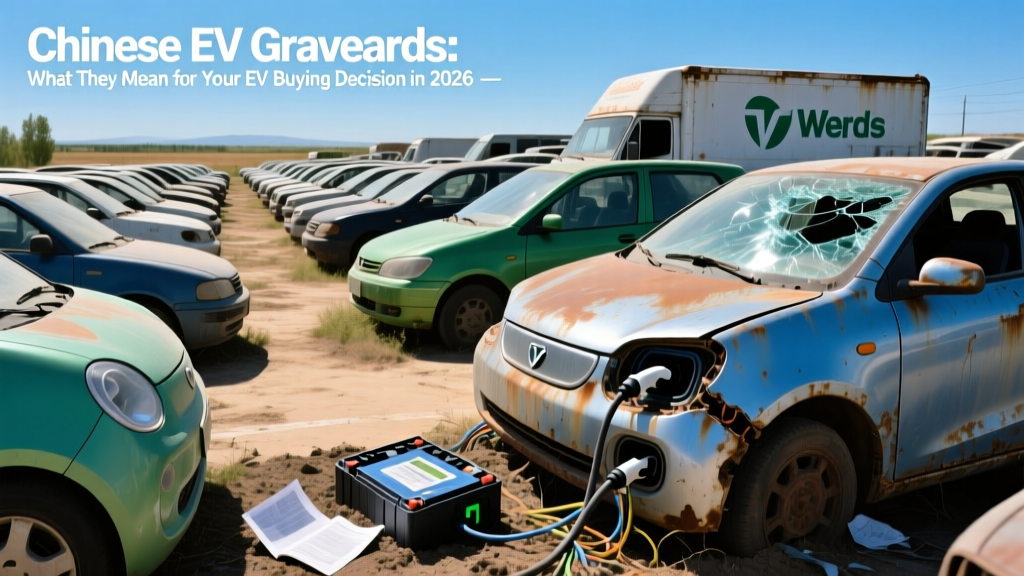
Starting around 2020, drone footage and investigative reporting — notably from outlets like the BBC and Reuters — surfaced images of vast lots in cities like Hangzhou, Hefei, and Jinan packed with unused or lightly used electric vehicles. Some lots held 10,000 or more cars, many still wrapped in factory plastic. The vehicles were predominantly compact, low-cost models from now-defunct or struggling Chinese startups and fleet operators: brands like Dorcen, Levdeo, and early BYD fleet-spec sedans with ranges under 100 miles (160 km) on the optimistic NEDC cycle.
The root cause was China's aggressive EV subsidy program, which between 2009 and 2022 distributed an estimated ¥200 billion (roughly $28 billion USD at the time) in purchase incentives. Manufacturers had strong incentives to produce vehicles — even if demand was artificial — because subsidies were tied to production volume and fleet deployment. When China tightened subsidy requirements in 2019 (raising minimum range thresholds from 150 km to 250 km and introducing energy-density requirements), many of these low-spec vehicles became ineligible. Fleet companies that had bulk-ordered them went bankrupt, and the cars sat.
By 2023, China's subsidy program had largely wound down for purchase incentives, transitioning to a trade-in and infrastructure model. The graveyards are a legacy artifact, not an ongoing phenomenon. China's actual EV market is now the largest in the world, with over 9 million new-energy vehicle (NEV) sales in 2024 alone, led by BYD, NIO, Xpeng, and Li Auto producing vehicles with genuine 250-400+ mile ranges.
Why This Matters for US EV Buyers
If you are shopping for an EV in the United States in 2026, the Chinese graveyard phenomenon matters for three concrete reasons:
- It illustrates subsidy-risk distortion. When a vehicle's purchase economics depend heavily on a tax credit — like the US federal §30D credit — buyers can make decisions based on the incentive rather than the vehicle's real utility. If the credit disappears or you don't qualify, you are left with a car that may not serve your needs.
- It highlights battery chemistry and degradation risk. Many abandoned Chinese fleet vehicles used early-generation LFP (lithium iron phosphate) or low-density NMC cells with poor thermal management. Sitting idle for 3-5 years at high state of charge without active battery management systems accelerated degradation. The lesson: battery care matters enormously for long-term value.
- It shows what happens without a real resale market. US EV buyers should factor in 5-year depreciation, which varies dramatically by model. A Tesla Model Y or Hyundai Ioniq 5 holds value; a low-volume, poorly supported EV may not.
EV vs. Gas vs. Hybrid: Real 2026 Cost Comparison
Before you buy, run the numbers for your actual driving pattern. The table below compares a representative 2026 BEV (Hyundai Ioniq 5 SE Standard Range), a comparable hybrid (Toyota RAV4 Hybrid XLE), and a gas-only baseline (Toyota RAV4 LE) over 5 years and 75,000 miles. All figures assume a national average electricity rate of $0.16/kWh and gasoline at $3.40/gallon.
| Cost Factor | 2026 Hyundai Ioniq 5 SE (BEV) | 2026 Toyota RAV4 Hybrid (HEV) | 2026 Toyota RAV4 LE (Gas) |
|---|---|---|---|
| Base MSRP | $42,600 | $34,075 | $30,445 |
| Federal Tax Credit (§30D, if eligible) | −$7,500 (point-of-sale) | $0 | $0 |
| Effective Purchase Price | $35,100 | $34,075 | $30,445 |
| EPA Efficiency | 114 MPGe (30 kWh/100 mi) | 39 MPG combined | 28 MPG combined |
| Energy/Fuel Cost (75k mi) | $3,600 | $6,538 | $9,107 |
| Estimated Maintenance (5 yr) | $1,800 | $3,200 | $3,800 |
| Estimated Insurance (5 yr) | $9,500 | $7,800 | $7,500 |
| 5-Year Depreciation (est.) | $18,500 | $14,200 | $15,800 |
| Total 5-Year Cost of Ownership | $68,500 | $65,813 | $66,652 |
Sources: fueleconomy.gov, manufacturer MSRP listings, IRS §30D guidance. Depreciation estimates based on 5-year Kelley Blue Book projections. Insurance varies significantly by state, driver profile, and model — get real quotes before purchasing.
The BEV wins on energy and maintenance costs but loses on insurance and depreciation. The break-even point depends heavily on your local electricity rate, annual mileage, and whether you qualify for the full §30D credit. If your electricity costs $0.30/kWh (common in California), the BEV fuel-cost advantage shrinks by roughly $1,680 over 5 years.
Real-World Ownership Considerations Most Buyers Miss
The Chinese graveyard vehicles failed in part because they were deployed without regard to real operating conditions. Don't make the same mistake in miniature. Here is what actually determines whether an EV works for you:
Home Charging Access
If you can install a Level 2 (240V) home charger, daily EV ownership is effortless — you wake up every morning with a "full tank." A typical Level 2 installation costs $800–$2,500 including a 48-amp charger (like the ChargePoint Home Flex or Emporia Level 2) and electrician labor, plus a possible $200–$500 permit fee. If your electrical panel needs a 200-amp upgrade, add $1,500–$3,500.
If you cannot charge at home (apartment, street parking, no garage), EV ownership shifts from convenience to chore. Public DC fast charging costs $0.30–$0.55/kWh nationally — roughly double the home rate — and requires 20–40 minutes of your time per session. Plan accordingly.
Climate and Range Reality
EPA range estimates assume moderate temperatures and mixed driving. In real-world testing, expect:
- Highway driving at 75 mph: 10–15% range reduction vs. EPA combined figure
- Cold weather (below 30°F / −1°C): 20–35% range reduction, depending on whether the vehicle has a heat pump. The Hyundai Ioniq 5 and Tesla Model Y both include heat pumps; older Nissan Leaf models do not.
- Mountainous terrain: Significant energy use climbing, partially recovered via regenerative braking on descent
A 2026 Ioniq 5 SE Standard Range has an EPA-estimated 290 miles of range from its 63.0 kWh (usable) LFP battery. On a 75-mph highway trip in 25°F weather, plan for roughly 195–215 miles of real range. That is sufficient for most daily driving but requires planning for road trips.
Charging Speed and the Taper Curve
The Ioniq 5's 800V architecture allows DC fast charging at up to 150 kW on a Standard Range model (the Long Range with the 84.0 kWh NMC battery peaks at ~240 kW). At 150 kW, a 10–80% charge takes roughly 22 minutes. However, charging speed is not linear: the vehicle will pull peak power only between roughly 10–55% state of charge, then taper significantly. Charging from 80–100% on DC fast charging is painfully slow and not recommended for battery longevity.
Common EV Misconceptions — Addressed with Data
| Myth | Fact |
|---|---|
| "EV batteries need replacing every 5 years." | Federal law mandates a minimum 8-year/100,000-mile battery warranty. Hyundai and Tesla offer 10-year/100,000-mile coverage. Real-world degradation data shows most NMC and LFP packs retain 85–92% capacity at 100,000 miles. A replacement pack for an Ioniq 5 costs approximately $8,000–$12,000 out of warranty — rare under normal ownership. |
| "EVs are worse for the environment because of battery mining." | Lifecycle analyses by the International Council on Clean Transportation (ICCT) consistently show BEVs produce 50–70% fewer lifecycle greenhouse gas emissions than comparable gas cars in the US grid mix, even accounting for battery manufacturing. The grid is also getting cleaner every year. |
| "Chinese EV graveyards prove EVs are a failed technology." | The graveyards reflect a specific subsidy-distorted market in China (2018–2022), not a technology failure. China's EV market is now the world's largest, and global EV sales exceeded 17 million units in 2024. The graveyards are a policy lesson, not a product one. |
| "You can't take an EV on a road trip." | The US DC fast-charging network now exceeds 50,000 ports. Tesla Superchargers (now open to NACS-equipped non-Tesla vehicles), Electrify America, and EVgo cover major interstate corridors. A 600-mile trip in an Ioniq 5 Long Range (EPA 320 mi) requires one 25-minute charging stop. |
| "All EVs qualify for the $7,500 tax credit." | Under current IRS §30D rules, eligibility depends on MSRP caps ($55,000 for sedans, $80,000 for SUVs/trucks), buyer income limits ($150k single / $300k joint AGI), battery critical-mineral sourcing, and North American final assembly. Many popular EVs qualify for only $3,750 or $0 depending on battery sourcing. Always verify on the IRS clean vehicle credit page before purchasing. |
Decision Framework: Should You Buy an EV, Hybrid, or Stick with Gas?
Choose a battery-electric vehicle (BEV) if:
- You have reliable home Level 2 charging access (garage, driveway, or employer-provided)
- Your daily driving is under 200 miles round-trip, or you are willing to plan DC fast-charging stops for longer trips
- You qualify for the §30D federal credit (check income, MSRP, and sourcing rules) or a state incentive
- You want the lowest per-mile energy cost ($0.04–$0.06/mile at home vs. $0.12–$0.15/mile for gas)
- You value instant torque, quiet operation, and minimal maintenance (no oil changes, no transmission fluid)
Choose a plug-in hybrid (PHEV) if:
- You can charge at home but frequently take trips exceeding 300 miles where charging infrastructure is sparse
- You want 25–40 miles of electric-only commuting with a gas engine as backup (e.g., Toyota RAV4 Prime: 42 miles electric, 38 MPG gas)
- You live in a region with extreme cold where EV range loss is a genuine concern
Choose a conventional hybrid (HEV) if:
- You have no home charging access and no workplace charging
- You want significantly better fuel economy (35–50 MPG) without any plugging in
- Your budget is tighter and you want proven long-term reliability with minimal new-technology risk
Stick with gas (for now) if:
- You drive fewer than 5,000 miles per year (the fuel savings of an EV or hybrid will not offset the purchase premium in a reasonable timeframe)
- You live in a rural area with no DC fast-charging access and cannot install a Level 2 charger at home
- You need a vehicle for heavy towing (over 7,500 lbs) where current EV options are limited and range under load drops sharply
First-Time EV Buyer Checklist
If you are seriously considering your first EV, work through this list before signing anything:
- Verify your charging situation. Can you install a 240V Level 2 charger? Get a quote from a licensed electrician before you buy. If your panel is 100-amp, you may need an upgrade.
- Check §30D eligibility. Use the IRS clean vehicle credit lookup tool for the specific model and trim. Point-of-sale transfer is available at participating dealers, reducing your purchase price directly.
- Test-drive in conditions that match your commute. Highway, city, hills — not just a 2-mile dealer loop.
- Understand the charge curve. Ask the dealer for the vehicle's 10–80% DC fast-charging time, not just the peak kW number. Peak is marketing; 10–80% is reality.
- Get insurance quotes before purchase. EV insurance premiums run 15–25% higher than comparable gas vehicles on average, due to higher repair costs and battery replacement risk.
- Read the battery warranty carefully. The federal minimum is 8 years / 100,000 miles for capacity retention (typically warranted to 70% of original capacity). Some manufacturers offer 10 years.
- Plan your road-trip charging. Use apps like A Better Routeplanner (ABRP) or PlugShare to map your most common long-distance route. If it requires three stops in dead zones, reconsider.
Frequently Asked Questions
Are Chinese EV graveyards still growing in 2026?
No. The phenomenon peaked between 2020 and 2023. China's purchase-subsidy program has largely ended, and the market has consolidated around major manufacturers (BYD, NIO, Xpeng, Li Auto, Geely/Zeekr) producing competitive vehicles with genuine demand. Some legacy lots are being cleared through export or recycling, but new graveyards are not forming at scale.
Should I avoid Chinese-brand EVs sold in the US?
As of 2026, Chinese-brand EVs have minimal US market presence due to 100%+ tariffs imposed in 2024 on Chinese-manufactured EVs. The Polestar 4 (built in China) and Volvo EX30 (China-sourced initially) faced tariff-related delays and pricing shifts. If a Chinese-brand EV is available in the US, evaluate it on its own specs — battery chemistry, range, charging speed, warranty, and service network — rather than country of origin alone.
What happens to an EV battery when the car is scrapped?
Battery recycling infrastructure is growing rapidly. Companies like Redwood Materials (founded by former Tesla CTO JB Straubel) and Li-Cycle recover 90–95% of critical minerals (lithium, cobalt, nickel) from end-of-life packs. The NHTSA and EPA have frameworks for battery end-of-life handling. A degraded EV battery (70–80% capacity) also has second-life applications in stationary energy storage before recycling.
How do I know if an EV will work in cold weather?
Look for a vehicle with a heat pump (standard on Hyundai Ioniq 5, Tesla Model Y, and most 2025+ EVs). Heat pumps reduce cabin heating energy consumption by 30–50% compared to resistive heaters. Also check if the vehicle offers battery preconditioning — this warms the battery before DC fast charging in cold weather, preventing painfully slow charge speeds. Expect 20–35% range loss below freezing regardless; plan your trips accordingly.
Is a used EV a good deal or a battery risk?
A used EV can be an excellent value, but the battery is the key variable. Request a State of Health (SoH) report from the dealer or use an OBD-II dongle with an app like LeafSpy (Nissan) or TeslaFi (Tesla) to check current capacity. Under the separate Used Clean Vehicle Credit (§25E), you may qualify for up to $4,000 (30% of sale price, capped) on a used EV priced at $25,000 or less from a dealer, subject to income limits ($75k single / $150k joint). This makes a used Chevrolet Bolt EV or Nissan Leaf significantly more affordable.