The Short Answer on Chinese Electric Trucks
As of early 2026, US consumers cannot directly purchase Chinese-brand electric trucks for personal use. A 100% tariff on Chinese-made EVs (raised from 25% in 2024 under updated USTR trade policy) makes models from BYD, Great Wall, and Geely subsidiaries economically unviable in the American market. However, Chinese-owned brands selling trucks built outside China — such as the Polestar 3 (Volvo/Geely, manufactured in South Carolina) — are available. For fleet buyers, limited commercial electric trucks with Chinese components exist through partnerships like the VIA Motors e-truck platform. Most American truck shoppers evaluating this space are better served comparing domestic and Korean/Japanese EV trucks currently on US soil.
Why Chinese Electric Trucks Aren't in US Driveways
The barrier isn't technology — Chinese automakers like BYD produce some of the most advanced and affordable electric trucks globally. The BYD Shark, a plug-in hybrid/electric pickup sold in Australia and Latin America, offers 62 miles of electric-only range and a combined system output of 430 horsepower at a price equivalent to roughly $35,000 USD. The problem is trade policy.
In 2024, the Biden administration increased Section 301 tariffs on Chinese EVs to 100%, and this rate persists into 2026. That effectively doubles the import cost of any China-manufactured electric vehicle. Combined with existing 2.5% auto tariffs, a Chinese electric truck with a factory price of $30,000 would land in the US at well over $60,000 before dealer markup — eliminating the price advantage that makes these trucks compelling abroad.
The IRS §30D federal tax credit further complicates matters: vehicles with battery components or critical minerals sourced from a "foreign entity of concern" (which includes Chinese companies like CATL and BYD) are disqualified from the up-to-$7,500 credit. So even if a Chinese truck could clear the tariff wall, it would likely fail the tax-credit test.
Chinese-Owned Brands You CAN Buy in the US
The distinction between "Chinese-made" and "Chinese-owned" matters. Several vehicles sold in America have Chinese parent companies but are manufactured locally or in allied nations:
| Brand / Model | Parent Company | Manufacturing Location | Type | Starting MSRP (2026) |
|---|---|---|---|---|
| Polestar 3 | Geely / Volvo | Ridgeville, South Carolina | Electric SUV (truck-like utility) | $67,500 |
| Polestar 4 | Geely / Volvo | Luqiao, China (imported) | Electric SUV coupe | $59,900 |
| Volvo EX90 | Geely / Volvo | Ridgeville, South Carolina | Electric 3-row SUV | $76,695 |
| Lotus Eletre | Geely | Wuhan, China | Electric SUV | $107,400 |
Note: none of these are pickup trucks. The US market for electric pickups remains dominated by the Ford F-150 Lightning, Rivian R1T, Chevrolet Silverado EV, and Tesla Cybertruck — all built domestically with varying degrees of Chinese-mineral content in their batteries.
The Real Comparison: US Electric Trucks vs. What China Offers Abroad
To understand what American buyers are missing — and what they're getting instead — here's a data-driven comparison of the BYD Shark (sold overseas) against trucks available in the US market:
| Spec | BYD Shark (Australia/LatAm) | Ford F-150 Lightning (XLT) | Rivian R1T (Dual-Motor) | Chevy Silverado EV (4WT) |
|---|---|---|---|---|
| Powertrain | PHEV (1.5T + electric) | BEV | BEV | BEV |
| EPA Electric Range | ~62 mi (EV only); N/A US EPA | 240 mi (std) / 320 mi (ext) | 270 mi (std pack) | 283 mi (std) / 460 mi (max) |
| Battery | 29.5 kWh (LFP, BYD Blade) | 98 kWh (std) / 131 kWh (ext) | 106 kWh (std, NMC) | ~200 kWh (max, NMC) |
| Peak DC Charge | N/A (PHEV) | 150 kW | 200+ kW | 350 kW (max range) |
| Horsepower | 430 hp (combined) | 580 hp | 533 hp | 510 hp (4WT) |
| 0-60 mph | ~5.7 sec | ~4.0 sec (ext range) | ~4.5 sec | ~5.5 sec |
| Towing Capacity | 2,500 kg (~5,500 lb) | 7,700 lb (std) / 10,000 lb (ext) | 11,000 lb | 10,000 lb |
| Base Price (USD equiv.) | ~$35,000 (not sold in US) | $54,995 | $69,900 | $57,900 (Work Truck) |
| Federal Tax Credit | Not eligible | Up to $7,500 (verify sourcing) | Up to $7,500 (verify sourcing) | Up to $7,500 (verify sourcing) |
The BYD Shark's price advantage evaporates entirely once tariffs and the loss of tax-credit eligibility are factored in. And as a plug-in hybrid rather than a full BEV, it doesn't offer the same fuel-cost savings or zero-tailpipe-emission driving that buyers in this segment increasingly expect.
Cost of Ownership: Electric Trucks vs. Gas Trucks
For buyers who can access home charging, a US-market electric truck delivers measurable savings over a comparable gas truck — but the math depends heavily on your driving patterns and electricity rate.
| Cost Factor (5-Year / 75,000 mi) | Ford F-150 Lightning (XLT, ext. range) | Ford F-150 Gas (XLT, 3.5L EcoBoost) |
|---|---|---|
| Purchase Price (after $7,500 credit) | $47,495 (est.) | $52,000 (est.) |
| Fuel / Electricity | $3,375 (home L2 at $0.135/kWh, 2.0 kWh/mi) | $11,250 (at $3.60/gal, 18 MPG combined) |
| Maintenance | ~$1,800 (no oil, fewer brakes via regen) | ~$4,200 (oil changes, brake pads, filters) |
| Insurance (avg.) | ~$11,500 (higher premiums for EVs) | ~$9,200 |
| Estimated Depreciation | ~$22,000 | ~$19,000 |
| 5-Year Total | ~$86,170 | ~$95,650 |
The electric truck saves roughly $9,500 over five years in this scenario, primarily through fuel and maintenance. However, insurance costs run 15-25% higher for EV trucks due to repair complexity and battery replacement costs. Depreciation remains a wildcard — EV truck resale values have been volatile, with some models losing 40-50% in their first two years according to iSeeCars data, though this is stabilizing as the market matures.
Home Charging: The Make-or-Break Factor
The cost math above assumes reliable Level 2 home charging. If you're dependent on public DC fast charging (at $0.35-$0.50/kWh average in 2026), your fuel cost jumps to $5,250-$7,500 over five years — narrowing the savings gap significantly. Before committing to an electric truck, confirm:
- You have a 240V / 50-amp circuit available (or can install one for $800-$2,500 including electrician labor and permits)
- Your daily driving falls within 80% of the truck's real-world range (accounting for 15-25% cold-weather loss and 20-30% highway-speed reduction)
- You have access to a public DC fast charger within 15 minutes of home for road trips
Common Misconceptions About Chinese EV Trucks
| Myth | Fact |
|---|---|
| "Chinese EVs are low quality" | BYD's Seal and Atto 3 have scored 5 stars in Euro NCAP testing. Build quality rivals or exceeds many Korean and Japanese competitors at similar price points. |
| "I can import a BYD truck myself" | Individual importation requires EPA/DOT compliance certification, which Chinese-market models have not passed. The 100% tariff applies regardless. |
| "Chinese batteries are inferior" | CATL and BYD are the world's two largest battery manufacturers. BYD's LFP Blade battery has demonstrated excellent thermal stability and cycle life exceeding 3,000 full cycles in testing. |
| "Chinese EVs will be here soon" | While BYD and others have discussed US entry, the 100% tariff, §30D sourcing restrictions, and political climate make consumer-market entry unlikely before 2028 at the earliest, and only via non-China manufacturing. |
| "All Chinese-owned EVs are tariffed" | Only vehicles manufactured in China face the 100% tariff. Polestar vehicles built in South Carolina are subject to standard import rules and qualify for tax credits if they meet §30D sourcing requirements. |
Decision Framework: What Should You Actually Buy?
If you want an electric truck in the US today:
- If you need maximum range and towing: Chevrolet Silverado EV with the Max Range pack (460 mi EPA, 10,000 lb tow) or Ford F-150 Lightning Extended Range (320 mi, 10,000 lb). The Silverado's 350 kW peak DC charging is the fastest in the segment.
- If you want off-road capability and adventure features: Rivian R1T with the Tri-Motor configuration (up to 410 mi with Max pack, 11,000 lb tow, quad-motor torque vectoring). The R1T's camp kitchen and gear tunnel are unmatched for overlanding.
- If you're budget-conscious and can wait: The base Ford F-150 Lightning at ~$55,000 before incentives remains the most accessible full-size electric truck. Watch for the 2027 model year refresh with NACS port and potential price reductions.
- If you want PHEV flexibility (no range anxiety): Consider the Ram 1500 Ramcharger (EREV, 150 mi electric + gas range extender) arriving in 2026. It's the closest US-market equivalent to the BYD Shark's dual-powertrain concept.
If you specifically want Chinese EV technology:
- If you want Geely/Volvo engineering with US availability: The Polestar 3 (300+ mi range, built in South Carolina) offers Chinese-parent-company tech with American manufacturing and potential tax-credit eligibility.
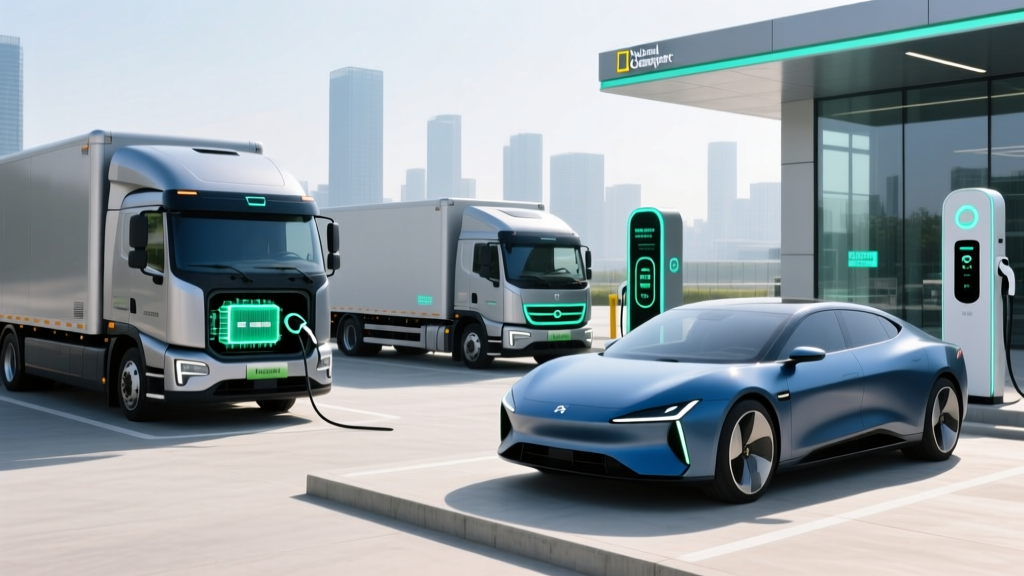
- If you're a fleet/commercial buyer: Monitor the VIA Motors and EdisonFuture programs, which have explored Chinese-platform electric trucks for last-mile delivery, though availability remains limited.
What First-Time EV Truck Buyers Need to Know
1. Real-world range is not EPA range. A Ford F-150 Lightning with a 320-mile EPA rating will deliver approximately 240-270 miles at sustained 75 mph highway speeds, and as low as 200-220 miles in sub-freezing temperatures. Plan your road trips around 200-mile legs with DC fast-charging stops.
2. Charging speed matters more than peak kW. The F-150 Lightning peaks at 150 kW but sustains that rate only briefly — expect a 10-80% charge in roughly 41 minutes. The Silverado EV's Ultium platform sustains higher rates longer, achieving 10-80% in approximately 20 minutes at a 350 kW-capable station. Always check the charge curve, not just the peak number.
3. The §30D tax credit is not guaranteed. Eligibility depends on your income (AGI under $150,000 single / $300,000 joint), the vehicle's MSRP (under $80,000 for trucks/SUVs), and battery sourcing. Vehicles with battery components from a foreign entity of concern (including Chinese suppliers) lose partial or full credit. Always verify current eligibility on fueleconomy.gov before purchasing.
4. Towing crushes range. Towing a 5,000-lb trailer can reduce an electric truck's range by 40-50%. That 320-mile F-150 Lightning becomes a 160-180-mile truck when towing. If you tow frequently, an EREV like the Ramcharger or a diesel truck may be more practical for now.
5. Battery warranties protect you. All major EV trucks include an 8-year/100,000-mile battery warranty covering degradation below 70% of original capacity (NHTSA requires this for emissions-related components, and manufacturers extend it to batteries). Real-world data from early Lightning owners shows approximately 5-8% degradation at 50,000 miles — well within warranty thresholds.
Frequently Asked Questions
Can I buy a BYD Shark pickup in the United States?
No. The BYD Shark is not sold or certified for the US market. The 100% tariff on Chinese-made EVs, combined with EPA/DOT compliance requirements, makes it unavailable to American consumers as of 2026.
Are any Chinese electric trucks sold commercially in the US?
A handful of commercial electric truck startups have used Chinese platforms or components (e.g., EdisonFuture EF1-V prototypes), but none have achieved meaningful production volume. The commercial electric truck market is currently served by US-based companies like BrightDrop, Tesla Semi, and legacy OEMs.
Will Chinese EV trucks ever come to the US?
It's possible but unlikely before 2028-2030. BYD and Geely have discussed North American expansion, but would need to build factories outside China (likely Mexico or the US) to avoid tariffs. Political headwinds and §30D battery-sourcing rules add additional barriers.
What's the best electric truck for someone who tows frequently?
For frequent towing, consider the Chevrolet Silverado EV Max Range (460 mi EPA, reducing to ~230-270 mi while towing) or wait for the Ram 1500 Ramcharger EREV, which eliminates range anxiety by using a gas generator to extend range. Towing with any pure BEV truck requires careful route planning around DC fast chargers.
Do Chinese-owned EVs sold in the US qualify for the $7,500 tax credit?
It depends on the specific vehicle's battery sourcing, not the parent company's nationality. A Polestar 3 built in South Carolina with US-sourced battery components can qualify. However, if the battery cells or critical minerals trace back to a Chinese entity of concern, the credit is reduced or eliminated. Check the IRS clean vehicle credit page for current eligibility.
How does cold weather affect electric truck range?
Expect 15-30% range loss in temperatures below 32°F, depending on whether the truck has a heat pump (which reduces HVAC-related battery drain). The F-150 Lightning with the extended-range pack includes a heat pump and typically loses 20-25% at 20°F. Preconditioning the battery while plugged in mitigates this loss and improves DC fast-charging speed in cold weather.