Quick Answer: Can You Actually Buy a Chinese Electric Supercar in the U.S.?
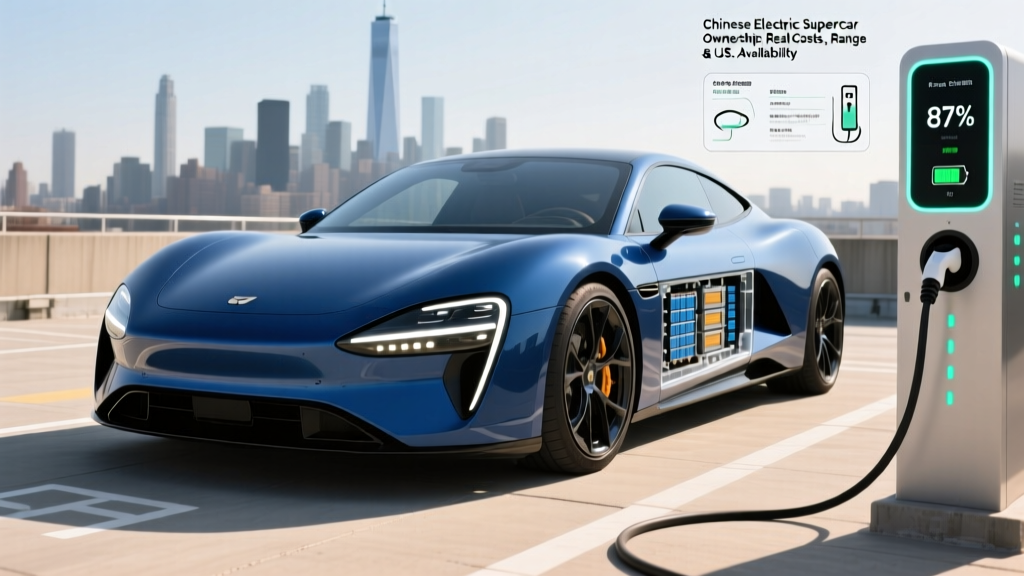
As of 2026, no Chinese electric supercar is officially sold or supported in the United States. Models like the BYD Yangwang U9 (~$235,000, 1,287 hp, 280-mile CLTC range) and the Xiaomi SU7 Ultra (~$113,000, 1,527 hp) are real, road-legal production vehicles — but only in China and select export markets. U.S. buyers face a 100% tariff on Chinese-made EVs (raised in 2024), zero dealer or service infrastructure, NHTSA/EPA homologation hurdles, and no federal tax credit eligibility. If you want hypercar-EV performance stateside today, the Lotus Evija or Rimac Nevera remain the only realistic — if far pricier — alternatives.
What Is a Chinese Electric Supercar, Exactly?
The term "Chinese electric supercar" refers to high-performance battery-electric vehicles produced by Chinese automakers that target the exotic and hypercar segments. Unlike the affordable EVs China exports globally (think MG4, BYD Dolphin), these are flagship halo cars designed to showcase engineering capability. Three models dominate the conversation in 2026:
- BYD Yangwang U9 — A 1,287-hp electric supercar with an active DiSus-X suspension system capable of tank turns and three-wheel driving. Priced at approximately ¥1,680,000 (~$235,000).
- Xiaomi SU7 Ultra — A four-door performance sedan with 1,527 hp from a tri-motor setup, 0-60 mph in 1.98 seconds, and a Nürburgring lap record for production EVs. Priced at approximately ¥814,900 (~$113,000).
- NIO EP9 (discontinued) — A limited-run, 1,341-hp track-focused hypercar produced in very small numbers starting in 2017. No longer in production but historically significant.
These vehicles are technologically legitimate. The question for U.S.-based enthusiasts is whether that technology translates to practical ownership.
Specs That Matter: BYD Yangwang U9 Deep Dive
Since the Yangwang U9 is the closest thing to a traditional "supercar" form factor from a Chinese OEM, it deserves a detailed spec breakdown. Note that range figures use the CLTC standard (China Light-Duty Vehicle Test Cycle), which is notably more generous than the U.S. EPA cycle.
| Attribute | Value |
|---|---|
| Powertrain | Quad-motor AWD (e4 platform) |
| Horsepower | 1,287 hp (960 kW) |
| 0-60 mph (claimed) | 2.36 seconds |
| Top Speed | 190 mph (306 km/h) |
| Battery Capacity | 80 kWh (LFP, Blade Battery) |
| Range (CLTC) | ~280 miles (450 km) |
| Estimated EPA Range | ~210-230 miles (real-world conversion) |
| DC Fast Charge (peak) | ~500 kW (800V architecture) |
| 10-80% Charge Time | ~15 minutes (at compatible charger) |
| Suspension | DiSus-X active (tank turns, 3-wheel mode) |
| Curb Weight | ~5,400 lbs (2,450 kg) |
| Price (China MSRP) | ¥1,680,000 (~$235,000 USD) |
| U.S. Availability | Not available |
Range Reality Check
The U9's 280-mile CLTC figure translates to roughly 210-230 miles EPA-equivalent, and expect 170-190 miles at sustained 75+ mph highway speeds. Cold weather (below 32°F) can reduce that further by 20-30%. For a supercar used primarily on weekends and track days, range is less critical — but it matters for any road trip to an event or circuit.
Chinese Electric Supercar vs. Gas Exotic: The Cost Comparison
Let's compare the Yangwang U9 (if you could import it) against a gas-powered benchmark in the same performance bracket: the Lamborghini Huracán Tecnica (~$238,000 MSRP, 631 hp, 0-60 in 2.9 seconds). We'll also include the Lotus Evija (~$2.1M, 1,972 hp) as the closest U.S.-available electric hypercar for reference.
| Cost Category | Yangwang U9 (hypothetical import) | Lamborghini Huracán Tecnica | Lotus Evija (U.S. available) |
|---|---|---|---|
| Purchase Price | $235,000 + ~$235,000 tariff = $470,000 | $238,000 | $2,100,000 |
| Federal EV Tax Credit (§30D) | $0 (not eligible, Chinese-sourced) | $0 (ICE) | $0 (exceeds MSRP cap) |
| Annual Insurance (est.) | $8,000-12,000 (no U.S. claims data) | $5,500-8,000 | $15,000+ |
| Fuel/Charging (5 yrs, 5K mi/yr) | $2,500-$3,500 (electricity) | $12,000-$15,000 (premium gas) | $3,000-$4,000 (electricity) |
| Maintenance (5 yrs) | $3,000-$5,000 (no dealer network = risk) | $15,000-$25,000 | $10,000-$15,000 |
| Depreciation (est. 5-yr) | 40-60% (unknown resale market) | 25-35% | 20-30% |
| Estimated 5-Yr Total | ~$580,000-$680,000+ | ~$330,000-$380,000 | ~$2,200,000+ |
The tariff math alone kills the value proposition. Even ignoring the 100% duty, the lack of a U.S. service network means any collision repair or battery issue becomes a custom-import nightmare with parts shipped from Shenzhen.
The Real Barriers to U.S. Ownership
Specs are only half the story. Here's what actually prevents Chinese electric supercar ownership in America:
1. The 100% Tariff Wall
In May 2024, the Biden administration raised the Section 301 tariff on Chinese-made EVs from 25% to 100%, effective for the 2025 model year onward. This effectively doubles the purchase price of any Chinese EV imported to the U.S. The Yangwang U9's $235,000 price tag becomes roughly $470,000 before shipping, homologation, or registration fees.
2. NHTSA and EPA Homologation
Every vehicle sold or imported for road use in the U.S. must comply with Federal Motor Vehicle Safety Standards (FMVSS) and EPA emissions certification. Chinese-market vehicles are not built to FMVSS specifications. Individual importation under the NHTSA's limited provisions is possible for vehicles over 25 years old or through a Registered Importer — neither of which applies to a brand-new supercar.
3. Zero Service Infrastructure
BYD, Xiaomi, and NIO have no U.S. service centers, parts depots, or certified technicians. A damaged carbon-fiber panel, a faulty inverter, or a battery module replacement would require international shipping and potentially flying in a specialist. For a daily-driven exotic, this is a dealbreaker.
4. Insurance Impossibility
U.S. insurers rely on crash-test data (IIHS/NHTSA), parts availability, and repair-cost databases to underwrite policies. A Chinese-market supercar with none of these will either be uninsurable or carry premiums that dwarf even the Lotus Evija's.
5. Charging Compatibility
Chinese-market EVs use the GB/T charging standard, not NACS (Tesla) or CCS1 (the U.S. standard). Even if you imported a Yangwang U9, you would need adapters for Level 2 and DC fast charging — and DC fast-charging adapters rated for 500 kW don't exist in consumer form in the U.S. market. Home Level 2 charging would require a custom adapter solution.
Myths vs. Facts About Chinese Electric Supercars
| Myth | Fact |
|---|---|
| "Chinese EVs are cheap knockoffs" | The Yangwang U9 and Xiaomi SU7 Ultra use proprietary 800V architectures, quad-motor torque vectoring, and LFP blade batteries — technology that matches or exceeds many Western OEMs. |
| "I can just import one through a dealer" | No U.S. dealer is authorized to sell or service these vehicles. Grey-market importation faces 100% tariffs, FMVSS non-compliance, and insurance barriers. |
| "The range is incredible — 280 miles!" | That's CLTC, not EPA. Real-world U.S. highway driving yields closer to 170-210 miles, especially at supercar speeds. |
| "It qualifies for the $7,500 tax credit" | Per IRS §30D rules, the credit requires North American final assembly, battery-component sourcing thresholds, and MSRP caps ($55,000 for sedans, $80,000 for SUVs/trucks). A $235,000 Chinese-built supercar fails all three tests. |
| "Chinese brands will be in the U.S. soon" | As of 2026, no Chinese OEM has announced U.S. retail plans. The tariff environment and geopolitical climate make near-term entry highly unlikely for any segment, especially exotics. |
What U.S. Buyers Can Actually Get Instead
If the appeal of a Chinese electric supercar is extreme EV performance at a relative bargain, here's what's actually buyable in the U.S. in 2026:
| Vehicle | Price (MSRP) | Horsepower | 0-60 mph | EPA Range | Max DC Charge |
|---|---|---|---|---|---|
| Tesla Model S Plaid | $89,990 | 1,020 hp | 1.99 sec | 396 mi | 250 kW |
| Lucid Air Sapphire | $249,000 | 1,234 hp | 1.89 sec | 427 mi | 300 kW |
| Porsche Taycan Turbo GT | $230,000 | 1,092 hp | 2.1 sec | 269 mi | 320 kW |
| Lotus Evija | $2,100,000 | 1,972 hp | <3.0 sec | ~250 mi (WLTP) | 350 kW |
| Rimac Nevera | $2,400,000 | 1,914 hp | 1.85 sec | ~340 mi (WLTP) | 500 kW |
The Lucid Air Sapphire is the closest spiritual match to the Yangwang U9: four-figure horsepower, sub-2-second 0-60, and a price in the low-$200K range — but with full U.S. service infrastructure, EPA certification, and Supercharger/NACS access.
Decision Framework: Should You Wait, Import, or Buy Domestic?
If-Then Ownership Guide
- If you want a Chinese electric supercar for U.S. road use today → Don't. The tariff, homologation, insurance, and service barriers make it financially irrational and logistically near-impossible.
- If you want supercar-EV performance under $250K → The Lucid Air Sapphire ($249K) or Tesla Model S Plaid ($89,990) deliver comparable or superior straight-line performance with full U.S. support.
- If you're a collector who wants one for a private track or display → Importation under NHTSA show-and-display provisions is theoretically possible but requires a Registered Importer, DOT bond, and acceptance that the car may never be street-legal.
- If you're betting on Chinese brands entering the U.S. market → Don't hold your breath. The 100% tariff and FMVSS requirements mean no Chinese OEM is likely to sell direct in the U.S. before 2028 at the earliest, and supercars would be the last segment to arrive.
- If you live outside the U.S. (Europe, Middle East, Southeast Asia) → Chinese EV brands are expanding rapidly in these markets. The U9 and SU7 Ultra may become available through official channels — check local BYD/Xiaomi distributors.
What a First-Time EV Buyer Should Know (Even If You're Not Buying a Supercar)
The Chinese electric supercar conversation raises broader ownership lessons relevant to any EV purchase:
- Charging standards matter. GB/T, CCS1, NACS, and CHAdeMO are not interchangeable. Always confirm connector compatibility before buying any EV — especially imported or grey-market vehicles.
- EPA range ≠ CLTC range ≠ WLTP range. The U.S. EPA cycle is the most conservative. If you're reading specs from a non-U.S. market, expect a 20-30% reduction when converting to real-world American driving.
- Home charging is essential for supercar-EV ownership. These vehicles have large batteries (80-120 kWh) that would take 40+ hours on a standard 120V outlet. A Level 2 home charger (9.6-19.2 kW, $500-$2,000 installed) is non-negotiable. Confirm your electrical panel can support a 60-amp circuit before committing.
- Tax credits have strict rules. Per current IRS §30D guidelines, the $7,500 federal credit requires North American assembly, battery-sourcing thresholds, MSRP caps, and buyer income limits. Almost no exotic or imported supercar qualifies.
- Insurance costs are rising for all performance EVs. Even U.S.-market EVs like the Model S Plaid carry premiums 40-60% higher than comparable gas sedans due to repair complexity and battery replacement costs.
Frequently Asked Questions
Can I personally import a BYD Yangwang U9 to the United States?
Technically, you can attempt it through a Registered Importer under NHTSA rules, but you'll face a 100% tariff (~$235,000 additional), FMVSS compliance modifications (which may be impossible for this vehicle), GB/T-to-NACS charging adapter challenges, and likely uninsurability for road use. The total cost would exceed $500,000 for a car with no service network.
Why are Chinese EVs banned from the U.S.?
They aren't explicitly "banned" — they face a 100% Section 301 tariff that makes them economically unviable, combined with FMVSS safety standards that Chinese-market vehicles aren't built to meet. The combination is a de facto barrier, not a legal prohibition.
How does the Yangwang U9's performance compare to a Tesla Model S Plaid?
The U9 produces more horsepower (1,287 vs. 1,020 hp) but is heavier (~5,400 lbs vs. ~4,766 lbs). Its claimed 0-60 of 2.36 seconds is slightly slower than the Plaid's 1.99 seconds. The U9's advantage is its active suspension and torque-vectoring capability, which may offer superior track handling — but without independent U.S. testing, this remains unverified.
Will BYD or Xiaomi ever sell cars in the U.S.?
As of 2026, neither company has announced U.S. retail plans. BYD has hinted at market research but faces the 100% tariff wall and geopolitical headwinds. Xiaomi's auto division is focused on China and select Asian/European markets. Realistic U.S. entry for either brand is unlikely before 2028-2030, if ever.
What's the cheapest way to get supercar-level EV performance in the U.S.?
The Tesla Model S Plaid at $89,990 MSRP delivers 1,020 hp, a 1.99-second 0-60, and 396 miles of EPA range — with full Supercharger access and a nationwide service network. It remains the best performance-per-dollar EV on the market, even if it lacks the exotic design of a Yangwang U9.
Do Chinese electric supercars use LFP or NMC batteries?
The BYD Yangwang U9 uses BYD's proprietary LFP (lithium iron phosphate) Blade Battery, which prioritizes safety and cycle life over energy density. The Xiaomi SU7 Ultra uses a CATL-supplied NMC (nickel manganese cobalt) pack optimized for power output. LFP batteries degrade more slowly but are heavier; NMC offers higher energy density but at greater thermal risk.