The Short Answer on Chinese Electric Cars in Canada
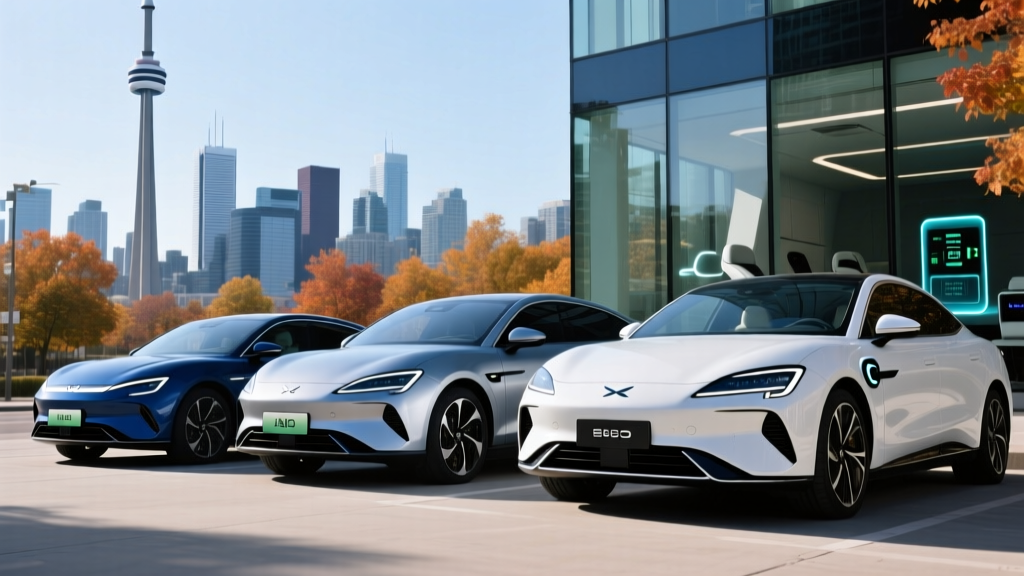
As of 2026, Chinese-made electric vehicles are effectively priced out of the Canadian market. Canada imposed a 100% surtax on all Chinese-manufactured EVs (effective October 1, 2024), mirroring U.S. trade policy. A vehicle like the BYD Atto 3, which might sticker around $38,000 CAD elsewhere, would face approximately $38,000 in additional duties before reaching a Canadian showroom. Combined with provincial sales taxes and freight, the effective price doubles. No major Chinese EV brand — BYD, NIO, Xpeng, or Zeekr — currently sells directly to Canadian consumers, and none have announced Canadian retail plans for 2026 or 2027.
If you're searching for affordable EVs in Canada, your realistic options remain Tesla (built in the U.S.), Hyundai/Kia (U.S. and Korea-built), and European models — all of which qualify for different incentive structures. Below, we map out exactly what the tariff means for your wallet, what Chinese EVs cost globally for context, and how to actually find a budget-friendly EV in Canada today.
Why Chinese EVs Are Blocked From Canada: The 100% Tariff Explained
On August 26, 2024, the Canadian government announced a 100% surtax on EVs manufactured in China, which took effect October 1, 2024. This applies to battery electric vehicles, plug-in hybrids, and certain hybrid vehicles produced in Chinese factories — regardless of the brand's headquarters. That means even a Volvo or Tesla built in a Chinese plant would be subject to the tariff if imported to Canada.
The policy rationale, per Finance Canada, is to counter what it describes as China's deliberate overcapacity strategy and state-subsidized pricing that undercuts domestic manufacturers. Canada's auto sector, anchored by Ontario-based Stellantis, Honda, and the incoming VW battery plant, is a key political consideration.
What this means in dollar terms:
| Vehicle (Global Market) | Approx. MSRP in China (CAD) | 100% Tariff Applied | Effective Canadian Price | Comparable EV in Canada |
|---|---|---|---|---|
| BYD Atto 3 (Standard) | ~$34,000 | +$34,000 | ~$68,000+ | Hyundai Kona Electric (~$44,000) |
| BYD Seal (Premium) | ~$42,000 | +$42,000 | ~$84,000+ | Tesla Model 3 Long Range (~$60,000) |
| BYD Dolphin | ~$28,000 | +$28,000 | ~$56,000+ | Chevrolet Bolt EUV (~$43,000) |
| Xpeng G6 | ~$40,000 | +$40,000 | ~$80,000+ | Ford Mustang Mach-E (~$57,000) |
| Zeekr 001 | ~$48,000 | +$48,000 | ~$96,000+ | BMW i4 eDrive40 (~$72,000) |
These figures are estimates based on global pricing and do not include freight, PDI, or provincial taxes (GST/HST/PST). The point is clear: the tariff erases the price advantage that makes Chinese EVs attractive in Europe, Southeast Asia, and South America.
Chinese EVs by the Numbers: What You're Missing (and What You're Not)
For context, here's what the leading Chinese EVs actually offer on paper — data drawn from global spec sheets and EV Database testing. These are the vehicles Canadian shoppers often ask about.
BYD Atto 3 (Yuan Plus)
- Battery: 60.5 kWh LFP (Blade Battery)
- WLTP Range: 420 km (~261 miles) — expect ~340 km in Canadian winter
- DC Fast Charge: 88 kW peak, 10–80% in ~29 minutes
- Motor: 201 hp, 0–100 km/h in 7.3 seconds
- Platform: e-Platform 3.0, front-wheel drive
BYD Seal
- Battery: 82.5 kWh LFP (Cell-to-Body structural pack)
- WLTP Range: 570 km (~354 miles) — expect ~430 km highway, less in cold
- DC Fast Charge: 150 kW peak, 10–80% in ~26 minutes
- Motor: 313 hp (RWD) / 530 hp (AWD), 0–100 km/h in 5.9s / 3.8s
Xpeng G6
- Battery: 87.5 kWh NMC
- WLTP Range: 570 km (~354 miles)
- DC Fast Charge: 800V architecture, 280 kW peak, 10–80% in ~20 minutes
- Motor: 296 hp (RWD), 0–100 km/h in 6.6 seconds
The honest assessment: These are competitive vehicles globally. BYD's LFP Blade Battery offers excellent thermal stability and cycle life (3,000+ cycles to 80% capacity). Xpeng's 800V charging architecture rivals the Hyundai Ioniq 5 and Porsche Taycan. But competitive specs do not translate to Canadian availability, and without a dealer network, parts supply, or cold-weather validation, importing one privately would be a significant risk.
Real Cost of EV Ownership in Canada: What Budget Buyers Should Actually Consider
Since Chinese EVs aren't an option, let's look at what a Canadian EV buyer on a budget is actually spending in 2026. We'll compare a realistic affordable EV — the Hyundai Kona Electric (built in South Korea, no tariff issues) — against a comparable gas-powered crossover, the Hyundai Kona 2.0L AWD.
| Cost Factor (5 Years / 100,000 km) | Kona Electric (Preferred, $44,000 MSRP) | Kona 2.0L AWD Gas ($33,000 MSRP) |
|---|---|---|
| Purchase Price (before incentives) | $44,000 | $33,000 |
| Federal iZEV Rebate | −$5,000 | $0 |
| Provincial Rebate (BC example) | −$3,000 | $0 |
| Net Purchase Price | $36,000 | $33,000 |
| Fuel/Energy (100,000 km) | $2,400 (home L2, $0.12/kWh avg) | $11,500 ($1.72/L avg, 8.5 L/100 km) |
| Maintenance (5 yr) | $1,200 | $4,800 |
| Insurance (5 yr avg) | $9,500 | $7,500 |
| 5-Year Total Cost | $49,100 | $56,800 |
Key takeaways:
- The Kona Electric saves approximately $7,700 over 5 years even before accounting for the higher purchase price, thanks to dramatically lower fuel and maintenance costs.
- EV insurance in Canada runs 15–30% higher than equivalent gas vehicles, per Insurance Bureau of Canada data. This partially offsets fuel savings.
- Home charging at off-peak rates ($0.08–$0.12/kWh in most provinces) is critical. Public DC fast charging at $0.35–$0.50/kWh erodes savings quickly.
- Cold-weather range loss of 25–40% is a real factor in Canadian winters. The Kona Electric's EPA-rated 417 km range drops to roughly 280–320 km at −20°C with cabin heating.
Common Misconceptions About Chinese EVs in Canada
| Myth | Fact |
|---|---|
| "You can import a BYD to Canada yourself." | Transport Canada requires all imported vehicles to meet CMVSS safety standards. Chinese-market EVs are not certified to these standards. Individual importation would require costly crash-testing and modifications — effectively impossible for a consumer. |
| "The tariff will be lifted soon." | As of early 2026, the 100% surtax has no sunset clause. The Canadian government has signaled this is a long-term trade policy, not a temporary measure. Both major federal parties support the tariff. |
| "Chinese EVs are cheaply made." | BYD's Blade Battery passed nail-penetration testing without thermal runaway. The Atto 3 scored 5 stars in Euro NCAP testing. Build quality is competitive with Korean and Japanese rivals, though software localization for North America remains unproven. |
| "Tesla is an alternative to Chinese brands." | Tesla vehicles sold in Canada are built at Giga Texas and Giga Berlin — not China. The Shanghai-built Model 3 that served the Canadian market pre-2024 has been replaced by North American production. Tesla qualifies for different trade treatment. |
| "Chinese brands will build a factory in Canada." | No Chinese automaker has announced a Canadian production facility. BYD is exploring a Mexico plant for the Latin American market, but Canadian or U.S. factory plans remain speculative and would face significant political hurdles. |
Decision Framework: What Canadian EV Buyers Should Actually Do
If You Want an Affordable EV in Canada (Under $50,000 CAD)
- If you have home charging and drive under 60 km/day: The Chevrolet Bolt (if remaining inventory exists), Hyundai Kona Electric, or Nissan Leaf are proven choices with federal iZEV eligibility.
- If you need AWD and winter capability: Tesla Model Y (Austin-built, ~$60,000), Hyundai Ioniq 5 AWD (~$62,000), or Subaru Solterra/Toyota bZ4X (~$55,000) — all eligible for the $5,000 federal rebate if MSRP is under $55,000 (base trims).
- If you want the absolute lowest cost of ownership: A used Tesla Model 3 (2021–2023) at ~$35,000–$42,000 CAD offers strong Supercharger access and proven cold-weather performance, though the federal used-EV rebate ($2,000) has limited availability.
- If you were hoping for a sub-$30,000 Chinese EV: This option does not exist in Canada in 2026. The closest equivalent is waiting for the next-generation Chevrolet Bolt or a potential entry-level Hyundai/Kia EV, expected 2027–2028.
If You're Considering a PHEV Instead
For Canadians without reliable home charging or those in extreme-cold regions (Prairies, Northern Ontario/Quebec), a plug-in hybrid like the Toyota RAV4 Prime (68 km electric-only range, 94 MPGe combined) or Hyundai Tucson PHEV (53 km electric-only, 80 MPGe) provides electric commuting with gas backup — no range anxiety, no charging-desert risk. These start around $48,000–$55,000 CAD and remain eligible for the $5,000 iZEV rebate.
First-Time EV Buyer Checklist for Canada
- Verify iZEV eligibility: The federal incentive requires a base MSRP under $55,000 (cars) or $60,000 (SUVs/trucks/pickups). Higher trims can push vehicles over the cap. Check Transport Canada's eligible vehicle list before committing.
- Get a home electrical assessment: A Level 2 charger (7.2–11.5 kW) requires a 240V circuit, typically 40–50 amps. Installation costs range from $800–$2,500 CAD depending on panel capacity. Older homes may need a $3,000–$5,000 panel upgrade.
- Check provincial rebates: BC offers up to $3,000 (income-dependent), Quebec up to $7,000 (phasing down through 2027), and Nova Scotia up to $3,000. Ontario has no provincial EV rebate as of 2026.
- Factor in winter range loss: Budget 30–40% below the EPA range sticker for deep-winter driving. A vehicle rated at 400 km EPA will deliver roughly 260–300 km at −25°C with resistive heating. Heat-pump equipped vehicles (Tesla, Hyundai/Kia, VW ID.4) lose only 20–25%.
- Test cold-weather charging: Lithium-ion batteries charge significantly slower when cold. Always precondition your battery before DC fast charging in winter. Without preconditioning, a 150 kW-capable vehicle may only accept 30–50 kW until the pack warms up.
- Understand battery warranty: Transport Canada and most manufacturers mandate 8 years / 160,000 km on the high-voltage battery, covering capacity loss below 70%. BYD's global warranty is 8 years / 160,000 km as well — but with no Canadian dealer network, warranty service would be impossible.
Frequently Asked Questions
Can I buy a BYD in Canada in 2026?
No. BYD does not have a Canadian retail presence, and the 100% federal surtax on Chinese-manufactured EVs makes importing one economically unviable. Even if BYD opened a dealership tomorrow, the tariff would roughly double the vehicle's price.
Will Chinese EV brands ever come to Canada?
Not under current trade policy. For a Chinese brand to sell competitively in Canada, it would need to either (a) manufacture vehicles outside China — BYD is building plants in Hungary, Thailand, Brazil, and potentially Mexico — or (b) the Canadian government would need to reduce or eliminate the surtax. Neither scenario is expected before 2028 at the earliest.
What about VinFast? They're Vietnamese, not Chinese.
VinFast is headquartered in Vietnam and is not subject to the China-specific 100% surtax. However, VinFast's VF 8 has faced significant quality and software issues in U.S. reviews, and the company has not established Canadian retail operations as of early 2026. Canadian availability remains uncertain.
Is the 100% tariff the same as the U.S. tariff on Chinese EVs?
Yes. The U.S. imposed its own 100% tariff on Chinese EVs effective August 2024 under Section 301. Canada followed with an equivalent measure in October 2024. Both countries are aligned on this trade policy to protect domestic auto manufacturing.
What's the cheapest new EV I can actually buy in Canada right now?
As of early 2026, the most affordable new EVs in Canada include the Nissan Leaf S (~$38,000 CAD, 240 km EPA range), the Hyundai Kona Electric (~$44,000 CAD, 417 km EPA range), and the Chevrolet Equinox EV (~$48,000 CAD, 513 km EPA range). All qualify for the $5,000 federal iZEV rebate, bringing effective starting prices to $33,000–$43,000.
Do Chinese EVs have reliable batteries?
BYD's LFP Blade Battery is widely regarded as one of the safest lithium-ion designs on the market, with excellent thermal stability and a demonstrated cycle life exceeding 3,000 charge cycles to 80% capacity. CATL, which supplies Tesla, BMW, and others, is also Chinese-headquartered and is the world's largest battery manufacturer. The battery technology is legitimate — it's the trade barriers, not quality concerns, blocking these vehicles from Canada.