The Short Answer: Technically Yes, Practically Very Limited
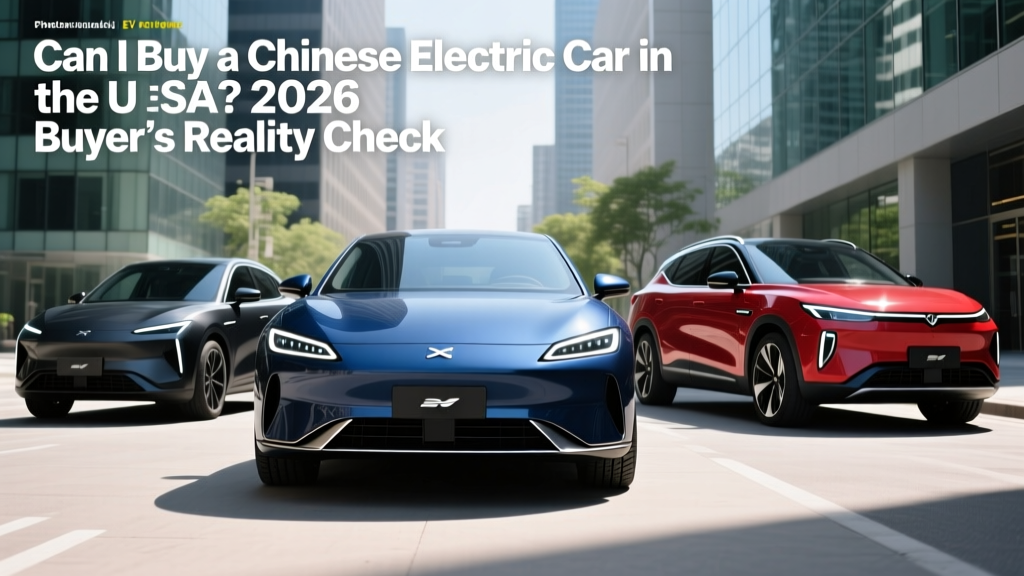
As of 2026, you cannot walk into a US dealership and buy a BYD, NIO, Xpeng, or Zeekr the way you'd buy a Tesla or Hyundai Ioniq. Chinese-branded EVs face a combined 100%+ tariff wall (25% Section 301 tariff + 2.5% standard auto tariff + additional duties under various trade actions), effectively doubling their sticker price and eliminating any cost advantage. A handful of Chinese-manufactured vehicles do reach US roads — notably the Polestar 4 (built in Hangzhou by Geely/Volvo's parent) and the Lotus Eletre — but these are marketed as European brands and carry premium pricing that places them far outside mainstream affordability. No mass-market Chinese EV brand operates a US retail or service network in 2026.
Why Chinese EVs Are Essentially Priced Out of the US Market
China dominates global EV production. BYD alone sold over 4 million plug-in vehicles worldwide in 2025, and brands like NIO, Xpeng, Li Auto, and Zeekr offer compelling technology at aggressive prices in their home market and in Europe. The BYD Dolphin, for example, starts around €30,000 in Europe — roughly $32,500 — with a 60.4 kWh LFP blade battery and an estimated 265 miles of WLTP range.
But the US tariff structure changes the math entirely:
| Cost Factor | Impact on a $30,000 Chinese EV |
|---|---|
| Base FOB price (factory) | $30,000 |
| Shipping & logistics to US port | +$1,500–$2,500 |
| 2.5% standard US auto tariff | +$750 |
| 25% Section 301 tariff (China-origin) | +$7,500 |
| Additional Section 301 EV-specific duty (raised to 100% in Aug 2024, active through 2026) | +$30,000 |
| Estimated landed cost before dealer markup | ~$70,000+ |
The 100% tariff on Chinese-origin EVs, announced by the Biden administration in May 2024 and implemented under USTR trade authority, was designed specifically to prevent low-cost Chinese EVs from undercutting domestic manufacturers. Even without this tariff, Chinese automakers have no US dealer network, no certified service centers, no NHTSA crash-test compliance filings, and no established parts supply chain.
Chinese-Manufactured EVs You CAN Actually Buy in the US
A small number of vehicles built in Chinese factories do reach US showrooms — but they're sold under European brand names, which complicates both the tariff question and the consumer value proposition.
Polestar 4 (Geely/Volvo)
The Polestar 4 is assembled in Hangzhou, China. For the 2026 model year, the Long Range Dual Motor variant offers:
- EPA range: ~310 miles (single motor), ~270 miles (dual motor AWD)
- Battery: 102 kWh (NMC, CATL-sourced)
- DC fast charging: up to 200 kW peak, 10–80% in approximately 28 minutes
- 0–60 mph: 3.8 seconds (dual motor, 544 hp)
- Base MSRP: ~$56,000 (single motor), ~$63,000 (dual motor)
- Federal tax credit (§30D): Eligibility varies by battery sourcing and buyer income; Polestar has worked to qualify for partial or full credit — check IRS §30D guidance for current-year rules
The Polestar 4 is a legitimate, well-engineered EV — but at $56K+, it's a premium crossover, not the $25K commuter car that Chinese EV pricing hype often implies.
Lotus Eletre (Geely)
The Lotus Eletre, also Geely-owned and built in Wuhan, starts above $100,000 in the US. It's a high-performance luxury SUV competing with the Porsche Taycan Cross Turismo and BMW iX, not a mass-market option.
Volvo EX30 (Partial China Production)
Volvo's compact EX30 SUV has production in both China and Ghent, Belgium. US-spec models are sourced to navigate tariff structures. Starting around $36,000 MSRP before incentives, the EX30 offers approximately 265 miles of EPA range with its 69 kWh NMC battery. This is the closest thing to an "affordable" vehicle with Chinese manufacturing ties available to US buyers — though Volvo markets it entirely as a Swedish brand.
Chinese EVs vs. US-Available Alternatives: A Cost Comparison
Since you can't practically buy a BYD or NIO in the US, here's how the hypothetical cost of a tariff-burdened Chinese EV compares to EVs you can actually purchase, plus a gas baseline:
| Vehicle | MSRP | EPA Range | Battery / Fuel | Est. Annual Fuel/Charge Cost | 5-Year Total Energy Cost |
|---|---|---|---|---|---|
| BYD Dolphin (hypothetical, tariffed) | ~$65,000* | ~230 mi (est.) | 60.4 kWh LFP | $550 | $2,750 |
| Chevrolet Equinox EV 2LT (2026) | $34,900 | 319 mi | 85 kWh NMC | $580 | $2,900 |
| Hyundai Ioniq 5 SE (2026) | $43,200 | 303 mi | 77.4 kWh NMC | $600 | $3,000 |
| Tesla Model 3 Long Range (2026) | $44,990 | 363 mi | 79 kWh NMC | $520 | $2,600 |
| Toyota RAV4 Hybrid (gas comparison) | $33,500 | N/A (39 MPG combined) | Gasoline | $1,650 | $8,250 |
*BYD Dolphin hypothetical cost includes estimated tariffs, shipping, and compliance markup. Actual import is not available through retail channels.
Common Misconceptions About Chinese EVs in America
| Myth | Fact |
|---|---|
| "I can import a BYD Seagull for $12,000" | After 100%+ tariffs, shipping, DOT/EPA compliance, and homologation, the landed cost exceeds $35,000 — and you'd have no warranty, no service network, and no guarantee of passing state registration requirements. |
| "Chinese EVs have terrible quality" | Modern BYD, NIO, and Xpeng vehicles score well in Euro NCAP testing and use advanced LFP blade batteries with excellent thermal stability. The quality concern is outdated — the barrier is trade policy, not build quality. |
| "Chinese EVs will flood the US market soon" | The 100% tariff, combined with NHTSA compliance requirements and the complete absence of a dealer/service network, makes near-term mass entry extremely unlikely. Chinese brands are instead expanding in Europe, Southeast Asia, and Latin America. |
| "I can buy a Chinese EV through a grey-market importer" | Under the 25-year import rule, a vehicle must be at least 25 years old to bypass DOT/EPA compliance. No modern Chinese EV qualifies. Show-or-display exemptions are extremely limited and do not apply to production EVs. |
| "Polestar and Volvo are Chinese cars" | They are owned by Geely (a Chinese conglomerate), but they are headquartered in Sweden, engineered in Europe, and marketed as European brands. US-spec vehicles are sourced from factories that comply with applicable tariff structures. |
Real-World Ownership Considerations for Any EV Purchase
Whether you're considering a Polestar 4, a Chevrolet Equinox EV, or waiting for trade policy to shift, these ownership realities apply to every US EV buyer:
Home Charging Access Is the Make-or-Break Factor
Charging at home on a Level 2 (240V) circuit is dramatically cheaper and more convenient than relying on public DC fast charging. A typical Level 2 home installation costs $1,200–$3,500 (charger hardware + electrician labor + permit), and delivers roughly 25–44 miles of range per hour of charging at 7.7–11.5 kW. At the US average electricity rate of ~$0.17/kWh, a full charge of an 85 kWh battery costs about $14.45 — versus $50–$70 for a gallon-equivalent of gasoline.
If you live in an apartment or lack garage/driveway access, public charging becomes your primary fuel source. DC fast charging costs $0.30–$0.50/kWh at networks like Electrify America or EVgo, pushing your per-mile cost closer to (though still below) a fuel-efficient hybrid.
Cold Weather Range Loss Is Real
All EVs lose range in freezing temperatures — typically 20–35% at 20°F compared to EPA estimates. An EV with a 300-mile EPA rating may deliver only 195–240 miles in harsh winter conditions. LFP batteries (used in many Chinese-market EVs) are somewhat more susceptible to cold-weather performance loss than NMC chemistries. If you live in the northern US, factor this into your range planning.
Federal Tax Credits Don't Apply to Most Chinese-Origin Vehicles
The §30D clean vehicle credit (up to $7,500) requires that the vehicle be assembled in North America, meet battery-component and critical-mineral sourcing thresholds, fall under MSRP caps ($55,000 for sedans, $80,000 for SUVs/trucks), and that the buyer's income not exceed $150K single / $300K joint. A vehicle imported from China fails the North American assembly requirement outright, making it ineligible regardless of other factors. See the IRS clean vehicle credit page for current eligibility rules.
Decision Framework: What Should You Actually Buy?
If Your Goal Is the Lowest-Cost EV Possible:
→ Buy a Chevrolet Equinox EV or Nissan Leaf. Both start under $35,000 MSRP. The Equinox EV offers 319 miles of EPA range and may qualify for the full $7,500 §30D credit (subject to income and sourcing rules), bringing effective cost below $28,000. No Chinese EV, even if imported, can match this after tariffs.
If You Want a Premium EV With Chinese Manufacturing Ties:
→ Consider the Polestar 4 or Volvo EX30. These are Geely-produced vehicles with legitimate European engineering, US warranty coverage, NHTSA compliance, and service networks. The EX30 starts around $36,000; the Polestar 4 around $56,000.
If You're Waiting for Chinese Brands to Enter the US:
→ Don't hold your breath for 2026–2028. BYD has publicly stated it has "no plans" to enter the US passenger car market under current tariff conditions. NIO and Xpeng are focused on Europe and China. Even if tariffs were reduced, building a US dealer and service network takes 3–5 years minimum.
If You Need Maximum Range and Efficiency Today:
→ Look at the Tesla Model 3 Long Range (363 mi EPA), Hyundai Ioniq 6 SE (361 mi), or Lucid Air Pure (419 mi). These are all US-available, fully warrantied, and eligible for various incentives depending on trim and buyer qualifications.
Cost Breakdown: What EV Ownership Actually Costs vs. Gas
Here's a realistic 5-year total cost comparison for a mainstream EV versus a comparable gas vehicle, assuming 15,000 miles/year and home Level 2 charging:
| Cost Category | Hyundai Ioniq 5 SE (EV) | Toyota RAV4 LE AWD (Gas) |
|---|---|---|
| MSRP / Purchase Price | $43,200 | $30,500 |
| Federal Tax Credit (§30D) | –$3,750 to –$7,500 (varies) | $0 |
| 5-Year Fuel/Energy Cost | $3,000 (home charging) | $8,250 (gas at $3.50/gal, 29 MPG) |
| 5-Year Maintenance | ~$1,200 (no oil, fewer brakes) | ~$3,500 (oil, filters, brakes, belts) |
| 5-Year Insurance (est.) | ~$9,500 (EVs cost ~15–20% more to insure) | ~$8,000 |
| Home Charger Install | $2,000 (one-time) | $0 |
| 5-Year Net Cost (before depreciation) | ~$48,200–$55,200 | ~$50,250 |
The EV breaks even or pulls ahead within 5 years when the tax credit applies, and the gap widens in years 6–10 as maintenance savings compound and fuel costs continue while electricity remains cheap. Insurance premiums remain the EV's consistent disadvantage — collision repair costs and battery replacement risk keep rates elevated.
Frequently Asked Questions
Can I personally import a BYD or NIO from China?
Technically, US import law allows individuals to import vehicles, but the car must meet DOT safety standards (FMVSS) and EPA emissions requirements — or be at least 25 years old. No current Chinese EV has FMVSS certification. The cost of independently crash-testing and homologating a single vehicle would exceed $100,000, making personal import economically nonsensical.
Will tariffs on Chinese EVs ever be lifted?
Tariff policy is inherently political and unpredictable. However, the 100% EV tariff has bipartisan support as a measure to protect domestic auto manufacturing. Even under optimistic scenarios, any reduction would likely take years and would still require Chinese automakers to build a US service infrastructure from scratch.
Are Chinese EV batteries safe?
BYD's LFP blade battery has demonstrated strong thermal stability in nail-penetration and crush tests, and LFP chemistry is inherently less prone to thermal runaway than NMC. CATL, which supplies batteries to Tesla, BMW, and Polestar among others, is the world's largest battery manufacturer with extensive safety testing. The safety concern around Chinese batteries is largely a perception issue, not an engineering one.
What about Chinese EV brands sold in Canada or Mexico — can I buy one there and drive it in the US?
Canada has also imposed 100% tariffs on Chinese EVs as of late 2024. Mexico remains a potential entry point, but driving a non-FMVSS-compliant vehicle across the US border would violate customs and DOT regulations. Registration in most US states requires proof of federal compliance.
What's the cheapest EV I can actually buy in the US right now?
The Nissan Leaf S starts at approximately $29,190 for the 2026 model year with a 40 kWh battery and 149 miles of EPA range. The Chevrolet Equinox EV starts around $34,900 with 319 miles of range and is the better value for most buyers. Both are eligible for some level of federal incentive depending on your income and the vehicle's battery sourcing.