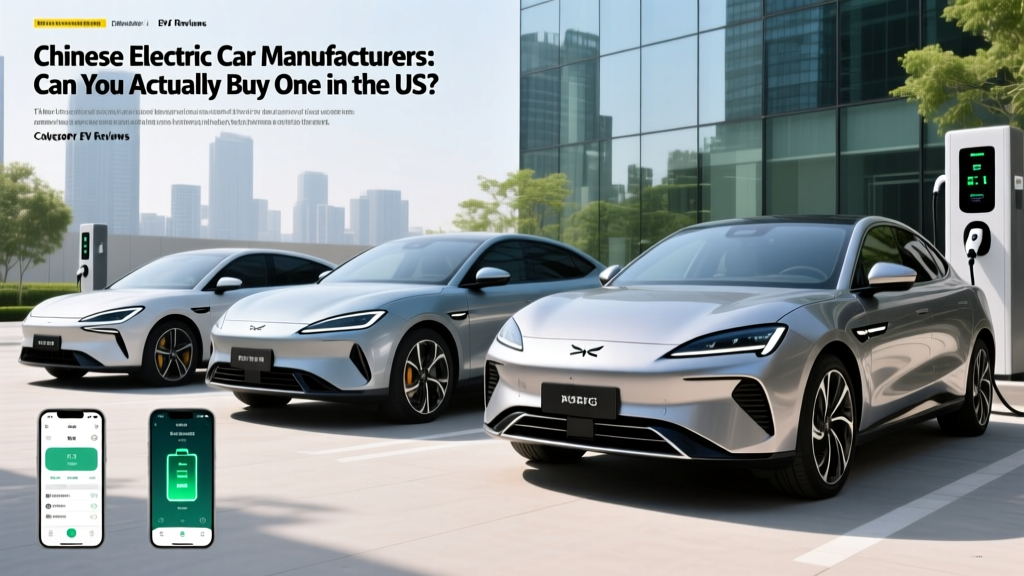
The Short Answer: Chinese EVs Are Mostly Blocked From the US Market
As of 2026, no mainstream Chinese electric car manufacturer sells vehicles directly to US consumers. A combination of 100%+ import tariffs, the USMCA trade agreement, and national-security data concerns have effectively locked brands like BYD, NIO, Xpeng, Li Auto, Zeekr, and Leapmotor out of the American market. Polestar (Geely-owned, China-manufactured) remains the sole partial exception, though its US availability has been disrupted by tariff changes. For US buyers, the practical alternatives are domestically assembled EVs from Tesla, Ford, GM, Hyundai/Kia, and others — many of which now match or undercut Chinese-brand pricing thanks to the §30D federal tax credit.
Why Chinese Electric Car Manufacturers Can't Reach US Buyers
The barrier isn't product quality — it's trade policy. Here's the tariff stack a Chinese-built EV faces entering the United States in 2026:
- Base auto tariff: 2.5%
- Section 301 tariff on Chinese EVs: 100% (raised from 25% in August 2024 under the Biden administration, maintained under subsequent policy)
- Additional IEEPA tariffs on Chinese goods: 20% (as of mid-2025 adjustments)
That means a BYD Seagull with an MSRP of roughly $12,000 in China would land in the US at well over $28,000 before dealer markup, shipping, and compliance costs — eliminating the price advantage entirely. For premium brands like NIO or Zeekr, the math is even worse.
Beyond tariffs, the US government has flagged connected-vehicle data security concerns with Chinese-manufactured automobiles. A Department of Commerce proposed rulemaking targets connected vehicle hardware and software from China and Russia, which would affect any Chinese EV's infotainment, telematics, and ADAS systems.
Who the Major Chinese Electric Car Manufacturers Are
Even though you can't buy them stateside, understanding the players matters — especially if you're tracking global EV pricing pressure, considering a move abroad, or watching for policy shifts.
BYD (Build Your Dreams)
The world's largest EV manufacturer by volume (surpassing Tesla in Q4 2023, trading the crown back and forth since). BYD makes its own LFP "Blade" batteries and sells everything from the $12,000 Seagull city car to the Yangwang U8 luxury SUV. US availability: none. BYD has publicly stated it has no near-term plans to enter the US passenger vehicle market, focusing instead on Europe, Southeast Asia, and Latin America. BYD does sell electric buses and commercial trucks in the US through a Lancaster, California facility.
NIO
Known for battery-swap stations and premium sedans/SUVs. The NIO ET7 offers an EPA-equivalent range of roughly 430 miles on its 150 kWh semi-solid-state pack (available in China only). US expansion was rumored for 2025 but never materialized. NIO's sub-brand Onvo and mass-market brand Firefly target Europe and developing markets.
Xpeng
Tech-forward with strong ADAS development (XNGP). The Xpeng G6 midsize SUV competes with the Tesla Model Y in China at aggressive pricing. Volkswagen took a stake in Xpeng in 2023 for platform technology sharing. No US sales.
Li Auto
Specializes in extended-range electric vehicles (EREVs) — series-hybrid setups where a gasoline engine acts as a generator. The Li L9 SUV offers ~130 miles of electric-only range plus a gas generator for unlimited total range. No US presence.
Zeekr (Geely Group)
Geely's premium EV brand. The Zeekr 001 shooting brake and Zeekr X compact SUV have drawn international attention. Geely also owns Volvo and Polestar, creating a complex web: Volvo's EX30 was planned for US import from China before tariff changes forced a production shift to Ghent, Belgium.
The Polestar Exception
Polestar (headquartered in Sweden, majority-owned by Geely) is the closest thing to a Chinese-manufactured EV available in the US. The Polestar 2 is built in Luqiao, China. However, the 100% Section 301 tariff has severely impacted Polestar 2 pricing. Polestar has been working to shift US-bound production to its Busan, South Korea facility and the Polestar 3 (SUV) production in Chengdu. Availability and pricing remain in flux for 2026.
What Chinese EVs Would Cost in the US — If Tariffs Didn't Exist
To understand the pricing threat Chinese electric car manufacturers represent, here's a hypothetical cost comparison. These figures assume zero tariffs, direct import, and a theoretical US MSRP with basic compliance adjustments:
| Vehicle | China Price (USD equiv.) | Hypothetical US MSRP (no tariff) | Comparable US-Built EV | US MSRP (after §30D credit) |
|---|---|---|---|---|
| BYD Seagull | ~$12,000 | ~$18,000 | Chevy Equinox EV (base) | ~$33,000 → ~$25,500* |
| BYD Dolphin | ~$15,000 | ~$21,000 | Nissan LEAF S | ~$28,140 → ~$20,640* |
| BYD Seal | ~$26,000 | ~$33,000 | Tesla Model 3 RWD | ~$38,990 → ~$31,490* |
| Xpeng G6 | ~$28,000 | ~$35,000 | Hyundai Ioniq 5 SE | ~$42,600 → ~$35,100* |
| NIO ET5 | ~$42,000 | ~$50,000 | BMW i4 eDrive40 | ~$57,900 (no credit — over MSRP cap) |
*§30D credit estimates assume buyer meets income caps ($150K single / $300K joint), vehicle meets MSRP cap ($55K sedans / $80K SUVs/trucks), and battery critical-mineral and sourcing requirements are satisfied per IRS guidelines. Always verify eligibility with a tax professional before purchase.
The takeaway: even without tariffs, Chinese EVs would only undercut US-market alternatives by roughly $5,000–$10,000 at the budget end. Once you factor in the §30D credit on US-built models, the gap narrows to near-zero for most segments.
The Real Alternatives: What US Buyers Should Consider Instead
Rather than waiting for a policy shift that may never come, here's how the best US-available EVs stack up against what Chinese electric car manufacturers offer globally. This comparison focuses on the segments where Chinese brands compete hardest.
| Category | Chinese Benchmark | US Alternative | EPA Range | 10-80% DC Charge | Base MSRP (after credit) |
|---|---|---|---|---|---|
| Budget compact | BYD Dolphin | Chevy Equinox EV 2LT | 319 mi | ~22 min (150 kW peak) | ~$25,500* |
| Midsize sedan | BYD Seal | Tesla Model 3 Long Range | 363 mi | ~15 min (250 kW peak) | ~$42,490* |
| Midsize SUV | Xpeng G6 | Hyundai Ioniq 5 SEL | 318 mi (AWD) | ~18 min (350 kW peak on 800V) | ~$35,100* |
| 3-row SUV | Li Auto L9 (EREV) | Kia EV9 Land (AWD) | 270 mi | ~24 min (236 kW peak) | ~$51,900* |
| Premium sedan | NIO ET7 | Lucid Air Pure | 419 mi | ~20 min (300 kW peak) | ~$69,900 |
Real-world range caveat: expect 15–25% reduction from EPA estimates during sustained highway driving at 75+ mph, and an additional 10–30% loss in sub-freezing temperatures depending on whether the vehicle has a heat pump.
Ownership Cost: EV vs Gas vs Hybrid
For buyers frustrated that Chinese electric car manufacturers aren't an option, the financial case for going electric with a US-built model remains strong. Here's a 5-year total cost of ownership comparison using the Hyundai Ioniq 5 SEL AWD as a representative EV, the Toyota RAV4 Hybrid as a hybrid baseline, and the Toyota RAV4 LE AWD as a gas baseline:
| Cost Category | Hyundai Ioniq 5 SEL AWD (EV) | Toyota RAV4 Hybrid AWD | Toyota RAV4 LE AWD (Gas) |
|---|---|---|---|
| MSRP | $49,100 | $33,425 | $30,425 |
| §30D Federal Credit | -$7,500 | $0 | $0 |
| Effective Purchase Price | $41,600 | $33,425 | $30,425 |
| Fuel/Energy (5 yr, 60K mi) | $3,600 (home L2 @ $0.14/kWh) | $5,400 (39 MPG combined) | $7,500 (28 MPG combined) |
| Maintenance (5 yr) | $1,800 | $3,200 | $3,800 |
| Insurance (5 yr avg.) | $9,500 | $7,200 | $7,000 |
| 5-Year Total Cost | $56,500 | $49,225 | $48,725 |
| Cost per mile | $0.94 | $0.82 | $0.81 |
The EV carries a higher upfront cost even after the tax credit, but dramatically lower fuel and maintenance expenses. The break-even point versus the gas RAV4 arrives around year 7–8 for a typical driver covering 12,000 miles annually. If you charge primarily on public DC fast chargers (averaging $0.35–$0.50/kWh), your energy costs roughly double — erasing much of the fuel savings.
Home charging access is the single biggest variable. If you can install a Level 2 charger at home (a 240V outlet on a 50-amp circuit, typically $500–$2,000 for installation depending on panel capacity), an EV is dramatically cheaper to operate day-to-day. If you rely entirely on public charging, a hybrid like the RAV4 Hybrid may be the more economical and practical choice.
Common Misconceptions About Chinese EVs
| Myth | Fact |
|---|---|
| "Chinese EVs are cheap and low quality" | BYD, NIO, and Xpeng vehicles score competitively in C-NCAP and Euro NCAP testing. The BYD Seal earned a 5-star Euro NCAP rating. Build quality in the $25K+ segments rivals Korean and European competitors. |
| "Chinese EVs will flood the US market soon" | The 100% Section 301 tariff makes this economically unviable. No Chinese EV manufacturer has announced a US production facility. BYD has explicitly declined to pursue US passenger vehicle sales. |
| "Buying Chinese means supporting forced labor" | This is a legitimate concern regarding Xinjiang-sourced polysilicon and minerals. However, the §30D tax credit's battery sourcing requirements (FEOC — Foreign Entity of Concern rules) already restrict battery components and critical minerals from Chinese entities, applying this standard to ALL EVs sold in the US, not just Chinese brands. |
| "If tariffs dropped, Chinese EVs would cost $10,000" | Even without tariffs, shipping, US homologation, dealer network setup, and compliance costs would push a BYD Seagull to roughly $18,000–$22,000 — affordable, but not the $10K headline from Chinese domestic pricing. |
| "Chinese EVs have worse batteries" | BYD is the world's second-largest EV battery manufacturer. Its LFP Blade Battery is used by Tesla (in some Model Y Standard Range units built in Berlin) and Toyota. CATL, another Chinese firm, supplies batteries to Tesla, BMW, and Ford. |
Decision Framework: What Should You Actually Buy?
Use this framework to decide your next move:
IF you want the lowest possible purchase price AND have home charging:
→ Consider the Chevy Equinox EV (~$33K base, ~$25.5K after §30D) or Nissan LEAF (~$28K base, ~$20.5K after credit). These are the closest US-market equivalents to Chinese budget EVs.
IF you want premium features at mid-market pricing:
→ The Hyundai Ioniq 5 or Tesla Model 3 deliver technology, charging speed, and range that compete with Xpeng G6 and BYD Seal globally. The Ioniq 5's 800V architecture enables 10-80% charging in ~18 minutes at a 350 kW charger.
IF you don't have reliable home charging access:
→ A PHEV like the Toyota RAV4 Prime (42 miles electric-only, 38 MPG gas) or a HEV like the RAV4 Hybrid (39 MPG combined) may be a smarter choice than a full BEV. Public DC fast charging costs $0.35–$0.50/kWh, which erodes the fuel-cost advantage of going fully electric.
IF you need 3-row seating:
→ The Kia EV9 (~$54K base, eligible for §30D) is the US-market answer to the Li Auto L9 and BYD Tang. Real-world range is ~230–250 miles highway with the AWD powertrain.
IF you're waiting for Chinese EVs to become available:
→ Don't hold your breath. The earliest realistic scenario for Chinese EV US sales would require a significant trade policy reversal, a Chinese OEM building a US factory (a multi-year, multi-billion-dollar commitment no company has announced), or a joint venture with an established US brand. None of these are in progress as of 2026.
What a First-Time EV Buyer Should Know
Whether you were drawn to Chinese electric car manufacturers for their pricing or you're simply EV-curious, these fundamentals apply to any EV purchase in the US market:
- kW vs kWh: kW (kilowatts) measures power — how fast you charge. kWh (kilowatt-hours) measures energy — how big your battery is. A 75 kWh battery charged at 150 kW gains energy quickly; the same battery at 50 kW charges slower. Never confuse the two.
- EPA range is optimistic: The EPA test cycle includes low-speed urban driving. Real-world highway range at 70–80 mph is typically 15–25% below the sticker. In sub-30°F weather, add another 10–30% loss unless the vehicle has a heat pump (which most 2025+ models do).
- Charging curves matter more than peak kW: A vehicle that "charges at 250 kW" only sustains that rate for a portion of the session. Above 80% state of charge (SoC), charging slows dramatically to protect battery health. Plan your road trips around 10-80% charge times, not peak rates.
- The §30D tax credit has strings: The IRS §30D credit requires meeting income caps ($150K single / $300K joint AGI), vehicle MSRP caps ($55K sedans / $80K SUVs, vans, trucks), and battery sourcing requirements (critical minerals and components cannot come from Foreign Entities of Concern, which includes most Chinese suppliers). As of 2025, the credit can be transferred at the point of sale as an instant rebate. Verify eligibility at fueleconomy.gov before purchasing.
- Battery warranties are strong: Federal law mandates a minimum 8-year/100,000-mile warranty on EV batteries. Most manufacturers guarantee 70% capacity retention over that period. Real-world degradation data shows most modern NMC and LFP batteries retain 85–92% capacity at 100,000 miles.
- Insurance costs more: EV insurance premiums run 15–25% higher than equivalent gas vehicles due to higher repair costs, specialized parts, and total-loss thresholds. Get quotes before committing to a purchase.
Frequently Asked Questions
Can I import a Chinese EV myself?
Technically, you can attempt a personal import, but the vehicle must meet all FMVSS (Federal Motor Vehicle Safety Standards) and EPA emissions requirements — which Chinese-market vehicles are not certified for. The import process requires a Registered Importer (RI), crash-test equivalence documentation, and modifications that typically cost $10,000–$30,000+. Combined with the 100%+ tariff, self-importing is not practical.
Will BYD ever sell cars in the US?
BYD executives have stated publicly that the US market is not a priority due to the trade environment. The company is investing heavily in factories in Thailand, Brazil, Hungary, Indonesia, and Turkey to serve those regional markets. A US entry would require either a policy shift or a US-based manufacturing commitment — neither appears imminent.
Are Chinese EV batteries safe?
BYD's Blade Battery (LFP chemistry) has demonstrated strong thermal stability in nail-penetration and crush tests, performing better than many NMC alternatives. CATL batteries power millions of vehicles globally, including Tesla Model 3 and Model Y variants sold in the US. The chemistry is not the concern — trade policy and data security are.
What's the cheapest EV I can actually buy in the US?
As of 2026, the Nissan LEAF S starts at ~$28,140 and qualifies for the full $7,500 §30D credit, bringing the effective price to approximately $20,640 — making it the most affordable new EV available. It offers 149 miles of EPA range with a 40 kWh battery, which is best suited as a city commuter or second vehicle rather than a primary car.
Do Chinese EVs affect US EV pricing even if they're not sold here?
Yes, indirectly. Chinese EV pricing pressure in Europe and other markets forces legacy automakers to cut costs and accelerate platform development. Tesla has reduced Model 3 and Model Y pricing globally in response to BYD competition. This pricing pressure eventually benefits US consumers through more competitive pricing from all manufacturers, even if Chinese brands aren't directly competing on US soil.