The Tesla Cybertruck's polarizing wedge design and stainless-steel exoskeleton have sparked imitators and challengers across the global EV market — nowhere more aggressively than in China. If you've been searching for a Chinese Cybertruck alternative, you've likely encountered a flood of angular electric pickups from brands like BYD, Geely, Great Wall Motor, and a wave of startups. But which of these trucks actually deliver on range, charging speed, and capability — and critically, can US buyers even get one?
This review profiles the most prominent Chinese electric pickup trucks competing in the Cybertruck's orbit for the 2026 model year, examining their real specs, real-world limitations, and the regulatory realities that govern their availability in North America.
The Chinese Cybertruck Landscape in 2026: Who's Actually Building These?
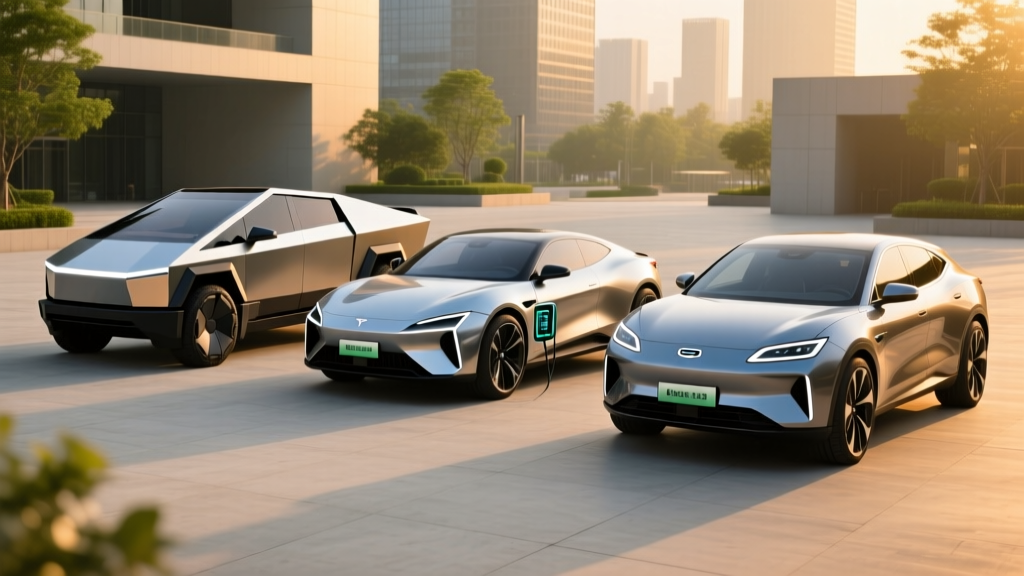
China's EV pickup segment has matured rapidly. Where 2023 offered mostly concepts and domestic-market curiosities, 2026 brings several production models with legitimate global ambitions. The key players targeting the Cybertruck's market position include:
- BYD Shark 6 PHEV / Shark EV — BYD's first unibody electric pickup, launched globally in select markets
- Geely Radar RD6 — A lifestyle-oriented electric pickup on Geely's SEA platform
- Great Wall Motor (GWM) Poer EV — The electric variant of GWM's global pickup line
- Jetour T2 EV (Chery sub-brand) — An off-road-oriented electric truck gaining traction in Asia and the Middle East
- XPeng P7 Pickup (announced) — XPeng's rumored entry, still in pre-production as of early 2026
None of these vehicles are currently sold through official dealer networks in the United States, a critical point we'll address in detail. However, their specifications and pricing in export markets provide a compelling benchmark for what global competition looks like — and what US buyers might eventually access through grey-market imports or future brand launches.
Spec Comparison: Chinese Cybertruck Rivals vs. Tesla Cybertruck
| Spec | BYD Shark EV (AWD) | Geely Radar RD6 (Long Range) | GWM Poer EV | Tesla Cybertruck (AWD) |
|---|---|---|---|---|
| EPA-Est. Range | N/A (WLTP: ~310 mi) | N/A (WLTP: ~342 mi) | N/A (WLTP: ~248 mi) | 340 mi (EPA) |
| Battery Capacity | ~86 kWh (LFP Blade) | ~100 kWh (NMC) | ~88 kWh (NMC) | 123 kWh (NMC) |
| Peak DC Charge Rate | ~150 kW | ~175 kW | ~140 kW | ~350 kW |
| 10–80% DCFC Time | ~30 min | ~28 min | ~34 min | ~15 min |
| Level 2 Home Charge | 11 kW (~30 mi/hr) | 11 kW (~32 mi/hr) | 7.2 kW (~20 mi/hr) | 11.5 kW (~44 mi/hr) |
| 0–60 mph | ~5.7 sec | ~6.5 sec | ~7.8 sec | 4.1 sec (AWD) |
| Horsepower | ~430 hp (dual motor) | ~272 hp (single motor) | ~245 hp (single motor) | 600 hp (AWD) |
| Drivetrain | AWD (dual motor) | RWD (single motor) | RWD (single motor) | AWD (dual motor) |
| Towing Capacity | ~5,500 lbs | ~4,400 lbs | ~5,000 lbs | 11,000 lbs |
| Bed Length | ~5.2 ft | ~5.0 ft | ~5.3 ft | 6.0 ft |
| Base Price (Export) | ~$38,000 USD equiv. | ~$32,000 USD equiv. | ~$35,000 USD equiv. | $79,990 (US MSRP) |
Note: Chinese-market and export-market prices vary significantly by region. US dollar equivalents are approximate based on early-2026 exchange rates. The Tesla Cybertruck remains the only vehicle in this comparison with an official EPA range rating and US MSRP. WLTP range figures are typically 10–15% higher than EPA equivalents.
Real-World Range Reality Check
WLTP vs. EPA translation: The WLTP testing cycle used in China and Europe is more generous than the US EPA cycle. As a rule of thumb, subtract 10–15% from WLTP figures to estimate EPA-equivalent range. That means:
- BYD Shark EV: WLTP ~310 mi → estimated EPA ~265–280 mi
- Geely Radar RD6: WLTP ~342 mi → estimated EPA ~290–308 mi
- GWM Poer EV: WLTP ~248 mi → estimated EPA ~210–225 mi
Highway and cold-weather impact: As with all EVs, sustained highway driving at 70+ mph reduces range by 15–25%. Cold weather (below 32°F) can further reduce range by 20–30%, particularly in trucks without heat-pump HVAC systems. The BYD Shark and Geely RD6 include heat pumps in higher trims; the GWM Poer EV does not in most export configurations. Expect real-world winter highway range of ~160–190 miles for the BYD Shark and ~180–210 miles for the Geely RD6 under harsh conditions.
Charging Speed and Infrastructure: Where These Trucks Fall Short
Charging speed is where the gap between Chinese-market EVs and the Cybertruck becomes most apparent. Tesla's 800V-class architecture and 350 kW peak charge rate set a benchmark that none of these competitors approach.
| Vehicle | Architecture | Peak DC kW | Sustained Avg kW (10–80%) | 10–80% Time |
|---|---|---|---|---|
| BYD Shark EV | 400V | 150 kW | ~110 kW | ~30 min |
| Geely Radar RD6 | 400V (SEA platform) | 175 kW | ~125 kW | ~28 min |
| GWM Poer EV | 400V | 140 kW | ~95 kW | ~34 min |
| Tesla Cybertruck | 800V-class | 350 kW | ~230 kW | ~15 min |
Peak vs. sustained charging: All four vehicles exhibit typical lithium-ion charge-curve taper. Peak kW is achieved only between roughly 10–30% state of charge (SoC), then progressively drops. The Cybertruck's 800V system maintains higher power deeper into the charge session, which is why its 10–80% time is nearly half that of its 400V competitors — despite a larger battery.
Home Level 2 charging: All three Chinese trucks support standard AC Level 2 charging via a Type 2 (or GB/T in China) connector. At 11 kW (BYD/Geely) or 7.2 kW (GWM), overnight charging from 20–80% takes 6–8 hours — adequate for daily use. However, US buyers would face connector-adaptation challenges since these vehicles use Chinese GB/T or European Type 2/CCS2 connectors, not the North American NACS (Tesla) or CCS1 standard.
Battery Chemistry: LFP vs. NMC in Chinese Electric Pickups
BYD's signature LFP (lithium iron phosphate) Blade Battery is the standout in this segment. The Shark EV's ~86 kWh LFP pack offers several ownership advantages:
| Characteristic | LFP (BYD Shark) | NMC (Geely RD6, GWM Poer) |
|---|---|---|
| Energy Density | Lower (~160 Wh/kg) | Higher (~220–260 Wh/kg) |
| Thermal Stability | Excellent (resists thermal runaway) | Good (requires active cooling) |
| Cycle Life | 3,000–5,000+ cycles | 1,500–2,500 cycles |
| Cold-Weather Performance | Weaker (more range loss below 32°F) | Better (less cold-weather degradation) |
| Recommended Daily Charge | 100% OK (no degradation penalty) | 80% daily recommended |
| Cost per kWh | Lower | Higher |
For a pickup truck used as a daily driver, BYD's LFP chemistry is a compelling choice: you can charge to 100% daily without accelerating degradation, and the pack should outlast the vehicle itself under normal use. The trade-off is heavier weight and greater cold-weather range loss — a meaningful concern for buyers in northern climates.
Can You Actually Buy a Chinese Cybertruck Rival in the US?
This is the most important section of this review, and the answer is: not through normal channels, and probably not soon.
As of 2026, no Chinese automaker sells vehicles through official US dealer networks. The barriers are substantial:
- Tariffs: Chinese-built EVs face a combined 100%+ tariff under Section 301 trade provisions (raised to 100% in 2024, still in effect in 2026), effectively doubling the vehicle's cost.
- Federal safety certification: All vehicles sold in the US must meet FMVSS standards set by NHTSA. Chinese-market vehicles are typically certified to China's GB standards or European ECE regulations, which differ significantly in crash-test protocols, lighting, and bumper requirements.
- EPA emissions compliance: Even zero-emission EVs require EPA certification for sale in the US market.
- Connected-vehicle data restrictions: Proposed US Commerce Department rules (first introduced in 2024) would ban Chinese-connected vehicles from US roads over national-security concerns about data collection — a regulation that, if finalized, could block Chinese EVs entirely regardless of tariff workarounds.
Grey-market imports: Under the 25-year import rule, a vehicle cannot be legally imported to the US until it is 25 years old unless it is substantially modified to meet FMVSS standards — a process that can cost $50,000+ and is rarely undertaken for mass-market trucks.
Bottom line: If you live in the US, these Chinese Cybertruck alternatives are benchmarking exercises, not purchase options. They matter because they pressure global pricing and innovation, and they may eventually reach US shores through joint ventures, local assembly (as BYD has explored in Mexico and Brazil), or regulatory shifts.
Performance, Tech, and Daily Usability
BYD Shark EV
The Shark is the most Cybertruck-like in ambition. Its dual-motor AWD system delivers ~430 hp and a 5.7-second 0–60 mph time — brisk for a midsize truck. The 5.2-foot bed is shorter than the Cybertruck's 6-foot vault, and towing tops out at ~5,500 lbs (vs. Cybertruck's 11,000 lbs). Inside, the Shark features a 15.6-inch rotating center screen (a BYD signature), a 12.3-inch driver display, and a 360-degree camera system. Driver assistance includes adaptive cruise control, lane-keeping, and automatic emergency braking — all SAE Level 2, meaning the driver must remain fully engaged at all times.
Geely Radar RD6
The RD6 is positioned more as a lifestyle vehicle — think Subaru Baja meets electric truck. Its single-motor RWD layout and ~272 hp yield a relaxed 6.5-second 0–60 mph. The standout feature is its integrated bed power system: a built-in 220V outlet and V2L (vehicle-to-load) capability that can power camping gear, tools, or a tailgate setup at up to 6 kW. The interior uses Geely's SEA-platform infotainment with a 14.6-inch display, wireless Apple CarPlay/Android Auto, and an available panoramic glass roof. Cargo volume behind the rear seats (in the four-door crew-cab configuration) is limited, with the bed offering ~42 cu ft of usable space.
GWM Poer EV
The Poer EV is the most conventional of the three — a body-on-frame truck adapted for electric propulsion. Its ~245 hp and 7.8-second 0–60 mph feel adequate but not exciting. The trade-off is ruggedness: the Poer has the most traditional truck architecture, with a solid rear axle and available locking differential for off-road use. Tech is more basic: a 12.3-inch infotainment screen, basic ADAS features, and no V2L capability in most trims.
Pros — Chinese Cybertruck Rivals (Collectively)
- Significantly lower base pricing ($32K–$38K vs. Cybertruck's $79,990+)
- BYD Shark's LFP battery offers outstanding cycle life and daily-charge flexibility
- V2L capability (Geely RD6) for camping, job-site, and emergency power
- Competent range for daily driving (estimated EPA 210–308 mi)
- Modern infotainment with large screens and phone integration
Cons — Chinese Cybertruck Rivals (Collectively)
- Not available for legal purchase in the United States
- 400V architecture means slower DC charging than Cybertruck
- Towing capacity far below Cybertruck (4,400–5,500 lbs vs. 11,000 lbs)
- No established US service/parts network or warranty support
- Connector incompatibility (GB/T or Type 2 vs. US NACS/CCS1)
- Regulatory risk: potential US ban on Chinese connected vehicles
Pricing, Tax Credits, and the US Cost Reality
In their home and export markets, these trucks are priced aggressively — roughly $32,000 to $38,000 USD equivalent. That's dramatically less than the Cybertruck's $79,990 starting MSRP (AWD trim) and even undercuts the Ford F-150 Lightning's base price.
However, even if one of these trucks were sold in the US, federal EV tax credit eligibility under IRS §30D would be extremely unlikely. Here's why:
- Battery sourcing requirements: §30D requires that critical minerals and battery components meet escalating US/free-trade-partner sourcing thresholds. Chinese-mined and Chinese-processed minerals (dominant in these supply chains) are specifically restricted — a "foreign entity of concern" (FEOC) exclusion disqualifies vehicles with Chinese-sourced battery components.
- MSRP caps: Trucks must have an MSRP at or below $80,000 to qualify. The Chinese trucks would clear this, but the battery-sourcing rule alone would eliminate them.
- Income caps: Buyer AGI must not exceed $150,000 (single) / $300,000 (joint) — applicable to all EVs.
- Final assembly: The vehicle must undergo final assembly in North America. None of these trucks are assembled outside China as of 2026.
For current US EV tax credit rules, consult the IRS §30D guidance page and verify eligibility with a tax professional before purchasing.
Warranty and Long-Term Ownership
In their export markets, warranty coverage for these vehicles is generally competitive:
| Coverage | BYD Shark EV | Geely Radar RD6 | GWM Poer EV | Tesla Cybertruck |
|---|---|---|---|---|
| Basic Vehicle | 6 yr / 93,000 mi | 5 yr / 62,000 mi | 5 yr / 62,000 mi | 4 yr / 50,000 mi |
| Battery / Powertrain | 8 yr / 124,000 mi | 8 yr / 93,000 mi | 8 yr / 93,000 mi | 8 yr / 120,000 mi |
| Battery Capacity Guarantee | ≥70% SoH | ≥70% SoH | ≥70% SoH | ≥70% SoH |
BYD's 8-year/124,000-mile battery warranty is among the best in the segment, and the LFP chemistry's inherent longevity means most owners will never approach the 70% state-of-health (SoH) threshold. However, warranty coverage is meaningless without a local service network — the most significant ownership risk for any grey-market import.
Who Should Consider a Chinese Cybertruck Alternative?
Decision Framework
These trucks make sense for you if:
- You live in Australia, Southeast Asia, the Middle East, South America, or Europe where some of these models are or will be officially sold
- You want an electric pickup for light-duty commuting and lifestyle use (camping, errands, light hauling) at a sub-$40K price point
- You value BYD's LFP battery longevity and are willing to accept slower DC charging and less cold-weather range
- You need V2L capability for off-grid power and don't require 11,000-lb towing
Stick with the Cybertruck (or Ford F-150 Lightning / Rivian R1T) if:
- You are a US-based buyer — these vehicles simply aren't available to you legally
- You need maximum towing capacity (11,000 lbs for Cybertruck, 10,000 lbs for F-150 Lightning)
- Fast DC charging is critical for your road-trip routine (Cybertruck's 350 kW peak is unmatched here)
- You want a full US warranty, dealer service network, and Supercharger access
Frequently Asked Questions
What is the real-world range of these Chinese Cybertruck alternatives?
Using WLTP-to-EPA conversion (subtract 10–15%), expect approximately 265–280 miles for the BYD Shark EV, 290–308 miles for the Geely Radar RD6, and 210–225 miles for the GWM Poer EV under mixed driving. Highway driving at 75 mph reduces these by an additional 15–25%. In sub-freezing temperatures, LFP-equipped trucks (BYD Shark) may lose 25–35% of range, while NMC trucks (Geely, GWM) lose 20–25%.
How fast do these trucks charge at home and on DC fast chargers?
DC fast charging ranges from 140 kW (GWM) to 175 kW (Geely), with 10–80% times of 28–34 minutes. Home Level 2 charging at 11 kW (BYD, Geely) adds roughly 30 miles of range per hour; the GWM at 7.2 kW adds about 20 miles per hour. None approach the Cybertruck's 350 kW / 15-minute 10–80% charge.
Do Chinese electric pickups qualify for the US federal EV tax credit?
No. Under current IRS §30D rules, a vehicle must undergo final assembly in North America, meet battery critical-mineral and component sourcing requirements (which exclude Chinese-sourced components under FEOC rules), and stay under MSRP and buyer income caps. Chinese-built EVs fail on assembly location and battery sourcing alone.
Is a Chinese Cybertruck alternative worth buying vs. a Tesla Cybertruck or Ford F-150 Lightning?
In markets where they're available, yes — for the right use case. If you need an affordable, efficient electric truck for daily driving and light utility, the BYD Shark or Geely RD6 offers strong value at roughly half the Cybertruck's price. If you need maximum towing, fast road-trip charging, or live in the US, the Cybertruck or F-150 Lightning remain the practical choices.
Will BYD, Geely, or GWM ever sell trucks in the United States?
BYD has publicly explored US-adjacent manufacturing in Mexico and Brazil, but 100%+ US tariffs on Chinese EVs, proposed connected-vehicle bans, and FMVSS certification requirements make a near-term US launch unlikely. Geely (which owns Volvo and Polestar) has the most plausible pathway through existing US-adjacent platforms, but has not announced a pickup for the US market as of early 2026.
What connector do these Chinese trucks use, and would it work in the US?
Chinese domestic models use the GB/T connector. Export models for Europe use Type 2/CCS2. Neither is directly compatible with US charging infrastructure (NACS or CCS1). Adapter solutions exist but add cost, reduce charging speed, and may not meet US electrical safety standards. This is a significant practical barrier even for grey-market imports.
Sources: NHTSA FMVSS Import Requirements, IRS §30D Clean Vehicle Credits, manufacturer press specifications (BYD Global, Geely Auto, Great Wall Motor, Tesla Inc.). Range and efficiency figures based on manufacturer-reported WLTP data; EPA estimates are approximations for comparison purposes only.