Quick Answer: Can You Buy a Chinese Car EV in the US?
As of 2026, no major Chinese EV brand — including BYD, NIO, XPeng, Zeekr, and Li Auto — sells passenger vehicles directly to US consumers. A combination of 100%+ tariffs on Chinese-made EVs, national-security reviews, and the absence of US dealership networks means these brands remain effectively locked out of the American market. If you're researching a "Chinese car EV" for purchase in the US, your realistic options are zero today. However, Chinese EV brands dominate globally, and understanding their specs, pricing, and technology matters if you're considering import-adjacent options, traveling abroad, or tracking where the industry is headed. Below, we break down exactly what these vehicles offer, what the barriers are, and what American buyers should consider instead.
Why Chinese EV Brands Aren't Sold in the United States
The absence of Chinese car EV models from US showrooms isn't an accident — it's the result of layered trade policy, regulatory gaps, and strategic decisions by the manufacturers themselves. Here's the breakdown:
The Tariff Wall
In 2024, the US raised tariffs on Chinese-made electric vehicles to 100% under Section 301 trade provisions. That rate remains in effect through 2026. A BYD Seal that sells for roughly $30,000 in China would carry a tariff-inflated price well above $60,000 before it even reached a US lot — eliminating the cost advantage that makes these cars compelling globally.
Regulatory and Safety Certification
Every vehicle sold in the US must meet Federal Motor Vehicle Safety Standards (FMVSS) set by NHTSA. Chinese-market vehicles are built to China's GB standards or European ECE regulations, which differ in crash-test protocols, lighting requirements, and software compliance. Re-engineering a vehicle for FMVSS compliance costs manufacturers hundreds of millions of dollars — an investment no Chinese EV brand has committed to for the US passenger market.
No Dealer or Service Network
Even if tariffs were reduced, Chinese brands lack the US dealer infrastructure required for sales, warranty service, and parts distribution. Building this network from scratch takes years and billions of dollars, as Tesla's early struggles and Rivian's ongoing expansion demonstrate.
Major Chinese EV Brands: Global Specs at a Glance
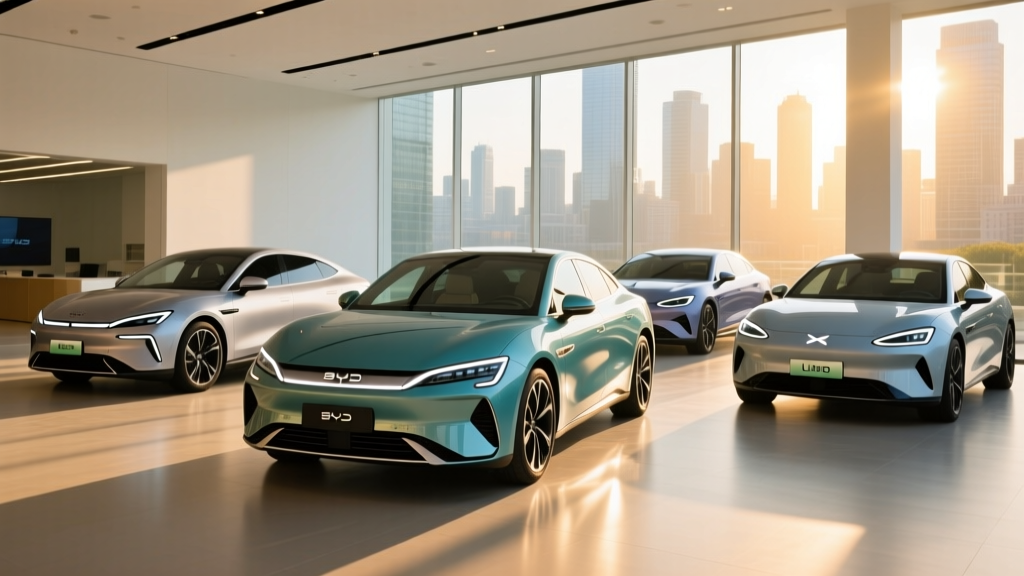
While you can't buy them stateside, these brands are reshaping EV markets in Europe, Southeast Asia, Australia, and Latin America. Here's how their flagship models stack up on paper against US-available equivalents:
| Brand / Model | Battery (kWh) | WLTP Range | Peak DC Charge (kW) | 0-100 km/h | China MSRP (approx.) | US Equivalent |
|---|---|---|---|---|---|---|
| BYD Seal | 82.5 (LFP Blade) | 570 km (354 mi) | 150 kW | 3.8s (AWD) | ~$28,000 | Tesla Model 3 LR |
| BYD Atto 3 (Yuan Plus) | 60.5 (LFP Blade) | 420 km (261 mi) | 88 kW | 7.3s | ~$20,000 | Chevy Equinox EV |
| NIO ET7 | 100 (NMC) | 700 km (435 mi) | 180 kW | 3.8s | ~$60,000 | BMW i5 / Mercedes EQE |
| XPeng G6 | 87.5 (NMC) | 570 km (354 mi) | 280 kW (800V) | 6.6s | ~$30,000 | Tesla Model Y LR |
| Zeekr 001 | 100 (NMC) | 656 km (408 mi) | 200 kW | 3.8s (AWD) | ~$40,000 | Porsche Taycan / Audi e-tron GT |
| Li Auto L7 (EREV) | 42.8 (NMC) + 1.5T gen | 210 km EV (131 mi) | 75 kW | 5.3s | ~$45,000 | No US EREV equivalent |
Important context: These range figures are WLTP, which tends to overestimate by 10-20% compared to the EPA test cycle used in the US. A BYD Seal rated at 354 miles WLTP would likely earn an EPA sticker closer to 285-300 miles. Charging speeds are peak rates — sustained rates taper significantly above 80% State of Charge.
Chinese Car EV vs. US-Available EV: What You're Actually Comparing
The appeal of Chinese EVs boils down to price. A BYD Atto 3 at $20,000 in China undercuts a base Chevy Equinox EV ($33,000 MSRP) by a staggering margin. But the comparison requires nuance:
True Cost Comparison: BYD Seal vs. Tesla Model 3 Long Range (2026)
| Factor | BYD Seal (if available in US) | Tesla Model 3 LR (AWD) |
|---|---|---|
| Base MSRP | ~$28,000 (China) → $56,000+ (with 100% tariff) | $42,630 |
| EPA-est. Range | ~290 mi (estimated EPA conversion) | 363 mi |
| Battery Chemistry | LFP (Blade) — excellent cycle life, lower energy density | NMC — higher energy density, faster degradation risk |
| DC Fast Charge (10-80%) | ~26 min (150 kW peak) | ~25 min (250 kW peak, V3 Supercharger) |
| Federal Tax Credit (§30D) | $0 (Chinese battery/minerals = ineligible) | Up to $7,500 (if sourcing requirements met) |
| US Service Network | None | Extensive (mobile + service centers) |
| ADAS | DiPilot (Level 2) | Autopilot (Level 2); FSD Supervised optional |
Once tariffs, tax-credit ineligibility, and missing service infrastructure are factored in, the BYD Seal's cost advantage evaporates for US buyers. The Tesla Model 3 LR — especially after the §30D point-of-sale credit — often costs less and delivers superior range, charging speed, and support infrastructure.
The Tariff and Tax Credit Reality for Chinese EVs
Even if a Chinese brand found a workaround to sell in the US, buyers would face severe financial headwinds:
- 100%+ tariff on Chinese-made EVs: Applied at the port of entry, doubling the vehicle's landed cost.
- §30D tax credit ineligibility: The IRS clean vehicle credit requires battery components and critical minerals to be sourced from the US or FTA-partner nations — explicitly excluding Chinese-sourced materials. A Chinese car EV would receive $0 of the up-to-$7,500 credit.
- State incentive limitations: Many state rebates (California's CVRP, Colorado's EV credit) require the vehicle to be on an eligible-vehicle list, which typically excludes brands without US distribution.
The result: a $25,000 Chinese EV becomes a $50,000+ purchase with no federal or state incentives — instantly uncompetitive against a Hyundai Ioniq 5 ($42,600, eligible for partial credit) or a Tesla Model 3 ($38,630 after credit).
What About Volvo and Polestar? Aren't They Chinese-Owned?
This is a common source of confusion. Volvo Cars and Polestar are majority-owned by China's Geely Holding Group. However:
- Volvo EX30 and EX90: The EX30 was initially built in China, but Volvo shifted US-market production to Ghent, Belgium, and is evaluating US assembly. The EX90 is built in Ridgeville, South Carolina. Tariff exposure varies by VIN and production origin — always check the specific vehicle's build location.
- Polestar 2 and 3: Polestar 2 is built in China and was hit by the 100% tariff, forcing Polestar to shift US-bound production to South Korea (Renault's Busan plant) starting in 2024-2025. The Polestar 3 is produced in South Carolina.
These Geely-affiliated brands illustrate the workaround: manufacture outside China to avoid tariffs. But the vehicles themselves are engineered to Western standards, priced at Western levels, and don't offer the "Chinese car EV at Chinese prices" proposition.
Real-World Ownership: What American EV Buyers Should Consider Instead
If you were researching Chinese EVs because you want affordable electric transportation, here's a practical decision framework based on your situation:
If X, Then Y: Finding Your Best EV in 2026
- If budget is your top priority (under $35K): Look at the Chevy Equinox EV (315 mi EPA, ~$33,000 base), the Nissan Leaf (up to 212 mi, ~$28,140), or a certified pre-owned Tesla Model 3 (2021-2023, typically $22,000-$28,000).
- If you want best-in-class range and charging: The Hyundai Ioniq 5 (318 mi, 800V architecture, 10-80% in ~18 min at 350 kW) or Tesla Model 3 LR (363 mi, Supercharger network access) lead the segment.
- If you can't charge at home: A PHEV like the Toyota RAV4 Prime (42 mi electric-only, 38 mpg combined after battery depletes) eliminates public-charging dependence while still electrifying daily driving.
- If you need a family SUV under $50K: The Kia EV6 (310 mi, 800V fast charging) or VW ID.4 (291 mi, US-built, often qualifies for partial §30D credit) are strong picks.
- If you want premium without the Tesla badge: The BMW i4 eDrive40 (307 mi, ~$52,200) or Cadillac Lyriq (314 mi, ~$57,100) compete with NIO ET7 on quality without tariff or service risks.
Common Misconceptions About Chinese Car EVs
| Myth | Fact |
|---|---|
| "Chinese EVs are low quality." | BYD, NIO, and Zeekr score well in Euro NCAP crash tests. Build quality in 2024-2026 models rivals or exceeds legacy brands in fit, finish, and tech integration. |
| "I can import a Chinese EV myself." | Under NHTSA import rules, a vehicle must comply with all FMVSS standards or be at least 25 years old. A 2026 BYD Seal cannot be legally imported for road use. |
| "Chinese EV batteries are unsafe." | BYD's Blade Battery (LFP chemistry) passes nail-penetration tests without thermal runaway. LFP is widely regarded as the safest lithium-ion chemistry in production. |
| "Chinese brands will enter the US soon." | BYD executives have stated publicly that the US market is not a near-term priority due to the tariff environment. Focus remains on Europe, Southeast Asia, and Latin America through 2027+. |
| "Chinese EVs have terrible range." | The Zeekr 001 achieves 656 km (408 mi) WLTP — comparable to a Lucid Air Pure. The issue isn't range; it's EPA certification and WLTP-to-EPA conversion losses. |
Real Costs of EV Ownership in the US: What to Budget
Whether you choose a US-available EV today or wait for market shifts, here's what ownership actually costs:
| Cost Category | Average EV (US, 2026) | Average Gas Car (US, 2026) | Notes |
|---|---|---|---|
| Purchase Price (avg.) | $45,000 (before credits) | $35,000 | EV premium narrowing; credits offset gap |
| Fuel / Electricity (annual, 12K mi) | $540 (home charging at $0.16/kWh) | $1,680 (gas at $3.50/gal, 25 mpg avg) | EV saves ~$1,140/yr on energy |
| Maintenance (annual) | $300-$500 | $900-$1,200 | No oil changes, fewer moving parts on EV |
| Insurance (annual) | $2,100-$2,600 | $1,600-$2,000 | EV insurance typically 15-25% higher |
| Home Charger Install | $800-$2,500 (Level 2, one-time) | $0 | Requires 240V circuit; panel upgrade may add $1,500-$3,000 |
| Battery Replacement (out of warranty) | $8,000-$20,000 | $4,000-$7,000 (engine/trans rebuild) | Rare before 150K+ miles; 8yr/100K mi warranty standard |
The five-year total-cost-of-ownership gap between EVs and gas cars has narrowed significantly, especially for buyers who qualify for the §30D credit and charge at home. But upfront cost and insurance premiums remain real barriers that no amount of "fuel savings" hand-waving can erase.
What First-Time EV Buyers Should Know
- Home charging is essential for most owners. Public DC fast charging costs $0.30-$0.50/kWh (comparable to gas per mile) and isn't practical as a daily strategy. Confirm you can install a Level 2 (240V, 32-48 amp) charger before buying.
- EPA range ≠ real-world range. Expect 15-25% range loss in freezing temperatures, 10-15% loss at sustained 75+ mph highway speeds, and further reduction in mountainous terrain.
- kW is charge speed; kWh is battery capacity. A 150 kW DC fast charger fills a 75 kWh battery — but only at peak rate for a portion of the session. Charging slows dramatically above 80% SoC to protect battery health.
- Battery degradation is real but slow. Most modern NMC batteries lose 5-10% capacity over 100,000 miles. LFP batteries (BYD Blade, Tesla Model 3 RWD) degrade even less but start with lower energy density.
- Check §30D eligibility before you buy. Income caps ($150K single / $300K joint), MSRP caps ($55K sedans / $80K SUVs), and battery-sourcing requirements all apply. The credit can transfer to the dealer at point of sale for an instant discount — but only if the specific VIN qualifies.
The Bottom Line for US Buyers Eyeing Chinese EVs
Chinese car EV models from BYD, NIO, XPeng, and others represent genuinely competitive electric vehicles — with advanced battery tech, impressive range, and prices that make Western automakers nervous. But for American buyers in 2026, they remain a spectator sport. The 100% tariff, FMVSS certification gap, and absent dealer network mean you cannot buy, import, or legally drive one on US roads.
The practical path forward: choose from the growing roster of US-available EVs that compete on range, charging speed, and increasingly, price. If affordability drives your search, the Chevy Equinox EV, used Tesla Model 3, and Nissan Leaf deliver electric transportation at prices that approach Chinese-brand levels — especially after federal and state incentives. Monitor trade policy if you're patient, but don't delay an EV purchase waiting for BYD to open a US showroom. It's not happening in this tariff environment.
Can I legally import a Chinese EV like the BYD Seal into the US?
No. Under NHTSA regulations, imported vehicles must comply with all applicable FMVSS standards. Chinese-market EVs are not built to these standards, and there is no waiver pathway for new vehicles. The 25-year import exemption does not apply to current-model vehicles.
Will BYD or NIO ever sell cars in the United States?
Not in the foreseeable future. BYD's 2025-2026 public statements confirm the US is not a priority market. The 100% tariff makes their price advantage impossible, and building a US dealer and service network would require a multi-billion-dollar investment with uncertain returns under current trade policy.
Are Chinese EV batteries safe compared to US-market EVs?
Yes, by available data. BYD's Blade Battery uses LFP chemistry, which is inherently more thermally stable than NMC. It has passed rigorous nail-penetration and crush tests without thermal runaway. The safety concern isn't chemistry — it's that Chinese-market vehicles haven't undergone NHTSA or IIHS crash testing, so structural safety in US-specific crash scenarios is unverified.
What's the cheapest EV I can actually buy in the US in 2026?
The Nissan Leaf S starts at approximately $28,140 with 149 miles of EPA range (212 mi in SV Plus trim). The Chevy Equinox EV LT starts around $33,000 with 315 miles of range and is the best value proposition for range-per-dollar in the new-vehicle market.
Do Geely-owned brands like Volvo and Polestar count as "Chinese car EVs"?
Ownership is Chinese, but engineering, safety certification, and manufacturing for US-market vehicles follow Western standards. Volvo's US-market EX90 is built in South Carolina. Polestar shifted US-bound Polestar 2 production to South Korea to avoid the China tariff. These brands are functionally European/Scandinavian in design and compliance, regardless of parent-company nationality.