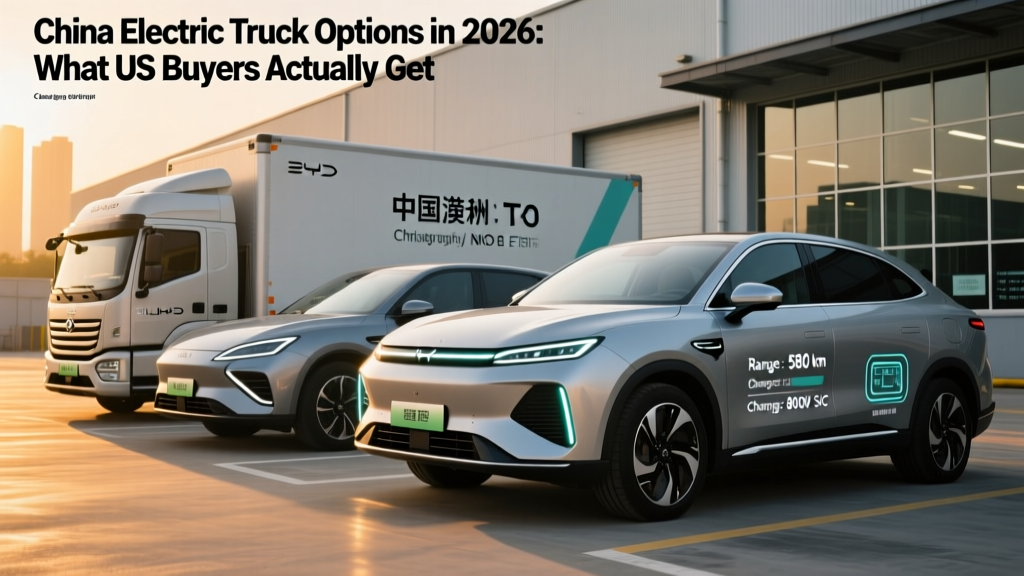
The Short Answer on China Electric Trucks
As of 2026, no Chinese-brand consumer electric pickup truck (BYD, Geely/Radar, Changan, etc.) is sold through authorized US dealership networks. A 100% tariff on Chinese-built EVs, combined with NHTSA homologation and EPA certification requirements, effectively blocks direct imports. US buyers looking at the "China electric truck" search trend are typically encountering one of three realities: (1) commercial fleet vehicles from BYD's US subsidiary, (2) the Radar RD6 (Geely) sold in Latin America and Southeast Asia but not North America, or (3) speculation about future market entry. If you want an electric truck today in the US, your realistic options remain the Ford F-150 Lightning, Rivian R1T, Chevrolet Silverado EV, GMC Sierra EV, and Tesla Cybertruck.
Why Chinese EV Trucks Aren't on US Dealer Lots
The US market is protected by a tariff wall that escalated dramatically in 2024 and remains in effect through 2026. Under Section 301 trade actions, Chinese-built electric vehicles face a 100% import tariff — effectively doubling the landed cost of any vehicle manufactured in China. This applies whether the truck wears a BYD, Great Wall, Chery, or Geely badge.
Beyond tariffs, every vehicle sold for US road use must meet Federal Motor Vehicle Safety Standards (FMVSS), which differ substantially from China's GB standards and Europe's UNECE regulations. NHTSA's import rules require manufacturers to self-certify compliance across crashworthiness, lighting, bumper standards, and electronic stability control — a process costing tens of millions of dollars per model line before a single unit is sold.
The EPA also requires emissions certification even for zero-emission vehicles, covering evaporative systems and onboard diagnostics documentation. Combined, these barriers mean that even a competitively priced Chinese electric truck like the BYD Shark (priced around $35,000 USD in Australia) would land in the US at well over $70,000 after tariffs, freight, and compliance modifications — eliminating the price advantage entirely.
The Chinese Electric Trucks You've Probably Seen Online
Several Chinese-market electric pickups generate international press and social media buzz. Here's what they actually are and where they're available:
| Model | Manufacturer | Markets Sold | Battery / Range | US Availability |
|---|---|---|---|---|
| BYD Shark 6 PHEV | BYD | Australia, Mexico, Brazil | 29.58 kWh LFP / ~60 mi EV (PHEV) | Not available |
| Radar RD6 | Geely (Radar Auto) | China, Thailand, Latin America | 86 kWh NMC / ~340 mi (CLTC) | Not available |
| Changan Hunter EV | Changan | China, Middle East | ~80 kWh / ~310 mi (CLTC) | Not available |
| BYD E-Vali (commercial van) | BYD | Europe, limited US fleet | Various / 150-200 mi | Fleet-only, not consumer |
| GWM Poer EV | Great Wall Motors | Australia (announced) | Preliminary specs | Not available |
Important range note: Chinese-market range figures use the CLTC testing cycle, which produces inflated numbers compared to the US EPA cycle. Expect CLTC range to be roughly 20-30% higher than an equivalent EPA figure. A Radar RD6 rated at 340 miles CLTC would likely achieve closer to 240-260 miles EPA if it were certified for the US market.
What US Buyers Actually Get: Domestic Electric Truck Specs
Since Chinese electric trucks are unavailable stateside, here's how the US-market electric pickups compare on the metrics that matter — range, charging speed, price, and capability:
| Spec | Ford F-150 Lightning (Ext. Range) | Rivian R1T (Dual Max) | Chevy Silverado EV (4WT) | Tesla Cybertruck (AWD) | GMC Sierra EV (Denali) |
|---|---|---|---|---|---|
| EPA Range | 320 mi | 420 mi | 492 mi (Max Range) | 340 mi | 440 mi |
| Battery (usable kWh) | ~131 kWh (NMC) | ~141 kWh (NMC) | ~200+ kWh (NMC) | ~123 kWh (NMC) | ~200+ kWh (NMC) |
| Peak DC Charge (kW) | 150 kW | 200+ kW | 350 kW | 250 kW | 350 kW |
| 10-80% Time | ~41 min | ~35 min | ~20 min | ~28 min | ~20 min |
| Level 2 Rate | 19.2 kW | 11.5 kW | 19.2 kW | 17 kW | 19.2 kW |
| 0-60 mph | ~4.0 sec | ~3.5 sec | ~4.5 sec | ~4.1 sec | ~4.5 sec |
| Horsepower | 580 hp | 665 hp | 510-754 hp | 600 hp | 655-754 hp |
| Max Towing | 10,000 lbs | 11,000 lbs | 12,500 lbs | 11,000 lbs | 12,000 lbs |
| Base MSRP (2026 est.) | ~$57,000 | ~$79,900 | ~$55,000 | ~$79,990 | ~$89,700 |
| Federal §30D Credit | Eligible (verify sourcing) | Eligible (verify sourcing) | Eligible (verify sourcing) | Eligible (verify sourcing) | Eligible (verify sourcing) |
Source: fueleconomy.gov and manufacturer spec sheets. Real-world highway range at 70+ mph typically runs 15-25% below EPA. Cold-weather range loss (below 32°F) can be 20-40% depending on heat pump availability and cabin preconditioning.
Cost Breakdown: Electric Truck vs Gas Truck Ownership
For buyers comparing an electric pickup against a gas equivalent like the Ford F-150 3.5L EcoBoost or Chevy Silverado 5.3L V8, the economics shift dramatically based on mileage, electricity rates, and how long you keep the vehicle.
| Cost Category (5 Years / 75,000 mi) | Ford F-150 Lightning XLT | Ford F-150 Gas (3.5L EcoBoost XLT) |
|---|---|---|
| Purchase Price (MSRP) | ~$57,000 | ~$52,000 |
| Federal Tax Credit (§30D) | -$7,500 (if eligible)* | $0 |
| Effective Purchase | ~$49,500 | ~$52,000 |
| Fuel / Electricity (75k mi) | ~$3,750 (home charging @ $0.14/kWh) | ~$10,500 (@ $3.50/gal, 18 MPG) |
| Maintenance | ~$1,800 | ~$4,200 |
| Insurance (est.) | ~$9,500 | ~$7,800 |
| 5-Year Total Cost | ~$64,550 | ~$74,500 |
| Cost Per Mile | ~$0.86 | ~$0.99 |
*§30D credit eligibility requires meeting battery sourcing and critical mineral thresholds, buyer income caps ($150k single / $300k joint), and vehicle MSRP caps ($80,000 for trucks). Credit can be transferred to dealer at point of sale. Verify current-year rules at IRS.gov §30D.
The electric truck wins on operating costs by roughly $6,750 over five years in fuel and maintenance savings alone. However, insurance premiums for EV pickups run 15-25% higher on average due to repair complexity and parts costs. If you drive fewer than 8,000 miles per year, the fuel savings shrink enough that the higher insurance and depreciation may erase the advantage.
Real-World Ownership: What First-Time EV Truck Buyers Must Know
If you've never owned an electric vehicle, a pickup truck amplifies several EV-specific considerations:
Home charging is nearly mandatory. Electric trucks have large batteries (120-200+ kWh). On a standard 120V Level 1 outlet adding ~3 miles of range per hour, fully recharging a depleted F-150 Lightning would take over 40 hours. A Level 2 home charger (240V, 40-80 amps) adds 25-45 miles per hour and is essential. Expect $1,200-$3,500 for a quality Level 2 unit plus electrician installation, with possible panel upgrade costs of $1,500-$4,000 if your home has a 100-amp service panel.
Towing destroys range. Pulling a 6,000-pound trailer at highway speeds can cut electric truck range by 40-50%. A Cybertruck rated for 340 miles EPA may deliver only 170-200 miles under a heavy tow load. Gas trucks experience similar proportional efficiency loss, but the refueling infrastructure makes it less consequential. If you tow frequently over long distances, plan routes around DC fast chargers and expect 25-35 minute stops every 150-180 miles.
Cold weather hits big batteries hard. At 20°F, expect 20-30% range reduction even with a heat pump. In sub-zero conditions, losses of 35-40% are documented. The Silverado EV's massive 200+ kWh battery provides a buffer — losing 30% still leaves 340+ miles — but smaller-battery trucks like the base Lightning become range-constrained in winter.
Public charging for trucks is still limited. Most DC fast charging stations are designed for passenger cars. Pulling a trailer into a Tesla Supercharger or Electrify America stall often requires unhitching or blocking multiple spots. Look for dedicated truck-friendly charging plazas (Pilot/Flying J locations with EV charging, Love's) which are expanding through 2026 but remain sparse in many regions.
Common Misconceptions About Chinese Electric Trucks
| Myth | Fact |
|---|---|
| "BYD trucks are coming to the US soon and will be half the price." | BYD has stated they have no plans to sell consumer vehicles in the US market. The 100% tariff eliminates any price advantage even if they did enter. |
| "You can import a Chinese EV truck personally." | NHTSA allows personal import only of vehicles conforming to FMVSS or those over 25 years old. A new Chinese truck cannot be individually federalized for road use. |
| "Chinese electric trucks have inferior batteries." | BYD is the world's largest LFP battery manufacturer. Their Blade Battery cell-to-pack design is used by Tesla in some markets. The battery technology is competitive — the barrier is trade policy, not quality. |
| "CLTC range numbers are the same as EPA." | CLTC (China Light-Duty Vehicle Test Cycle) produces range figures 20-30% higher than EPA testing. A "400 km" CLTC truck would likely rate ~280-310 miles EPA. |
| "The $7,500 tax credit applies to any EV I import." | §30D requires North American final assembly. No Chinese-built vehicle qualifies, even if tariffs were waived. See IRS §30D guidelines. |
Decision Framework: What Should You Actually Buy?
Choose a Ford F-150 Lightning if: You want the most car-like truck experience, need Pro Power Onboard (9.6 kW V2L for job-site tools or tailgating), and prioritize a sub-$60,000 starting price with §30D credit eligibility.
Choose a Rivian R1T if: You want the most range (420 mi Max pack), best off-road capability with quad-motor torque vectoring, and don't mind the ~$80,000+ entry price. Best for adventure-oriented buyers.
Choose a Chevy Silverado EV if: Maximum range (492 mi Max) and maximum towing (12,500 lbs) are your priorities, and you're willing to accept a very large, heavy vehicle. The 4WT work truck trim targets commercial fleet use.
Choose a Tesla Cybertruck if: You want the NACS-native Supercharger network advantage (the most reliable DC fast charging network in 2026), stainless steel exoskeleton durability, and accept polarizing styling. Note: Cybertruck FSD remains SAE Level 2 — you must supervise at all times.
Wait on Chinese electric trucks if: You're hoping for a $30,000 electric pickup from BYD or Geely. Trade policy shows no signs of shifting before 2028 at the earliest, and any eventual market entry would likely come through a US-assembled joint venture, not direct import.
FAQ: China Electric Truck Questions
Can I buy a BYD Shark in the United States?
No. BYD does not sell consumer vehicles in the US market. The BYD Shark 6 PHEV is available in Australia, Mexico, and Brazil. Even if you could arrange a private import, it would not meet FMVSS safety standards and could not be legally registered for road use. BYD's US presence is limited to commercial electric buses and heavy-duty trucks through their Lancaster, California facility.
Will Chinese electric trucks ever come to America?
Not in the near term. The 100% tariff, FMVSS compliance costs, and current geopolitical tensions create a barrier that no Chinese automaker has signaled intent to overcome for consumer pickup trucks before 2028+. Some Chinese-adjacent brands (Volvo/Polestar, owned by Geely) sell in the US but manufacture in Europe or South Carolina — not China.
How do Chinese electric truck prices compare to US options?
In their home markets, Chinese electric pickups like the Radar RD6 start around $25,000-$35,000 USD equivalent. However, after the 100% US tariff, freight, compliance modifications, and dealer markup, those same vehicles would land at $60,000-$80,000+ — offering no savings over a domestically built F-150 Lightning or Silverado EV that also qualifies for the §30D tax credit.
What's the cheapest electric truck I can buy in the US in 2026?
The Ford F-150 Lightning Pro starts around $55,000-$57,000 MSRP, potentially dropping to ~$47,500-$49,500 after the $7,500 federal credit (if eligible). The Chevrolet Silverado EV Work Truck (4WT) targets a similar price point. Both are fleet-oriented base trims with reduced features but full powertrain capability.
Do electric trucks qualify for the full $7,500 tax credit?
Eligibility depends on current-year §30D rules including: vehicle MSRP under $80,000 (truck/van/SUV cap), buyer AGI under $150,000 (single) or $300,000 (joint), North American final assembly, and battery critical mineral/sourcing thresholds that tighten annually. Always verify at IRS.gov before purchasing, as eligibility can change between model years.