Quick Answer: China EVs in Canada (2026)
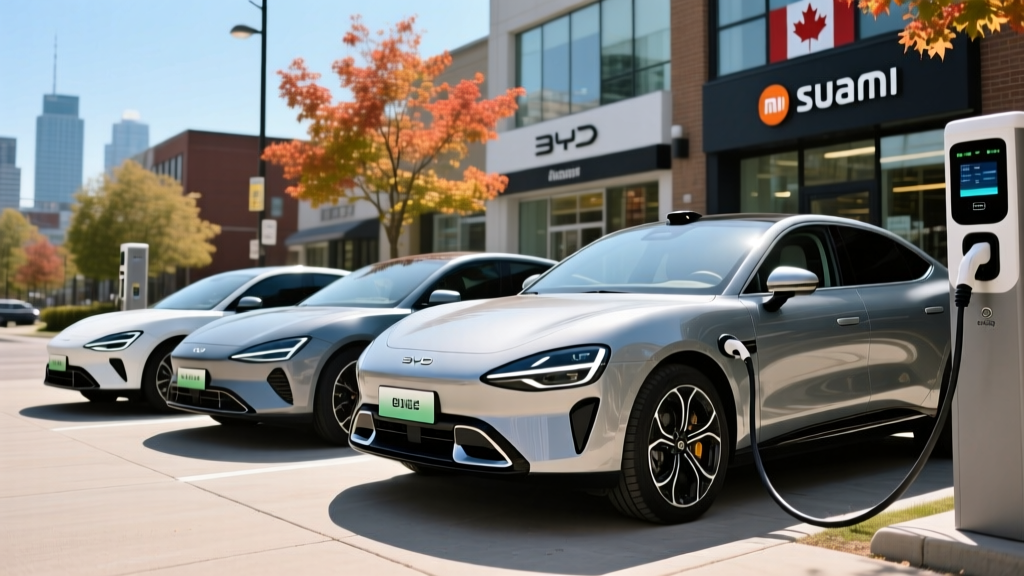
Canada currently imposes a 100% surtax on all Chinese-made electric vehicles, effective October 1, 2024. This means a BYD Seal with a factory price of ~$45,000 CAD faces an additional $45,000 in duties before it even reaches a dealer lot. As of early 2026, no Chinese-brand EVs (BYD, NIO, Xpeng, Zeekr, MG) are officially sold through Canadian dealerships. You can technically grey-market import one, but the combined tariff, Transport Canada homologation costs, and lack of service infrastructure make it financially impractical for nearly every buyer.
Why Chinese EVs Are Making Headlines but Not Canadian Driveways
China produces over 60% of the world's electric vehicles, with brands like BYD surpassing Tesla in global BEV volume. Models like the BYD Dolphin, Seagull, and Seal offer compelling specs — LFP Blade batteries, 300+ km of range, and aggressive pricing that undercuts legacy automakers by 30-40% in markets without protective tariffs. In Europe, Australia, and Southeast Asia, these vehicles are readily available.
Canada took a different path. Following the United States' lead and citing concerns about subsidized overcapacity and intellectual property practices, the Canadian government enacted an Order in Council under the Customs Tariff that adds a 100% surtax on top of the standard 6.1% import duty for EVs manufactured in China. This applies regardless of brand — a Tesla Model 3 built at Giga Shanghai and shipped to Vancouver would face the same penalty.
The practical result: Chinese-brand EVs are effectively priced out of the Canadian market. A vehicle that might retail for $35,000 CAD in Europe lands in Canada at $70,000+ before dealer markup, freight, and provincial taxes.
The Real Math: What a China EV Actually Costs in Canada
Let's use the BYD Seal as a worked example. This midsize sedan competes with the Tesla Model 3 and Hyundai Ioniq 6 in global markets.
| Cost Component | BYD Seal (Imported) | Tesla Model 3 RWD | Hyundai Ioniq 6 Preferred |
|---|---|---|---|
| Base MSRP / Factory Price | $45,000 CAD | $54,990 CAD | $52,999 CAD |
| Standard Import Duty (6.1%) | $2,745 | $0 (US-built) | $0 (Korea-built) |
| China EV Surtax (100%) | $45,000 | $0 | $0 |
| Freight & Homologation | ~$8,000+ | $2,200 | $2,095 |
| Estimated Total Before Tax | ~$100,745 | $57,190 | $55,094 |
| Federal iZEV Rebate Eligibility | Unlikely (no dealer network) | Up to $5,000 | Up to $5,000 |
The BYD Seal is a genuinely competitive vehicle globally — it offers a 82.5 kWh LFP Blade battery, approximately 570 km of WLTP range (roughly 450-480 km EPA equivalent), and DC fast charging up to 150 kW (10-80% in ~26 minutes). But at double the import price, it simply cannot compete against locally available alternatives that also qualify for federal and provincial rebates.
Available EVs in Canada That Fill the Gap
If you're researching Chinese EVs because you want affordable, long-range electric transportation, here's what the Canadian market actually offers at competitive price points:
| Model | EPA Range | Battery (kWh) | DC Fast Charge (kW) | 10-80% Time | Starting MSRP (CAD) |
|---|---|---|---|---|---|
| Tesla Model 3 RWD | 584 km | 60 (LFP) | 170 kW peak | ~25 min | $54,990 |
| Hyundai Ioniq 6 Preferred LR | 581 km | 77.4 (NMC) | 240 kW peak | ~18 min | $52,999 |
| Chevrolet Equinox EV 2LT | 513 km | 85 (NMC) | 150 kW peak | ~30 min | $49,998 |
| Volkswagen ID.4 Pro | 443 km | 82 (NMC) | 135 kW peak | ~29 min | $51,995 |
| Nissan Ariya Engage | 489 km | 87 (NMC) | 130 kW peak | ~35 min | $53,998 |
Several of these qualify for the Transport Canada iZEV rebate of up to $5,000 for base models under $55,000 MSRP, plus provincial incentives in BC ($4,000), Quebec ($7,000), and others — bringing effective prices well below any hypothetical Chinese import.
What About Grey Market Imports? The Homologation Problem
Some buyers ask whether they can personally import a BYD or NIO vehicle through a Registered Importer (RI) under Transport Canada's rules. Technically, yes — but the barriers are substantial:
- 100% surtax still applies — personal import does not exempt you from the Customs Tariff order.
- Transport Canada compliance: Chinese-market EVs are built to GB/T charging standards and Chinese safety regulations (C-NCAP). Converting to meet Canada Motor Vehicle Safety Standards (CMVSS) requires modifying lighting, airbags, seatbelt pretensioners, and potentially the entire high-voltage system.
- Charging connector: China uses GB/T for both AC and DC charging. Canada uses SAE J1772 (AC) and CCS1/NACS (DC). Adapters exist but are not certified for all use cases, and no public DC fast chargers in Canada offer GB/T connectors.
- No dealer service: If your BYD Seal's battery management system faults or a drive unit needs replacement, no Canadian shop has diagnostic software, parts inventory, or warranty authorization. You're on your own.
- Insurance: Most major Canadian insurers (ICBC, TD, Intact) will not underwrite a grey-market Chinese EV due to the lack of repair data and parts availability.
The estimated cost to fully homologate a single Chinese EV for Canadian roads ranges from $15,000 to $30,000+ in RI fees, on top of the doubled purchase price from the tariff.
Canadian Winter: A Real-World Factor for Any EV
One reason buyers look at Chinese EVs is the promise of LFP (lithium iron phosphate) batteries, which BYD champions. LFP offers excellent cycle life (3,000+ cycles to 80% capacity retention) and superior thermal stability. However, LFP chemistry suffers more capacity loss in extreme cold than NMC.
In Canadian winter testing conditions (-15°C to -25°C), expect:
- NMC batteries (Ioniq 6, ID.4, Ariya): 25-35% range reduction vs. EPA sticker
- LFP batteries (Tesla Model 3 RWD, BYD Blade): 30-40% range reduction vs. EPA/WLTP sticker
- Heat pump equipped models recover 10-15% of that loss by using ambient heat for cabin warming
The Hyundai Ioniq 6 and Tesla Model 3 both include heat pumps as standard equipment, partially mitigating winter range loss. Most Chinese-market BYD models sold domestically in China do not include heat pumps in base trims — another complication for importers.
Decision Framework: Should You Wait for Chinese EVs in Canada?
If-Then Buying Guide
- IF you want an affordable long-range EV now → THEN buy a Tesla Model 3 RWD, Chevy Equinox EV, or Hyundai Ioniq 6. All are available, warrantied, and rebate-eligible.
- IF you specifically want a BYD, NIO, or Xpeng → THEN wait. The 100% tariff has no announced sunset date. Political relations and trade negotiations would need to shift substantially. Realistically, this is a 2028+ scenario at the earliest.
- IF you're considering a grey-market import → THEN run the full math (tariff + RI fees + charging adapter + no warranty + insurance difficulty). For 99% of buyers, a domestically available EV is the rational choice.
- IF you live near the US border and wonder about importing from America → THEN note that Chinese-made EVs sold in the US face their own 100%+ tariff, so the same models are unavailable stateside at reasonable prices.
Common Misconceptions About Chinese EVs in Canada
| Myth | Fact |
|---|---|
| "Chinese EVs are banned in Canada" | Not banned — they face a 100% surtax that effectively doubles the price. Import is legal but financially impractical. |
| "I can just drive one across from the US" | The US imposes its own 100% tariff on Chinese EVs (raised in 2024). Chinese-brand EVs are not sold at US dealerships either. |
| "BYD is coming to Canada soon" | As of 2026, BYD has announced no Canadian dealer network. The tariff makes market entry economically unviable without policy change. |
| "Chinese EVs are lower quality" | Benchmarking by European agencies (Euro NCAP) shows models like the BYD Seal and NIO ET7 achieving 5-star ratings. The barrier is trade policy, not build quality. |
| "I'll save money importing directly" | Between the 100% surtax, 6.1% duty, RI homologation ($15K-$30K), GB/T-to-CCS adapter costs, and zero warranty coverage, total landed cost exceeds comparable Canadian-market EVs by $30,000+. |
The Ownership Cost Picture: EV vs. Gas in Canada
Regardless of origin, the economic case for EVs in Canada hinges on fuel and maintenance savings. Here's a 5-year comparison based on 20,000 km/year driven, BC Hydro residential rates ($0.11/kWh), and $1.55/L gasoline:
| Category | Hyundai Ioniq 6 (EV) | Toyota Camry LE (Gas) |
|---|---|---|
| Fuel / Electricity (5 yrs) | $2,200 (home charging) | $12,400 |
| Maintenance (5 yrs) | ~$1,500 | ~$4,200 |
| Insurance (avg 5 yrs) | ~$11,500 | ~$9,500 |
| Total Operating Cost | $15,200 | $26,100 |
| Savings (EV vs Gas) | $10,900 over 5 years | |
EV insurance premiums in Canada run 15-25% higher on average, driven by higher repair costs for collision damage to battery packs and specialized body structures. However, the fuel and maintenance gap more than offsets this for most drivers — particularly those with access to home Level 2 charging and time-of-use electricity rates.
Frequently Asked Questions
Will the 100% tariff on Chinese EVs be removed?
There is no announced timeline for tariff removal. The policy is tied to broader Canada-China trade relations and concerns about state-subsidized vehicle dumping. A change would likely require a significant shift in diplomatic or trade negotiation outcomes. Monitor Department of Finance Canada announcements for updates.
Can I buy a Chinese EV if I move to Canada from China?
You can import personal vehicles when immigrating, but the 100% surtax on Chinese-origin EVs still applies under the Customs Tariff. Transport Canada compliance modifications are also required. Most new immigrants find it more practical to purchase a vehicle domestically after arrival.
Are Tesla vehicles made in China sold in Canada?
Tesla vehicles sold in Canada are manufactured at Giga Texas (Austin) or Giga Berlin, not Giga Shanghai. The China surtax applies based on country of manufacture, so any Tesla built in China would face the same 100% penalty. Tesla's Canadian lineup is sourced from US and European plants.
What's the cheapest EV I can actually buy in Canada in 2026?
The Nissan Leaf S starts at approximately $42,998 CAD with a 40 kWh battery and 240 km of EPA range. After the federal iZEV rebate ($5,000) and applicable provincial incentives, effective prices can drop below $35,000 in some provinces. The Chevrolet Equinox EV 2LT at $49,998 offers 513 km of range and is the value leader for longer-range needs.
Do Chinese EVs use different charging connectors?
Yes. China uses the GB/T standard for both AC (home/public Level 2) and DC (fast charging) connections. Canada uses SAE J1772 for AC and CCS1 or NACS (Tesla) for DC fast charging. While GB/T-to-CCS adapters exist for roughly $500-$800 CAD, they are not universally certified, add a point of failure, and no Canadian public charging network supports GB/T natively.
Sources: Department of Finance Canada — Tariff Announcement, Transport Canada iZEV Program, EPA Fuel Economy.