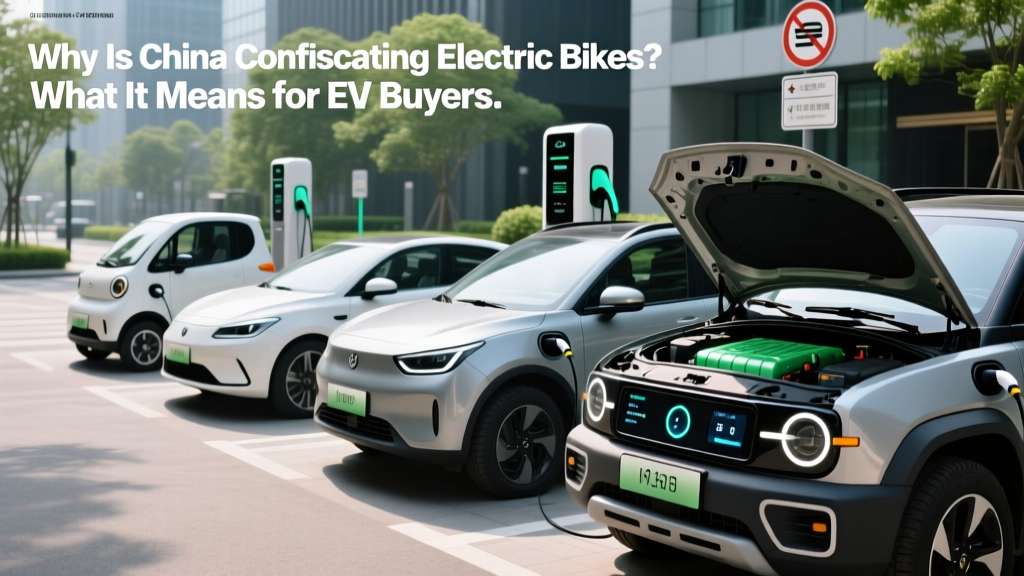
Quick Answer: Why Is China Confiscating Electric Bikes?
China is confiscating electric bikes primarily because of lithium-ion battery fire risks linked to unregulated aftermarket battery modifications, thermal runaway events in residential buildings, and non-compliant vehicles that exceed the national speed limit of 25 km/h (15.5 mph). The crackdown intensified in 2024 and expanded through 2025–2026 after a series of deadly apartment fires in Beijing, Shanghai, and Nanjing traced to e-bike batteries charged indoors. Authorities have seized millions of non-compliant units under updated GB national standards, banned indoor charging in many cities, and introduced mandatory battery traceability codes.
If you're researching electric vehicles and stumbled onto the question "why is China confiscating electric bikes?" — you're not alone. The headline is jarring, especially for Western EV shoppers who associate China with aggressive electrification. The reality is more nuanced: China isn't anti-electric. It's the world's largest EV market by a wide margin, with over 9 million new-energy vehicle (NEV) sales in 2025 alone. The e-bike crackdown targets a specific, poorly regulated segment of micromobility — not the broader EV ecosystem.
But the reasons behind the confiscations carry real lessons for anyone buying an electric car, plug-in hybrid, or even a home battery system in 2026. Here's what's actually happening, the data behind it, and what it means for your EV purchase decision.
The Scale of China's E-Bike Problem
China has roughly 350 million registered electric bikes on its roads — more than one for every four citizens. Many are affordable commuter vehicles costing ¥2,000–¥5,000 ($275–$690 USD), powered by 48V lithium-ion or lead-acid battery packs ranging from 0.5 kWh to 1.5 kWh. They fill a critical last-mile transportation gap in dense urban centers.
The problem is the aftermarket. A massive grey market exists for:
- Range-extending battery mods: Riders swap compliant 48V packs for 60V or 72V packs to boost speed and range, often using cells of unknown provenance.
- Speed limiter removal: The 25 km/h national limit is routinely bypassed, pushing e-bikes to 40–60 km/h without the braking or structural safety to match.
- Indoor charging: With limited outdoor charging infrastructure, millions of riders bring battery packs into apartments, hallways, and elevator lobbies to charge overnight.
The result: China's fire departments reported over 21,000 e-bike-related fires in 2023, a number that continued to drive policy through 2024 and 2025. A single February 2024 fire in Nanjing killed 15 people and injured 44 — traced to an e-bike battery charging in a ground-floor lobby. That incident became the catalyst for the most aggressive enforcement wave yet.
What the Crackdown Actually Targets
Understanding the confiscations requires separating three distinct enforcement actions:
1. Non-Compliant Vehicle Seizures
Under China's updated GB 17761-2018 national standard (enforced aggressively starting 2024), compliant e-bikes must have:
- Maximum speed: 25 km/h (15.5 mph)
- Motor power: ≤400W
- Battery voltage: ≤48V
- Vehicle weight: ≤55 kg (121 lbs) including battery
- Functional pedals
Any e-bike exceeding these specs is classified as an electric motorcycle, which requires registration, licensing, and insurance. Millions of riders operate unregistered, non-compliant bikes — and cities like Beijing, Guangzhou, and Shenzhen have conducted mass seizures at checkpoints.
2. Battery Traceability and Certification
Starting in 2025, China mandated QR-code-based battery traceability for all new e-bike lithium-ion packs. Each cell and pack must carry a unique identifier linked to the manufacturer, chemistry type, and production batch. Batteries without valid codes can be confiscated at the point of sale or during roadside inspections. This is a direct response to counterfeit and recycled cells entering the supply chain.
3. Indoor Charging Bans
Over 20 major Chinese cities now prohibit bringing e-bike batteries into residential buildings. Enforcement ranges from fines (¥200–¥1,000) to confiscation of batteries found charging in common areas. Some cities have installed outdoor smart-charging cabinets with fire suppression systems, but rollout lags far behind demand.
| Myth | Fact |
|---|---|
| China is banning all electric bikes | China is enforcing existing compliance standards; compliant e-bikes remain legal and are still sold by the millions |
| This signals China is turning against EVs | China sold 9+ million NEVs (cars, SUVs, trucks) in 2025 — the e-bike crackdown targets micromobility safety, not electrification policy |
| All confiscated bikes are destroyed | Many are held until owners bring them into compliance (speed limiter restoration, battery swap to certified pack) |
| Lithium batteries are inherently unsafe | Properly manufactured and managed LFP and NMC batteries in EVs have excellent safety records — the issue is unregulated aftermarket cells |
| This won't affect EV buyers outside China | Global battery safety standards are tightening in response, with UL and IEC updating certification requirements for battery storage and micromobility |
What This Means for EV Battery Safety Standards Globally
The e-bike crisis in China is accelerating regulatory action worldwide — and that directly affects what you'll find under the hood (or floor) of the EV you buy next.
Battery chemistry matters. The e-bike fires overwhelmingly involve low-quality NMC (nickel manganese cobalt) cells with thin separators, no battery management system (BMS), and no thermal management. Modern EVs use fundamentally different engineering:
| Feature | Regulated EV Battery Pack | Aftermarket E-Bike Pack |
|---|---|---|
| Cell Chemistry | LFP (lithium iron phosphate) or automotive-grade NMC 811/622 | Unknown — often recycled or reject-grade NMC cells |
| Battery Management System | Active BMS monitoring voltage, temp, and current per cell group | Absent or minimal passive balancing |
| Thermal Management | Liquid cooling/heating with dedicated thermal loop | None — passive air cooling at best |
| Cell-Level Protection | Ceramic-coated separators, CID (current interrupt device), vent valves | Basic or no protection mechanisms |
| Testing Standards | UN 38.3, UL 2580, SAE J2464, GB/T 31485 | Rarely tested; no certification |
| Traceability | Full cell-to-pack lot tracking | No traceability; counterfeit labels common |
This is why LFP chemistry is gaining market share in EVs globally. LFP cells are more thermally stable — they don't enter thermal runaway until roughly 270°C (518°F), compared to 210°C (410°F) for NMC. Tesla, BYD, Ford, and others now offer LFP-equipped trims. The BYD Blade battery (LFP) and CATL's Shenxing LFP pack both passed nail penetration tests without fire — a benchmark no grey-market e-bike cell could approach.
According to NHTSA data, EV fire incidents in the US remain significantly lower per 100,000 vehicles than internal combustion engine fires. The China e-bike crisis reinforces why regulated, certified battery systems matter — and why buying from manufacturers with transparent supply chains protects you.
EV Ownership Costs in 2026: The Real Numbers
Whether the China headlines make you cautious or curious about EVs, the purchase decision still comes down to cost. Here's a concrete comparison using a popular 2026 model — the Hyundai Ioniq 5 SE Standard Range — against its closest gas-powered competitor, the Toyota RAV4 LE AWD.
| Category | Ioniq 5 SE (BEV) | RAV4 LE AWD (Gas) |
|---|---|---|
| MSRP | $42,600 | $31,975 |
| Federal Tax Credit (§30D) | Up to $7,500 (income/MSRP/sourcing dependent — see IRS guidelines) | $0 |
| Effective Purchase Price | ~$35,100 (if credit applies) | $31,975 |
| EPA Range / Fuel Economy | 290 mi range / 114 MPGe combined | 30 MPG combined |
| Energy/Fuel Cost (15,000 mi/yr) | ~$585/yr (home charging at $0.14/kWh) | ~$1,750/yr (gas at $3.50/gal) |
| 5-Year Energy/Fuel Total | ~$2,925 | ~$8,750 |
| Maintenance (5-year est.) | ~$1,200 (no oil, fewer brake replacements due to regen) | ~$3,500 (oil changes, transmission fluid, brake pads) |
| Insurance (avg. annual) | ~$2,100/yr | ~$1,650/yr |
| 5-Year Insurance Total | ~$10,500 | ~$8,250 |
| 5-Year Total Cost of Ownership | ~$49,725 | ~$52,475 |
Key takeaway: The EV's higher sticker price and insurance premiums are offset by dramatically lower energy and maintenance costs — and the federal tax credit, if you qualify. Over 5 years, the Ioniq 5 comes out roughly $2,750 ahead, with the gap widening in years 6–10 as gas costs compound and EV maintenance stays minimal.
Note on the §30D tax credit: Eligibility for the full $7,500 depends on your modified adjusted gross income (≤$150K single / ≤$300K joint), vehicle MSRP caps ($55K for sedans, $80K for SUVs/trucks), and battery critical-mineral and component sourcing requirements that tighten annually. The credit can now be transferred to the dealer at point of sale as an instant discount. Always verify current-year rules at IRS.gov and consult a tax professional.
Real-World Ownership: What First-Time EV Buyers Must Know
The China e-bike story is ultimately about infrastructure and usage patterns — and that's the same lens you need when buying an EV in the US.
Home Charging Access Is Non-Negotiable (For Most Buyers)
Over 80% of EV charging happens at home. If you can install a Level 2 (240V) charger — typically a 32A–48A unit delivering 7.7–11.5 kW — you'll wake up to a full battery every morning and rarely visit a public charger. Installation costs range from $500–$2,500 depending on panel capacity and run length, but can exceed $5,000 if a 200A panel upgrade is needed.
If you cannot charge at home (apartment, street parking, landlord restrictions), an EV is still possible but significantly less convenient. You'll depend on workplace charging or public DC fast chargers, where costs are 2–4× higher than home rates ($0.30–$0.55/kWh vs. $0.12–$0.16/kWh).
Real-World Range vs. EPA Sticker
EPA range estimates are generated under controlled lab conditions. In practice:
- Highway driving at 75+ mph: Expect 10–15% range reduction vs. EPA
- Cold weather (below 30°F): Expect 20–35% range loss without a heat pump; 15–25% with one
- Mountain driving: Significant elevation gain consumes more; regen recovers some on descent
- Battery buffer: Manufacturers reserve a top/bottom buffer (typically 3–5 kWh) to protect longevity — the usable capacity is less than the stated kWh
For a 290-mile EPA-rated Ioniq 5, plan for ~245 miles of real-world highway range in moderate weather and ~200 miles in winter. That's still ample for most daily driving (the average American drives 37 miles/day per FHWA data), but it demands honest trip planning for road trips.
Charging Speed: Peak kW Is Not Sustained kW
When a manufacturer advertises "240 kW DC fast charging," that's the peak rate — typically achieved only between 10–30% state of charge. The charge curve tapers significantly above 50%, and dramatically above 80%, to protect battery health. A realistic 10–80% session on a 240 kW-capable Ioniq 5 takes approximately 18–22 minutes at a compatible charger — not the "5 minutes to full" impression marketing sometimes implies.
EV Purchase Decision Framework
Choose a BEV (battery electric vehicle) if:
- You have home or workplace Level 2 charging access
- Your daily driving is under 80 miles round-trip
- You qualify for the §30D federal tax credit or state incentives
- You want the lowest per-mile energy cost (~$0.04/mi on home charging)
- You're willing to plan charging stops on road trips (15–25 min every 200–250 mi)
Choose a PHEV (plug-in hybrid) if:
- You can charge at home but frequently drive 200+ miles without stopping
- You want 25–45 miles of electric-only range for daily commuting with gas-engine backup
- You live in an area with sparse DC fast-charging infrastructure
- You're not ready to commit to full electric but want to reduce fuel consumption 60–80%
Choose an HEV (standard hybrid) if:
- You have no charging access at home or work
- You want better fuel economy (45–55 MPG) without any plug-in behavior change
- You want a lower purchase price and simpler ownership experience
The Bigger Picture: Battery Regulation Is Tightening Everywhere
China's e-bike confiscations are the most visible example of a global trend: governments are taking battery safety seriously, and standards are getting stricter. In the US and EU, this means:
- UL 2271 and UL 2849 certification is becoming mandatory for e-bike and micromobility batteries sold through major retailers
- NYC Local Law 39 (2023) banned the sale of uncertified e-bike batteries — a model other cities are following
- EU Battery Regulation (2024–2027) introduces battery passports with full lifecycle traceability for EV and industrial batteries
- US DOE battery manufacturing standards tie federal loan and grant funding to quality and traceability requirements
For EV car buyers, this is net positive. The vehicles you're shopping — from Tesla and Hyundai to Ford, GM, Rivian, and BYD — already operate under far more rigorous battery safety frameworks than the e-bike sector that prompted China's crackdown. The 8-year/100,000-mile battery warranty mandated as an EPA emission-control component (fueleconomy.gov tracks these) provides additional financial protection against premature degradation.
Frequently Asked Questions
Is China confiscating electric cars too, or just e-bikes?
Just e-bikes and electric scooters. China's EV car market is fully supported by government policy — the country purchased over 9 million new-energy vehicles in 2025, and manufacturers like BYD, NIO, and XPand receive substantial subsidies and infrastructure investment. The confiscations target the unregulated micromobility sector specifically.
Should the China e-bike fires make me worried about EV car battery safety?
No — but it should reinforce the importance of buying from certified manufacturers. EV battery packs have active thermal management, sophisticated BMS systems, cell-level protection, and undergo extensive crash and thermal testing. E-bike batteries involved in the Chinese fires typically have none of these. According to NHTSA and IIHS data, EVs have lower fire incidence rates than gasoline vehicles.
What battery chemistry is safest for an EV?
LFP (lithium iron phosphate) is the most thermally stable chemistry currently in mass production. It resists thermal runaway to approximately 270°C vs. ~210°C for NMC, and doesn't contain cobalt or nickel. Trade-offs include lower energy density (heavier packs for the same range) and reduced cold-weather performance. Many 2026 models offer LFP options: Tesla Model 3 RWD, Ford Mustang Mach-E Select, BYD Atto 3, and the base Hyundai Ioniq 5.
How do I check if an EV qualifies for the federal tax credit?
The §30D clean vehicle credit offers up to $7,500, split into two components: $3,750 for meeting critical-mineral sourcing requirements and $3,750 for battery component manufacturing requirements. Additional eligibility gates include buyer income limits ($150K single / $300K joint MAGI), vehicle MSRP caps ($55K sedans / $80K SUVs, vans, trucks), and final assembly in North America. The IRS maintains a qualified vehicles list that updates regularly — always verify before purchasing.
What's the real cost to charge an EV at home vs. fueling a gas car?
At the US average residential electricity rate of ~$0.16/kWh and an EV efficiency of 3.5 miles/kWh, home charging costs approximately $0.046 per mile. A gas car at 28 MPG combined and $3.50/gallon costs $0.125 per mile — nearly 3× more. Over 15,000 miles annually, that's $690 for electricity vs. $1,875 for gasoline, saving ~$1,185/year. Public DC fast charging at $0.35–$0.55/kWh narrows the gap but still undercuts gasoline in most markets.
Can I still buy an e-bike legally in the US?
Yes. US e-bike regulations are set at the state level, with most states following a 3-class system (Class 1: pedal-assist to 20 mph; Class 2: throttle to 20 mph; Class 3: pedal-assist to 28 mph). The China confiscations don't affect US e-bike legality, but purchasing UL-certified batteries (UL 2849) is strongly recommended to avoid the same fire risks that prompted China's crackdown.
The question "why is China confiscating electric bikes" ultimately reveals a story about battery safety regulation catching up to rapid electrification — a dynamic that benefits every EV buyer who chooses certified, well-engineered vehicles over the cheapest option with an opaque supply chain.