The Short Answer
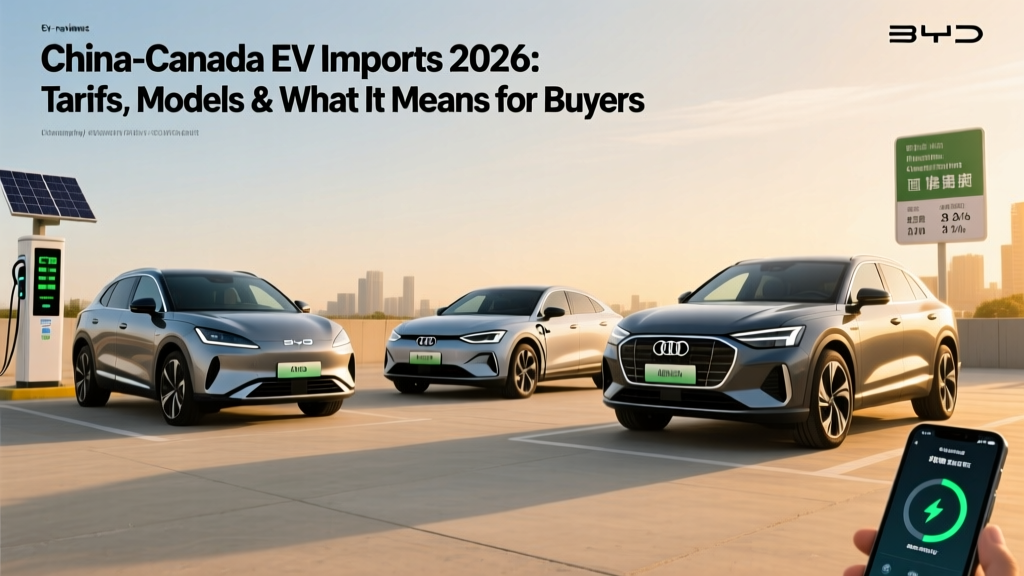
As of 2026, Canada imposes a 100% surtax on all electric vehicles manufactured in China, including Chinese-brand vehicles (BYD, MG, Nio) and non-Chinese brands assembled there (Tesla Model 3 from Giga Shanghai). This tariff effectively doubles the import price, making most China-built EVs uncompetitive in the Canadian market. If you're researching a China-built EV for Canadian purchase, expect to pay roughly $60,000–$90,000+ CAD after duties on vehicles that sticker for $25,000–$45,000 in other markets. Canada's $5,000 federal iZEV rebate and provincial incentives still apply to qualifying models, but the tariff eliminates the price advantage Chinese EVs enjoy elsewhere. Your best alternatives are EVs assembled in North America or South Korea.
Why Canada Imposed a 100% Tariff on Chinese EVs
In October 2024, Canada aligned with U.S. trade policy by implementing a 100% additional tariff on Chinese-made electric vehicles, on top of the existing 6.1% import duty. The policy, enforced under the Department of Finance Canada customs framework, targets vehicles classified under HS code 8703.80 (battery electric vehicles) originating from China. The stated rationale includes countering Chinese government subsidies that enable below-market pricing and protecting Canada's domestic auto manufacturing sector.
This tariff applies to country of assembly, not brand nationality. That distinction matters:
- Tesla Model 3 built in Shanghai — subject to the 100% surtax if imported to Canada
- Tesla Model 3 built in Fremont, CA — not subject (normal import duties only)
- BYD Atto 3, Seal, Dolphin — all China-built, all subject to the tariff
- MG4, MG ZS EV — China-built (SAIC Motor), tariff applies
- Polestar 2 (China-built) — tariff applies; Polestar shifted some production to South Korea partly in response
The Real Cost: China-Built EV Pricing in Canada After Tariffs
Let's run the numbers on several popular China-built EVs to show what the tariff actually does to the sticker price. These figures use approximate 2026 MSRP equivalents converted to CAD, with the 100% surtax plus the base 6.1% duty applied.
| Model | Global MSRP (CAD equiv.) | Base Duty (6.1%) | 100% Surtax | Total Landed Cost | Effective Markup |
|---|---|---|---|---|---|
| BYD Atto 3 (Extended Range) | $38,000 | $2,318 | $38,000 | ~$78,318 | +106% |
| BYD Seal (Premium) | $48,000 | $2,928 | $48,000 | ~$98,928 | +106% |
| MG4 XPOWER | $42,000 | $2,562 | $42,000 | ~$86,562 | +106% |
| Tesla Model 3 RWD (Shanghai) | $52,000 | $3,172 | $52,000 | ~$107,172 | +106% |
| Polestar 2 LR Single Motor | $55,000 | $3,355 | $55,000 | ~$113,355 | +106% |
Note: These estimates exclude dealer fees, freight within Canada, GST/HST, and luxury tax. Tesla Canada sources Model 3 units primarily from Fremont, so the tariff largely doesn't affect Canadian Tesla buyers — but it prevents Tesla from using Shanghai as a lower-cost supply source for Canada.
How China-Built EVs Compare to Available Canadian Alternatives
With the tariff in place, the question shifts: what can you actually buy in Canada that delivers similar range, tech, and value? Here's a side-by-side comparison of the China-built models Canadian shoppers often research versus the North American and Korean-built alternatives that are actually accessible.
| Spec | BYD Seal (China-built, tariff-blocked) | Hyundai Ioniq 6 Preferred LR (Korea-built) | Tesla Model 3 LR AWD (US-built) |
|---|---|---|---|
| EPA Range | ~340 mi (WLTP ~370 mi) | 361 mi | 341 mi |
| Battery (usable kWh) | 82.5 kWh (LFP) | 77.4 kWh (NMC) | 75 kWh (NMC) |
| Peak DC Fast Charge | 150 kW | 240 kW | 250 kW |
| 10–80% Charge Time | ~30 min | ~18 min | ~20 min |
| 0–60 mph | 5.9 sec (RWD) | 5.1 sec | 4.2 sec |
| Canadian MSRP (CAD) | ~$98,928 (after tariff) | $55,499 | $63,990 |
| iZEV Rebate Eligible | Yes (if imported) | Yes — $5,000 federal | Yes — $5,000 federal |
| Battery Warranty | 8 yr / 150,000 km | 8 yr / 160,000 km | 8 yr / 192,000 km |
The Hyundai Ioniq 6 Preferred Long Range, built in South Korea, delivers comparable or better range than the BYD Seal at roughly $43,000 less after the tariff is factored in. The Ioniq 6 also charges significantly faster — its 800V architecture peaks at 240 kW versus the Seal's 150 kW, meaning less time at highway rest stops.
Real-World Ownership Costs: EV vs. Gas in Canada
Whether you choose a Korea-built Hyundai, a US-built Tesla, or a Canadian-assembled EV like the Honda Prologue (built in Tennessee), the ownership economics versus a gas car follow the same framework. Here's a 5-year cost comparison using realistic Canadian figures.
| Cost Category | Hyundai Ioniq 6 Preferred LR (EV) | Toyota Camry SE AWD (Gas) |
|---|---|---|
| Purchase Price (after $5,000 iZEV) | $50,499 | $38,500 |
| Fuel/Energy (100,000 km) | $3,750 (home charging, $0.10/kWh avg) | $13,200 (8.0 L/100 km, $1.65/L) |
| Maintenance (5 years) | $1,800 | $4,500 |
| Insurance (5-year avg, Ontario) | $12,500 | $9,800 |
| Estimated Depreciation | $18,000 | $12,500 |
| 5-Year Total Cost | $86,549 | $78,500 |
The EV still carries a higher total cost at the 5-year mark — primarily due to the higher purchase price and steeper depreciation. The $9,450 fuel savings and $2,700 maintenance savings offset much of the gap, but don't fully close it in this comparison. At 8+ years of ownership, the EV begins to pull ahead, especially as battery warranties remain in effect and gas-car maintenance costs accelerate.
A few critical Canadian-specific factors:
- Cold-weather range loss: Expect 25–40% range reduction at –20°C. The Ioniq 6's 361-mile EPA range drops to roughly 220–270 miles in deep Canadian winter. The heat pump (standard on Preferred trim) helps, but physics wins.
- Home charging access: If you can install a Level 2 charger (240V, 32–48A), your per-km cost stays around $0.03–0.04. Without home charging and relying on public DC fast chargers ($0.35–0.55/kWh in Canada), your energy cost roughly triples.
- Provincial rebates vary: Quebec offers up to $7,000 additional rebate (as of early 2026, though the program is being phased down); BC's CleanBC rebate is income-tested up to $4,000. Check your province's current program before budgeting.
Common Misconceptions About Chinese EVs in Canada
| Myth | Fact |
|---|---|
| "I can just import a BYD from the US to save money." | The tariff applies at the Canadian border regardless of the point of origin. Importing a China-built EV through the US doesn't bypass the surtax. |
| "The tariff only applies to Chinese brands." | It applies to all EVs assembled in China, regardless of brand. Tesla, Volvo/Polestar, and BMW (iX3) units built in China are all affected. |
| "Chinese EVs are cheap because they're low quality." | BYD, Nio, and Xpeng vehicles score well in Euro NCAP testing. The low pricing comes from vertically integrated supply chains, government subsidies, and aggressive market-share strategies — not poor build quality. |
| "The tariff will be removed soon." | As of early 2026, there's no announced timeline for tariff reduction. Canada's policy aligns with the US position and may persist or deepen depending on trade negotiations. |
| "All EVs sold in Canada have Chinese batteries." | Many do use CATL or BYD battery cells, but the §30D-style sourcing rules in Canada's iZEV program focus on final assembly location. Battery cell origin affects US tax credits more directly than Canadian rebates. |
Decision Framework: What Should a Canadian EV Buyer Do?
Choose Based on Your Situation
Choose a Korea-built EV (Hyundai Ioniq 5/6, Kia EV6/EV9) if you want the best value-to-range ratio, fast 800V charging, and full iZEV rebate eligibility. These vehicles avoid the China tariff entirely and offer strong dealer/service networks across Canada. The Ioniq 5 Preferred at ~$53,000 CAD (before rebates) with 303 miles of EPA range is the current sweet spot.
Choose a US/Canada-built EV (Tesla Model 3/Y, Ford Mustang Mach-E, Honda Prologue, GM Equinox EV) if you want domestic manufacturing provenance, widely available service, and access to the Tesla Supercharger network (for Tesla) or growing NACS compatibility. The Tesla Model 3 Long Range at $63,990 CAD before rebates offers 341 miles of range and 250 kW peak charging.
Wait on Chinese-brand EVs if you're specifically interested in BYD, Nio, or Xpeng models. Until the tariff is lifted or these brands establish non-China assembly for the Canadian market, their pricing is non-competitive. BYD has discussed building a factory in Mexico, but as of 2026, no production has started and any Mexican-built vehicles would face separate trade scrutiny.
Consider a PHEV (Toyota RAV4 Prime, Hyundai Tucson PHEV) if you lack reliable home Level 2 charging, live in a region with harsh winters and sparse public charging, or regularly drive beyond typical EV range. The RAV4 Prime's 42 miles of electric-only range covers most daily commutes, and the gas engine eliminates range anxiety on long trips. At ~$52,000 CAD, it's more affordable than most long-range EVs and still qualifies for partial iZEV incentives.
What First-Time Canadian EV Buyers Must Know
Beyond the tariff question, here are the fundamentals every Canadian EV buyer should verify before signing:
- Confirm the assembly location. Check the VIN — the first character indicates country of origin (L = China, 1/4/5 = US, K = South Korea, 2 = Canada). This determines tariff exposure.
- Get a home charging assessment. A Level 2 charger installation typically costs $1,500–$3,500 CAD including the unit (ChargePoint Home Flex, Emporia V2L, or Wallbox Pulsar Plus) and electrician labor. Older homes with 100A panels may need a $2,000–$4,000 panel upgrade to 200A.
- Budget for winter tires. EVs are heavier than comparable gas cars due to battery mass. Winter tires on an Ioniq 6 or Model 3 cost $1,200–$1,800 for a quality set (Nokian Hakkapeliitta, Michelin X-Ice) on rims.
- Check insurance quotes before purchasing. EV insurance in Canada runs 15–30% higher than equivalent gas vehicles. Get a firm quote from your provider — some insurers (TD Insurance, Intact) offer EV-specific discounts.
- Verify iZEV eligibility at point of sale. Canada's federal incentive requires the vehicle's base MSRP to be under $55,000 CAD (cars) or $60,000 (SUVs/pickups). The dealer applies the $5,000 rebate at purchase; you don't file separately. Confirm the specific trim qualifies — adding options can push the MSRP above the cap.
Frequently Asked Questions
Can I personally import a BYD or Nio from China to Canada?
Technically yes, but the 100% surtax plus 6.1% duty applies, effectively doubling the vehicle cost. You'll also face Transport Canada compliance certification, which Chinese-market vehicles may not meet without modifications. The total cost and regulatory burden make personal import impractical for most buyers.
Does the China tariff apply to EV parts and batteries?
The 100% surtax applies to complete vehicles (HS 8703.80). EV battery packs, cells, and components imported separately face different tariff schedules — typically 0–6.1% depending on classification. However, Canada has signaled it may expand tariffs to battery components in future trade actions.
Will BYD or other Chinese brands build factories in Canada?
As of 2026, no Chinese EV manufacturer has announced a Canadian production facility. BYD is evaluating sites in Mexico, Brazil, Hungary, and Southeast Asia. A Canadian factory would bypass the tariff but faces questions about market size and political appetite for Chinese manufacturing investment.
How does Canada's EV tariff compare to the US and EU?
The US imposes a 100% tariff on Chinese EVs (effective 2024). The EU imposed countervailing duties of 17–36.3% on Chinese EVs (varying by manufacturer, effective late 2024). Canada's 100% tariff aligns with the US and is significantly higher than the EU's approach.
What's the cheapest EV I can actually buy in Canada right now?
The Hyundai Kona Electric Preferred starts at approximately $46,999 CAD before the $5,000 iZEV rebate, bringing it to ~$41,999. It offers 261 miles of EPA range, 150 kW DC fast charging, and is built in South Korea — no tariff issues. The Nissan Leaf S at ~$44,999 CAD is also available but offers only 149 miles of range and uses the aging CHAdeMO connector.