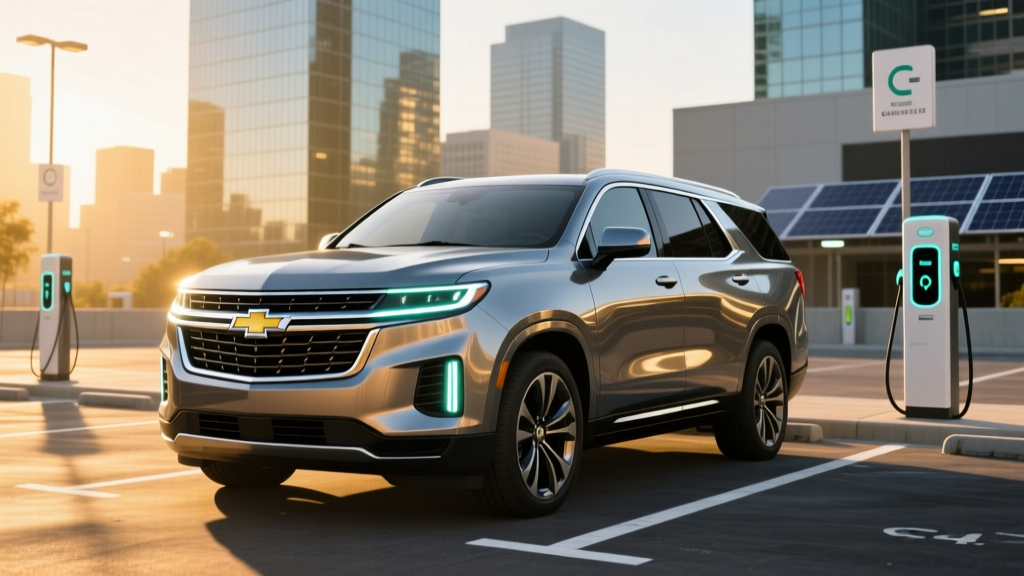
The short answer: As of early 2026, Chevrolet has not yet released a fully electric Tahoe. GM has confirmed that an electric full-size SUV built on the BT1 (Silverado EV-derived) platform is in development, and industry reporting points to a late-2026 or 2027 model-year debut. If you need a three-row electric SUV today, the closest GM option is the Chevrolet Equinox EV (up to 319 miles EPA) or the Cadillac Escalade IQ (announced, ~460 miles target range). Below is everything confirmed, estimated, and worth watching — plus a cost comparison against the current gas Tahoe so you can plan your next move.
What GM Has Actually Said About an Electric Tahoe
General Motors has been publicly committed to an all-electric lineup by 2035, and the full-size SUV segment — Tahoe, Suburban, and their GMC and Cadillac siblings — represents some of the brand's highest-margin vehicles. In earnings calls throughout 2024 and 2025, GM executives confirmed that the BT1 body-on-frame EV platform (which underpins the Silverado EV) will eventually support SUV derivatives.
However, GM has not published an official spec sheet, MSRP, or release date for a Chevy Tahoe electric variant. What follows is a synthesis of confirmed platform data from the Silverado EV and Escalade IQ, plus reasonable projections based on the physics of a vehicle in this weight class.
Projected Specs: What a Battery-Electric Tahoe Could Look Like
Using the Silverado EV (available with up to a ~200 kWh Ultium battery pack and 440 miles of EPA range in the 4WT long-range work truck trim) and the Cadillac Escalade IQ (~200+ kWh pack, ~460 miles targeted) as benchmarks, we can build an educated estimate for a Tahoe EV:
| Attribute | Projected / Estimated | Basis |
|---|---|---|
| Battery capacity (usable) | ~175–200 kWh | Silverado EV / Escalade IQ packs |
| Battery chemistry | NMC (Ultium pouch cells) | All current Ultium-based EVs |
| EPA range (target) | ~350–400 miles | Heavier, less aero than Silverado EV |
| Peak DC fast-charge rate | ~350 kW (800V architecture) | Escalade IQ / Silverado EV capability |
| 10–80% DC charge time | ~20–25 minutes (projected) | Based on 350 kW peak + taper curve |
| Level 2 charge rate | ~11.5–19.2 kW (AC) | Silverado EV dual-level charger |
| 0–60 mph | ~4.5–5.5 seconds (est. AWD) | Comparable Ultium AWD outputs |
| Horsepower | ~500–750 hp (trim dependent) | Silverado EV ranges 510–754 hp |
| Towing capacity | ~8,000–10,000 lbs (est.) | Silverado EV max ~13,000 lbs |
| Seating | 7–8 passengers, 3 rows | Current Tahoe configuration |
| Estimated starting MSRP | ~$80,000–$90,000 | Between Equinox EV and Escalade IQ |
Important caveat: These are projections, not manufacturer-confirmed figures. A production Tahoe EV's aerodynamic profile (taller, boxier than the Silverado EV) and curb weight (likely 8,500+ lbs) will reduce efficiency compared to the pickup. Expect real-world highway range to land 10–15% below the EPA sticker — meaning a 380-mile EPA rating could deliver roughly 320–340 miles at 70 mph in moderate temperatures, and potentially 250–280 miles in sub-freezing winter conditions due to cabin heating demands and battery chemistry limitations.
Electric Tahoe vs. Gas Tahoe: Cost & Capability Comparison
For buyers weighing whether to wait for the electric Tahoe or purchase the current internal-combustion model, here's how the numbers stack up. We're using the 2025/2026 gas Tahoe with the 5.3L V8 as the baseline, sourced from fueleconomy.gov.
| Metric | Gas Tahoe 5.3L V8 (Current) | Projected Tahoe EV |
|---|---|---|
| Starting MSRP | ~$59,000 | ~$80,000–$90,000 (est.) |
| EPA fuel economy / efficiency | 16 city / 20 hwy / 17 combined MPG | ~70–80 MPGe (est.) |
| Energy cost per mile | ~$0.20/mi (at $3.40/gal) | ~$0.05–$0.07/mi (home L2, $0.14/kWh) |
| Annual fuel/energy (15,000 mi) | ~$3,000 | ~$750–$1,050 |
| Annual maintenance | ~$600–$900 | ~$200–$400 (no oil, fewer fluids) |
| 5-year fuel + maintenance | ~$18,000–$22,500 | ~$4,750–$7,250 |
| Federal §30D tax credit | None | Up to $7,500 (if eligible — see below) |
| Towing | ~8,200 lbs (5.3L V8) | ~8,000–10,000 lbs (est.) |
| Range / total distance | ~420 miles (24-gal tank) | ~350–400 miles (est. EPA) |
| Refuel / recharge time | ~5 minutes | ~20–25 min (10–80% DC fast) |
5-Year Total Cost of Ownership Snapshot (75,000 miles):
| Category | Gas Tahoe | Projected Tahoe EV |
|---|---|---|
| Purchase price (base) | $59,000 | $85,000 (mid-estimate) |
| Federal tax credit | $0 | –$7,500 (if eligible) |
| Fuel / energy | $15,000 | $4,500 |
| Maintenance | $3,750 | $1,500 |
| Insurance (est. avg) | $9,000 | $10,500 (EVs typically 10–15% higher) |
| 5-Year Total | ~$86,750 | ~$94,000 |
Note: Depreciation, state incentives, and local electricity rates will shift these figures. The EV closes the gap significantly if you can charge primarily at home on off-peak rates and if the §30D credit applies.
Federal Tax Credit: Will the Tahoe EV Qualify for §30D?
The IRS §30D Clean Vehicle Credit offers up to $7,500 for qualifying new EVs, but eligibility depends on several requirements that change regularly:
- MSRP cap: SUVs must have an MSRP at or below $80,000. A base Tahoe EV near $80,000 could qualify, but higher trims (Premier, High Country) likely will not.
- Buyer income limits: Modified adjusted gross income cannot exceed $300,000 (joint), $225,000 (head of household), or $150,000 (single).
- Battery component sourcing: A percentage of battery components must be manufactured or assembled in North America, and critical minerals must meet sourcing thresholds — both percentages increase annually.
- Point-of-sale transfer: As of 2024+, buyers can transfer the credit to the dealer at purchase, reducing the sale price directly rather than waiting for a tax refund.
- Final assembly: Vehicle must undergo final assembly in North America (likely satisfied if built at GM's Arlington, TX or Orion, MI plants).
Bottom line: A base-trim Tahoe EV at or under $80,000 MSRP could qualify for the full $7,500 if your income and the battery sourcing rules align. Higher trims almost certainly won't. Consult a tax professional and check the latest IRS guidance before relying on this credit in your budget.
Real-World Ownership: What to Consider Before Waiting
Buying an electric full-size SUV involves practical considerations that go beyond the spec sheet:
Home Charging Is Almost Mandatory
A ~200 kWh battery on Level 1 (120V, ~1.4 kW) would take roughly 140+ hours for a full charge — impractical for daily use. A Level 2 home charger (240V, 11.5–19.2 kW) is essential, charging the pack in roughly 10–17 hours overnight. Installation typically costs $800–$2,500 depending on your electrical panel capacity. Homes with 100-amp panels may need a $1,500–$3,000 service upgrade to 200 amps to support a high-amperage EVSE alongside existing loads.
Cold-Weather Range Loss Is Real
NMC-based Ultium batteries in a large SUV will lose an estimated 20–30% of range in sustained sub-25°F driving, primarily due to cabin heating and reduced battery efficiency. A projected 380-mile EPA range could drop to 260–300 miles in winter. If you live in the upper Midwest or Northeast and regularly drive 200+ miles in winter, plan your routes around DC fast chargers.
Charging Infrastructure for Road Trips
GM has transitioned Ultium-based EVs to the NACS (Tesla-style) connector, giving the Tahoe EV access to Tesla's Supercharger network (now 25,000+ stalls in North America) via native compatibility. Combined with Electrify America, EVgo, and other networks, long-distance travel is increasingly viable — but rural charging deserts remain a concern in parts of the Mountain West, Great Plains, and rural South.
Driving Patterns That Favor EV Ownership
The Tahoe EV will make the most financial sense if you:
- Drive 30–80 miles daily (well within battery range, maximizing fuel savings)
- Have reliable home or workplace Level 2 charging
- Take road trips fewer than 3–4 times per year (minimizing DC fast-charge dependency)
- Live in a state with off-peak electricity rates under $0.12/kWh
Myths vs. Facts: Common Misconceptions About a Full-Size Electric SUV
| Myth | Fact |
|---|---|
| "An electric Tahoe can't tow." | The Silverado EV tows up to 13,000 lbs. A Tahoe EV should manage 8,000–10,000 lbs — comparable to the gas V8. However, towing will cut range by 30–50%, requiring more frequent charge stops on long hauls. |
| "The battery will need replacing in 5 years." | GM's Ultium battery warranty covers 8 years / 100,000 miles against defects and excessive degradation (typically below 70% capacity retention). Real-world data from earlier Ultium vehicles suggests 10–15% degradation over 150,000+ miles with proper charging habits. |
| "Charging takes hours on road trips." | At a 350 kW DC fast charger, a 10–80% session should take roughly 20–25 minutes — comparable to a sit-down meal stop. Charging above 80% slows dramatically (the charge curve taper), so most drivers stop at 80% and resume driving. |
| "I'll save money immediately." | The higher purchase price (~$20,000–$30,000 more than a gas Tahoe) means the break-even point on fuel and maintenance savings is typically 4–6 years at 15,000 miles/year, depending on local electricity rates and whether the $7,500 tax credit applies. |
| "All electric SUVs qualify for the $7,500 tax credit." | The §30D credit has strict MSRP, income, and battery-sourcing requirements. Many EVs — especially higher-trim full-size SUVs — do not qualify. Always verify on the IRS website before purchasing. |
Decision Framework: Should You Wait for the Tahoe EV or Buy Now?
Buy the gas Tahoe now if:
- You need a Tahoe within the next 6–12 months
- You regularly tow heavy loads (boats, campers) over 300+ miles in a single day
- You lack home charging access and can't install a Level 2 charger
- Your budget caps at $60,000–$70,000
- You live in an area with limited public DC fast-charging infrastructure
Wait for the electric Tahoe if:
- Your purchase timeline extends to late 2027 or beyond
- You have (or can install) a Level 2 home charger on a 200-amp panel
- Your daily driving is under 100 miles round-trip, with occasional longer road trips
- You want to eliminate oil changes, transmission fluid, and exhaust maintenance
- You're in a state with strong EV incentives (check your local DMV/energy office) and low electricity rates
- You value instant torque, quiet operation, and the ability to "refuel" at home overnight
Consider an alternative EV now if:
- You want a three-row electric SUV today: the Rivian R1S (up to ~410 miles EPA, ~$79,900), Kia EV9 (up to ~304 miles EPA, ~$54,900), or the upcoming Cadillac Escalade IQ (~460 miles targeted, ~$130,000+) are available or imminent
- A plug-in hybrid could bridge the gap: no current Tahoe PHEV exists, but the Jeep Grand Wagoneer and other full-size PHEVs offer partial electrification
Frequently Asked Questions
Is there a Chevy Tahoe EV available to buy in 2026?
No. As of early 2026, Chevrolet has not released or opened reservations for an electric Tahoe. GM has confirmed the BT1 platform will support full-size SUVs, but no production date, pricing, or spec sheet has been published.
Will the electric Tahoe use the same Ultium battery as the Silverado EV?
Very likely, yes. The Ultium platform is GM's modular battery architecture used across the Silverado EV, Blazer EV, Equinox EV, Cadillac Lyriq, and Escalade IQ. A Tahoe EV would almost certainly share battery modules, motors, and the 800V charging architecture.
How much will the Chevy Tahoe EV cost?
No official pricing exists. Based on the Silverado EV's pricing ($55,000–$90,000+ depending on trim) and the Escalade IQ's expected starting price above $130,000, a reasonable estimate for a base Tahoe EV is $80,000–$90,000. This would place it at or near the IRS §30D MSRP cap of $80,000 for SUVs.
Will the Tahoe EV have three rows and seat seven or eight?
GM has not confirmed seating details, but the current gas Tahoe offers 7- and 8-passenger configurations across trims. A body-on-frame EV variant built on the BT1 platform should have similar interior volume, though battery packaging under the floor may slightly affect floor height and third-row headroom.
Can I charge a Tahoe EV at home?
Yes, but you'll need a Level 2 (240V) home charger for practical daily use. A ~200 kWh battery will require 10–17 hours on a Level 2 charger for a full charge. Most owners charge partially each night rather than from 0–100%. Ensure your home has a 200-amp electrical panel; older homes with 100-amp service may need an upgrade costing $1,500–$3,000.
How will towing affect the Tahoe EV's range?
Towing a 5,000–8,000 lb trailer is expected to reduce range by 30–50%, similar to how the Silverado EV and Rivian R1T lose range under load. If the Tahoe EV achieves ~380 miles EPA unloaded, expect roughly 190–265 miles while towing, depending on trailer weight, terrain, speed, and temperature. Plan charge stops accordingly for long towing trips.
What's the best full-size electric SUV I can buy right now?
If you need three rows and electric drivetrain today, the Rivian R1S (Dual-Motor, up to ~410 miles EPA, starting ~$79,900) is the most capable option. The Kia EV9 (~304 miles, ~$54,900) offers a more affordable entry point with slightly less range and towing capacity. The Cadillac Escalade IQ is expected to begin deliveries in 2026 for buyers wanting a luxury-tier full-size EV.