Quick Verdict: The Silverado EV Is a Tow-First Electric Truck
The 2026 Chevrolet Silverado EV was engineered around one headline number: 12,500 pounds of maximum towing capacity on the WT (Work Truck) trim. That figure places it at the top of the current electric pickup segment, edging past the Ford F-150 Lightning's 10,000-pound max and the Rivian R1T's 11,000-pound rating. But towing is only part of the equation for a full-size electric truck that starts above $55,000 and stretches past $95,000 at the top trim. This review breaks down real-world range when hauling, charging logistics on job sites and highways, total cost after federal incentives, and whether the Silverado EV's Ultium platform delivers where it counts.
For 2026, Chevrolet offers the Silverado EV in four core configurations: the fleet-oriented WT, the well-equipped LT, the off-road-leaning Trail Boss, and the luxury-performance RST. Each carries a different battery size, motor tune, and tow rating. If you're cross-shopping the Chevy Silverado EV configurator or weighing it against the Lightning and R1T, here are the exact numbers you need.
Spec Sheet: Silverado EV Trims at a Glance
| Spec | WT (4WT) | LT | Trail Boss | RST |
|---|---|---|---|---|
| EPA Range | 390 mi | 380 mi | 360 mi (est.) | 440 mi |
| Battery (usable) | ~200 kWh (NMC) | ~200 kWh (NMC) | ~200 kWh (NMC) | ~240 kWh (NMC) |
| Max Tow Capacity | 12,500 lbs | 10,200 lbs | 10,200 lbs | 10,000 lbs |
| Payload | 1,800 lbs | 1,600 lbs | 1,600 lbs | 1,300 lbs |
| Horsepower | 510 hp | 645 hp | 645 hp | 754 hp |
| 0-60 mph | ~5.9 sec | ~4.5 sec | ~4.5 sec | ~3.8 sec |
| Drivetrain | Dual-motor AWD | Dual-motor AWD | Dual-motor AWD | Dual-motor AWD |
| Max DC Charge | 200 kW | 350 kW | 350 kW | 350 kW |
| 10-80% DC Time | ~48 min | ~20 min | ~20 min | ~25 min |
| Base MSRP | $55,000 | $72,300 | $78,500 | $94,500 |
Note: Trail Boss specs are preliminary for the 2026 model year based on GM's announced powertrain details. RST uses the larger Ultium pack. Tow ratings require the available Max Tow package and proper equipment. Source: Chevrolet.
Real-World Range: What the EPA Number Doesn't Tell You
EPA Sticker: Up to 440 miles (RST), 390 miles (WT)
Real-World Expectation: 320-370 miles highway (unloaded); 150-200 miles when towing at max capacity; 20-30% loss in sub-30°F conditions.
The Silverado EV's headline range figures are impressive on paper — the RST's 440-mile EPA estimate is among the highest of any production electric vehicle sold in the U.S. But physics governs electric trucks the same way it governs diesel ones: aerodynamic drag, rolling resistance, and gross combined weight all consume energy.
On a flat, 70-mph highway loop in moderate temperatures (65-75°F), expect the WT to deliver roughly 340-360 miles unloaded — about 8-12% below its EPA sticker. The RST, despite its larger pack, suffers from 24-inch wheel options and a wider tire contact patch, so real-world highway range lands closer to 370-390 miles. City driving with regenerative braking recapture pushes efficiency higher, often meeting or slightly exceeding EPA estimates.
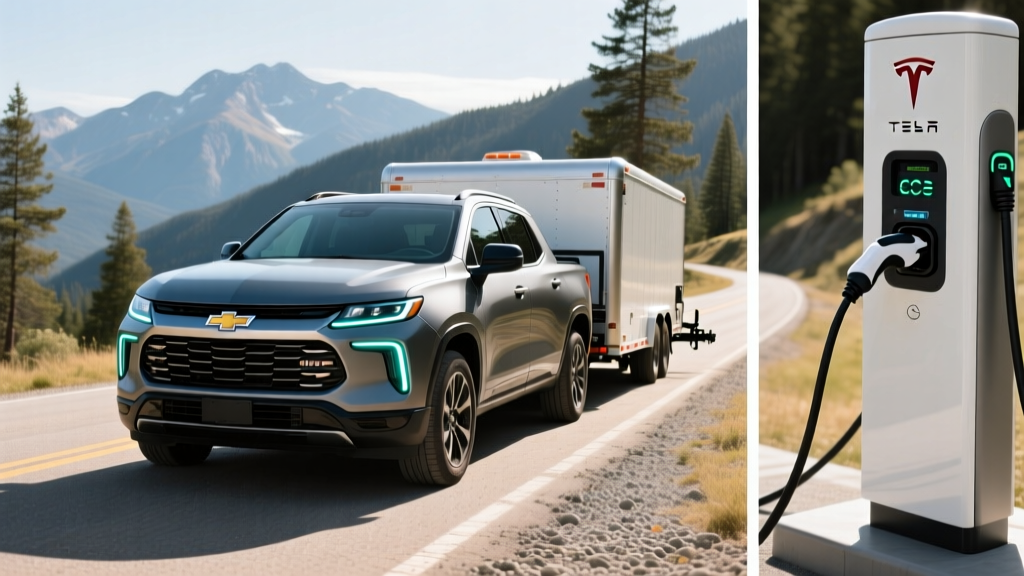
Towing is where range collapses. Pulling a 7,000-pound enclosed trailer at highway speeds cuts effective range roughly in half across all trims. At the WT's max 12,500-pound rating, plan for 150-180 miles of range on a flat route in mild weather, and potentially less with headwinds or elevation gain. This isn't a Silverado EV flaw — it's the thermodynamic reality of moving 17,000+ pounds of combined vehicle and trailer weight. The Ford F-150 Lightning and Rivian R1T exhibit nearly identical range loss under equivalent loads.
Cold weather compounds the problem. GM's Ultium platform uses a liquid thermal management system with battery preconditioning, but in sustained sub-freezing temperatures, expect a 20-30% range reduction even without towing. Preconditioning the battery while plugged in (via the myChevrolet app) mitigates this substantially and is essential for preserving DC fast-charge speeds in winter.
According to fueleconomy.gov, the Silverado EV WT achieves approximately 57 MPGe combined (roughly 59 kWh/100 mi), while the RST lands around 61 MPGe combined (54 kWh/100 mi) thanks to its larger battery spreading fixed losses over more capacity.
Charging Speed: DC Fast, Level 2, and the 800-Volt Advantage
Chevrolet equips the Silverado EV LT, Trail Boss, and RST with an 800-volt architecture capable of accepting up to 350 kW at compatible DC fast chargers. The WT uses a 400-volt system capped at 200 kW. This distinction matters enormously for road-trip downtime and job-site turnaround.
| Charging Level | Power | Speed (Approx.) | Notes |
|---|---|---|---|
| Level 1 (120V) | 1.4 kW | ~3-4 mi/hr | Emergency/trickle only |
| Level 2 (240V, 48A) | 11.5 kW | ~27-31 mi/hr | Standard home charging; full charge in 17-22 hr |
| Level 2 (240V, 80A) | 19.2 kW | ~45-52 mi/hr | Available with upgraded home charger; full charge in 10-13 hr |
| DC Fast (WT, 400V) | 200 kW peak | 10-80% in ~48 min | Sustained rate tapers after 60% SoC |
| DC Fast (LT/TB/RST, 800V) | 350 kW peak | 10-80% in ~20-25 min | Peak rate held briefly; tapers significantly above 80% |
A few practical notes on the charge curve: the 800V trims hit peak 350 kW only between roughly 10-30% state of charge. By 50% SoC, the rate drops to approximately 200-230 kW, and above 80% it slows dramatically to protect battery longevity — a universal lithium-ion behavior, not a Silverado-specific limitation. This is why the 10-80% metric is the industry standard for comparing fast-charge capability.
For home charging, most Silverado EV owners will install a Level 2 wall connector on a 60-amp circuit (delivering 48 amps continuous). At 11.5 kW, the WT's ~200 kWh pack charges from empty to full in roughly 17 hours — fine for overnight replenishment of daily driving. If you opt for an 80-amp circuit and a 19.2 kW capable charger (requires hardwiring and a 100-amp breaker), you cut that to about 10-11 hours. Most daily driving of 60-80 miles requires only 2-3 hours of Level 2 charging.
GM's partnership with EVgo and access to the Tesla Supercharger network (via the included NACS adapter on 2026 models) gives Silverado EV owners access to over 40,000 DC fast chargers nationwide. However, many existing 150 kW stations won't unlock the full 350 kW capability — you'll need a CCS or NACS station rated at 350 kW to see peak speeds.
Towing Deep Dive: Chevy Silverado EV Tow Capacity by Trim
The Silverado EV's tow rating varies significantly by trim, and understanding why requires looking at the interplay between battery weight, motor output, and chassis tuning.
WT (12,500 lbs max): The Work Truck achieves its segment-leading rating with the standard ~200 kWh pack, dual-motor AWD, and the available Max Tow package. The WT's lower horsepower (510 hp) is offset by massive low-end electric torque and a stiffer rear suspension tune optimized for heavy tongue weights. This trim targets fleet buyers, contractors, and agricultural users who need maximum pull and don't require luxury features.
LT and Trail Boss (10,200 lbs max): Both trims use the same ~200 kWh battery and 645 hp dual-motor setup but carry additional comfort and technology weight. The 10,200-pound rating still outpaces the F-150 Lightning's Extended Range max tow rating of 10,000 pounds and covers most boat trailers, car haulers, and mid-size campers.
RST (10,000 lbs max): Despite its larger ~240 kWh battery and 754 hp, the RST's tow rating is actually the lowest in the lineup. The larger battery pack adds roughly 400-500 pounds of curb weight, which eats into the Gross Combined Weight Rating (GCWR) available for trailer weight. The RST is positioned as a performance/luxury truck first, tow vehicle second.
All trims include GM's Trailering App with trailer light diagnostics, tire pressure monitoring integration, and a hitch-view camera. The available Super Cruise driver-assistance system (SAE Level 2 — driver must remain attentive) works on over 750,000 miles of mapped roads and supports trailer-towing mode, which adjusts following distance and braking calibration.
Pricing, Trims, and Federal Tax Credit Eligibility
| Trim | Base MSRP | As-Tested (Typical) | §30D Credit Eligible? |
|---|---|---|---|
| WT (4WT) | $55,000 | $60,000-$65,000 | Likely — under $80k MSRP cap |
| LT | $72,300 | $78,000-$85,000 | Likely — under $80k MSRP cap |
| Trail Boss | $78,500 | $85,000-$90,000 | Borderline — check final MSRP |
| RST | $94,500 | $98,000-$105,000 | No — exceeds $80k MSRP cap |
The IRS §30D federal tax credit provides up to $7,500 for qualifying new EVs, but eligibility hinges on three factors that eliminate many expensive trucks:
- MSRP cap: Pickup trucks must have a base MSRP at or below $80,000. This immediately disqualifies the RST and heavily optioned Trail Boss builds.
- Income cap: Buyer modified adjusted gross income must not exceed $150,000 (single), $225,000 (head of household), or $300,000 (joint filing).
- Battery sourcing: A percentage of critical minerals and battery components must be sourced from the U.S. or free-trade-agreement countries. GM has worked to qualify Ultium batteries, but the exact credit amount ($3,750 or $7,500) depends on current-year sourcing thresholds.
For 2026, the WT and LT trims are the strongest candidates for the full $7,500 credit, potentially bringing the WT's effective price to approximately $47,500. The credit can be transferred to the dealer at point of sale as a purchase-price reduction, so you don't need to wait until tax filing. Always verify eligibility with your tax professional and the dealer's credit-verification tool at the time of purchase — sourcing requirements tighten annually.
Battery, Warranty, and Long-Term Durability
The Silverado EV uses GM's Ultium platform with NMC (nickel manganese cobalt) lithium-ion pouch cells manufactured at the Ultium Cells joint-venture plants in Ohio and Tennessee. The WT, LT, and Trail Boss carry approximately 200 kWh of usable capacity, while the RST steps up to roughly 240 kWh — among the largest production EV batteries ever sold.
GM provides an 8-year/100,000-mile battery and powertrain warranty covering defects and capacity loss below a stated threshold (typically 60-70% state of health retention, per GM's warranty documentation). The bumper-to-bumper warranty covers 3 years/36,000 miles.
NMC chemistry offers higher energy density than LFP (lithium iron phosphate), enabling the Silverado EV's long range in a package that still fits within a full-size truck frame. The trade-off is slightly faster degradation over time compared to LFP — expect roughly 10-15% capacity loss over 150,000 miles based on industry data from similar Ultium and BEV3-platform vehicles. GM's thermal management system actively cools and heats the pack to mitigate this, and real-world degradation data from early Ultium vehicles (Cadillac Lyriq, GMC Hummer EV) suggests the warranty threshold is conservative.
For fleet buyers concerned about long-term battery replacement cost, GM has not published official out-of-warranty pricing, but industry estimates for a pack of this size range from $25,000 to $40,000 — a significant consideration for high-mileage commercial use beyond the warranty period.
Interior, Cargo, and Technology
The Silverado EV's interior varies dramatically by trim. The WT is spartan and fleet-ready with rubberized flooring, vinyl seats, and a 7-inch infotainment screen. The LT upgrades to an 11-inch touchscreen with wireless Apple CarPlay and Android Auto, heated front seats, and cloth/leatherette upholstery. The RST goes full luxury with a 17-inch portrait touchscreen, genuine leather, ventilated seats, a head-up display, and a premium Bose audio system.
Cargo and storage highlights:
- Bed: 5-foot-11-inch bed (standard across trims) with Multi-Flex tailgate and available power-operated tonneau cover
- Frunk (eTrunk): Approximately 10.2 cubic feet of lockable front trunk space — enough for tools, charging cables, or a week's groceries
- Passenger space: Crew cab configuration with approximately 43.4 inches of rear legroom
- Towing tech: Integrated trailer brake controller, hitch-view camera, trailer tire-pressure monitoring
Driver assistance (SAE Level 2): Super Cruise is available on LT and standard on RST, enabling hands-free driving on compatible highways with the driver's eyes monitored by a camera on the steering column. This is not autonomous driving — the driver must remain alert and ready to take over. The Trail Boss includes a Terrain Mode calibrated for low-speed off-road crawling.
Silverado EV vs. the Competition
The electric truck market in 2026 has three serious full-size contenders. Here's how they stack up on the metrics that matter to truck buyers:
| Metric | Silverado EV WT | F-150 Lightning (Ext. Range) | Rivian R1T (Dual-Motor Max) |
|---|---|---|---|
| Max Tow | 12,500 lbs | 10,000 lbs | 11,000 lbs |
| EPA Range | 390 mi | 320 mi | 410 mi |
| Battery | ~200 kWh NMC | ~131 kWh NMC | ~149 kWh NMC |
| Peak DC Charge | 200 kW | 150 kW | 220 kW |
| Starting MSRP | $55,000 | $62,995 | $79,900 |
The Silverado EV wins on tow capacity and starting price. The F-150 Lightning offers the most established dealer network and the Pro Power Onboard feature (vehicle-to-load power for job sites). The R1T delivers the most range, the most refined ride quality, and a 4-motor option for off-road enthusiasts — but at a significantly higher price with no federal tax credit eligibility due to its MSRP.
Pros and Cons
Pros
- Segment-leading 12,500-lb tow rating (WT)
- Massive battery delivers genuine 350+ mile real-world range (unloaded)
- 800V charging on LT/TB/RST enables 20-minute 10-80% fills
- WT pricing eligible for $7,500 federal credit
- Huge eTrunk and Multi-Flex tailgate for cargo versatility
- Super Cruise hands-free driving with trailer support
Cons
- Towing cuts range to 150-180 miles — requires careful route planning
- WT's 200 kW max charge rate is slow for a 200 kWh pack
- RST exceeds $80k MSRP cap — no federal tax credit
- Enormous curb weight (over 8,500 lbs) affects tire wear and efficiency
- Cold-weather range loss of 20-30% compounds towing limitations
- No LFP battery option for buyers prioritizing cycle-life longevity
Who Should Buy the Chevy Silverado EV?
Choose the Silverado EV WT if: You need maximum tow capacity for work applications, can charge at a depot or home overnight, and want the lowest entry price in a full-size electric truck with tax-credit eligibility.
Choose the Silverado EV LT if: You want a balance of tow capability, comfort features, and 350 kW fast charging for road trips, and your build stays under the $80,000 MSRP cap.
Choose the RST if: Budget is not a primary concern, you want the longest range and quickest acceleration in an electric truck, and you accept that the $94,500+ price excludes you from the federal credit.
Look elsewhere if: You regularly tow heavy loads over 200+ mile routes without access to DC fast charging along the way — no current electric truck handles that use case without significant downtime.
Frequently Asked Questions
What is the real-world range of the Chevy Silverado EV?
Unloaded, expect 340-390 miles on the highway depending on trim and conditions — roughly 8-12% below EPA estimates. When towing near max capacity, range drops to 150-180 miles. Cold weather (below 30°F) reduces range by an additional 20-30%.
How fast does the Silverado EV charge at home and on the road?
At home on a standard 48-amp Level 2 charger, expect about 27-31 miles of range per hour of charging. On a 350 kW DC fast charger (LT, Trail Boss, RST), the 10-80% fill takes approximately 20-25 minutes. The WT, limited to 200 kW, takes about 48 minutes for the same 10-80% session.
How much does the Silverado EV cost after the federal tax credit?
The WT starts at $55,000 MSRP and is likely eligible for the full $7,500 §30D credit, bringing the effective price to approximately $47,500. The LT at $72,300 also likely qualifies. The RST at $94,500 exceeds the IRS $80,000 MSRP cap for pickups and does not qualify. Always verify current-year sourcing and income requirements with your tax professional.
Is the Silverado EV worth buying over the F-150 Lightning or Rivian R1T?
If tow capacity is your top priority, the Silverado EV WT's 12,500-pound rating is best in class. If you value charging infrastructure and job-site power output, the F-150 Lightning's Pro Power Onboard and Ford's dealer network are compelling. If range, refinement, and off-road capability matter most and budget allows, the Rivian R1T is the most well-rounded package — but costs significantly more.
Does the Silverado EV qualify for the federal EV tax credit?
The WT and LT trims are strong candidates for the up-to-$7,500 §30D credit, provided the buyer meets income caps ($150k single / $300k joint) and the vehicle's battery meets current-year critical-mineral and component-sourcing thresholds. The RST does not qualify due to its MSRP exceeding $80,000. Check the IRS Clean Vehicle Provisions page and your dealer's point-of-sale credit tool before purchasing.
What is the Chevy Silverado EV tow capacity on each trim?
The WT leads at 12,500 pounds with the Max Tow package. The LT and Trail Boss are rated at 10,200 pounds. The RST is rated at 10,000 pounds. All ratings require proper equipment and are subject to the vehicle's GCWR — actual tow capacity may be lower with heavy passenger or bed cargo loads.
How long will the Silverado EV battery last?
GM warranties the Ultium battery for 8 years or 100,000 miles against defects and excessive capacity loss. Based on NMC chemistry data from similar platforms, expect 10-15% degradation over 150,000 miles under normal use. Fleet buyers running high annual mileage should budget for potential out-of-warranty replacement costs of $25,000-$40,000 beyond the warranty period.