Quick Answer: Is the Chevy Silverado EV Right for Logan Drivers?
The 2026 Chevy Silverado EV delivers an EPA-estimated 390 miles of range (4WT trim with the larger pack), a peak DC fast-charge rate of 350 kW (10–80% in roughly 20 minutes under ideal conditions), and starts around $57,400 before incentives. For Logan, Utah buyers, the key realities are: winter temperatures regularly dip below freezing, which can reduce real-world range by 15–30%; home Level 2 charging is essential given limited public fast-charging infrastructure in Cache Valley; and the Silverado EV qualifies for varying federal tax credit amounts depending on battery-sourcing compliance and your income. Compared to a gas Silverado 1500, expect to save $1,200–$1,800 annually on fuel at Utah's electricity rates, but pay more upfront and face higher insurance premiums.
The Silverado EV Lineup: Specs That Matter for Real Buyers
Chevrolet offers the 2026 Silverado EV across multiple trims, all built on GM's Ultium platform with nickel-manganese-cobalt (NMC) lithium-ion battery packs. Here's what the current lineup looks like with hard numbers:
| Trim | Battery (usable kWh) | EPA Range | Peak DC Charge (kW) | 10–80% Time | Horsepower | 0–60 mph | MSRP |
|---|---|---|---|---|---|---|---|
| 4WT Standard Range | ~170 kWh (est.) | ~260 mi | 200 kW | ~28 min | 510 hp | ~5.5 sec | $57,400 |
| 4WT Extended Range | ~200 kWh (est.) | ~390 mi | 350 kW | ~20 min | 510 hp | ~5.3 sec | $67,900 |
| RST First Edition | ~200 kWh (est.) | ~440 mi | 350 kW | ~20 min | 754 hp | ~4.5 sec | $94,500 |
| Trail Boss | ~200 kWh (est.) | ~380 mi | 350 kW | ~22 min | 655 hp | ~4.8 sec | $78,900 |
All trims include the NACS (North American Charging Standard) connector, giving Silverado EV owners native access to Tesla Supercharger V3 and V4 stations without an adapter — a significant advantage for road-trip charging reliability across the Intermountain West. Towing capacity maxes out at 12,500 lbs when properly equipped, though towing will slash range by 40–50% based on trailer weight and speed.
Real-World Range vs. EPA Sticker: What Logan Drivers Actually Get
The EPA-estimated 390-mile figure for the Extended Range 4WT assumes moderate temperatures and mixed driving. In Logan's climate, expect these adjustments:
- Spring/Fall (50–70°F): ~350–380 miles highway at 65–70 mph
- Summer (90°F+): ~340–370 miles (A/C load reduces efficiency slightly)
- Winter (20–35°F): ~270–320 miles — cold reduces battery chemistry efficiency and cabin heating draws significant energy
- Deep winter (below 15°F): ~240–290 miles without preconditioning
The Silverado EV's heat pump (standard on higher trims) mitigates some winter losses, but battery chemistry simply performs worse in cold. Preconditioning the battery while plugged in — using the myChevrolet app before your morning commute — recovers a meaningful portion of that loss.
EV vs Gas Silverado: The Numbers Behind the Switch
The decision between a Silverado EV and a conventional Silverado 1500 with the 5.3L V8 or 2.7L turbo comes down to your driving patterns and how you value upfront cost versus long-term savings. Here's a data-driven comparison using Utah-specific fuel and electricity pricing:
| Metric | Silverado EV 4WT Ext. Range | Silverado 1500 5.3L V8 (Gas) |
|---|---|---|
| MSRP (base) | $67,900 | $43,200 |
| Federal Tax Credit (§30D) | Up to $7,500 (see eligibility below) | $0 |
| Effective Purchase Price | ~$60,400 | $43,200 |
| Energy Cost per Mile (UT avg) | ~$0.045/mi (home L2) / $0.12/mi (DC fast) | ~$0.18/mi (gasoline at $3.40/gal, 19 MPG combined) |
| Annual Fuel/Energy (15,000 mi) | $675 (home) / $1,800 (DC fast) | $2,700 |
| Annual Maintenance | ~$300 (tire rotation, cabin filter, wiper fluid) | ~$900 (oil, filters, brakes, transmission fluid) |
| 5-Year Energy + Maintenance | $4,875–$10,500 | $18,000 |
| EPA Efficiency | 62 MPGe / 34 kWh/100mi | 19 MPG combined |
| Insurance (annual avg, UT) | ~$2,400 | ~$1,800 |
The Silverado EV saves roughly $1,200–$1,800 per year on energy and maintenance when charging primarily at home. Over five years, that's $6,000–$9,000 in operational savings — but the effective purchase price remains $17,000+ higher even after the tax credit. The break-even point lands around 8–12 years for most drivers, depending on annual mileage and electricity rates.
Charging at Home in Logan: What You Need to Know
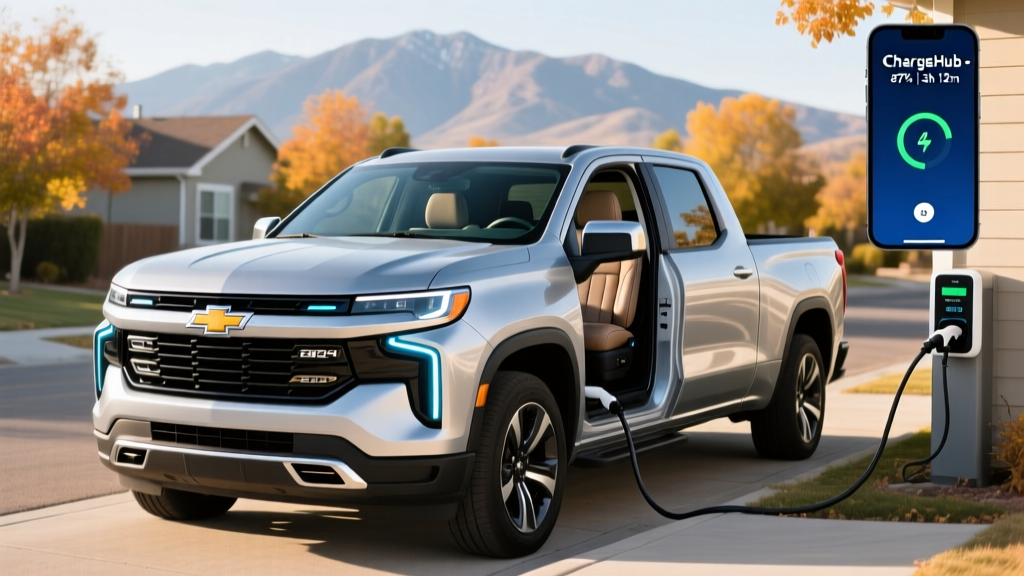
Home charging is the backbone of practical EV truck ownership. The Silverado EV accepts up to 19.2 kW on Level 2 AC charging, which is among the fastest in the EV truck segment. Here's what installation actually costs and delivers:
| Charging Level | Power (kW) | Miles Added/Hour | Full Charge Time (200 kWh) | Install Cost |
|---|---|---|---|---|
| Level 1 (120V outlet) | 1.4 kW | ~4 mi/hr | ~140 hours | $0 (existing outlet) |
| Level 2 (240V, 32A) | 7.7 kW | ~22 mi/hr | ~26 hours | $800–$1,500 |
| Level 2 (240V, 48A) | 11.5 kW | ~33 mi/hr | ~17 hours | $1,200–$2,200 |
| Level 2 (240V, 80A) | 19.2 kW | ~55 mi/hr | ~10 hours | $2,000–$3,500 |
Logan-specific installation considerations:
- Electrical panel capacity: Many Logan homes built before 2000 have 100-amp panels. A 48A or 80A EV charger circuit may require a panel upgrade to 200 amps, adding $1,500–$3,000 to your installation cost. Always get a licensed electrician's assessment first.
- Rocky Mountain Power rates: Utah's average residential rate sits around $0.10/kWh, making home charging extremely cost-effective. Time-of-use plans (if available) can drop overnight rates further.
- Cold-weather charging: In sub-freezing temperatures, the Silverado EV's battery management system will warm the pack before accepting a full charge rate. Plug in and use scheduled charging or preconditioning to avoid slow morning starts.
For a truck with a 200 kWh battery, a 48A Level 2 charger is the practical minimum — it adds roughly 33 miles of range per hour, meaning an overnight charge (10 hours) restores about 330 miles. That covers nearly all daily driving and towing needs in Cache Valley.
Federal Tax Credit Eligibility: Don't Assume You Get $7,500
The §30D Clean Vehicle Credit is not automatic. For the 2026 tax year, eligibility depends on several factors that interact:
- Buyer income cap: Modified adjusted gross income (MAGI) must not exceed $150,000 (single), $225,000 (head of household), or $300,000 (joint filing) — per IRS §30D guidelines.
- MSRP cap: Vans, SUVs, and pickup trucks are capped at $80,000 MSRP. The Silverado EV RST First Edition ($94,500) does NOT qualify. The 4WT Extended Range ($67,900) and Trail Boss ($78,900) fall under the cap.
- Battery sourcing: The credit splits into two $3,750 halves — one for critical minerals sourcing and one for battery component manufacturing. GM's Ultium batteries are assembled in the U.S., but critical mineral compliance varies by model year and supply chain changes. The credit amount may be $3,750, $7,500, or $0 depending on current sourcing rules.
- Point-of-sale transfer: You can transfer the credit to the dealer at purchase to reduce your out-of-pocket cost immediately, rather than waiting to claim it on your tax return.
- Final assembly: The Silverado EV is assembled at GM's Factory ZERO in Detroit-Hamtramck, satisfying the North American final assembly requirement.
Always verify current credit eligibility on fueleconomy.gov before purchasing, as battery-sourcing rules have changed multiple times since 2023 and may shift again.
Public Charging Reality: Road Trips From Logan
Cache Valley's public charging infrastructure is improving but remains thin compared to urban corridors. Here's the practical picture:
- In Logan: A handful of Level 2 public chargers exist (ChargePoint, EVgo locations), but DC fast chargers within city limits are limited as of early 2026. Plan on home charging for daily use.
- I-15 corridor: Heading south toward Salt Lake City or north toward Idaho, Tesla Supercharger stations (now NACS-open) and Electrify America locations provide 150–350 kW DC fast charging. The Silverado EV can add ~200 miles in 15 minutes at a 350 kW station.
- Charging curve reality: The Silverado EV's 350 kW peak rate only sustains between roughly 10–30% SoC. Above 50%, charge speed tapers to 150–200 kW. Above 80%, it drops further to protect battery longevity. Plan road-trip stops around 10–80% charges, not 0–100%.
- Cold-weather DC charging: In winter, a cold battery will charge significantly slower until the thermal management system warms it. Use navigation-based preconditioning (enter your charging destination in the infotainment system) so the truck warms the pack en route.
Common Misconceptions About the Silverado EV
| Myth | Fact |
|---|---|
| "The battery will need replacing in 5 years" | GM warranties the Ultium battery for 8 years/100,000 miles with a minimum 70% capacity retention threshold. Real-world data from GM's Bolt EV fleet shows ~5–8% degradation at 100,000 miles. Full battery replacement costs $15,000–$25,000 out of warranty, but most owners will never need one. |
| "You can't tow with an EV truck" | The Silverado EV is rated for up to 12,500 lbs. However, towing a 7,000-lb trailer at highway speeds will cut range roughly in half. It's viable for short to medium hauls with charging stops planned, but not cross-country towing without significant downtime. |
| "EVs are worse in snow and cold" | The Silverado EV has standard AWD, instant torque (useful for traction), and a low center of gravity from the underfloor battery pack. Range loss is real (15–30%), but the truck performs well mechanically in winter conditions. Preconditioning while plugged in mitigates much of the range penalty. |
| "The tax credit is guaranteed $7,500" | The credit depends on battery sourcing, your income, and the truck's MSRP. It may be $3,750, $7,500, or nothing. Always check current IRS rules before relying on a specific credit amount in your purchase math. |
| "Public charging is too unreliable" | Non-Tesla networks (Electrify America, EVgo) still have variable uptime, but the Silverado EV's native NACS connector opens Tesla's Supercharger network — consistently the most reliable DC fast-charging network in the U.S. with 95%+ uptime. |
Decision Framework: Should You Buy the Silverado EV in Logan?
Choose the Silverado EV if:
- You can install a Level 2 home charger (240V, 48A minimum recommended) — this is non-negotiable for practical truck ownership
- Your daily driving is under 200 miles round-trip (covers ~95% of Cache Valley commutes, including trips to SLC and back)
- You value low operating costs: $0.04–$0.05/mile on home electricity versus $0.18/mile on gasoline
- You want instant torque for off-road or worksite use (the EV's electric motors deliver peak torque from 0 RPM)
- You plan to keep the truck 7+ years, allowing operational savings to offset the higher purchase price
- You qualify for at least $3,750 of the federal tax credit based on income and sourcing rules
Stick with a Gas or Hybrid Silverado if:
- You regularly tow over 8,000 lbs on long routes — range loss makes EV towing impractical for heavy, long-distance hauling
- You live in an apartment or lack access to home/work charging — relying solely on public DC fast charging is expensive ($0.12+/mile) and time-consuming
- Your budget is under $50,000 — the Silverado EV's entry price, even after incentives, remains well above a gas 1500
- You frequently drive remote backcountry roads in deep winter where charging infrastructure is nonexistent and range loss is maximum
- You trade vehicles every 3–4 years — you won't recoup the price premium through fuel savings
Frequently Asked Questions
How much does it cost to charge a Silverado EV at home in Logan, Utah?
At Utah's average residential rate of ~$0.10/kWh, fully charging the 200 kWh Extended Range battery from empty costs roughly $20. For a typical daily commute of 40 miles, you'd use about 14 kWh — roughly $1.40 per day. Over a month, home charging for normal driving costs $40–$60, compared to $200–$250 in gasoline for the same mileage in a gas Silverado.
Does the Silverado EV qualify for the full $7,500 federal tax credit?
It depends on the trim and current battery-sourcing rules. The 4WT trims and Trail Boss fall under the $80,000 MSRP cap for trucks. However, the credit splits into two $3,750 components — battery components and critical minerals — and GM's sourcing compliance can change. Check fueleconomy.gov for the latest eligibility before purchasing. The RST First Edition at $94,500 does not qualify regardless of sourcing.
How does the Silverado EV handle Logan's winters?
Mechanically, it handles winter well — AWD is standard, regenerative braking provides smooth deceleration on slick roads, and the heavy battery pack gives excellent traction. The main impact is range: expect 15–30% loss in sub-freezing temperatures. Preconditioning the battery while plugged in (using the myChevrolet app's scheduled departure feature) warms the pack and cabin using grid power rather than battery power, preserving range for your drive.
Can I use Tesla Superchargers with the Silverado EV?
Yes. The 2026 Silverado EV comes with a native NACS charge port, meaning you can plug directly into Tesla Supercharger V3 (250 kW) and V4 stations without an adapter. This dramatically expands your road-trip charging options along I-15 and across the western U.S. Just use the Tesla app or your vehicle's infotainment system to initiate sessions.
What's the battery warranty, and what does replacement cost?
GM covers the Ultium battery for 8 years or 100,000 miles, whichever comes first, guaranteeing a minimum of 70% original capacity retention. If the battery degrades below that threshold within the warranty period, GM will repair or replace it at no cost. Out-of-warranty replacement is estimated at $15,000–$25,000 depending on pack size, though industry data suggests most EV batteries retain 85–92% capacity at 150,000 miles with normal use.
Is the Silverado EV good for worksite or ranch use around Logan?
For daily worksite commuting and light hauling within a 100-mile radius, the Silverado EV works well — instant torque is excellent for moving loads, the bed is functional (with the available Multi-Flex midgate extending cargo length to over 10 feet), and operating costs are low. For heavy towing to remote sites without charging access, a gas or diesel Silverado remains more practical.