Quick Verdict: The Silverado EV Is a Tech-Forward Workhorse With a Cabin Built for Screens
The 2026 Chevrolet Silverado EV has carved out a distinct identity in the electric truck segment — not as a legacy pickup with a battery strapped in, but as a ground-up EV built on GM's Ultium platform with a cabin that prioritizes digital real estate and modular utility. The headline number remains its available 460-mile EPA-estimated range on the Max Range variant, but it's the Chevy Silverado EV interior — anchored by a massive 17.7-inch infotainment display and a configurable Multi-Flex Midgate — that separates it from the Ford F-150 Lightning and Rivian R1T in daily use.
After spending time with the Silverado EV across multiple trims, the takeaway is clear: this truck works best for buyers who need serious range, appreciate a tech-dense cockpit, and value GM's Super Cruise hands-free driving system for long hauls. It trades some raw off-road capability and compact footprint (the Rivian R1T's forte) for highway comfort, cargo versatility, and class-leading DC fast-charging speeds.
Spec Table: 2026 Chevy Silverado EV at a Glance
| Spec | Standard Range (WT4 / 4WT) | Extended Range (LT) | Max Range (LT / RST) |
|---|---|---|---|
| EPA Range | ~270 mi | ~360 mi | ~460 mi |
| Battery (usable) | ~100 kWh (NMC) | ~150 kWh (NMC) | ~200 kWh (NMC) |
| Drivetrain | Dual-Motor AWD | Dual-Motor AWD | Dual-Motor AWD |
| Horsepower | 510 hp | 645 hp | 754 hp (RST) / 645 hp (LT) |
| 0-60 mph | ~5.5 sec | ~4.5 sec | ~4.2 sec (RST) |
| Max DC Fast Charge | 350 kW | 350 kW | 350 kW |
| 10-80% DCFC Time | ~20 min | ~28 min | ~35 min |
| Level 2 Home Charging | 19.2 kW (~52 mi/hr) | 19.2 kW (~52 mi/hr) | 19.2 kW (~52 mi/hr) |
| Max Towing | 10,000 lbs | 12,500 lbs | 12,500 lbs (up to 14,000 w/ max tow pkg) |
| Base MSRP | ~$55,000 | ~$72,000 | ~$88,000 (RST) |
| EPA Efficiency | ~62 MPGe | ~60 MPGe | ~58 MPGe |
Note: Specs reflect 2026 model-year data from Chevrolet's official Silverado EV configurator and fueleconomy.gov. Exact figures vary by trim and option package.
Inside the Cabin: Screens, Storage, and the Multi-Flex Midgate
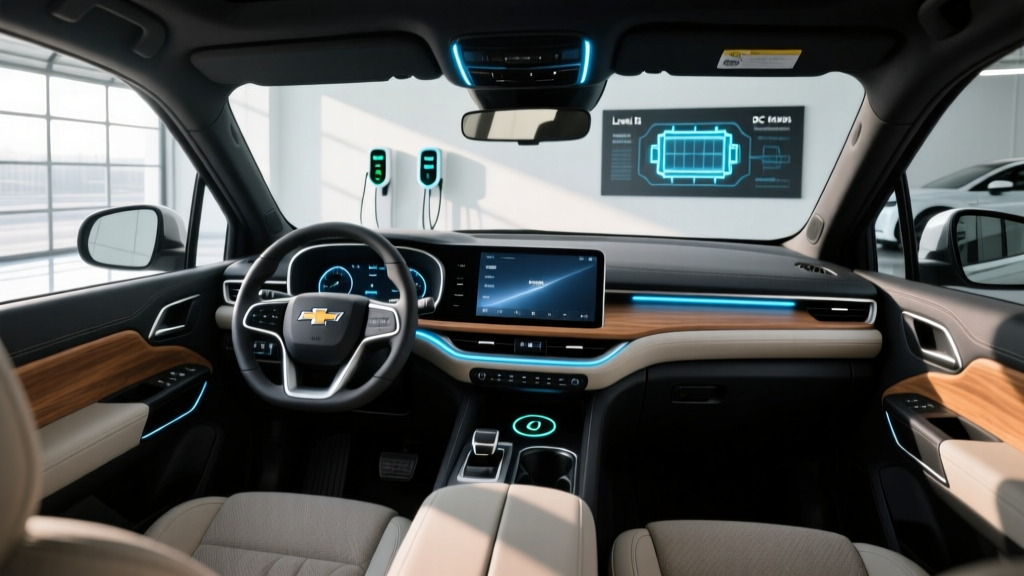
The Chevy Silverado EV interior is dominated by two things: glass and flexibility. The dashboard centers on a portrait-oriented 17.7-inch infotainment touchscreen running GM's latest Ultifi-based software, paired with an 11-inch digital instrument cluster. A head-up display (available on higher trims) projects speed, navigation, and Super Cruise status onto the windshield.
Material quality varies meaningfully by trim. The WT4 work truck uses durable, hard-wearing plastics and vinyl surfaces designed for job-site abuse — wipe-clean floors, rubberized cupholders, and seat fabrics that resist staining. The LT and RST trims step up to perforated leather, soft-touch dash materials, heated and ventilated front seats, and a heated steering wheel. The RST First Edition tops the range with premium leather, a Bose 10-speaker audio system, and ambient interior lighting.
Cargo and Passenger Dimensions
As a crew cab, the Silverado EV offers generous passenger space:
- Front legroom: ~44.5 inches
- Rear legroom: ~43.4 inches
- Front headroom: ~42.3 inches
- Rear headroom: ~40.1 inches
The bed measures approximately 5 feet 11 inches with the tailgate up. However, the Multi-Flex Midgate — a partition between the cabin and bed that folds down — extends the load floor to over 9 feet with the tailgate down, letting you haul lumber, kayaks, or ladders without a trailer. The front trunk (e-trunk or "frunk") provides 10.2 cubic feet of lockable, weather-sealed storage — large enough for a full set of power tools or a week's groceries.
Tech and Driver Assistance
Every Silverado EV comes standard with a Wi-Fi hotspot, wireless Apple CarPlay and Android Auto, and over-the-air update capability. The standout feature is Super Cruise, GM's hands-free Level 2 driver-assistance system, which operates on over 750,000 miles of mapped highways in the US and Canada. Super Cruise includes automatic lane changes on compatible trims and, critically, works while towing — a significant advantage for long-distance haulers.
Super Cruise is a Level 2 driver-assist system. Despite the hands-free operation on mapped roads, the driver must remain attentive and ready to take over at any time. This is not a self-driving (Level 4) system. An infrared camera monitors driver attention and will issue escalating alerts if you look away.
Range and Efficiency: 460 Miles on Paper, Less in the Real World
EPA Estimate: Up to 460 miles (Max Range LT/RST)
Real-World Highway (70 mph): Expect ~370-400 miles
Cold Weather (below 30°F): Expect ~310-350 miles (20-30% reduction)
Towing (5,000+ lb trailer): Expect ~200-250 miles
The 460-mile EPA figure applies to the Max Range variant with its massive ~200 kWh Ultium battery pack. That battery uses NMC (nickel manganese cobalt) chemistry, which offers higher energy density than LFP but requires careful thermal management. GM's battery preconditioning system warms or cools the pack ahead of fast charging or heavy use, but the sheer mass of a 200 kWh pack means you'll notice range loss more acutely in extreme conditions.
The Standard Range models with ~100 kWh packs are more practical for daily commuting and moderate road trips, offering around 270 EPA miles — enough for most workday round-trips with overnight Level 2 charging at home. Efficiency across the lineup hovers around 58-62 MPGe, translating to roughly 48-52 kWh per 100 miles. That's thirstier than a sedan but competitive with the F-150 Lightning and well below the Hummer EV.
Charging Speed: 350 kW Peak, but Watch the Curve
| Charging Level | Power | Miles Added per Hour | Notes |
|---|---|---|---|
| Level 1 (120V household) | ~1.4 kW | ~3 mi/hr | Emergency/top-up only |
| Level 2 (240V home) | Up to 19.2 kW | ~52 mi/hr | Full charge overnight (~10 hrs for Max Range) |
| DC Fast Charge | Up to 350 kW | ~250+ mi/hr (peak) | 10-80% in ~20-35 min depending on pack size |
The Silverado EV supports up to 350 kW DC fast charging on CCS-equipped public chargers (and NACS via adapter as GM transitions to the Tesla connector standard across its 2025+ lineup). On a 350 kW-capable station, the Standard Range pack can add roughly 100 miles in about 10 minutes, while the Max Range pack takes longer due to its larger capacity — expect 10-80% in approximately 35 minutes.
A critical nuance: peak 350 kW is not sustained. Like all EVs, the Silverado follows a charging curve that tapers significantly above 80% state of charge. On the Max Range pack, you'll see peak speeds between roughly 10-50% SoC, after which the rate progressively drops to protect battery health. Plan your road-trip stops to charge from 10% to 80% rather than topping off to 100% — the last 20% can add 20+ minutes at a fast charger.
For home charging, the Silverado EV's onboard charger accepts up to 19.2 kW on Level 2 (requiring a 100-amp dedicated circuit). Most residential installations use a 48-amp or 60-amp circuit delivering 11.5-14.4 kW, which adds 30-39 miles per hour — still sufficient for overnight replenishment. Budget $1,200-$3,000 for a professional Level 2 home charger installation, potentially more if your electrical panel needs an upgrade to 200 amps.
Pricing, Trims, and Federal Tax Credit Eligibility
| Trim | Base MSRP | §30D Credit Potential | Effective Price (est.) |
|---|---|---|---|
| WT4 (Work Truck, Standard Range) | ~$55,000 | Up to $7,500 | ~$47,500 |
| 4WT (Work Truck, Standard Range) | ~$60,000 | Up to $7,500 | ~$52,500 |
| LT (Extended Range) | ~$72,000 | Up to $7,500* | ~$64,500 |
| LT (Max Range) | ~$80,000 | Up to $7,500* | ~$72,500 |
| RST First Edition (Max Range) | ~$88,000+ | Up to $7,500* | ~$80,500 |
*Federal §30D tax credit eligibility is subject to multiple requirements. Consult a tax professional and the IRS clean vehicle credit page for your specific situation.
§30D Tax Credit Checklist (2026 Rules)
- MSRP Cap: Trucks/vans/SUVs must have an MSRP at or below $80,000. The RST First Edition at ~$88,000 may exceed this cap — verify the exact window sticker price.
- Buyer Income Cap: Modified AGI must not exceed $150,000 (single), $225,000 (head of household), or $300,000 (joint filers).
- Battery Sourcing: A percentage of critical minerals and battery components must be sourced from the US or free-trade-agreement countries. GM has worked to qualify Ultium packs, but sourcing rules tighten annually. Confirm current-year compliance on the IRS eligible vehicle list.
- Point-of-Sale Transfer: As of 2024, buyers can transfer the credit to the dealer at purchase, reducing the purchase price directly rather than waiting for a tax refund.
- Assembly: Vehicle must undergo final assembly in North America (the Silverado EV is built at GM's Factory ZERO in Detroit — this requirement is met).
Pros and Cons: What Owners Should Know
✅ Pros
- Class-leading available range (460 mi EPA)
- 350 kW DC fast-charging capability
- Multi-Flex Midgate extends bed to 9+ feet
- Super Cruise hands-free driving (works while towing)
- Massive 10.2 cu ft front trunk (e-trunk)
- 19.2 kW Level 2 onboard charger (fast home charging)
- Up to 14,000 lbs towing with max tow package
❌ Cons
- Max Range trims exceed $80K MSRP cap (credit risk)
- Heavy curb weight (~9,000 lbs) hurts efficiency
- 35+ min 10-80% time on Max Range pack
- Rear visibility compromised by bed height (camera helps)
- WT4 base interior feels utilitarian at this price
- No single-motor/RWD option for lower-cost entry
- Large footprint — tight in urban parking
Who Should Buy the Silverado EV?
🎯 Choose the Silverado EV If:
- You regularly drive 200+ miles one-way and need the longest possible range without stopping
- You tow a boat, camper, or equipment trailer on highway routes and want Super Cruise assistance
- You need the Midgate for hauling long items (lumber, ladders, kayaks) without a trailer
- You can install a Level 2 home charger and charge overnight between workdays
- You value GM's dealer network for service in rural or mid-market areas
Look Elsewhere If:
- You want a compact electric truck for city use → consider the Rivian R1T (smaller footprint, quad-motor performance)
- You need a sub-$50K electric truck → the Ford F-150 Lightning Pro starts lower (though with less range)
- You want the most off-road capability → the Rivian R1T or Chevrolet Colorado ZR2 (ICE) are better suited
- You want LFP battery chemistry for maximum longevity and daily 100% charging → neither the Silverado EV nor its rivals currently offer LFP in the full-size truck segment
Warranty and Long-Term Ownership
GM backs the Silverado EV with a competitive warranty package:
- Battery & Propulsion: 8 years / 100,000 miles (whichever comes first), covering the Ultium battery pack, drive motors, and power electronics. GM warrants the battery will retain at least 70% of its original capacity during this period.
- Bumper-to-Bumper: 3 years / 36,000 miles
- Powertrain (non-EV components): 5 years / 60,000 miles
- Corrosion: 6 years / 100,000 miles
- Roadside Assistance: 5 years / 100,000 miles
The 8-year/100,000-mile battery warranty is the federal minimum for EVs and matches Ford, Rivian, and most competitors. Long-term degradation data for the Ultium platform is still building — early indications from fleet use suggest typical lithium-ion curves of 5-10% capacity loss in the first 100,000 miles, but the 200 kWh Max Range pack's large buffer may mean usable range remains strong even with moderate degradation.
Frequently Asked Questions
What is the real-world range of the Chevy Silverado EV?
The Max Range variant is EPA-rated at 460 miles, but expect roughly 370-400 miles in real-world highway driving at 70+ mph, and 310-350 miles in cold weather (below 30°F). Towing a heavy trailer can cut range to 200-250 miles. The Standard Range models deliver ~270 EPA miles, with real-world highway figures around 220-240 miles.
How fast does the Silverado EV charge at home and on the road?
At home on a 240V Level 2 charger, the Silverado EV accepts up to 19.2 kW, adding approximately 52 miles of range per hour — a full overnight charge for most owners. On DC fast chargers, it peaks at 350 kW, reaching 10-80% in about 20 minutes (Standard Range) to 35 minutes (Max Range). Charging slows significantly above 80% SoC due to the battery management system protecting cell health.
Does the Chevy Silverado EV qualify for the $7,500 federal tax credit?
Most trims qualify, but eligibility depends on your income (AGI caps apply), the specific trim's MSRP (must be ≤$80,000 for trucks), and battery-sourcing compliance under current-year IRS §30D rules. The RST First Edition at ~$88,000 MSRP likely exceeds the cap. Always verify on the IRS eligible vehicle list before purchasing, and consult a tax professional.
How does the Silverado EV compare to the Ford F-150 Lightning and Rivian R1T?
The Silverado EV offers more maximum range (460 vs. ~320 for the Lightning Extended Range) and faster peak DC charging (350 kW vs. ~150-230 kW for competitors). The F-150 Lightning starts at a lower price and has a more familiar truck layout. The Rivian R1T is more compact, more off-road capable, and offers a quad-motor option, but has less range and a higher starting price. The Silverado EV's Midgate and Super Cruise are unique advantages for highway-heavy, cargo-hauling use cases.
Can I charge the Silverado EV at Tesla Superchargers?
Yes. GM has adopted the NACS (North American Charging Standard) connector for its 2025+ EVs. The Silverado EV can access Tesla's Supercharger network using a GM-provided adapter (included or available depending on trim). This dramatically expands the available DC fast-charging infrastructure, particularly in rural areas where Tesla's network has broader coverage than Electrify America or EVgo.
Is Super Cruise self-driving?
No. Super Cruise is an SAE Level 2 driver-assistance system. While it allows hands-free driving on over 750,000 miles of mapped highways, you must remain attentive and ready to take control. An infrared camera monitors your eye position and will alert you — then slow the vehicle — if you fail to pay attention. This is fundamentally different from Level 4 robotaxi services like Waymo, which operate without a human driver in geofenced areas.
What does it cost to charge the Silverado EV vs. fueling a gas Silverado?
At the US average residential electricity rate of ~$0.16/kWh, fully charging the Max Range 200 kWh pack at home costs roughly $32, yielding ~460 miles — about $0.07 per mile. A gas Silverado 1500 getting 20 MPG at $3.50/gallon costs $0.175 per mile. Over 15,000 miles annually, that's a fuel savings of approximately $1,500-$2,000 per year with home charging. Public DC fast charging is more expensive ($0.35-$0.50/kWh) and narrows the gap.
Sources: Chevrolet Silverado EV Official Specs, fueleconomy.gov (EPA), IRS §30D Clean Vehicle Credit.