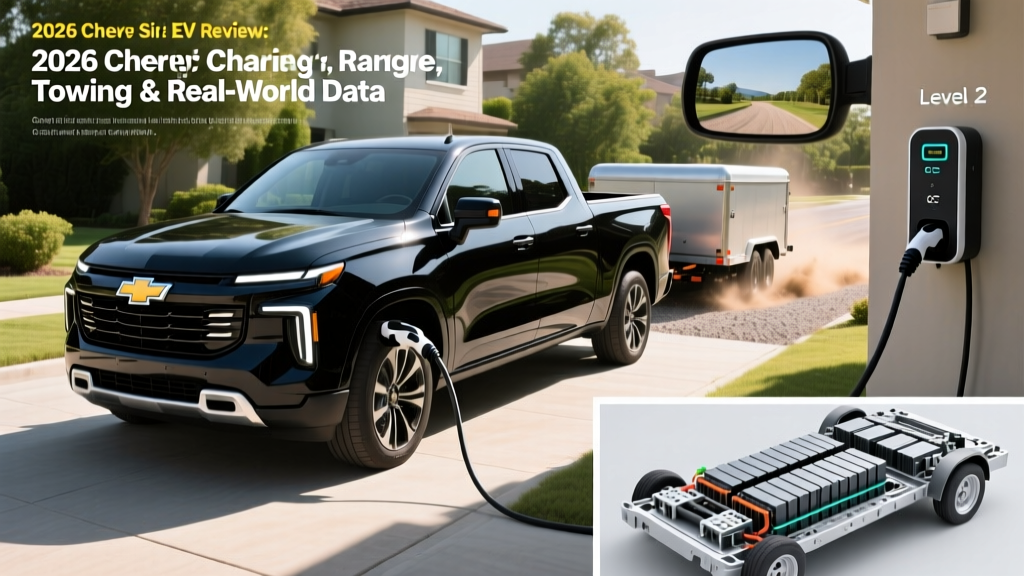
The 2026 Chevy Sierra EV enters its second full model year as GM's electric full-size pickup, built on the Ultium platform and aimed squarely at buyers who need truck capability without the fuel bill. With an EPA-estimated range reaching 390 miles on the top battery configuration and DC fast-charging speeds that rival the best sedans on the market, the Sierra EV makes a compelling case for electrifying the worksite and the weekend trail run alike. But full-size electric pickups carry compromises — weight, pricing, and real-world efficiency under load — that every buyer should understand before signing.
We've compiled every official spec, cross-referenced real-world range expectations, and mapped the federal tax credit eligibility so you know exactly what you're buying and what it actually costs.
Range, Battery, and Real-World Efficiency
The 2026 Sierra EV is offered with GM's Ultium lithium-ion battery system using NMC (nickel manganese cobalt) chemistry, prioritizing energy density for the large pack sizes a full-size truck demands. The available battery configurations are:
| Configuration | Usable Battery (kWh) | Chemistry | EPA Range (mi) | Efficiency |
|---|---|---|---|---|
| Standard (WT 4WT) | ~200 kWh (est.) | NMC | 390 | ~53 kWh/100mi |
| Extended Range (RST) | ~200 kWh (est.) | NMC | 380 | ~55 kWh/100mi |
| Smaller Pack (WT Fleet) | ~150 kWh (est.) | NMC | ~260 | ~58 kWh/100mi |
The Sierra EV's efficiency of roughly 53–58 kWh per 100 miles places it in the expected range for a 9,000+ lb electric truck. For comparison, the Rivian R1T achieves around 48 kWh/100mi with its smaller form factor, while the Ford F-150 Lightning sits around 49–54 kWh/100mi depending on battery pack. The Sierra EV's larger mass and taller profile extract a small efficiency penalty, but the trade-off is class-leading range from the oversized pack.
Charging Speed: DC Fast, Level 2, and Infrastructure
GM equipped the 2026 Sierra EV with an 800-volt architecture, enabling DC fast-charging rates that rank among the fastest of any production pickup.
| Charging Level | Power / Rate | Speed / Time | Connector |
|---|---|---|---|
| DC Fast Charge (Peak) | 350 kW (peak) | 10–80% in ~30 min; ~100 mi in 10 min | NACS (native Tesla Supercharger access) |
| Level 2 (Home/Public AC) | 19.2 kW (max onboard charger) | ~34 mi/hr of range added | NACS (J1772 adapter included) |
| Level 1 (120V outlet) | ~1.4 kW | ~2–3 mi/hr | Standard household |
The 350 kW peak charge rate is a headline number, but understanding the charge curve matters more for trip planning. The Sierra EV sustains its highest charge rates between roughly 10–50% state of charge (SoC), then tapers progressively. The 10–80% time of approximately 30 minutes reflects this taper above 60%. On a road trip, you'll see the fastest gains in the first 15 minutes, then diminishing returns — a pattern common to all large NMC packs.
The 19.2 kW onboard AC charger is a standout feature. Most competitors offer 11.5 kW Level 2 charging. With a 48-amp or higher home wall connector on a 240V circuit, the Sierra EV can recover roughly 34 miles of range per hour — meaning a full overnight charge from 20% to 100% takes about 10–12 hours. For a truck with a 200+ kWh battery, that onboard charger speed is essential.
The Sierra EV ships with a NACS (North American Charging Standard) port, granting native access to the Tesla Supercharger network — now the largest and most reliable DC fast-charging infrastructure in the U.S. (Chevrolet charging info). A CCS adapter is available for Electrify America and other legacy networks.
Performance, Powertrain, and Towing Capability
The 2026 Sierra EV is offered in multiple configurations, but the performance flagship is the RST (Rally Sport Truck) with dual-motor AWD:
| Metric | WT 4WT (Work Truck) | RST (Dual-Motor AWD) |
|---|---|---|
| Horsepower | ~510 hp | ~660 hp (754 hp with Wide Open Watts mode) |
| Torque (lb-ft) | ~615 lb-ft | ~785 lb-ft |
| 0–60 mph | ~5.5 sec | ~4.3 sec |
| Drivetrain | Dual-motor AWD | Dual-motor e4WD |
| Max Towing Capacity | 10,000 lbs | 10,000 lbs |
| Payload Capacity | ~1,800 lbs | ~1,300 lbs |
The RST's 754-horsepower Wide Open Watts mode delivers supercar-rivaling acceleration in a 9,400-lb truck — a 4.3-second 0–60 time is genuinely startling. The dual-motor setup provides precise torque vectoring, and the low center of gravity from the floor-mounted battery pack gives the Sierra EV better body control than most body-on-frame pickups through corners.
Towing is where the Sierra EV makes its strongest utility case. The 10,000-lb max tow rating exceeds the Ford F-150 Lightning's 10,000-lb rating (on comparable trims) and matches or beats most half-ton gas trucks. However, the range penalty under tow is severe — expect roughly 1.5 to 2.0 miles per kWh when pulling a heavy enclosed trailer, cutting the 390-mile range roughly in half. GM's available trailering tech package includes integrated trailer brake control, trailer camera integration, and Super Cruise compatibility with select trailers.
Interior, Cargo, and Technology
The Sierra EV ditches the traditional body-on-frame architecture for a dedicated EV platform, which unlocks packaging advantages unavailable to the gas Sierra:
- Front trunk (e-trunk): Approximately 10.7 cu ft of lockable, weather-sealed storage under the hood — large enough for multiple carry-on bags or a full set of power tools
- MidGate system: A fold-down partition between the cab and bed (borrowed from the defunct Avalanche) extends the effective bed length from 5'11" to over 9 feet with the tailgate down
- Bed length: 5'11" standard (with MidGate up); 9'+ with MidGate and tailgate open
- Rear-seat legroom: ~43.4 inches — competitive with crew-cab gas trucks
- Bed payload floor: Flat, low load-in height thanks to the absence of a rear differential housing
The RST trim features a 16.8-inch diagonal infotainment touchscreen running Google Built-In (Google Maps, Google Assistant, Play Store). The WT (Work Truck) trim uses an 11-inch display. Wireless Apple CarPlay and Android Auto are standard across trims.
On the driver-assistance front, the Sierra EV offers Super Cruise — GM's hands-free highway driving system — on over 750,000 miles of compatible roads in the U.S. and Canada. Super Cruise is an SAE Level 2 system: it controls steering, acceleration, and braking on divided highways, but requires the driver to remain attentive. A camera-based attention monitor ensures eyes stay on the road. This is not autonomous driving — the driver is always responsible.
Pricing, Trims, and Federal Tax Credit
The 2026 Sierra EV lineup spans from fleet-oriented work trucks to the premium RST:
| Trim | Base MSRP | Est. Tax Credit (§30D) | Effective Price (if eligible) |
|---|---|---|---|
| WT 4WT (Fleet/Standard Range) | ~$55,000 | Up to $7,500 | ~$47,500 |
| WT Extended Range | ~$63,000 | Up to $7,500 | ~$55,500 |
| RST (Dual-Motor AWD) | ~$87,000 | Up to $7,500* | ~$79,500 |
*Tax credit eligibility depends on multiple IRS §30D requirements. See checklist below.
- MSRP Cap: Trucks/vans/SUVs must have an MSRP ≤ $80,000. The RST at ~$87,000 exceeds this cap and is NOT eligible for the new-vehicle credit. The WT trims qualify.
- Buyer Income Cap: Modified AGI must not exceed $300,000 (joint), $225,000 (head of household), or $150,000 (single).
- Battery Sourcing: Critical minerals and battery components must meet escalating domestic/free-trade-partner thresholds. GM has made significant progress in North American battery sourcing via Ultium Cells plants, but exact qualification varies by build date. (IRS §30D rules)
- Point-of-Sale Transfer: Eligible buyers can transfer the credit to the dealer at purchase, reducing the out-of-pocket price immediately rather than waiting for tax filing.
Always verify eligibility with your tax professional and the dealer at the time of purchase. Rules are subject to change.
Warranty and Long-Term Ownership
GM backs the Sierra EV with competitive warranty coverage:
- Battery & Propulsion: 8 years / 100,000 miles (whichever comes first), covering defects and capacity loss below a specified threshold (typically ~70% retention)
- Bumper-to-Bumper: 3 years / 36,000 miles
- Corrosion: 6 years / 100,000 miles
- Roadside Assistance: 5 years / 60,000 miles
The 8-year/100,000-mile battery warranty is standard across the industry for EVs and federally mandated for emissions-related components. GM's Ultium battery modules are designed for individual module replacement rather than full-pack swaps, which should reduce out-of-warranty repair costs compared to sealed-pack designs. However, with a ~200 kWh NMC pack, a full replacement outside warranty would likely exceed $20,000–$25,000 based on current NMC cell pricing — a long-term ownership risk worth acknowledging.
Insurance costs for the Sierra EV tend to run 15–25% higher than the equivalent gas Sierra, reflecting the vehicle's high MSRP, repair complexity, and ADAS calibration costs after collisions. Get quotes before purchasing.
Sierra EV vs. Ford F-150 Lightning vs. Rivian R1T
The full-size electric truck segment is competitive. Here's how the Sierra EV stacks up on the metrics that matter:
| Specification | 2026 Chevy Sierra EV (RST) | 2026 Ford F-150 Lightning (Platinum) | 2026 Rivian R1T (Dual-Motor Max) |
|---|---|---|---|
| EPA Range | 380–390 mi | ~320 mi | ~410 mi |
| Max DC Charge Rate | 350 kW | ~150 kW | ~220 kW |
| 0–60 mph | 4.3 sec | ~4.0 sec | ~3.5 sec |
| Max Towing | 10,000 lbs | 10,000 lbs | 11,000 lbs |
| Base Price (Top Trim) | ~$87,000 | ~$96,000 | ~$99,000 |
| Charging Port | NACS (native) | NACS (native) | NACS (native) |
| Unique Feature | MidGate extendable bed | Pro Power Onboard / Mega Power Frunk | Quad-motor option / Gear Tunnel |
The Sierra EV's key advantages are its 350 kW charging speed (significantly faster than the F-150 Lightning), the MidGate bed system for long-cargo flexibility, and Super Cruise for highway commuting. The F-150 Lightning wins on overall market maturity and dealer network depth. The Rivian R1T offers more range with its Max Pack and a more adventure-focused design, but at a higher price point and without a traditional truck bed.
✓ Pros
- Class-leading 390-mile EPA range (large pack)
- 350 kW DC fast charging — fastest in the segment
- NACS port with native Supercharger access
- MidGate bed system for oversized cargo
- Super Cruise hands-free highway driving
- 10,000-lb towing with integrated trailering tech
- 19.2 kW onboard AC charger (best in class)
✗ Cons
- RST trim ($87K) exceeds §30D MSRP cap — no federal credit
- Real-world highway/cold-weather range drops 20–30%
- Towing cuts range roughly in half
- Higher insurance premiums vs. gas Sierra
- Very large footprint — challenging in tight urban spaces
- Heavy curb weight (~9,400 lbs) impacts tire wear
- WT fleet trims limited tech features vs. consumer trims
Who Should Buy the Chevy Sierra EV?
- You need a full-size truck bed with 10,000-lb towing and want the longest electric range available
- You have home Level 2 charging and mostly drive under 250 miles daily
- You want Super Cruise for highway-heavy commutes
- The MidGate bed system solves a specific cargo problem (lumber, kayaks, ladders)
- You're buying the WT trim and qualify for the §30D credit (MSRP ≤ $80K)
- You regularly tow heavy trailers over 200+ miles — range under tow is a deal-breaker without route charging
- You want the RST but need the federal credit — the MSRP cap disqualifies it
- You lack reliable home charging and depend on public infrastructure alone
- You prefer a smaller, more maneuverable electric truck (consider the Rivian R1T or Hyundai Santa Cruz PHEV)
Frequently Asked Questions
What is the real-world range of the Chevy Sierra EV?
The EPA estimates 390 miles for the largest battery configuration, but real-world highway driving at 70+ mph yields approximately 300–330 miles. In freezing temperatures, expect 270–310 miles. Under tow with a 7,000-lb trailer, plan for 150–180 miles between charges.
How fast does the Sierra EV charge at home and on the road?
On a DC fast charger, the Sierra EV peaks at 350 kW and charges from 10–80% in approximately 30 minutes. At home on Level 2 (240V), the 19.2 kW onboard charger adds about 34 miles of range per hour — a full charge from near-empty takes roughly 10–12 hours.
Does the Chevy Sierra EV qualify for the federal EV tax credit?
The WT trims (MSRP under $80,000) qualify for up to $7,500 under IRS §30D, assuming the buyer meets income caps ($150K single / $300K joint) and the vehicle meets battery sourcing requirements. The RST trim at ~$87,000 exceeds the $80,000 MSRP cap for trucks and does not qualify. Always confirm with the IRS and your tax professional. (IRS source)
How much does it cost to charge the Sierra EV at home?
With a ~200 kWh battery and the U.S. average electricity rate of $0.17/kWh, a full home charge costs approximately $34. That delivers 390 miles of range — equivalent to about $0.087 per mile, compared to roughly $0.15–$0.20 per mile for a gas Sierra getting 19 MPG at $3.50/gallon.
Is the Sierra EV worth buying over the F-150 Lightning?
The Sierra EV wins on range (390 vs. ~320 miles), DC charging speed (350 vs. ~150 kW), and the unique MidGate bed system. The F-150 Lightning has a longer market track record, broader dealer familiarity, and a larger frunk. If charging speed and range are your top priorities, the Sierra EV has the edge. If dealer support and proven reliability data matter more, the Lightning remains a strong choice.
Can the Sierra EV power my home or job site?
GM offers available Pro Power Onboard-style vehicle-to-load (V2L) capability, allowing the Sierra EV's battery to power tools, appliances, and even home circuits during outages via a bidirectional charger (sold separately). With a ~200 kWh battery, the Sierra EV can theoretically power an average U.S. home (30 kWh/day) for nearly a week.
Sources: EPA fuel economy data via fueleconomy.gov, Chevrolet official specifications via chevrolet.com, IRS §30D credit rules via irs.gov.