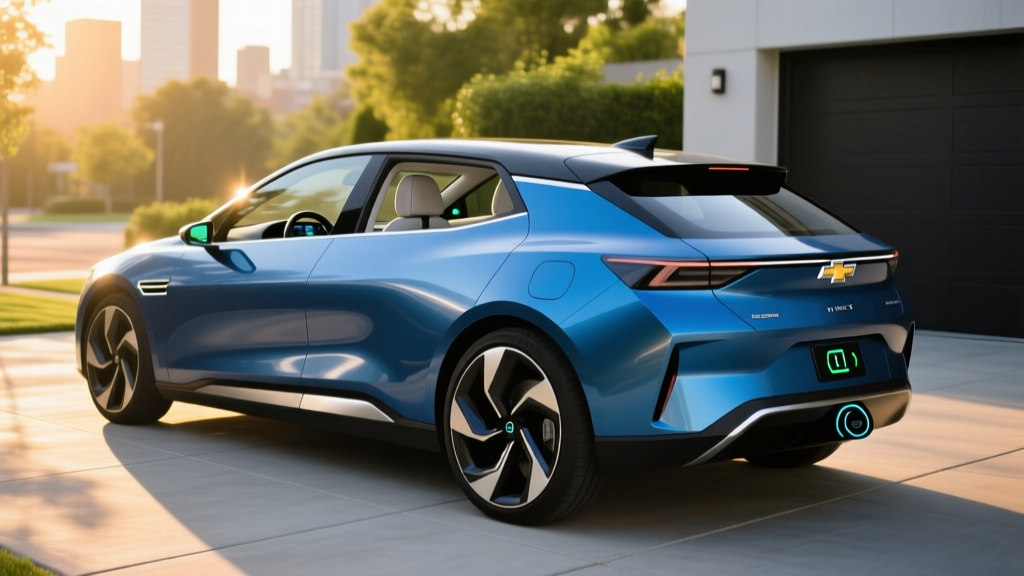
What Is the Chevy EV2?
The Chevrolet EV2 is GM's announced next-generation affordable electric vehicle, targeting a base MSRP around $30,000 and built on the Ultium platform. As of early 2026, GM has confirmed the EV2 nameplate and price target, but full EPA range, battery capacity, and production timelines remain preliminary. If it reaches market at the stated price and qualifies for the federal §30D tax credit, the effective cost could drop to approximately $22,500 for eligible buyers — positioning it as one of the least expensive new EVs available in the U.S.
What We Know About EV2 Specs So Far
GM has been deliberate about withholding final specifications until closer to launch. What the automaker has confirmed or strongly signaled through GM Newsroom announcements and investor presentations:
- Platform: Next-gen Ultium architecture (distinct from the current Ultium platform underpinning the Equinox EV and Blazer EV)
- Target MSRP: ~$30,000 before incentives
- Estimated battery: Likely 55–65 kWh usable capacity based on GM's LMR (lithium manganese-rich) cell development, though unconfirmed
- Projected EPA range: GM has referenced 250+ miles as a target; expect the real-world figure to vary based on trim and drivetrain
- Charging: NACS connector confirmed for all future GM EVs, granting access to Tesla Supercharger stations
- Production: Expected late 2026 or 2027 model year, likely assembled at a retooled U.S. plant
Note: All specifications above are preliminary. Final EPA certification, battery chemistry confirmation, and trim-level pricing will be published by GM closer to the on-sale date.
EV2 vs. Gas Car vs. Hybrid: The Cost Math
The EV2's entire value proposition rests on total cost of ownership. Here's how a ~$30,000 EV compares to the vehicles it's designed to replace: a compact gas sedan (like the Honda Civic) and a compact hybrid (like the Toyota Corolla Hybrid).
| Category | Chevy EV2 (est.) | Honda Civic Gas | Toyota Corolla Hybrid |
|---|---|---|---|
| Base MSRP | $30,000 | $26,000 | $28,500 |
| Fed. Tax Credit (§30D) | Up to $7,500* | $0 | $0 |
| Effective Purchase | $22,500 | $26,000 | $28,500 |
| Fuel/Energy (5 yr) | $3,000–$4,500 | $8,750 | $5,250 |
| Maintenance (5 yr) | $1,500 | $3,200 | $2,800 |
| Insurance (5 yr est.) | $7,500 | $6,000 | $6,200 |
| Total 5-Yr Cost | $34,500–$36,000 | $43,950 | $42,750 |
*§30D eligibility depends on buyer income caps, battery sourcing requirements, and MSRP limits. See IRS.gov for current rules. Tax credit applied at point of sale per 2024+ rules.
The EV2's advantage hinges on two variables: qualifying for the full $7,500 credit and having access to affordable home charging. At the U.S. average electricity rate of ~$0.17/kWh and an assumed efficiency of 3.5 mi/kWh, the EV2 would cost roughly $0.049/mile to fuel at home. The Civic at 33 MPG combined and $3.50/gal costs $0.117/mile. The Corolla Hybrid at 50 MPG combined costs $0.07/mile.
Real-World Ownership: What First-Time Buyers Need to Know
Sticker price is only one input. The EV2's practicality depends on your daily driving pattern, charging access, and climate.
Home Charging Access Is the Biggest Variable
Approximately 70–80% of EV charging happens at home, according to the U.S. Department of Energy. If you can install a Level 2 (240V) charger at home — typically a 32–48 amp unit delivering 7.7–11.5 kW — you'll wake up to a full battery every morning and rarely need public charging for daily driving.
Level 2 installation costs range from $500–$2,500 depending on your electrical panel's capacity and the distance from panel to charger location. Homes with older 100-amp panels may require a $1,500–$3,000 panel upgrade to support a dedicated 40–50 amp circuit. Renters and condo dwellers face additional barriers: landlord approval, shared infrastructure, and HOA rules.
If you lack home charging and must rely entirely on public DC fast charging, your per-mile energy cost roughly doubles (to ~$0.10–$0.15/mile at typical public rates of $0.30–$0.48/kWh), and convenience drops significantly.
Cold Weather Reduces Range 20–35%
If the EV2 achieves a 250-mile EPA rating, expect roughly 165–200 miles of real range in sustained sub-freezing temperatures. Battery chemistry generates internal resistance in cold conditions, and cabin heating draws significant energy. A heat pump — standard on some GM EVs, optional on others — can recover 10–15% of that loss. GM has not confirmed whether the EV2 will include a heat pump.
Charging Speed Matters for Road Trips
GM hasn't published peak DC fast-charge rates for the EV2. For reference, the current Equinox EV peaks around 150 kW, achieving a 10–80% charge in approximately 30 minutes. A sub-$30K vehicle may charge at 100–150 kW peak, which is adequate for road trips with planned stops but slower than the 200+ kW rates offered by Hyundai/Kia's E-GMP vehicles.
Federal Tax Credit: Will the EV2 Qualify?
The §30D clean vehicle credit offers up to $7,500, split between a $3,750 battery-component requirement and a $3,750 critical-minerals requirement. Eligibility depends on multiple factors that can change annually:
§30D Requirements Checklist (2026 Rules)
- MSRP cap: Sedans/hatchbacks ≤ $55,000; SUVs/trucks ≤ $80,000. The EV2 at ~$30K clears this easily.
- Buyer income cap: AGI ≤ $150K (single), ≤ $225K (head of household), ≤ $300K (joint). Exceed these and you're ineligible.
- Battery component sourcing: Percentage of battery components manufactured/assembled in North America must meet the annual threshold (ramping up yearly).
- Critical minerals: Percentage of critical minerals sourced from the U.S. or FTA partners must meet the annual threshold.
- FEOC exclusion: Vehicles with battery components from a "foreign entity of concern" (primarily Chinese manufacturers) are disqualified.
- Point-of-sale transfer: Buyers can apply the credit as a down-payment reduction at the dealer, rather than waiting for a tax refund.
GM's Ultium cells are produced in joint-venture U.S. plants (Ultium Cells LLC in Ohio, Tennessee, and Michigan). This gives the EV2 a strong structural advantage for meeting North American component requirements. However, critical-minerals sourcing rules tighten each year, and final eligibility for any given model year can only be confirmed when the IRS publishes its approved vehicle list. Always verify on fueleconomy.gov before purchasing.
Common EV2 Misconceptions vs. Facts
| Myth | Fact |
|---|---|
| "A $30K EV will have tiny range." | GM targets 250+ miles EPA. The current Equinox EV starts near $33K and delivers 319 miles. Battery costs have declined enough to make 250 mi feasible at $30K. |
| "It'll be too small to be practical." | GM hasn't released dimensions, but the EV2 is expected to be a compact crossover or hatchback — similar in footprint to the Trax or Trailblazer, with adequate cargo space for a small family. |
| "Cheap EVs don't last." | GM's battery warranty typically covers 8 years/100,000 miles with a 70% capacity-retention threshold. LMR chemistry, if used, may offer longer cycle life than conventional NMC. |
| "I'll save $7,500 no matter what." | §30D eligibility depends on your income, the vehicle's battery sourcing, and current-year IRS rules. Not every buyer qualifies, and the credit can phase or change with legislation. |
| "I can charge it anywhere." | GM's adoption of NACS grants Tesla Supercharger access — a significant network advantage. But CCS-only public chargers (Electrify America, EVgo CCS stalls) will require an adapter, and rural charging deserts remain real. |
Decision Framework: Is the EV2 Right for You?
Choose the EV2 (or wait for it) if:
- You have home charging access (garage, driveway, or landlord-approved outlet)
- Your daily commute is under 80 miles round-trip
- You're shopping in the $25K–$35K price bracket and want a new vehicle with a warranty
- You qualify for the §30D credit (check income caps and sourcing requirements)
- You want a compact EV for commuting and errands, not towing or cross-country hauling
Consider a hybrid (PHEV or HEV) instead if:
- You cannot charge at home and lack reliable workplace charging
- You regularly drive 300+ miles in a single day through areas with sparse DC fast-charging infrastructure
- You live in extreme cold (sustained below 0°F) and cannot precondition in a garage
- You don't qualify for the federal credit due to income limits
Look at a used EV instead if:
- You need a vehicle now and can't wait for EV2 production
- The §30D used-EV credit (up to $4,000, income-capped) applies to your situation
- You're comfortable with a 2–3-year-old battery and reduced remaining warranty
What to Watch Before EV2 Goes on Sale
Between now and the EV2's launch, several data points will determine whether it delivers on its promise:
- Final EPA range certification — the difference between 230 and 270 miles is meaningful for real-world usability
- Confirmed battery chemistry and capacity (kWh) — LMR vs. LFP vs. NMC affects longevity, cold-weather performance, and charging speed
- Peak DC fast-charge rate (kW) and 10–80% time — anything under 25 minutes at 10–80% is competitive; over 35 minutes is a road-trip liability
- Trim-level pricing — a $30,000 base that jumps to $38,000 with essential features (heat pump, ADAS, larger battery) changes the value equation
- §30D eligibility confirmation — IRS approval of the specific model year and battery configuration
Frequently Asked Questions
When will the Chevy EV2 be available to buy?
GM has indicated late 2026 or 2027 for production. Exact on-sale dates have not been announced. Pre-orders or reservation systems may open several months before first deliveries.
Will the EV2 qualify for the full $7,500 federal tax credit?
The EV2's U.S.-built Ultium battery gives it a structural advantage, but final eligibility depends on the model year's critical-minerals sourcing thresholds and your personal income. Check fueleconomy.gov and consult a tax professional before relying on the credit in your purchase decision.
How does the EV2 compare to the Chevy Equinox EV?
The Equinox EV starts around $33,000 (2025 model year) with up to 319 miles of EPA range on a ~85 kWh battery. The EV2 is expected to be smaller, less expensive, and likely equipped with a smaller battery. Think of the EV2 as a subcompact entry point and the Equinox EV as a compact family crossover.
What charger connector will the EV2 use?
NACS (North American Charging Standard), which is the Tesla connector. This gives the EV2 native access to Tesla Supercharger stations — currently the largest and most reliable DC fast-charging network in the U.S.
Is the EV2 an SUV, sedan, or hatchback?
GM has not confirmed the body style. Industry reporting suggests a compact crossover or hatchback format, competing with vehicles like the Nissan Leaf successor, the base Tesla Model 2 (if produced), and affordable PHEVs like the Toyota Prius.