Quick Answer: Which Chevy EV Should You Buy?
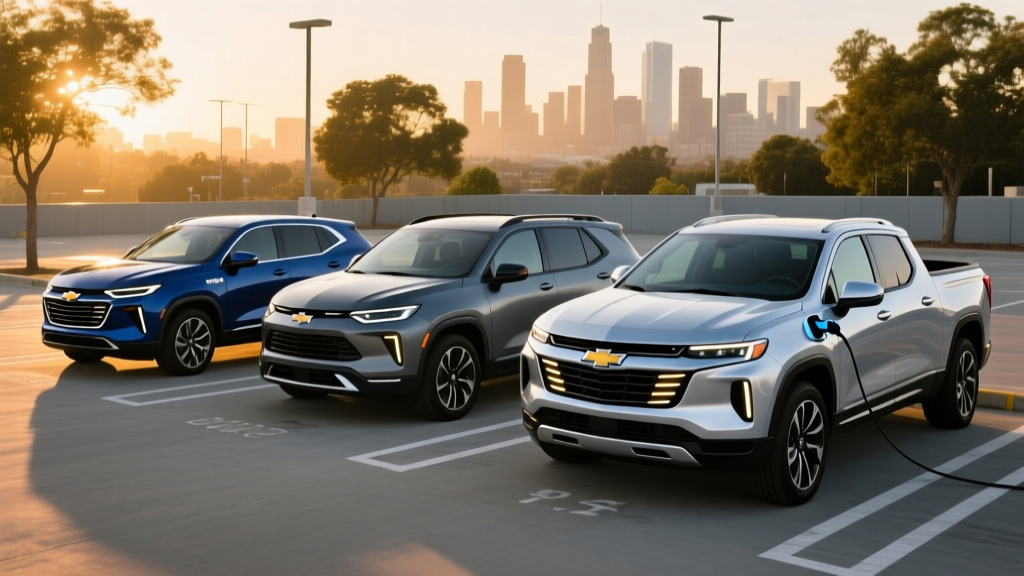
Chevrolet's 2026 EV lineup spans three distinct models built on GM's Ultium platform. The Equinox EV starts around $33,600 and delivers up to 319 miles of EPA range — the best value in the lineup. The Blazer EV offers a sportier, midsize crossover experience with up to 324 miles EPA and starts near $44,600. The Silverado EV targets truck buyers with up to 492 miles EPA (4WT trim) and a starting price around $57,900 for work-oriented trims. All three use the NACS (Tesla-style) charging connector natively for 2026, granting direct access to Tesla Superchargers. Federal §30D tax credit eligibility varies by trim, battery sourcing, and your income — check the details below before assuming you'll get $7,500.
The 2026 Chevy EV Lineup at a Glance
Chevrolet has committed fully to the Ultium battery architecture, and by 2026 the brand's electric portfolio has matured past early-production stumbles. Software reliability has improved significantly over the 2024 launch-year issues that plagued the Blazer EV, and the NACS connector adoption means you no longer need an adapter to use Tesla's Supercharger network. Here's how the three models stack up on paper:
| Spec | Equinox EV | Blazer EV | Silverado EV |
|---|---|---|---|
| Base MSRP | $33,600 (LT2) | $44,600 (2LT) | $57,900 (4WT) |
| EPA Range (max) | 319 mi (RS FWD) | 324 mi (RS RWD) | 492 mi (4WT) |
| Battery (usable) | ~85 kWh (NMC) | ~102 kWh (NMC) | ~200 kWh (NMC) |
| Peak DC Fast Charge | 150 kW | 190 kW | 350 kW |
| 10–80% DCFC Time | ~32 min | ~24 min | ~20 min |
| Level 2 Charge Rate | 11.5 kW | 11.5 kW | 19.2 kW |
| 0–60 mph | ~8.0 sec (FWD) | ~5.4 sec (AWD) | ~4.5 sec (RST AWD) |
| Horsepower | 213 hp (FWD) | 288–557 hp | 510–754 hp |
| Connector (2026) | NACS (native) | NACS (native) | NACS (native) |
| Battery/Powertrain Warranty | 8 yr / 100,000 mi | 8 yr / 100,000 mi | 8 yr / 100,000 mi |
Sources: fueleconomy.gov, Chevrolet official specifications. Real-world range will vary — see below.
Real-World Range vs. EPA Estimates
Equinox EV 3RS (FWD): EPA 319 mi → Expect ~250–275 mi at sustained 70 mph highway speeds; ~220–240 mi in sub-freezing weather.
Blazer EV RS (AWD): EPA 283 mi → Expect ~225–245 mi highway; ~195–215 mi in cold conditions.
Silverado EV 4WT: EPA 492 mi → Expect ~380–420 mi highway at 70 mph; significantly less when towing (plan for ~200–250 mi with a heavy trailer).
EPA range stickers assume a mix of city and highway driving at moderate temperatures. In practice, highway-only driving at 70+ mph consumes 15–20% more energy than the combined cycle, and cold weather (below 32°F) can reduce range by 20–30% depending on whether you use the heat pump and precondition the cabin. The Equinox EV's smaller battery means its absolute range loss in winter is smaller in miles, but the percentage hit is similar.
The Silverado EV's enormous ~200 kWh pack gives it a massive buffer, but that same mass means efficiency drops sharply under load. If you tow frequently, the 492-mile sticker is not realistic — plan your charging stops around a 200–250 mile working range with a trailer.
Charging Speeds and Infrastructure Reality
All three 2026 Chevy EV vehicles use the NACS connector natively, which is a significant practical advantage. You can plug directly into any Tesla Supercharger V3 (150 kW) or V4 station, as well as any CCS-equipped public charger using the industry-standard protocol handshake. This effectively doubles your fast-charging network compared to pre-2025 models that required adapters.
| Charging Level | Power | Miles Added/Hour (approx.) | Best For |
|---|---|---|---|
| Level 1 (120V outlet) | ~1.4 kW | 3–5 mi/hr | Overnight top-ups, PHEV-style use |
| Level 2 (240V home) | 11.5–19.2 kW | 30–55 mi/hr | Daily home charging, full overnight refill |
| DC Fast (150–350 kW) | Up to 350 kW | ~100+ mi in 10 min (Silverado) | Road trips, rapid top-ups |
Understanding kW vs kWh: kW (kilowatts) is the rate of energy flow — like water pressure from a hose. kWh (kilowatt-hours) is the total energy stored — like the size of the bucket. A 150 kW charger fills your battery faster than a 50 kW charger, but the battery's total capacity is measured in kWh.
A critical nuance: peak charge rate is not sustained rate. The Equinox EV may peak at 150 kW, but as the battery passes 60–70% State of Charge (SoC), the rate tapers to protect battery health. That 10–80% time of ~32 minutes reflects the average curve, not the peak. For road-trip planning, assume an average of ~90–100 kW sustained for the Equinox, ~120 kW for the Blazer, and ~200 kW for the Silverado during a typical highway rest stop charge.
Home Charging Setup
For daily use, a Level 2 home charger is essential. Expect to pay $500–$700 for a quality 48-amp Level 2 wall unit (like a ChargePoint Home Flex or Emporia V2) and $800–$2,500 for professional electrician installation, depending on whether your panel needs an upgrade to 200A service. If you live in an apartment or lack garage access, rely on public DCFC or workplace charging — but factor in higher per-kWh costs ($0.30–$0.55/kWh at public chargers vs. ~$0.13–$0.18/kWh at home).
Total Cost of Ownership: Chevy EV vs. Gas Equivalent
The purchase price of a Chevy EV is only part of the equation. Let's compare the Equinox EV to its gas-powered sibling, the 2026 Equinox (gas), over 5 years and 75,000 miles:
| Cost Category | Equinox EV (LT2 FWD) | Equinox Gas (LT FWD) |
|---|---|---|
| MSRP | $33,600 | $29,900 |
| Federal Tax Credit (§30D) | Up to $7,500* | $0 |
| Effective Purchase Price | ~$26,100* | $29,900 |
| Fuel/Energy (75k mi) | ~$3,750 (home charging) | ~$8,100 (28 MPG avg, $3.40/gal) |
| Maintenance (5 yr) | ~$1,200 | ~$3,500 |
| Insurance (5 yr avg) | ~$9,500 | ~$7,800 |
| Est. Depreciation (5 yr) | ~$12,000 | ~$13,500 |
| 5-Year Total | ~$52,550* | ~$62,800 |
* Tax credit eligibility depends on your modified adjusted gross income, battery critical-mineral sourcing, and MSRP caps under IRS §30D rules. Verify with a tax professional.
The EV wins on fuel and maintenance savings — electric motors have no oil changes, no transmission fluid, and regenerative braking extends pad life. However, EV insurance premiums run 15–25% higher on average due to higher repair costs for battery and structural components. If you don't qualify for the full tax credit, the cost advantage narrows considerably.
Federal Tax Credit Eligibility: What You Actually Qualify For
The §30D clean vehicle credit is not a guaranteed $7,500 for every buyer. Here's the checklist for 2026:
- Income caps: MAGI ≤ $150,000 (single), $225,000 (head of household), $300,000 (married filing jointly)
- MSRP caps: ≤ $55,000 for SUVs and sedans; ≤ $80,000 for trucks and vans
- Battery sourcing: Critical minerals and battery components must meet phased-in percentage thresholds from US or FTA-partner countries — these thresholds increase annually
- Point-of-sale transfer: You can transfer the credit to the dealer at purchase, reducing your out-of-pocket cost immediately (instead of waiting for tax filing)
- One credit per SSN per year: You can claim one new EV credit and one used EV credit per year
For the Equinox EV (MSRP under $55K), most trims qualify on price. The Blazer EV RS AWD at ~$50,000 also clears the SUV cap. The Silverado EV, classified as a truck, clears the $80K cap on most trims. However, the battery sourcing requirement is the variable most likely to reduce or eliminate the credit — GM has worked to localize Ultium battery supply chains, but specific mineral-sourcing compliance can shift by model year and production batch. Always verify current eligibility on fueleconomy.gov before purchasing.
Common Misconceptions About Chevy EVs
| Myth | Fact |
|---|---|
| "The battery will need replacing in 5 years." | GM warrants the Ultium battery for 8 years/100,000 miles against defects and capacity loss below 60%. Industry data from Recurrent Auto shows most modern NMC packs retain 88–93% capacity after 100,000 miles. |
| "You can't take an EV on a road trip." | With native NACS access to 20,000+ Tesla Superchargers plus Electrify America and EVgo networks, the Equinox EV can cover a 600-mile trip with two 25-minute charging stops. Plan ahead using the built-in route planner or A Better Route Planner. |
| "EVs are worse in the cold." | Range does drop 20–30% in freezing temperatures, but preconditioning the battery and cabin while plugged in recovers much of that loss. The Equinox EV's heat pump (standard on most trims) is more efficient than resistive heating. |
| "Charging takes too long." | At home on Level 2, charging happens while you sleep — 11.5 kW adds ~35 miles per hour, fully replenishing the Equinox EV overnight. On road trips, a 20–30 minute DCFC stop aligns with a rest break. |
| "The Blazer EV's software is still broken." | GM overhauled the Blazer EV's infotainment stack in mid-2024 with the Ultifi software platform. 2026 models ship with the updated system and have received positive reliability feedback from owners. |
Decision Framework: Which Chevy EV Fits Your Life?
Choose the Equinox EV if:
- You want the most affordable entry point into a practical EV
- Your daily commute is under 80 miles round-trip
- You have Level 2 home charging access
- You don't need AWD or towing capability
- Budget target: ~$26,000–$35,000 after incentives
Choose the Blazer EV if:
- You want a sportier midsize crossover with more cargo room
- You need AWD for snow or mountain driving
- You value faster DC charging (190 kW peak) for frequent road trips
- You want the SS performance variant (557 hp, 3.4-sec 0–60)
- Budget target: ~$40,000–$58,000
Choose the Silverado EV if:
- You need a full-size truck bed and towing capability (up to 10,000 lbs on 4WT)
- You want maximum range for long-distance driving without charging stops
- You can accommodate a large vehicle in your garage/driveway
- You're replacing a gas Silverado or F-150 and want to eliminate fuel costs
- Budget target: ~$50,000–$90,000+ depending on trim
Stick with a gas or hybrid Chevy if:
- You lack reliable home or workplace charging access
- You regularly tow heavy loads over 300+ miles in a single day
- Your budget is strictly under $25,000 and you can't wait for used-EV credit savings
- You live in a region with sparse public DCFC infrastructure (check PlugShare or the DOE's Alternative Fuels Station Locator)
First-Time EV Buyer Essentials
If this is your first electric vehicle, here's what you need to know before signing the paperwork:
1. Confirm your home electrical capacity. A Level 2 charger requires a dedicated 240V circuit (typically 40–60 amps). If your home has a 100-amp main panel, you may need an upgrade to 200 amps — this can cost $1,500–$4,000 depending on your utility's requirements. Get a quote from a licensed electrician before committing to the car.
2. Understand your electricity rate. Charging at home on a standard rate of ~$0.15/kWh means the Equinox EV costs about $12.75 to go from 0–100% (85 kWh × $0.15). That's roughly $0.04 per mile — about one-quarter the cost of gas at $3.40/gallon and 28 MPG. If your utility offers time-of-use rates, charging overnight at off-peak rates can drop this further.
3. Download the right apps. The myChevrolet app handles remote start, charge scheduling, and preconditioning. For road trips, PlugShare and A Better Route Planner are essential for finding chargers and estimating arrival SoC. Tesla's Supercharger network is now accessible to Chevy EVs via the built-in navigation or the Tesla app (required for non-Tesla vehicles at some stations).
4. Learn to precondition. Warming or cooling the battery and cabin while the car is still plugged in uses grid power instead of battery power. This preserves your range and, in cold weather, enables faster DC charging speeds because the battery arrives at the charger at an optimal temperature.
5. Budget for insurance. EV insurance is typically 15–25% higher than equivalent gas vehicles. Get quotes from your current insurer and at least two competitors before purchasing. Some insurers (like Progressive and State Farm) have begun offering EV-specific discounts.
FAQ: Chevy EV Vehicles
Are Chevy EV vehicles reliable in 2026?
GM's Ultium platform has matured past the early software issues that affected 2024 Blazer EV models. The 2026 lineup ships with the Ultifi software architecture, which has been substantially more stable. Mechanical reliability of the electric powertrain itself is strong — electric motors have far fewer moving parts than internal combustion engines. Check IIHS and owner forums for the latest reliability data by specific model.
Can I charge a Chevy EV at a Tesla Supercharger?
Yes. All 2026 Chevy EV vehicles come with the NACS connector built in. You can plug directly into Tesla Supercharger V3 and V4 stations without an adapter. You'll need to set up payment through the Tesla app or the vehicle's built-in navigation system at supported stations.
How long does the Ultium battery last?
GM warrants the battery for 8 years or 100,000 miles, whichever comes first, covering defects and capacity loss below 60% of original capacity. Real-world data from fleet operators and analytics firm Recurrent Auto suggests modern NMC Ultium packs are tracking toward 88–93% capacity retention at 100,000 miles, well above the warranty threshold. Full battery replacement, if ever needed outside warranty, currently costs $12,000–$20,000+ depending on the pack size — but this is rare within the first 150,000 miles.
Is the Equinox EV or Blazer EV better for my budget?
If your priority is minimizing cost per mile and keeping the purchase price low, the Equinox EV is the clear winner — starting at $33,600 with 319 miles of range. The Blazer EV costs roughly $11,000 more and offers AWD, more cargo space, and faster charging, but the value proposition is strongest in the Equinox for budget-conscious buyers who don't need those features.
Do Chevy EVs qualify for the $7,500 federal tax credit?
Eligibility depends on three factors: your income (MAGI caps apply), the vehicle's MSRP (must be under $55K for SUVs, $80K for trucks), and the battery's critical-mineral and component sourcing. Most Equinox EV and Blazer EV trims clear the MSRP cap. The Silverado EV also qualifies on price as a truck. However, the battery sourcing requirement changes annually — verify current eligibility for your specific model year and trim on the IRS website or fueleconomy.gov before purchasing.