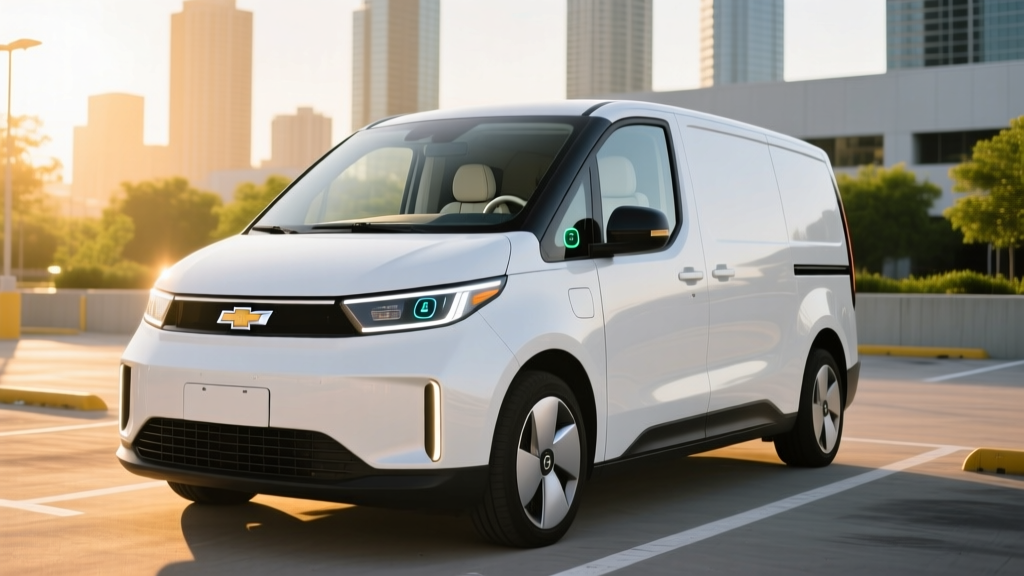
If you're researching a Chevy EV van for commercial delivery or fleet use in 2026, the answer centers on GM's BrightDrop Zevo lineup — specifically the Zevo 400 and Zevo 600. These are purpose-built electric cargo vans (not passenger vans) sold primarily to fleet operators, with EPA-estimated ranges up to 272 miles, DC fast charging up to 120 kW, and starting MSRPs in the mid-$50,000s before federal tax incentives. For small-business owners and fleet managers weighing an electric cargo van against a gas-powered Ford Transit or Ram ProMaster, the Zevo offers dramatically lower per-mile fuel and maintenance costs — but requires depot-level charging infrastructure and carries a higher upfront purchase price. This guide breaks down the exact numbers, real-world ownership economics, and the decision framework you need to determine if a Chevy EV van makes financial sense for your operation.
Quick Answer: The Chevy EV Van in 2026
GM's BrightDrop Zevo 400 (compact cargo) and Zevo 600 (full-size cargo) are the only Chevy-branded electric vans available for the 2026 model year. They are commercial-grade delivery vehicles — not consumer passenger vans. Expect 160–272 miles of EPA range, 120 kW peak DC fast charging, and fleet pricing starting around $55,000. The §45W commercial clean vehicle credit (up to $7,500) applies to qualifying business purchases, not the consumer §30D credit.
BrightDrop Zevo 400 vs Zevo 600: Spec Comparison
GM launched BrightDrop as a commercial EV brand, and for 2026 the Zevo vans are increasingly sold through Chevrolet's commercial fleet channels. Here's how the two models stack up on paper:
| Specification | BrightDrop Zevo 400 | BrightDrop Zevo 600 |
|---|---|---|
| Cargo Volume | 412 cu ft | 584 cu ft |
| Battery (usable, NMC) | ~80 kWh | ~140 kWh |
| EPA Range | ~160 miles | Up to 272 miles |
| Peak DC Fast Charge | 120 kW | 120 kW |
| 10–80% DC Charge Time | ~45 min | ~75 min |
| Level 2 AC Charge Rate | 11.5 kW | 11.5 kW |
| Horsepower | ~200 hp (FWD) | ~200 hp (FWD) |
| Max Payload | ~2,500 lbs | ~2,800 lbs |
| Starting MSRP (est.) | ~$55,000 | ~$74,000 |
| Powertrain Warranty | 5 yr / 60,000 mi | 5 yr / 60,000 mi |
| Battery Warranty | 8 yr / 100,000 mi | 8 yr / 100,000 mi |
Note: BrightDrop publishes payload and range figures that vary by configuration. The EPA range of 272 miles applies to the Zevo 600 with the standard-range battery under optimal conditions. Real-world range with a full payload and stop-and-go urban delivery routes typically runs 15–25% lower. Always confirm final specs with your Chevrolet commercial dealer.
Real-World Range and Charging: What Fleets Actually See
EPA range stickers are a starting point, not a guarantee — especially for commercial vans that carry variable payloads and operate in diverse climates. Here's what to expect in practice:
Real-World Range Reality Check
Zevo 600 (272 mi EPA): Expect ~210–230 miles on mixed urban delivery routes with moderate payload. In winter conditions (below 32°F), range can drop to 170–190 miles due to battery chemistry limitations and cabin/cargo heating demands. Highway-speed driving (65+ mph) further reduces range to ~190–200 miles.
Zevo 400 (160 mi EPA): Expect ~125–140 miles on urban routes. Cold weather may reduce this to 100–115 miles. This model is designed for predictable, short-radius last-mile delivery — not long highway runs.
Charging Infrastructure Requirements
Unlike a consumer EV that can rely on a home garage charger, commercial Chevy EV vans require depot charging infrastructure. Here's the practical breakdown:
- Level 2 depot charging (11.5 kW): A fully depleted Zevo 600 (140 kWh battery) takes roughly 12 hours on Level 2 — ideal for overnight charging between shifts. A Zevo 400 charges in about 7 hours.
- DC fast charging (120 kW peak): Useful for mid-day top-ups, but the Zevo's charge curve tapers significantly above 80% SoC. Fleet operators should plan depot schedules around overnight Level 2 rather than relying on public DC fast chargers, which are neither cost-efficient nor convenient for large vans.
- Electrical upgrades: Installing multiple Level 2 chargers at a depot typically requires a commercial panel upgrade (200–400A service) and dedicated 60A circuits per charger. Budget $3,000–$10,000+ per charger installation depending on existing electrical capacity and local utility requirements.
Chevy EV Van vs Gas Cargo Van: Cost Comparison
The core question for fleet buyers isn't whether electric is "better" in the abstract — it's whether the total cost of ownership (TCO) justifies the higher upfront price. Here's a 5-year / 75,000-mile comparison between a Zevo 600 and a comparably equipped Ford Transit 250 gas cargo van:
| Cost Category | BrightDrop Zevo 600 (EV) | Ford Transit 250 (Gas) |
|---|---|---|
| Purchase Price (MSRP) | $74,000 | $48,000 |
| Federal Tax Credit (§45W) | −$7,500 | $0 |
| Net Purchase Cost | $66,500 | $48,000 |
| Fuel/Energy (75k mi) | $5,625 (est. $0.15/kWh) | $16,875 (est. $3.50/gal, 15 MPG) |
| Maintenance (5 yr) | ~$2,500 | ~$6,500 |
| Depot Charger Install (1 unit) | $5,000 | $0 |
| Insurance (est. 5 yr) | $14,000 | $11,500 |
| 5-Year Total Cost | $93,625 | $82,875 |
| Cost Per Mile | $1.25/mi | $1.11/mi |
Key takeaway: Over 5 years, the Zevo 600 still carries a ~$10,750 TCO premium in this scenario. However, the math shifts significantly with higher annual mileage (the per-mile energy savings compound), available state/local utility rebates for commercial EV charging, and fleet-specific incentive programs. Many fleets in California, New York, and other states with clean-fleet mandates see the TCO gap close or invert within 3–4 years. Consult your state's commercial fleet incentive database and your tax professional regarding IRS §45W commercial clean vehicle credit eligibility.
Where the EV Van Wins on Operating Cost
- Fuel savings: At $0.15/kWh (commercial electricity rate), the Zevo 600 costs roughly $0.075/mile in energy. The gas Transit at 15 MPG combined and $3.50/gallon costs $0.23/mile — a 3x difference.
- Maintenance: No oil changes, no transmission fluid, no spark plugs, no exhaust system. Regenerative braking dramatically extends brake pad life. EV cargo vans typically save $800–$1,200/year in scheduled maintenance.
- Downtime: Fewer moving parts means fewer unexpected mechanical failures — a meaningful advantage for fleets where a van off the road costs $300–$500/day in lost revenue.
Federal and State Incentives for Commercial EV Vans
Commercial fleet buyers should understand that the consumer §30D tax credit (the one you see in headlines about $7,500 for personal EVs) does not apply to business-purchased cargo vans. Instead, the relevant incentive is:
§45W Commercial Clean Vehicle Credit — Key Rules
- Credit amount: Up to $7,500 for vehicles under 14,000 lbs GVWR (both Zevo models qualify)
- Eligibility: Vehicle must be purchased for business use and deployed in a commercial fleet
- No MSRP cap: Unlike the consumer credit, there's no vehicle price limit
- No buyer income cap: Business income does not affect eligibility
- Domestic assembly: Vehicle must be assembled in North America (Zevo vans are built at GM's CAMI Assembly plant in Ontario, Canada — qualifying under USMCA rules)
- Transferability: The credit can be transferred to the dealer at point of sale as a price reduction (effective 2024 onward)
- Stacking: Can be combined with state-level commercial EV incentives and utility rebates in many jurisdictions
Always verify current-year rules at irs.gov and consult a qualified tax professional before making a purchase decision based on incentive eligibility.
Common Misconceptions About the Chevy EV Van
| Myth | Fact |
|---|---|
| "It's a Chevy — I can buy one at any dealer." | BrightDrop Zevo vans are sold through Chevrolet's commercial/fleet channel and BrightDrop's direct sales program. Not every Chevy dealer stocks or services them. |
| "The 272-mile range means I can drive 272 miles loaded." | EPA range is tested under optimal conditions. A fully loaded Zevo 600 on stop-and-go delivery routes in cold weather may see 170–200 miles of practical range. |
| "I'll charge it at public Superchargers." | The Zevo uses the CCS connector standard (NACS adapter availability varies). More critically, public DC fast charging at $0.35–$0.50/kWh erases most of the fuel-cost advantage. Depot Level 2 charging is the intended model. |
| "EV vans can't handle cold climates." | They can — but range drops 20–35% in sub-freezing temps. Fleet operators in cold regions should spec routes with a 30% range buffer and consider depot preconditioning. |
| "The battery will need replacing in 5 years." | GM warranties the Zevo battery for 8 years/100,000 miles against falling below 60–70% capacity. Commercial fleet data from early BrightDrop customers shows typical degradation of 8–12% over the first 100,000 miles — well within warranty thresholds. |
Who Should (and Shouldn't) Buy a Chevy EV Van
Decision Framework: Is the Zevo Right for Your Fleet?
Choose the BrightDrop Zevo 600 if:
- Your daily routes are under 200 miles with predictable return-to-depot patterns
- You can install Level 2 depot charging (overnight charging covers your needs)
- You operate in a state or city with clean-fleet mandates or commercial EV incentives
- Your fleet drives 20,000+ miles/year per vehicle (fuel savings offset the higher purchase price faster)
- You want to reduce maintenance downtime and simplify fleet servicing
Choose the BrightDrop Zevo 400 if:
- Your routes are under 120 miles/day — classic last-mile urban delivery
- Cargo volume needs are moderate (~400 cu ft is sufficient)
- You operate in a dense metro area where the smaller footprint aids maneuverability
Stick with a gas or diesel cargo van if:
- Your routes exceed 250 miles/day or are highly variable/unpredictable
- You lack depot charging access and cannot install it (leased yard, rural location, utility capacity limits)
- You operate in extreme cold (consistent sub-0°F temps) where range loss exceeds 35%
- Your annual mileage is under 12,000 miles/year — the fuel savings won't offset the purchase premium within a reasonable payback period
- You need a passenger van — the Zevo is cargo-only with no rear seating configuration
What First-Time EV Fleet Buyers Need to Know
Transitioning even a single van from gas to electric involves operational changes beyond the vehicle itself. Here's a practical checklist based on fleet operator feedback:
- Audit your routes first. Before ordering a Zevo, log 2–4 weeks of GPS route data for the vehicle you plan to replace. Total daily miles, stop frequency, and payload weight determine which Zevo model fits — and whether an EV van is viable at all.
- Engage your utility early. Commercial EV charger installations can take 3–6 months for utility service upgrades. Contact your electric utility's commercial EV program before you order vehicles, not after. Many utilities offer demand-management programs that reduce your electricity rate for off-peak depot charging.
- Budget for charger installation separately. The van and the charger are separate purchases. A single Level 2 ChargePoint or Blink commercial unit costs $1,500–$3,000; professional installation with conduit, permits, and potential panel upgrades adds $2,000–$7,000 per stall.
- Train drivers on regen braking and preconditioning. One-pedal driving via regenerative braking extends range and reduces brake wear — but drivers accustomed to gas vans need orientation. Similarly, preconditioning the battery (warming it while still plugged in at the depot) preserves range in cold weather and improves DC fast-charge acceptance.
- Track kWh/mile, not just miles driven. Fleet telematics for EVs should monitor energy consumption per mile (target: 2.0–2.5 kWh/mile for the Zevo 600 loaded). Rising consumption over time can indicate tire pressure issues, brake drag, or battery health concerns.
- Understand the warranty structure. GM's 8-year/100,000-mile battery warranty covers capacity loss below a specified threshold (typically 60–70% of original capacity). It does not cover physical damage from road debris or flooding. Review the full warranty terms with your dealer before purchase.
Charging Speeds and Connector Details
| Charging Level | Power (kW) | Zevo 600 Miles Added/Hour | Zevo 400 Miles Added/Hour | Best Use Case |
|---|---|---|---|---|
| Level 1 (120V) | ~1.4 kW | ~3 mi/hr | ~4 mi/hr | Not practical for fleet use |
| Level 2 (240V, 48A) | 11.5 kW | ~25 mi/hr | ~30 mi/hr | Overnight depot charging (primary) |
| DC Fast Charge | Up to 120 kW | ~150 mi in 45 min (10–80%) | ~100 mi in 30 min (10–80%) | Mid-day opportunity charging |
Important distinction — kW vs kWh: The Zevo 600's battery stores 140 kWh (kilowatt-hours) of energy — that's the tank size. The charger delivers power at up to 120 kW (kilowatts) — that's the flow rate. Think of kWh as gallons and kW as gallons-per-minute. The charge rate tapers as the battery fills, which is why 10–80% is faster than 10–100%.
Frequently Asked Questions
Is there a Chevy EV passenger van for families?
No. As of the 2026 model year, GM does not offer an electric passenger van under the Chevrolet brand. The Chevy Bolt EV and Equinox EV are passenger crossovers, not vans. If you need a 7–8 seat electric passenger van, look at the Mercedes-Benz EQV (limited US availability) or consider an electric SUV like the Kia EV9. The BrightDrop Zevo is strictly a commercial cargo vehicle with no rear passenger configuration.
Can I buy a BrightDrop Zevo as an individual, not a fleet?
BrightDrop primarily sells to commercial fleets, but small-business owners and sole proprietors can purchase through Chevrolet's commercial channel. You'll need to work with a Chevy dealer that has commercial/fleet sales capability. Individual retail availability is limited, and pricing may differ from published fleet MSRPs.
How long does the Zevo battery last before replacement?
Based on early fleet data and GM's NMC battery chemistry, expect 8–15% degradation over the first 100,000 miles. The battery is warranted for 8 years/100,000 miles against dropping below 60–70% of original capacity. Full battery replacement on a Zevo 600 (140 kWh pack) would likely cost $15,000–$25,000 out of warranty — though replacements at that scale are uncommon within the first decade of use.
Does the Zevo qualify for the $7,500 consumer EV tax credit?
No. The consumer §30D credit is for personal-use vehicles. Business-purchased Zevo vans qualify for the §45W commercial clean vehicle credit, which also offers up to $7,500 but has different eligibility rules (no income cap, no MSRP cap, must be for business use). Consult your tax professional to confirm your specific eligibility.
What's the payload and towing capacity?
The Zevo 600 offers approximately 2,800 lbs of payload capacity and up to 584 cu ft of cargo volume. The Zevo 400 provides about 2,500 lbs payload and 412 cu ft. Neither model is rated for trailer towing — these are urban delivery vehicles, not haulers. If your operation requires towing, a gas or diesel cargo van remains the practical choice.
How does cold weather affect the Zevo's range?
In temperatures below 32°F, expect 20–30% range reduction due to increased battery internal resistance and cabin/cargo heating demands. Below 0°F, losses can reach 35%. The Zevo does not currently offer a heat pump (which would mitigate cabin-heating energy draw), so fleet operators in northern climates should plan routes with a significant range buffer and use depot preconditioning whenever possible.