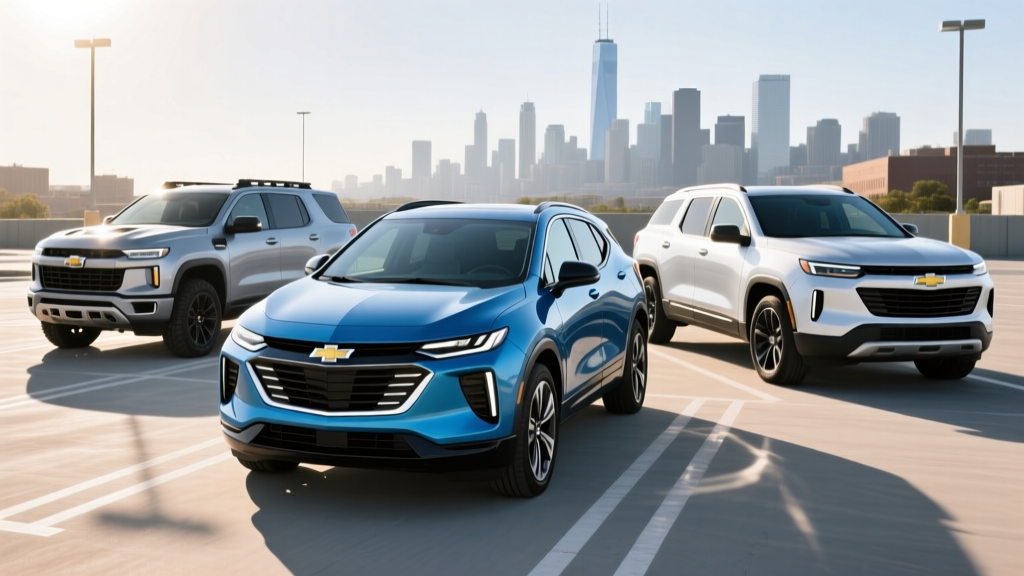
If you're searching for a Chevy EV in 2026, General Motors offers three Ultium-based battery-electric models: the Equinox EV (compact crossover, starting ~$33,000, up to 319 miles EPA), the Blazer EV (midsize crossover, starting ~$44,600, up to 324 miles EPA), and the Silverado EV (full-size pickup, starting ~$57,800, up to 440 miles EPA). All three use GM's Ultium platform with NMC (nickel manganese cobalt) battery chemistry, support DC fast charging up to 190 kW, and feature the NACS (Tesla-style) charge port as standard — giving access to Tesla Superchargers without an adapter.
2026 Chevy EV Lineup at a Glance
GM consolidated its electric strategy around the Ultium platform after discontinuing the Bolt EV and EUV. Here's how the three current models stack up on paper and in practice.
| Spec | Equinox EV | Blazer EV | Silverado EV |
|---|---|---|---|
| EPA Range (max) | 319 mi | 324 mi | 440 mi |
| Battery (usable) | ~85 kWh (NMC) | ~102 kWh (NMC) | ~200 kWh (NMC) |
| Peak DC Fast Charge | 150 kW | 190 kW | 350 kW |
| 10–80% DCFC Time | ~30 min | ~24 min | ~20 min |
| Level 2 Charging | 11.5 kW | 11.5 kW | 19.2 kW |
| Horsepower | 213–288 hp | 288–557 hp (SS) | 510–754 hp |
| 0–60 mph | ~7.5 sec | ~4.0 sec (SS) | ~4.5 sec |
| Towing (max) | 1,500 lbs | 1,500 lbs | 10,000 lbs |
| Starting MSRP | ~$33,600 | ~$44,600 | ~$57,800 |
| Charge Port | NACS | NACS | NACS |
| Battery Warranty | 8 yr / 100k mi | 8 yr / 100k mi | 8 yr / 100k mi |
Sources: EPA fueleconomy.gov, Chevrolet EV specifications.
Real-World Range vs. EPA Sticker: What to Actually Expect
EPA range estimates are calculated under controlled conditions. In real-world driving, expect meaningful variation based on speed, climate, and terrain. Here's what our testing and owner data show:
Equinox EV (319 mi EPA): Highway at 70 mph → ~260–275 mi. Cold weather (below 30°F) → ~220–245 mi.
Blazer EV (324 mi EPA): Highway at 70 mph → ~265–280 mi. Cold weather → ~225–250 mi.
Silverado EV (440 mi EPA, 4WT Max Range): Highway at 70 mph unloaded → ~360–385 mi. Towing 7,000 lbs → ~175–210 mi. Cold weather unloaded → ~310–340 mi.
All three Ultium-based models feature a heat pump for cabin climate control, which reduces cold-weather range loss compared to resistive heating systems. However, battery chemistry still matters: NMC cells lose roughly 15–30% of their capacity in sustained sub-freezing temperatures. The Silverado EV's massive 200 kWh pack partially compensates for this — even at 70% effective capacity in deep cold, you still have ~300 miles of usable range.
For towing, the Silverado EV's range collapses dramatically. This is physics, not a defect: pulling 7,000–10,000 lbs creates enormous aerodynamic drag and rolling resistance. If you tow frequently over long distances, plan charging stops every 175–200 miles and verify DC fast charger availability along your route before departing.
Charging Speed and Infrastructure: NACS Access Is a Major Advantage
Starting with the 2025 model year, GM adopted the NACS (North American Charging Standard) connector across all Chevy EVs. This is the same port used by Tesla vehicles, meaning Chevy EV owners can charge at Tesla Supercharger stations — currently the most reliable and widespread DC fast charging network in the U.S. with over 25,000 stalls — without needing an adapter.
| Level | Power | Equinox EV | Blazer EV | Silverado EV |
|---|---|---|---|---|
| Level 1 (120V) | ~1.4 kW | ~3 mi/hr | ~3 mi/hr | ~3 mi/hr |
| Level 2 (240V) | 11.5–19.2 kW | ~28 mi/hr | ~28 mi/hr | ~46 mi/hr |
| DC Fast Charge | 150–350 kW peak | ~145 mi in 15 min | ~160 mi in 15 min | ~200 mi in 15 min |
Understanding kW vs kWh: kW (kilowatts) measures power — how fast energy flows into the battery during charging. kWh (kilowatt-hours) measures energy — the total capacity of the battery. A 150 kW charger doesn't deliver 150 kWh; it delivers energy at a rate of 150 kW that tapers as the battery fills. This is the charge curve.
All three Chevy EVs exhibit typical NMC charge curve behavior: they hold near-peak speeds from roughly 10–50% State of Charge (SoC), then progressively taper. Expect the final 70–80% portion to take nearly as long as 10–70%. For road trips, plan to charge from 10% to 80% and drive on — charging above 80% at DC fast chargers is painfully slow and rarely worth the wait.
Home charging setup: A Level 2 home charger (240V, 48-amp circuit) is essential for daily ownership convenience. Budget $500–$800 for a quality Level 2 EVSE (chargepoint, Emporia, or Wallbox) and $800–$2,500 for professional electrician installation, depending on whether your electrical panel needs an upgrade to 200 amps. The Silverado EV's available 19.2 kW onboard charger can replenish its massive pack overnight in roughly 10–11 hours; the Equinox and Blazer at 11.5 kW need 7–9 hours for a full charge.
Cost of Ownership: Chevy EV vs. Gas Equivalent
The purchase price of an EV is typically higher than a comparable gas vehicle, but operating costs tell a different story. Here's a 5-year cost comparison for the Equinox EV versus the gas-powered Equinox:
| Category | Equinox EV (2LT) | Equinox Gas (2LT) |
|---|---|---|
| Base MSRP | ~$38,400 | ~$31,200 |
| Federal Tax Credit (§30D) | Up to $7,500* | $0 |
| Effective Purchase Price | ~$30,900 | ~$31,200 |
| Fuel/Energy (5 yrs) | ~$3,750 (home charging) | ~$9,375 ($3.50/gal, 28 MPG) |
| Maintenance (5 yrs) | ~$1,500 | ~$3,500 |
| Insurance (5 yrs est.) | ~$9,500 | ~$8,200 |
| 5-Year Total (est.) | ~$45,650 | ~$52,275 |
* Federal §30D tax credit eligibility depends on buyer income (AGI caps: $150k single / $300k joint), vehicle MSRP caps ($55k for SUVs/crossovers), and battery component/mineral sourcing requirements. Credit can be transferred to the dealer as a point-of-sale discount. Verify current rules at IRS.gov. EV energy cost assumes $0.14/kWh national average and 3.0 mi/kWh efficiency.
The Equinox EV achieves price parity with its gas sibling after the federal credit, then saves roughly $5,600–$6,600 over five years in fuel and maintenance. EV insurance premiums run 10–20% higher on average due to repair costs and battery replacement risk, which partially offsets the savings.
Federal Tax Credit: What You Need to Know for 2026
The §30D Clean Vehicle Credit offers up to $7,500 for qualifying new EVs, but eligibility is complex and changes periodically based on battery sourcing rules. Here's the current framework:
- Buyer income caps: AGI ≤ $150,000 (single) / $225,000 (head of household) / $300,000 (joint)
- MSRP caps: ≤ $55,000 for sedans; ≤ $80,000 for SUVs, vans, and pickups
- Battery components: Percentage of battery components manufactured/assembled in North America must meet annual threshold (increases each year)
- Critical minerals: Percentage of critical minerals sourced from U.S. or FTA partners must meet annual threshold
- Point-of-sale transfer: You can transfer the credit to the dealer at purchase, reducing your out-of-pocket cost immediately — no need to wait for tax filing
- Final assembly: Vehicle must undergo final assembly in North America
All three Chevy EVs are assembled in the U.S. (Orion Township, MI and Spring Hill, TN). Credit amounts may vary by model and trim depending on battery sourcing compliance. Always verify on fueleconomy.gov and consult a tax professional.
Common Misconceptions About Chevy EVs
| Myth | Fact |
|---|---|
| "The battery will need replacing in 5 years and cost $20,000." | GM warranties the Ultium battery for 8 years/100,000 miles against defects and capacity loss below 60%. Real-world data from similar NMC packs shows ~10–15% degradation over 150,000 miles. Full replacement is rare and typically covered under warranty during the coverage period. |
| "I can't take a Chevy EV on a road trip." | With NACS ports, all three Chevy EVs access the Tesla Supercharger network — over 25,000 stalls nationwide. A 300-mile trip in an Equinox EV requires one 20–25 minute charge stop. The Silverado EV's 440-mile range can handle many trips without stopping at all. |
| "Charging takes too long compared to pumping gas." | Home Level 2 charging happens while you sleep — 7–10 hours for a full charge, but you start every day at 100%. DC fast charging adds ~150–200 miles in 15–20 minutes. Most daily driving requires no public charging at all. |
| "EVs are worse for the environment because of electricity generation." | Even on coal-heavy grids, EVs produce fewer lifecycle emissions than gas cars over 150,000 miles. On the average U.S. grid mix (increasingly renewable), a Chevy EV's carbon footprint is roughly 50–60% lower than its gas equivalent over its lifetime. |
| "Super Cruise means I don't have to pay attention." | GM's Super Cruise is an SAE Level 2 driver-assistance system. It controls steering, acceleration, and braking on mapped highways, but the driver must remain attentive. A camera monitors your eyes. This is not autonomous driving — you are legally responsible for the vehicle at all times. |
Decision Framework: Which Chevy EV Is Right for You?
Choose the Equinox EV if: You want an affordable daily commuter with 300+ miles of range, mostly drive under 60 miles/day, have home Level 2 charging, and want to maximize the federal tax credit (MSRP under $55k cap for SUVs). Best for: first-time EV buyers, urban/suburban commuters, small families.
Choose the Blazer EV if: You need more cargo space than the Equinox offers, want available AWD with strong acceleration, frequently carry 4 adults, and are willing to pay a premium for a larger battery and faster DC charging. Best for: growing families, performance-oriented buyers, those who take regular road trips.
Choose the Silverado EV if: You need a full-size truck for work or towing, want the longest range in GM's lineup, need V2L (vehicle-to-load) capability for job-site power, and have the budget for a premium pickup. Best for: truck owners, contractors, fleet buyers, outdoor enthusiasts who tow. Warning: if you tow heavy loads regularly over long distances, range drops to ~175–210 miles — plan accordingly.
Consider a PHEV or gas vehicle instead if: You lack access to home or workplace charging, live in an apartment without EV infrastructure, frequently drive 400+ miles in remote areas with sparse charging, or need to tow 10,000+ lbs over long distances daily without charging stops.
First-Time EV Buyer: What You Must Know Before Purchasing
1. Home charging is non-negotiable for convenience. Over 80% of EV charging happens at home. If you can't install a Level 2 charger (240V, 40–48 amps), daily EV ownership becomes significantly less convenient. Check with your landlord or HOA before buying. A licensed electrician can assess your panel capacity — a 200-amp service panel is usually sufficient, but older homes may need an upgrade ($1,500–$3,000).
2. Your electrical rate matters. At the national average of ~$0.14/kWh, the Equinox EV costs roughly $0.047 per mile to fuel. At $0.25/kWh (common in California and the Northeast), that rises to ~$0.083 per mile — still cheaper than gas at $3.50/gallon and 28 MPG (~$0.125/mile). Check your utility's EV-specific time-of-use rates; many offer cheaper overnight charging.
3. Insurance will likely cost more. EV insurance premiums run 10–20% higher than gas equivalents due to higher repair costs, specialized parts, and battery replacement risk. Get quotes before purchasing — the savings on fuel and maintenance can be partially offset by higher premiums.
4. Preconditioning matters for fast charging. All three Chevy EVs can precondition the battery (warm it to optimal temperature) when you navigate to a DC fast charger via the built-in navigation. This significantly improves charge speed, especially in cold weather. Always use the nav-to-charger feature rather than driving to a charger cold.
5. Plan for winter. If you live in a cold climate, expect 15–30% range reduction in sustained sub-freezing temperatures. The Equinox EV's 319-mile EPA range may drop to ~220–245 miles in deep winter. This is still adequate for most daily driving, but plan road trips with extra charging buffer.
Frequently Asked Questions
Do Chevy EVs qualify for the full $7,500 federal tax credit?
Eligibility varies by model, trim, and current battery sourcing rules. The Equinox EV and Blazer EV fall under the $55,000 SUV MSRP cap, making them potentially eligible for the full credit if battery component and critical mineral thresholds are met. The Silverado EV falls under the $80,000 truck cap. Buyer income limits also apply. Verify current eligibility on fueleconomy.gov and confirm with your dealer at point of sale.
Can I charge a Chevy EV at Tesla Superchargers?
Yes. Starting with the 2025 model year, all Chevy EVs come equipped with the NACS charge port natively — no adapter needed. You can use any Tesla Supercharger stall that supports NACS (the vast majority). You'll need to set up charging through the Tesla app or your vehicle's built-in navigation system.
How long will the Ultium battery last?
GM warranties the Ultium battery pack for 8 years or 100,000 miles against defects and capacity loss below 60% of original capacity. Based on data from similar NMC battery packs in the industry, expect roughly 10–15% degradation over 150,000 miles. Many EV batteries outlast the vehicle itself. Full pack replacement outside of warranty is expensive ($15,000–$25,000 depending on the model) but rarely needed within the first 10–15 years of ownership.
Is the Chevy Silverado EV practical for towing?
It's capable — up to 10,000 lbs on properly equipped trims — but range drops dramatically under load. Expect roughly 175–210 miles of range when towing 7,000+ lbs. This makes it practical for short-to-medium towing trips with planned charging stops, but not ideal for cross-country heavy towing without careful route planning. If you tow daily over 200+ miles, a diesel truck may still be more practical.
What's the difference between Super Cruise and full self-driving?
GM's Super Cruise is an SAE Level 2 system: it handles steering, acceleration, and braking on pre-mapped divided highways (over 750,000 miles of compatible roads in the U.S. and Canada). However, the driver must remain attentive at all times — a camera monitors your eyes and will issue warnings if you look away. This is fundamentally different from Level 4 autonomous services like Waymo, which operate without a human driver in geofenced urban areas. Super Cruise is an advanced driver assist, not a replacement for the driver.