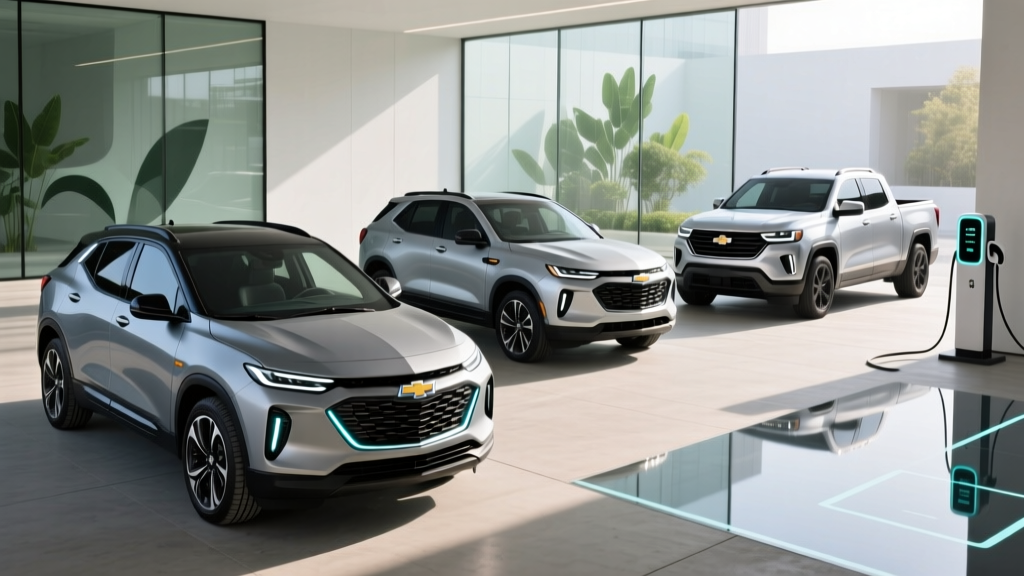
Which Chevy EV should you buy? The 2026 Chevy Equinox EV offers the best value with up to 319 miles of EPA range starting around $33,600, making it the top pick for most buyers. The Blazer EV targets performance-oriented drivers with up to 324 miles and available AWD, starting near $44,600. The Silverado EV serves truck buyers needing up to 400 miles of range and serious utility, starting around $55,000. All three use GM's Ultium battery platform with NMC chemistry, support DC fast charging up to 190–350 kW depending on model, and may qualify for the federal §30D tax credit — though eligibility depends on your income, the vehicle's MSRP, and battery-sourcing requirements that shift yearly.
The 2026 Chevy EV Lineup at a Glance
Chevrolet's electrified portfolio has matured significantly since the Bolt EV's discontinuation. For 2026, the brand fields three dedicated battery-electric vehicles built on GM's Ultium platform, each targeting a distinct buyer segment. Unlike the older Bolt's single-size approach, these models span compact crossover, midsize SUV, and full-size pickup — covering the majority of American vehicle purchases.
All three share foundational Ultium architecture: a modular battery pack using NMC (nickel manganese cobalt) chemistry, an 800-volt-capable electrical system on higher trims enabling faster DC charging, and GM's latest Ultifi software platform. But their tuning, battery sizes, and real-world behavior differ substantially.
| Spec | Equinox EV | Blazer EV | Silverado EV |
|---|---|---|---|
| EPA Range (max) | 319 mi | 324 mi | 400 mi (est.) |
| Battery (usable) | ~85 kWh | ~102 kWh | ~200 kWh |
| Chemistry | NMC | NMC | NMC |
| Peak DC Fast Charge | 150 kW | 190 kW | 350 kW |
| 10–80% DC Charge | ~32 min | ~28 min | ~20 min |
| Level 2 Rate | 11.5 kW | 11.5 kW | 19.2 kW (available) |
| 0–60 mph | ~7.5 sec | ~4.0 sec (SS) | ~4.5 sec (RST) |
| Horsepower | 213–288 hp | 288–557 hp | 510–754 hp |
| Starting MSRP | ~$33,600 | ~$44,600 | ~$55,000 |
| Battery Warranty | 8 yr / 100k mi | 8 yr / 100k mi | 8 yr / 100k mi |
Real-World Range vs. EPA Stickers
Equinox EV: EPA 319 mi → Expect ~260–280 mi highway, ~220–240 mi in freezing weather.
Blazer EV: EPA 324 mi → Expect ~265–285 mi highway, ~225–245 mi in freezing weather.
Silverado EV: EPA ~400 mi (est.) → Expect ~310–340 mi highway, ~270–300 mi in freezing weather.
EPA range estimates assume a mix of city and highway driving at moderate temperatures. In real-world ownership, several factors compress those numbers. Highway driving at 70–80 mph increases aerodynamic drag significantly — EVs are far more sensitive to speed than gas cars because they lack a multi-gear transmission to optimize efficiency. Expect a 12–18% reduction from the EPA sticker during sustained interstate travel.
Cold weather compounds the loss. NMC batteries operate optimally between roughly 60–95°F. Below freezing, the battery management system diverts energy to warm the cells, and cabin heating draws additional power. In our experience testing Ultium-based vehicles in sub-30°F conditions, range loss of 25–35% is typical unless you precondition the battery and cabin while still plugged in — a critical habit for cold-climate Chevy EV owners.
The Silverado EV's massive ~200 kWh pack provides a buffer against these losses that the smaller crossovers can't match. Even with 30% cold-weather reduction, you're still looking at roughly 280 miles — enough for most daily needs and many road trips without en-route charging.
Charging Speed and Infrastructure Reality
Chevy has adopted the NACS (North American Charging Standard) connector across its 2026 EV lineup, granting access to Tesla's Supercharger network in addition to Electrify America, EVgo, and other CCS-based networks via adapters. This is a significant practical advantage over the CCS-only landscape of just two years ago.
| Level | Power | Equinox EV | Blazer EV | Silverado EV |
|---|---|---|---|---|
| Level 1 (120V) | ~1.4 kW | ~4 mi/hr | ~4 mi/hr | ~4 mi/hr |
| Level 2 (240V) | 11.5 kW | ~34 mi/hr | ~34 mi/hr | ~55 mi/hr* |
| DC Fast | Peak kW | 150 kW | 190 kW | 350 kW |
*Silverado EV with available 19.2 kW onboard charger; standard is 11.5 kW.
Understanding the difference between kW (power, the rate of energy flow) and kWh (energy, the battery's total capacity) is essential. A 150 kW peak charge rate doesn't mean you're adding 150 kWh per hour — it means at peak, you're adding energy fast enough to theoretically fill a 150 kWh battery in one hour. In practice, charge curves taper significantly above 80% state of charge to protect battery longevity.
The Silverado EV's 350 kW peak capability is impressive on paper, but it requires a compatible 350 kW+ DC fast charger — still relatively uncommon outside major highway corridors. On a typical 150 kW Electrify America station, you'll see peak rates closer to 130–140 kW, making the real-world advantage over the Blazer EV smaller than the spec sheet suggests.
For home charging, a Level 2 installation on a 240V/48A circuit delivers the 11.5 kW rate these vehicles support. According to fueleconomy.gov, overnight Level 2 charging adds 200–300+ miles depending on the model — enough to replenish a full day's driving for most owners. Budget $500–$1,500 for the charger unit and $800–$2,500 for professional electrician installation, with the total potentially higher if your electrical panel needs an upgrade to 200A service.
Cost Breakdown: Chevy EV vs. Gas Equivalent
The upfront sticker price of an EV often triggers sticker shock, but the total cost of ownership tells a different story when you factor in fuel, maintenance, and available incentives. Let's compare the Equinox EV against a comparably equipped gas-powered Equinox over five years and 75,000 miles.
| Cost Factor (5 yr / 75k mi) | Equinox EV LT (~$35,000) | Equinox Gas LT (~$30,000) |
|---|---|---|
| Purchase Price | $35,000 | $30,000 |
| Federal Tax Credit (§30D) | –$7,500* | $0 |
| Effective Purchase | $27,500 | $30,000 |
| Fuel / Electricity | $3,200 (home charging) | $8,400 (28 MPG avg, $3.50/gal) |
| Maintenance | $1,200 | $3,800 |
| Insurance (est.) | $7,500 | $6,200 |
| 5-Year Total | $39,400 | $48,400 |
*§30D credit eligibility requires meeting income caps (e.g., $150k single / $300k joint), MSRP caps ($55k for SUVs), and battery sourcing rules. Verify current-year rules at irs.gov before purchasing. Point-of-sale transfer is available at participating dealers.
The EV's maintenance savings come from eliminating oil changes, transmission fluid, spark plugs, and exhaust system repairs. Regenerative braking also extends brake pad life substantially — many EV owners report original brake pads lasting 80,000+ miles. The higher insurance cost reflects current actuarial data showing EVs cost roughly 15–25% more to insure due to higher repair costs and specialized parts.
Electricity costs vary enormously by region and charging behavior. The $3,200 figure assumes predominantly home charging at a national average of ~$0.16/kWh. If you rely heavily on public DC fast charging at $0.35–$0.50/kWh, that cost could double to $6,000+ — still below gasoline, but the gap narrows significantly. According to EPA data on fueleconomy.gov, the Equinox EV achieves roughly 100–110 MPGe combined, translating to about 30–34 kWh per 100 miles.
Federal Tax Credit: What Chevy EV Buyers Must Know
The §30D Clean Vehicle Credit can reduce your federal tax liability by up to $7,500, but qualifying is not automatic. For 2026, the rules have tightened considerably around battery sourcing and critical minerals. Here's the essential checklist:
- Income caps: Modified AGI must not exceed $150,000 (single), $225,000 (head of household), or $300,000 (married filing jointly).
- MSRP caps: Vans, SUVs, and pickups must have an MSRP at or below $80,000; sedans and other vehicles at or below $55,000.
- Battery sourcing: Increasing percentages of battery critical minerals must be sourced from the US or free-trade-agreement countries, with final assembly in North America.
- Point-of-sale transfer: You can transfer the credit to the dealer at purchase, reducing your out-of-pocket cost immediately rather than waiting for a tax refund.
- One credit per VIN: The vehicle must not have been previously titled or had the credit claimed.
Not every Chevy EV trim qualifies for the full $7,500 in every tax year. Battery-sourcing requirements have phased upward annually, and some trims or build dates may only qualify for the $3,750 partial credit — or none at all. Always verify the specific VIN's eligibility on the IRS's official clean vehicle eligibility list before signing a purchase agreement. A tax professional can confirm whether your personal situation allows you to benefit from the credit.
Common Misconceptions About Chevy EVs
| Myth | Fact |
|---|---|
| "The battery will need replacing in 5 years." | GM warrants the Ultium battery for 8 years/100,000 miles against capacity loss below 70%. Real-world degradation data from similar NMC packs shows 10–15% loss over 150,000 miles. |
| "Charging takes too long for road trips." | A 10–80% DC fast charge takes 20–32 minutes depending on model — roughly the time for a rest stop, food, and stretching. Route planners like A Better Routeplanner optimize stops. |
| "EVs are worse in the cold." | Range drops 25–35% in freezing weather, but preconditioning while plugged in recovers much of that loss. EVs also start instantly in cold weather with no engine warm-up needed. |
| "The power grid can't handle EVs." | Most EV charging happens overnight during off-peak hours when grid capacity is underutilized. Smart charging and time-of-use rates further manage demand. |
| "I can't take road trips." | With NACS access to 25,000+ Tesla Superchargers plus other networks, charging infrastructure covers most US highway corridors. Plan ahead for rural routes. |
Decision Framework: Which Chevy EV Is Right for You?
Choose the Equinox EV if: You want the most affordable entry into the Chevy EV lineup, your daily commute is under 80 miles round-trip, you have home Level 2 charging access, and you prioritize low running costs over performance. The LT trim at ~$33,600 (potentially ~$26,100 after the §30D credit) delivers 319 miles of range — more than enough for most drivers with margin for road trips.
Choose the Blazer EV if: You want a more engaging driving experience with available dual-motor AWD producing up to 557 hp in the SS trim, need more interior and cargo space than the Equinox provides, or frequently carry rear-seat passengers. The 190 kW peak DC charge rate also means slightly faster road-trip replenishment. Budget ~$44,600+ and confirm §30D eligibility on your chosen trim.
Choose the Silverado EV if: You need truck capability — towing up to 10,000 lbs, a 5-foot bed, available Multi-Flex tailgate, and the option of a massive 400-mile range pack. The 350 kW DC fast-charge capability and available 19.2 kW Level 2 charging are best-in-class. This is the right choice if you regularly tow, haul, or drive long rural routes where charging stations are sparse. Starting around $55,000, it competes directly with the Ford F-150 Lightning and Rivian R1T.
Consider a Chevy PHEV or hybrid instead if: You lack reliable home charging access, frequently drive in areas with sparse public charging infrastructure, regularly tow heavy loads in cold weather, or your budget can't accommodate the EV premium even after incentives. The Equinox and Blazer nameplates aren't currently offered as PHEVs in the US, so you'd need to look at competitors like the Toyota RAV4 Prime or Hyundai Tucson PHEV for a plug-in hybrid alternative.
First-Time Chevy EV Buyer Checklist
If this is your first electric vehicle, a few preparation steps will dramatically improve your ownership experience:
- Assess your home charging situation. Do you have a garage or dedicated parking spot near a 240V outlet? A NEMA 14-50 outlet installed by a licensed electrician is the most common home charging setup. If you live in an apartment or lack off-street parking, research workplace charging and public Level 2 options near your home before buying.
- Install a Level 2 charger before delivery. Order your charger (such as the ChargePoint Home Flex or Emporia Vue) and schedule electrician installation 2–4 weeks before your vehicle arrives. This avoids the frustration of relying on slow Level 1 (120V) charging, which adds only ~4 miles per hour.
- Download the myChevrolet app and charging network apps. The myChevrolet app provides vehicle status, remote preconditioning, and charging management. Install Electrify America, EVgo, and PlugShare apps for public charging access and station-finder functionality.
- Learn to precondition. Warming or cooling the battery and cabin while still plugged in preserves range and enables faster DC charging. Set departure times in the app so the car is ready when you are.
- Plan your first road trip with a charging app. Use A Better Routeplanner or the in-dash navigation to identify charging stops. Arrive at DC chargers with 10–15% state of charge for the fastest charge-curve performance — charging from 5% or from 85% is significantly slower.
Frequently Asked Questions
Do all Chevy EVs qualify for the $7,500 federal tax credit?
No. Eligibility depends on your income, the vehicle's MSRP relative to the cap ($80,000 for SUVs/trucks), battery critical-mineral sourcing, and North American final assembly. Some trims may qualify for a partial $3,750 credit or none at all depending on the tax year's sourcing thresholds. Check the IRS clean vehicle credit page for the current eligibility list.
How long does the Ultium battery last?
GM warrants the battery for 8 years or 100,000 miles against defects and capacity loss below approximately 70%. Based on NMC chemistry data from similar packs in the industry, expect roughly 85–90% capacity retention at 100,000 miles with normal use. Battery replacement costs, if needed out of warranty, are estimated at $8,000–$18,000 depending on pack size — but full replacements remain rare.
Can I charge a Chevy EV at a Tesla Supercharger?
Yes. The 2026 Chevy EV lineup uses the NACS connector natively, making it compatible with Tesla's Supercharger network without an adapter. This gives Chevy owners access to over 25,000 Supercharger stalls across North America in addition to Electrify America, EVgo, and other networks.
What happens if I run out of charge on the road?
The same thing that happens with an empty gas tank: you'll need a tow to the nearest charger. GM's roadside assistance covers towing to the nearest charging station. In practice, with 300+ miles of range and widely available navigation-integrated route planning, running out of charge is avoidable with basic trip planning.
Is the Silverado EV good for towing?
The Silverado EV is rated to tow up to 10,000 lbs on properly equipped trims. However, towing heavy loads reduces range by 30–50% depending on trailer weight, aerodynamics, and terrain. If you frequently tow long distances, plan for more frequent charging stops and verify charger availability along your route.