Quick Answer: Is the Chevy EV Blazer Right for You?
The 2026 Chevrolet Blazer EV delivers 279–320 miles of EPA-estimated range depending on trim, DC fast-charges at up to 190 kW (10–80% in roughly 30 minutes), and starts around $44,600 before incentives. It makes sense if you have Level 2 home charging access, drive under 300 miles daily, and want a midsize electric SUV with modern tech. It's less ideal if you frequently tow, live in extreme cold without a garage, or lack reliable home or workplace charging.
2026 Chevy EV Blazer: Specs That Matter
The Blazer EV rides on GM's Ultium platform with an NMC (nickel manganese cobalt) lithium-ion battery pack. Chevrolet offers multiple configurations that meaningfully change range, power, and price. Here are the numbers buyers need before stepping into a dealership.
| Spec | 2LT (FWD) | RS (AWD) | SS (AWD) |
|---|---|---|---|
| EPA Range | ~320 mi | ~279 mi | ~293 mi |
| Battery (usable) | ~102 kWh (NMC) | ~102 kWh (NMC) | ~102 kWh (NMC) |
| Horsepower | ~220 hp | ~288 hp | ~557 hp |
| 0–60 mph | ~7.8 sec | ~6.0 sec | ~4.0 sec (WAW mode) |
| Max DC Fast Charge | 190 kW | 190 kW | 190 kW |
| 10–80% DC Time | ~30 min | ~30 min | ~30 min |
| Level 2 Charge Rate | 11.5 kW | 11.5 kW | 11.5 kW |
| Base MSRP | $44,600 | $48,600 | $61,400 |
| Battery/Powertrain Warranty | 8 yr / 100,000 mi | 8 yr / 100,000 mi | 8 yr / 100,000 mi |
Real-World Range vs. EPA Sticker
The EPA estimate is a laboratory average. In real-world highway driving at 70–75 mph, expect the 2LT FWD to deliver roughly 260–280 miles on a full charge. In cold weather (below 30°F), range can drop 20–30%, meaning a 320-mile sticker could yield 220–250 miles without preconditioning. The AWD RS trim, with its lower EPA rating, may see 220–240 miles on the highway and as low as 180–200 in deep winter conditions. Always plan road trips around 80% of the sticker figure to build in a buffer.
Charging the Blazer EV: What You Need to Know
Understanding the difference between kW (power, or how fast energy flows) and kWh (energy, or how much the battery holds) is essential. The Blazer EV's ~102 kWh battery stores the energy; the 190 kW peak DC rate is how quickly you can refill it. That peak rate is not sustained across the entire session — like all EVs, the Blazer's charge curve tapers significantly above 80% State of Charge (SoC) to protect battery health.
| Charging Level | Power | Miles Added Per Hour | Typical Use Case |
|---|---|---|---|
| Level 1 (120V household) | ~1.4 kW | ~3–4 mi/hr | Emergency / overnight trickle |
| Level 2 (240V home/public) | 11.5 kW (max) | ~30–34 mi/hr | Daily home charging |
| DC Fast Charge | Up to 190 kW | ~150+ mi in 15 min (10–40% SoC) | Road trips |
Preconditioning matters. If you navigate to a DC fast charger using the Blazer EV's built-in navigation, the battery thermal management system will warm or cool the pack to optimal temperature before you arrive. Skipping preconditioning in cold weather can slow peak charge rates by 30–50%, extending your stop from 30 minutes to 45+.
The Blazer EV uses the CCS1 connector for DC fast charging on most trims, though GM has been transitioning to the NACS (Tesla-style) port on newer models. Verify your specific build's connector before purchasing a home charger or planning public charging routes. With an adapter, NACS-equipped Blazers can access Tesla Superchargers; CCS-equipped models rely on Electrify America, EVgo, and ChargePoint networks.
Blazer EV vs. Gas Blazer: The Real Cost Comparison
The most common question from midsize SUV shoppers: does the EV version actually save money? Let's compare the 2026 Blazer EV 2LT against the 2026 gas-powered Blazer 2LT (2.0L turbo, FWD) over a 5-year ownership period at 15,000 miles per year.
| Cost Factor (5 Years) | Blazer EV 2LT | Gas Blazer 2LT (2.0T FWD) |
|---|---|---|
| Base MSRP | $44,600 | $38,200 |
| Est. Federal Tax Credit (§30D) | Up to $7,500* | $0 |
| Effective Purchase Price | ~$37,100 | $38,200 |
| Fuel/Energy (75k miles) | ~$3,800–$5,200** | ~$8,600 |
| Maintenance (5 yr) | ~$1,200 | ~$3,500 |
| Insurance (est. avg) | ~$9,500 | ~$7,800 |
| 5-Year Total (before depreciation) | ~$51,600–$53,000 | ~$58,100 |
* Federal §30D tax credit eligibility depends on buyer income caps (AGI ≤ $150K single / $300K joint), vehicle MSRP caps (≤ $80,000 for SUVs), and battery critical-mineral and component sourcing rules that tighten annually. The credit can now be transferred to the dealer as a point-of-sale discount. Always verify current eligibility at IRS.gov or with a tax professional.
** Energy cost assumes $0.14–$0.18/kWh for home charging and $0.35–$0.48/kWh for public DC fast charging. Actual costs vary widely by utility rate and charging mix. Data sourced from fueleconomy.gov.
Efficiency at a Glance
| Metric | Blazer EV (2LT FWD) | Gas Blazer (2.0T FWD) |
|---|---|---|
| EPA Efficiency | ~87 MPGe combined | ~25 MPG combined |
| Cost Per Mile (fuel/energy) | ~$0.05–$0.07 | ~$0.11–$0.13 |
| Energy/Fuel for 75,000 Miles | ~$3,800–$5,200 | ~$8,600 |
The EV Blazer wins on operating costs, especially if you charge primarily at home on a standard utility rate. Public DC fast charging is significantly more expensive and can approach gas-car fuel costs per mile — another reason home charging access is the single biggest factor in EV satisfaction.
Real-World Ownership: What First-Time EV Buyers Must Know
Buying an EV is not just swapping the fuel tank for a battery. Here are the practical realities that spec sheets don't highlight.
Home Charging Is Non-Negotiable for Most Owners
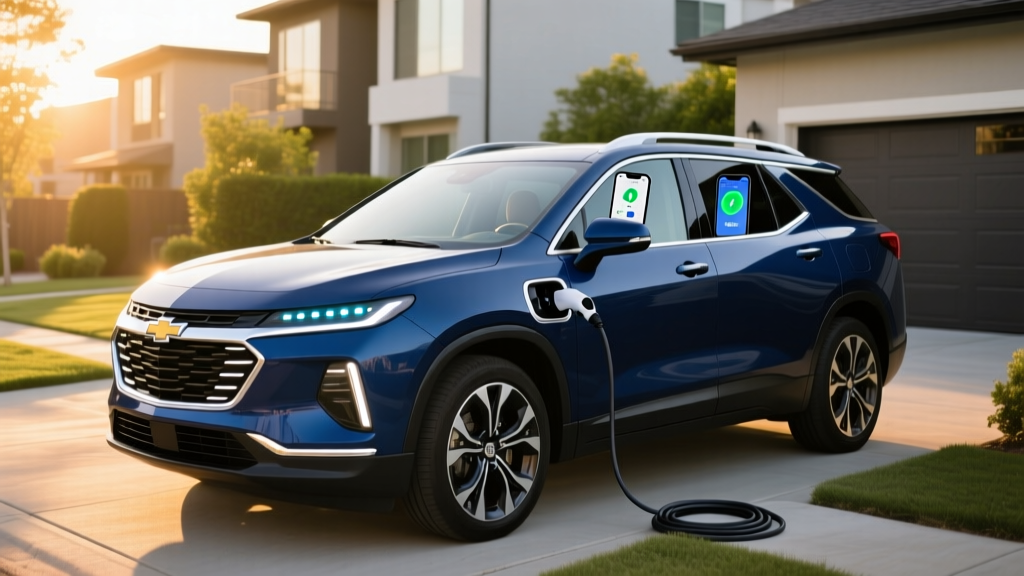
Over 80% of EV charging happens at home. A Level 2 home charger (240V, 40–48 amps) adds roughly 30–34 miles of range per hour — enough to fully replenish the Blazer EV overnight. Expect to pay $800–$2,500 for a quality Level 2 unit (like a ChargePoint Home Flex or Emporia Level 2) plus $500–$2,000 for electrician installation, depending on whether your panel needs an upgrade to support a 50-amp circuit. If you live in an apartment or lack a dedicated parking spot with electrical access, public charging becomes your primary strategy — and that changes the economics substantially.
Cold Weather Reduces Range — Plan Accordingly
The Blazer EV's liquid-cooled battery includes a heat pump on select trims, which helps, but physics wins in extreme cold. At 10°F, expect 20–30% range loss compared to mild-weather driving. Preconditioning the battery while the car is still plugged in (using departure scheduling in the MyChevrolet app) mitigates this by warming the pack using grid power rather than battery energy. Garage parking in winter is a significant advantage.
Maintenance Is Simpler but Not Zero
No oil changes, no spark plugs, no transmission fluid. But EVs still need tire rotations (EVs wear tires faster due to instant torque and heavier weight), cabin air filter replacements, brake fluid checks, and windshield washer fluid. Regenerative braking significantly extends brake pad life — many EV owners report original brake pads lasting 80,000+ miles.
Insurance Typically Costs More
EV insurance premiums run 15–25% higher than comparable gas vehicles, driven by higher repair costs for battery and structural components. Shop quotes from multiple carriers before purchasing — some insurers now offer specific EV discounts.
Tax Credits and Incentives: What Applies in 2026
The federal §30D Clean Vehicle Credit offers up to $7,500, split into two halves: $3,750 for meeting critical-mineral sourcing requirements and $3,750 for battery-component sourcing. As of 2026, sourcing rules have tightened significantly, and not every EV qualifies for the full amount — or any amount at all. Key eligibility requirements:
- MSRP Cap: SUVs must have an MSRP ≤ $80,000 (all Blazer EV trims qualify)
- Buyer Income Cap: Modified AGI ≤ $150,000 (single) / $225,000 (head of household) / $300,000 (joint)
- Battery Sourcing: Critical minerals and battery components must meet escalating domestic/free-trade-agreement thresholds — verify the specific build's eligibility
- Point-of-Sale Transfer: You can transfer the credit to the dealer for an immediate price reduction, rather than waiting for a tax refund
- Final Assembly: Vehicle must undergo final assembly in North America (the Blazer EV is built in Ramos Arizpe, Mexico — verify current assembly-status eligibility)
Many states and utilities also offer rebates or reduced electricity rates for EV owners. Check the AFDC state incentive database for your area. These incentives are separate from and stack with the federal credit where applicable.
Common Misconceptions About the Blazer EV
| Myth | Fact |
|---|---|
| "The battery will need replacing in 5 years" | GM warranties the battery for 8 years/100,000 miles against capacity loss below 60%. NMC batteries in liquid-cooled packs like the Ultium platform typically retain 85–90% capacity at 100,000 miles based on industry degradation data. |
| "It can't handle road trips" | At 190 kW peak DC charging, the Blazer adds ~150 miles in a 15-minute stop. A 600-mile trip requires two 25–30 minute charging breaks — comparable to rest stops on any long drive. |
| "Charging takes too long" | Home Level 2 charging happens while you sleep — 9+ hours of charging adds 270+ miles. You start every morning with a full "tank." The time concern only applies to DC fast charging on road trips. |
| "EVs are worse in winter" | EVs start instantly in cold weather (no cold-start issues), and preconditioning means you can warm the cabin while plugged in without burning fuel. Range loss is real but manageable with planning. |
| "The Blazer EV qualifies for the full $7,500 credit automatically" | Credit eligibility depends on your income, the specific battery build's sourcing compliance, and current-year IRS rules. Always verify before relying on the credit in your budget. |
Decision Framework: Should You Buy the Blazer EV?
Choose the Blazer EV If:
- You have access to Level 2 home charging (garage, driveway, or workplace)
- Your daily commute is under 80 miles round-trip
- You want a tech-forward midsize SUV with strong acceleration (especially the SS trim)
- You qualify for the federal tax credit or state incentives that close the price gap with the gas Blazer
- You plan to keep the vehicle 5+ years to recoup the higher upfront cost through fuel and maintenance savings
Consider the Gas Blazer or a PHEV Alternative If:
- You lack reliable home or workplace charging and your area has sparse public DC infrastructure
- You frequently tow — the Blazer EV's towing capacity (~1,500 lbs) trails the gas Blazer's ~4,500 lbs
- You regularly drive 400+ mile trips in winter through areas with limited fast-charging coverage
- Your budget is tight and you don't qualify for the federal credit, making the upfront premium harder to justify
Frequently Asked Questions
What is the real-world range of the Chevy Blazer EV?
The EPA rates the 2LT FWD at ~320 miles and the RS AWD at ~279 miles. In real-world highway driving at 70+ mph, expect roughly 260–280 miles (2LT) and 220–240 miles (RS). In cold weather below 30°F, subtract another 20–30%. Always plan trips using 80% of the EPA figure as your practical maximum.
How long does it take to charge the Blazer EV at home?
On a Level 2 home charger at 11.5 kW, a full 0–100% charge takes approximately 9.5 hours. Most owners plug in each evening and wake up to a full battery. On a standard 120V outlet (Level 1), expect roughly 3–4 miles of range per hour of charging — adequate only for very low daily mileage or as a backup.
Does the Blazer EV qualify for the $7,500 federal tax credit?
Potentially, but it depends on your income (AGI caps apply), the battery's critical-mineral and component sourcing compliance for the current tax year, and the vehicle's MSRP (all trims are under the $80,000 SUV cap). The credit can be applied as a point-of-sale discount at the dealer. Verify current eligibility on IRS.gov before finalizing your purchase.
How does the Blazer EV compare to the Hyundai Ioniq 5 or Tesla Model Y?
The Blazer EV offers competitive range and a more traditional SUV driving position versus the Ioniq 5's crossover stance. The Tesla Model Y leads in charging infrastructure access (Supercharger network) and efficiency. The Blazer EV's 190 kW peak charge rate trails the Ioniq 5's 800V architecture (~350 kW peak, 10–80% in ~18 minutes). If fast-charging speed is a priority, the Ioniq 5 has a clear advantage. If you prefer a conventional SUV feel and GM's dealer network, the Blazer EV is a strong option.
What does Blazer EV battery replacement cost?
Out-of-warranty Ultium battery pack replacement is estimated at $12,000–$18,000 including labor, though prices are expected to decline as the platform matures. The 8-year/100,000-mile battery warranty covers capacity loss below 60%, and industry data suggests liquid-cooled NMC packs like this one typically retain 85–90% of original capacity at the 100,000-mile mark. Most owners will never need a full pack replacement during typical ownership.
Can I tow with the Blazer EV?
Yes, but capacity is limited. The Blazer EV is rated for approximately 1,500 lbs of towing — adequate for a small utility trailer or a pair of dirt bikes, but not for a camper or boat. If towing is a priority, the gas Blazer (up to ~4,500 lbs) or a truck-based EV like the Silverado EV (up to 10,000 lbs) are better choices. Towing also significantly reduces EV range — expect a 30–50% range reduction at maximum tow load.
Sources: EPA range and efficiency data from fueleconomy.gov, manufacturer specifications from Chevrolet, federal tax credit rules from IRS.gov §30D guidance, and state incentive data from the Alternative Fuels Data Center.