The Quick Verdict: Capable Commuter, Modest Tower
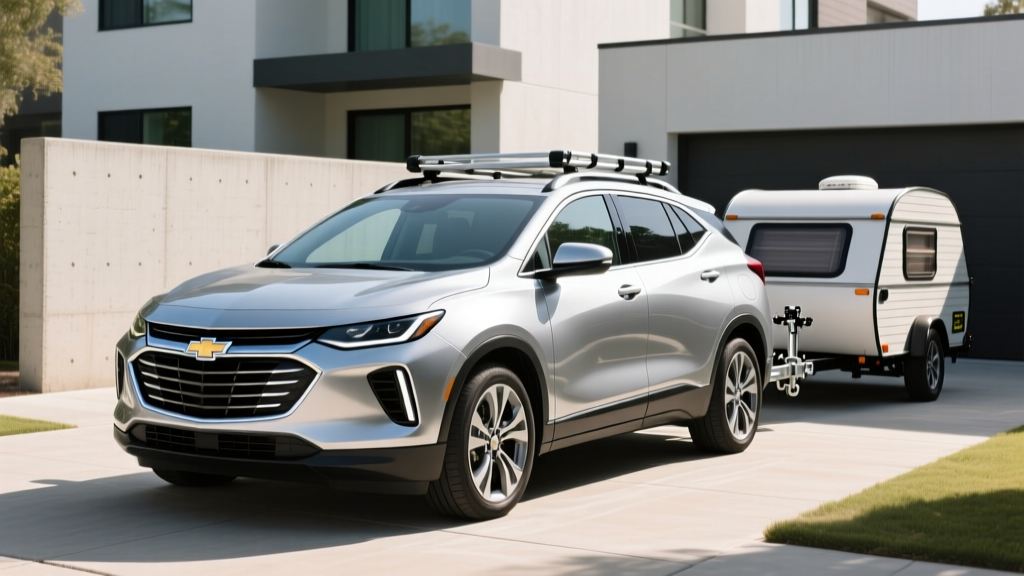
If you've searched for the Chevy Equinox EV towing capacity hoping it could haul a boat or a camper, the answer will temper expectations: the 2026 Chevrolet Equinox EV is rated to tow 1,500 pounds when properly equipped. That's enough for a small utility trailer, a pair of dirt bikes, or a lightweight pop-up camper — but it falls well short of body-on-frame SUVs and even some EV rivals. Where the Equinox EV genuinely shines is its EPA-estimated range of up to 319 miles, sub-$35,000 pricing on base trims, and fast DC charging that makes it one of the most practical compact electric crossovers on the market.
Below, we dissect every number that matters — from battery chemistry to real-world highway range, charging curves, cargo volume, and the fine print on the §30D federal tax credit — so you can decide if the Equinox EV fits your garage and your lifestyle.
Full Spec Sheet at a Glance
| Specification | Value |
|---|---|
| EPA Range (FWD, max battery) | 319 miles |
| EPA Range (AWD, max battery) | 285 miles |
| Battery Capacity (usable) | ~85 kWh (Ultium NMC) |
| Battery Chemistry | NMC (Nickel Manganese Cobalt) |
| Max DC Fast Charge Rate | 150 kW |
| 10–80% DC Fast Charge Time | ~30 minutes |
| Level 2 Home Charge Rate | 11.5 kW (~34 mi/hr) |
| Horsepower (FWD / AWD) | 213 hp / 288 hp |
| 0–60 mph (AWD) | ~6.0 seconds |
| Towing Capacity (max, when equipped) | 1,500 lbs |
| Cargo Volume (behind rear seats) | 26.4 cu ft |
| Cargo Volume (seats folded) | 57.2 cu ft |
| EPA Efficiency (FWD combined) | ~110 MPGe / 31 kWh/100mi |
| Battery/Powertrain Warranty | 8 years / 100,000 miles |
| Base MSRP (2LT FWD) | $33,600 |
Towing Capacity: 1,500 Pounds and What That Means
The 2026 Chevy Equinox EV's maximum towing capacity of 1,500 pounds is available on both FWD and AWD configurations when equipped with the factory towing package. To put that number in perspective:
- Small utility trailer (empty): 800–1,200 lbs — fits within capacity
- Two dirt bikes on a trailer: ~1,100–1,400 lbs — tight but doable
- Lightweight pop-up camper: 1,200–1,800 lbs — exceeds capacity on most models
- Small boat on single-axle trailer: 1,500–2,500 lbs — generally exceeds capacity
The 1,500-pound rating is constrained by the Equinox EV's unibody crossover architecture, which prioritizes efficiency and interior volume over heavy-duty hauling. If you regularly tow above 1,500 pounds, the Chevrolet Silverado EV (rated up to 10,000 lbs on certain trims) or a hybrid SUV like the Toyota Grand Highlander Hybrid would serve you better.
One critical note: towing at or near maximum capacity significantly reduces range. Expect a 30–50% range reduction when towing 1,500 lbs at highway speeds, based on real-world EV towing data across the compact SUV segment. That 319-mile EPA sticker drops to roughly 160–220 miles per charge with a trailer attached — plan charging stops accordingly.
Range and Efficiency: EPA Sticker vs. Real-World
EPA Estimate: 319 miles (FWD, max battery) / 285 miles (AWD)
Real-World Expectation: In mixed driving at 65–70 mph, expect 270–295 miles from the FWD model. Sustained highway driving at 75+ mph drops that to approximately 250–270 miles. In cold weather (below 30°F), range can decrease by 15–25%, yielding roughly 220–260 miles without preconditioning.
The Equinox EV's 85 kWh (usable) Ultium battery pack uses NMC (nickel manganese cobalt) chemistry, which offers higher energy density than LFP but is more sensitive to sustained 100% state of charge. For daily driving, Chevrolet recommends charging to 80% — which still gives you roughly 255 real-world miles in the FWD configuration, more than adequate for most commutes.
The Equinox EV's efficiency of approximately 31 kWh per 100 miles (FWD) is competitive with the Hyundai Ioniq 5 (30 kWh/100mi) and slightly better than the Ford Mustang Mach-E AWD (34 kWh/100mi), according to fueleconomy.gov. Regenerative braking is adjustable via steering-wheel paddles, and one-pedal driving mode can recover meaningful energy in stop-and-go traffic.
Charging Speed: DC Fast Charge and Home Level 2
| Charging Level | Power / Rate | Miles Added per Hour | Notes |
|---|---|---|---|
| Level 1 (120V household) | ~1.4 kW | ~4 mi/hr | Emergency/trickle only |
| Level 2 (240V home) | 11.5 kW | ~34 mi/hr | Full charge in ~8.5 hours |
| DC Fast Charge | 150 kW peak | ~250+ mi/hr (peak) | 10–80% in ~30 minutes |
The Equinox EV's 150 kW peak DC fast-charging rate is respectable for its class, though it trails the Hyundai Ioniq 5's 240 kW capability. Here's what that means on a road trip: arriving at a 150+ kW charger with a low state of charge, you'll see peak speeds briefly before the charge curve tapers. The 10–80% charge takes approximately 30 minutes, which aligns with a typical rest stop.
Above 80% state of charge, charging slows significantly — a characteristic of NMC batteries protecting cell longevity. If you need to charge from 80–100% at a DC fast charger, budget an additional 25–35 minutes. For daily ownership, a home Level 2 charger at 11.5 kW (48-amp circuit) is the sweet spot: plug in when you get home, wake up to a full battery every morning.
Home installation note: A 48-amp Level 2 charger requires a dedicated 60-amp circuit. Installation costs typically range from $800 to $2,500 depending on panel capacity, conduit run length, and local permit fees. Have a licensed electrician evaluate your panel before purchasing equipment.
Performance and Drivetrain
The 2026 Equinox EV is offered in front-wheel drive (single motor, 213 hp) and all-wheel drive (dual motor, 288 hp) configurations. The AWD model's 0–60 mph time of approximately 6.0 seconds is brisk for a family crossover, though it isn't positioned as a performance EV like the Tesla Model Y Performance (3.5 seconds).
Ride quality is tuned for comfort over sportiness. The Ultium platform's low center of gravity — with the battery pack mounted under the floor — keeps body roll well-controlled in corners. Steering is light and predictable, ideal for urban maneuvering but less engaging on winding roads. The AWD system provides confident traction in rain and light snow, though ground clearance (6.5 inches) limits off-road ambition.
Pricing, Trims, and Federal Tax Credit Eligibility
| Trim | Drivetrain | MSRP | Est. Price After §30D Credit* |
|---|---|---|---|
| 2LT | FWD | $33,600 | ~$26,100 |
| 2LT | AWD | $36,900 | ~$29,400 |
| 3LT | FWD | $38,200 | ~$30,700 |
| RS | AWD | $43,400 | ~$35,900 |
*Federal §30D tax credit eligibility depends on buyer income, vehicle MSRP caps, battery component sourcing, and critical mineral requirements. See IRS guidelines below.
The Equinox EV's pricing is its strongest competitive weapon. A base 2LT FWD at $33,600 — potentially dropping to roughly $26,100 with the full §30D federal tax credit — undercuts nearly every rival in the compact electric SUV segment.
Key §30D eligibility requirements for 2026:
- MSRP cap: SUVs must have an MSRP at or below $80,000 — all Equinox EV trims qualify.
- Buyer income cap: Modified adjusted gross income must not exceed $150,000 (single), $225,000 (head of household), or $300,000 (joint filers).
- Battery sourcing: A percentage of critical minerals and battery components must be sourced from the U.S. or free-trade-agreement countries. GM's Ultium battery sourcing has progressively met these thresholds, but exact eligibility varies by model year and production batch. Always confirm with your dealer and reference the IRS's current eligible vehicle list before purchase.
- Point-of-sale transfer: The credit can now be transferred to the dealer at purchase, reducing your out-of-pocket cost immediately rather than waiting for tax filing.
Consult a tax professional to confirm your personal eligibility — rules can shift, and state-level incentives may stack on top of the federal credit.
Interior Space, Technology, and Drawbacks
The Equinox EV's cabin is a step above the outgoing gas Equinox in both materials and technology. A 17.7-inch diagonal infotainment touchscreen dominates the dashboard, running Google Built-In with native Google Maps navigation, Google Assistant voice control, and access to the Play Store for apps. Wireless Apple CarPlay and Android Auto are standard.
Passenger space is generous for the class:
- Front legroom: 43.3 inches
- Rear legroom: 38.9 inches
- Cargo (rear seats up): 26.4 cu ft
- Cargo (rear seats folded): 57.2 cu ft
Driver-assistance technology includes Chevy Super Cruise availability on higher trims — a hands-free highway driving system on compatible mapped roads. Super Cruise is an SAE Level 2 system, meaning the driver must remain attentive and eyes on the road at all times, monitored by an infrared camera on the steering column.
- Towing limited to 1,500 lbs — insufficient for most boat or large camper trailers.
- DC fast-charging peaks at 150 kW, slower than Ioniq 5 (240 kW) and Model Y (~250 kW).
- No front trunk (frunk) — the Ultium platform's under-hood space is occupied by power electronics.
- Regenerative braking is not strong enough for true one-pedal driving in all conditions.
- AWD range drops to 285 miles EPA, a meaningful reduction from FWD.
How It Stacks Up Against Competitors
The compact electric SUV segment is crowded. Here's how the Equinox EV compares on the metrics that matter:
| Metric | Equinox EV (FWD) | Hyundai Ioniq 5 (RWD) | Ford Mustang Mach-E (RWD) | Tesla Model Y (RWD) |
|---|---|---|---|---|
| EPA Range | 319 mi | 303 mi | 250 mi (std) / 320 mi (ext) | 320 mi |
| Base MSRP | $33,600 | $42,600 | $39,995 | $44,990 |
| Max DC Charge | 150 kW | 240 kW | 150 kW | ~250 kW |
| 10–80% Time | ~30 min | ~18 min | ~30 min | ~25 min |
| Towing Capacity | 1,500 lbs | 2,300 lbs | 2,200 lbs | 3,500 lbs |
| Cargo (seats up) | 26.4 cu ft | 27.2 cu ft | 29.7 cu ft | 30.2 cu ft |
- Budget is your top priority — it's the most affordable in this group by a wide margin.
- You value maximum EPA range at a low price point.
- Your towing needs are light (under 1,500 lbs) or nonexistent.
- You prefer a traditional dealership experience for service and support.
- You need towing capacity above 1,500 lbs — the Model Y (3,500 lbs) or Ioniq 5 (2,300 lbs) are stronger.
- Fastest possible DC charging matters — the Ioniq 5's 18-minute 10–80% time is significantly quicker.
- Cargo volume is paramount — the Mach-E and Model Y offer more space behind the rear seats.
Battery Warranty and Long-Term Ownership
Chevrolet backs the Equinox EV's Ultium battery pack and electric drive components with an 8-year / 100,000-mile limited warranty, which is standard for the segment. The warranty covers battery capacity degradation below a specified threshold (typically 60–70% of original capacity, though exact terms should be confirmed with your dealer at purchase).
NMC batteries like the one in the Equinox EV generally degrade 1–2% per year under normal use patterns. To maximize longevity:
- Avoid routinely charging to 100% — set your daily limit to 80%.
- Use preconditioning before DC fast charging (the Equinox EV does this automatically when you navigate to a charger via Google Maps).
- Minimize exposure to extreme heat — park in shade or a garage when possible.
- Avoid frequent DC fast charging when Level 2 is available; reserve fast charging for road trips.
Insurance costs for the Equinox EV are expected to be moderate for the EV segment. Check with your insurer — some carriers offer EV-specific discounts, while others charge premiums 10–20% higher than equivalent gas vehicles due to higher repair costs after collisions.
Who the Equinox EV Suits Best
The 2026 Chevrolet Equinox EV is purpose-built for budget-conscious commuters and small families who want long electric range without the premium price tag of a Tesla or Hyundai Ioniq 5. It's ideal if you:
- Commute 30–80 miles round-trip and can charge at home overnight.
- Take occasional road trips of 200–280 miles where one charging stop suffices.
- Need a practical, easy-to-park crossover with modern tech and strong safety features.
- Don't need to tow more than a small utility trailer.
If towing is a regular part of your lifestyle — boats, campers, horse trailers — the Equinox EV's 1,500-pound limit makes it the wrong tool. Consider the Tesla Model Y, Ford F-150 Lightning, or a plug-in hybrid alternative instead.
Frequently Asked Questions
What is the real-world range of the Chevy Equinox EV?
The EPA rates the FWD Equinox EV at 319 miles and the AWD at 285 miles. In real-world mixed driving at highway speeds, expect approximately 270–295 miles (FWD) and 245–265 miles (AWD). Cold weather below 30°F can reduce range by 15–25% without preconditioning.
How fast does the Equinox EV charge at home and on the road?
At home on a Level 2 (240V) charger, the Equinox EV accepts up to 11.5 kW, adding roughly 34 miles of range per hour — a full charge in about 8.5 hours. On a DC fast charger, it peaks at 150 kW, charging from 10–80% in approximately 30 minutes.
Does the Equinox EV qualify for the $7,500 federal tax credit?
The Equinox EV's MSRP falls well under the $80,000 SUV cap, making it a candidate for the §30D credit. However, eligibility also depends on your income (single filers must earn under $150,000 MAGI), battery component sourcing requirements, and critical mineral thresholds. The credit can be transferred at the point of sale to reduce your purchase price directly. Always verify current eligibility on IRS.gov and consult a tax professional.
Can the Equinox EV tow a camper trailer?
With a 1,500-pound towing capacity, the Equinox EV can handle very lightweight pop-up campers or teardrop trailers that fall under that weight when loaded. Most conventional travel trailers and larger campers exceed this limit. Always check your trailer's GVWR (gross vehicle weight rating) before towing.
Is the Equinox EV worth buying over the Tesla Model Y or Ioniq 5?
If your priority is the lowest purchase price with the longest range, the Equinox EV is the strongest value in the segment. If you need faster DC charging, more towing capacity, or more cargo space, the Ioniq 5 and Model Y are stronger choices — but at a $10,000+ price premium. The right choice depends on your budget, towing needs, and charging access.
What are the biggest pros and cons of the Equinox EV?
Pros: Lowest base price in its class, up to 319 miles EPA range, spacious interior with 17.7-inch screen, Super Cruise availability, strong battery warranty. Cons: 1,500-lb towing limit, 150 kW max DC charging (slower than rivals), no frunk, AWD significantly reduces range, one-pedal driving mode is mild.